
When Private Tooling Beats Stock Sunglasses
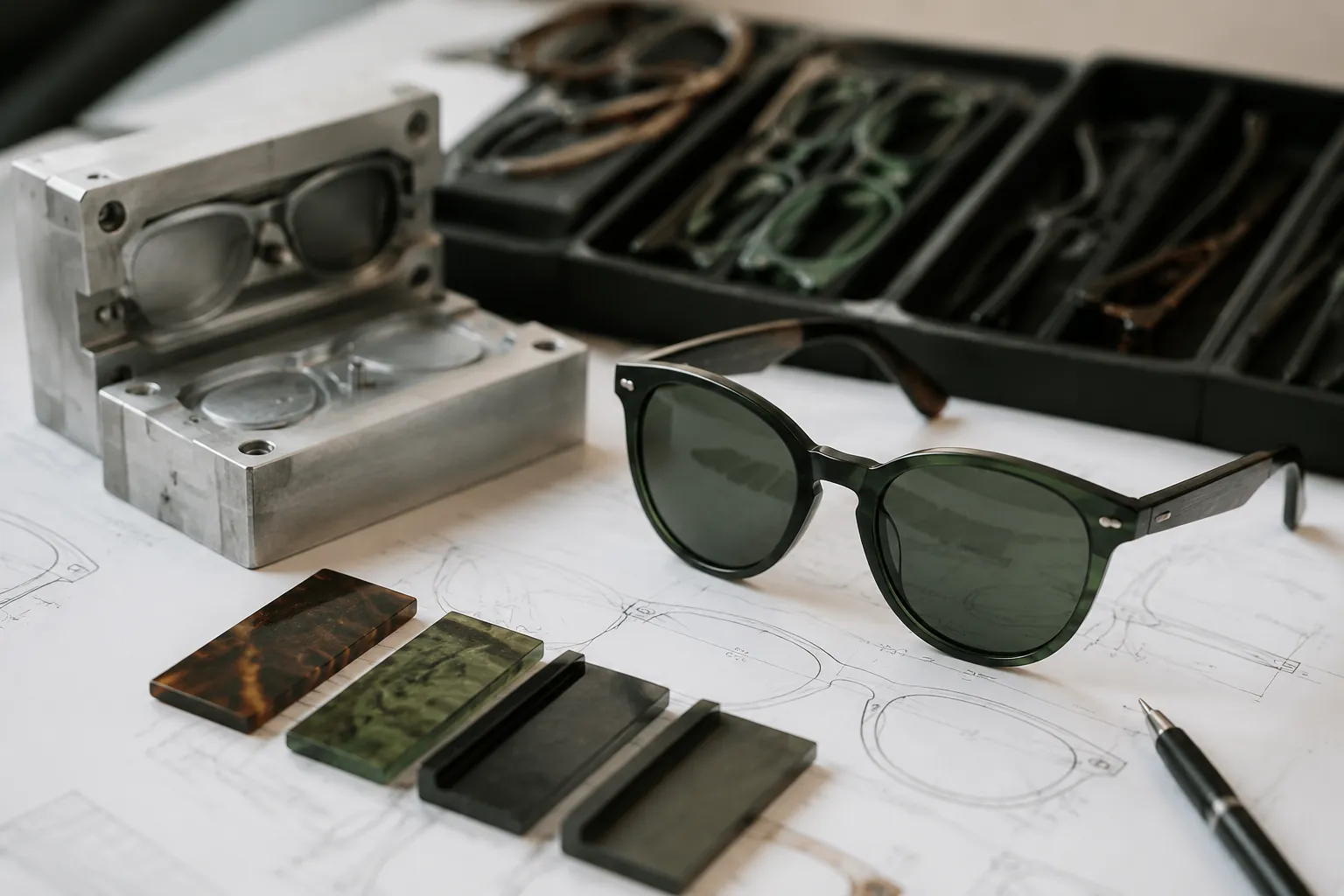
This guide is for overseas eyewear brands, importers, distributors, and retailers deciding whether to use stock-frame sunglasses or invest in private tooling. It gives a practical framework based on volume, margin, lead time, tolerances, material behavior, decoration limits, and compliance risk. Tooling is not automatically a premium move. It is only worth paying for when a new mold lowers commercial risk or gives the product an advantage that stock frames cannot deliver.
The Short Answer: Tooling Needs Repeat Orders
Private tooling makes sense when the same frame family can sell across more than one purchase order. One seasonal order rarely pays back a new mold unless the retail price is high, the design is central to the brand, or distribution is already confirmed before development starts.
The first checkpoint is reorder confidence. If your team cannot reasonably forecast a second and third PO, start with stock frames. Custom lenses, colors, temple logos, metal plates, hangtags, cases, and packaging can still create a controlled product without taking on mold risk.
LumiShades supports both routes: stock-frame customization from 50 pairs per design, and private tooling for buyers who need ownership of frame shape, fit, and brand details. Its Wenzhou operation includes injection molding, acetate cutting, CNC milling, lens tinting, decoration, assembly, and QC in-house. That reduces handoff risk. It does not change the rule: molds need volume.
Blunt test: if you are still proving demand, use stock customization. If the product already sells and stock geometry is limiting margin, fit, or differentiation, run the tooling calculation.
Stock Frame vs Private Tooling: What Changes
Stock-frame sunglasses are not automatically generic. A strong stock program can still control lens category, UV400 claim, frame color, lens color, temple printing, laser logo, packaging, hangtag, pouch, and carton labeling. For many buyers, that is enough.
Private tooling changes the physical product. You control the front shape, lens size, bridge, pantoscopic angle, temple profile, hinge position, wall thickness, logo recess, surface texture, and real-world fit. That matters when the brand needs a recognizable silhouette, when competitors are selling the same catalog shape, or when returns come from poor bridge fit, temple pressure, or frame imbalance.
| Decision Area | Stock Frame Customization | Private Tooling |
|---|---|---|
| Starting MOQ | From 50 pairs per design at LumiShades for selected stock styles | Usually considered when repeat demand can reach 1,000-5,000+ pairs |
| Sample Timing | Normally 7-10 days for color, lens, logo, and packaging samples | Often 25-45 days before a reliable first sample, depending on mold complexity |
| Bulk Timing | Usually 25-35 days after sample approval for standard custom orders | Bulk timing starts after mold approval; first cycle needs drawing, trial, correction, and PP sample approval |
| Design Control | Surface branding, color, lens, and packaging choices | Frame geometry, fit, construction, material thickness, lens seating, and brand detail |
| Cost Logic | Best for low-risk tests and small or medium batches | Best when added gross profit can recover tooling over repeat runs |
| Main Risk | Similarity to other buyers using the same base frame | Development delays, fit corrections, and tooling cost recovery |
The Break-Even Math Buyers Should Run
Do not approve a mold because the render looks good. Run the numbers first. Private tooling wins only when added gross profit over a stock-frame option covers tooling, development time, samples, approval loops, and the risk of slower sell-through.
The formula is simple: planned units multiplied by added gross profit per unit must exceed tooling and development cost. Added gross profit can come from a higher selling price, a lower unit cost at volume, fewer markdowns, stronger reorder retention, or reduced returns from better fit.
Example: if a private frame creates $1.20 more gross profit per pair than a decorated stock frame, 5,000 pairs recover $6,000 of tooling and development cost. If the gain is only $0.40 per pair, recovery takes 15,000 pairs. If the first PO is 800 pairs and the reorder is uncertain, the math is weak. Attractive design does not fix weak demand.
LumiShades pricing improves at practical volume bands such as 300, 1,000, and 5,000+ pairs. Depending on material, lens, decoration, and packaging, large-volume programs can reach about $2.10 per pair. Tooling discussions become serious when the buyer has a credible path to repeat quantities, not when the first quote looks cheap.
- Use conservative volume: count confirmed orders and probable reorders, not optimistic sales-deck numbers.
- Include approval loops: one trial shot is not always enough; bridge fit, lens seating, temple tension, and hinge alignment may need correction.
- Separate mold cost from unit cost: a low unit price does not matter if the mold never reaches the second run.
- Model cash timing: if your sales cycle is six months, tooling recovery and inventory payback take longer.
- Protect the exit: clarify mold ownership, exclusivity, maintenance fees, and what happens if orders stop.
Volume Signals That Justify a Mold
The strongest signal is not one large PO. It is repeatable demand for a stable shape. A retailer asking for 800 pairs once for a summer test is usually a stock-frame buyer. A brand that can place 1,500 pairs now, reorder 2,000 pairs in four months, and keep the shape for two selling seasons is a tooling candidate.
Look at demand by SKU family, not only by color. One private mold can support several colorways and lens combinations, but the front and temple geometry must stay stable. If every season needs a new silhouette, payback gets harder.
Four signals make tooling more rational. First, one hero shape carries the line. If 50-60% of sunglass sales come from one frame style, owning that shape may protect margin. Second, returns are fit-related. Bridge width, temple length, lens rake, frame weight, and pressure behind the ears are geometry problems. Third, competitors are too close. If buyers can find the same stock frame with another logo, price pressure will rise. Fourth, purchasing and sales agree on a replenishment rhythm, such as quarterly or twice-yearly reorders.
Low MOQ still helps brands that may tool later. LumiShades can produce from 50 pairs per design, so buyers can test lens colors, transparent frame tones, matte finishes, logo positions, and packaging before committing to a mold. Test first. Tool the winner.
Material and Tolerance Details That Matter
Private tooling is not just about making a frame look different. The value is controlled geometry. A few millimeters can change comfort, lens retention, hinge feel, and perceived quality.
For injection-molded PC, TR90, or other plastic frames, wall thickness needs careful control. Thin areas can feel weak, twist during demolding, or warp during cooling. Overly thick sections can create sink marks near the bridge, brow, hinge block, or logo recess. Avoid sudden thickness changes. Review high-stress areas before mold cutting. Lens groove depth, bridge radius, and hinge seat flatness need special attention.
For acetate frames, CNC milling and hand polishing allow richer sheet colors, layered effects, and a cleaner edge finish. The tradeoff is slower production, higher material waste, and more manual variation. Acetate fronts and temples must be checked for polishing consistency, temple balance, and hinge riveting accuracy. Small dimensional variation is normal, so QC criteria should define acceptable tolerances before bulk production.
Typical inspection points include front width, lens size, bridge width, temple length, hinge opening angle, lens groove fit, screw tightness, frame rocking on a flat surface, and logo position. For many sunglass programs, buyers should define critical dimensions within about +/-0.3 mm to +/-0.5 mm where fit or lens retention is affected, and allow broader tolerance where the dimension is cosmetic. Color approval should use a physical master sample, because transparent plastics and tinted lenses shift under different light sources.
Decoration Choices Are Not Interchangeable
Decoration should match the material, order volume, brand position, and wear conditions. A logo that looks fine on a render can fail on a curved temple, across a texture, or near a hinge stress point.
Pad printing is cost-efficient for promotional and mid-market lines. It works well for small logos and simple colors, but it needs abrasion checks and can lose sharpness on curved or textured areas. Laser engraving is cleaner for tonal logos, especially on acetate or certain coated surfaces, but it is usually subtler and may not satisfy buyers who want high-contrast branding. Metal logo plates give a more premium feel, but the recess must not weaken a thin temple. A plate also adds assembly steps and requires checks for glue strength, edge burrs, and alignment.
Lens decoration requires extra caution. Mirror coatings, gradient tints, polarized lenses, and fashion colors can all affect perceived quality and compliance claims. A category 3 dark lens, a light fashion tint, and a polarized driving lens are not interchangeable. Buyers should approve the exact lens color, transmittance category, UV claim, and market labeling before mass production.
LumiShades handles injection molding, acetate cutting, CNC milling, lens tinting, laser engraving, pad printing, and metal logo plates in-house. That makes technical tradeoff discussions easier before tooling. A recessed metal badge may be replaced with pad print for a low-cost promo order. Laser engraving may be better for a premium tonal acetate line. The right choice depends on the product, not the render.
Compliance and Lead Time Must Be Planned Together
Sunglasses are fashion products, but they are also eye protection products. Compliance depends on the finished sunglass, especially the lens, not just the frame. Confirm destination markets before sampling. Lens category, labeling, warnings, driving suitability, and test standards differ by market.
LumiShades has compliance coverage for CE EN ISO 12312-1, FDA registration, ANSI Z80.3, AS/NZS 1067, REACH, ISO 9001, and BSCI. Use those documents correctly. Do not ask a factory to print unsupported claims on lenses, packaging, or user information. The test report should match the actual lens and sunglass configuration being sold.
| Market or Requirement | What It Affects | Buyer Action |
|---|---|---|
| CE EN ISO 12312-1 | EU sunglass performance, UV protection, lens category, and user information | Confirm category, marking, warnings, and lens test file before approval |
| ANSI Z80.3 | Non-prescription sunglasses for the United States | Match UV, impact, and lens claims to the finished product report |
| AS/NZS 1067 | Sunglasses for Australia and New Zealand | Check category labeling and driving restrictions before packaging print |
| REACH | Chemical compliance for EU materials, coatings, and decorations | Review colorants, coatings, logo plates, and packaging contact materials |
| FDA registration | U.S. import and regulatory documentation context | Keep supplier documents, product files, and shipment records organized |
Lead time also changes by route. Stock customization is faster because the frame already exists: samples normally take 7-10 days and bulk production usually takes 25-35 days after approval. Private tooling adds concept review, technical drawing, 3D confirmation if needed, mold quotation, mold cutting, trial shots or first acetate sample, fitting review, correction, lens and color sampling, and pre-production approval. Build at least one correction loop into the first tooling calendar.
Approval Checklist Before Paying for Tooling
Before paying for private tooling, put the commercial, technical, quality, and compliance details into one approval pack. This prevents disputes later and forces the buyer's internal team to agree on what the frame must achieve.
- Sales case: first order quantity, reorder forecast, target wholesale price, target retail price, gross margin target, and markdown risk.
- Frame specification: material, front width, lens size, bridge width, temple length, hinge type, screw size, lens base curve, logo method, lens category, and packaging.
- Technical drawing: freeze dimensions, construction, decoration position, surface finish, and critical tolerance points before mold cutting.
- Tooling terms: define mold ownership, exclusivity, maintenance responsibility, storage, replacement parts, and what happens if orders stop.
- Approval samples: require physical samples for fit, lens color, logo execution, hinge feel, temple balance, packaging, and carton labeling.
- QC criteria: define acceptable color tolerance, lens scratches, frame warpage, hinge tightness, screw torque, print position, glue overflow, and packing defects.
- Compliance file: match the actual product to CE EN ISO 12312-1, ANSI Z80.3, AS/NZS 1067, REACH, FDA registration context, or other destination-market requirements.
If two or more of these items are unclear, stay with stock frames for another cycle. Private tooling is not a shortcut. It is a commitment to a product platform with its own cost, calendar, and quality controls.
Have a custom sunglasses project in mind?
Send us your styles, target market and quantities and we will return a detailed quote with MOQ, lead time and a sample plan.
Get a QuoteWhy source this from Wenzhou with LumiShades
Wenzhou in Zhejiang Province is widely regarded as China’s eyewear manufacturing capital, producing a large share of the world’s sunglasses. That concentration matters to buyers: a deep local supply chain for acetate sheet, hinges, lens blanks, plating and packaging means shorter component lead times, easier color and material matching, and a workforce with decades of eyewear-specific skill. LumiShades has manufactured in this ecosystem since 2009, and our vertical integration — in-house injection molding, acetate cutting, CNC milling, lens tinting, decoration and quality control — means no part of your order is quietly subcontracted to a workshop you cannot audit.
For international buyers, that vertical control translates into accountability. When a single factory owns every step, defects are traced and fixed at source rather than bounced between vendors, and your specifications survive intact from first sample to bulk. We back this with 15+ years of experience, shipments to 60+ countries, more than 5 million pairs produced per year and a 98.5% on-time delivery rate. Our certifications — CE EN ISO 12312-1, FDA registration, ANSI Z80.3, AS/NZS 1067, REACH, ISO 9001 and BSCI audit — mean the compliance documentation your market requires already exists. Explore our manufacturing capabilities and quality control process to see how this works in practice.
Frequently asked questions
What order volume usually makes private tooling worth considering? Start the calculation once you can see at least 1,000 pairs across repeat orders, not just one PO. At 3,000-5,000+ pairs, the economics usually become more realistic, especially if the frame improves margin, sell-through, or return rates.
Can I test the market before paying for a mold? Yes. Use stock frames with custom lens colors, frame colors, logos, hangtags, cases, and packaging. LumiShades can start from 50 pairs per design, with samples typically in 7-10 days.
Will private tooling make the unit price lower? Sometimes, but not always on the first order. The mold cost must be recovered. The bigger benefit may be a higher selling price, exclusive shape, better fit, lower similarity risk, and stronger reorder control.
What should I approve before mold cutting starts? Approve the technical drawing, material, dimensions, hinge type, screw size, lens category, logo method, surface finish, tooling cost, ownership terms, target tolerances, and compliance requirements.
Which certifications should I ask LumiShades for? Ask for documents relevant to your market and product configuration: CE EN ISO 12312-1, FDA registration context, ANSI Z80.3, AS/NZS 1067, REACH, ISO 9001, and BSCI. Match the report to the exact lens and finished sunglass being ordered.
How long does the first private tooling project take? It takes longer than stock customization because drawings, mold cutting, trial samples, fitting review, and corrections come first. After the mold and pre-production sample are approved, bulk production can follow the normal production planning cycle.
Ready to start?
Explore our round sunglasses or request a quote — our sales team replies within 12 hours.
Request a Quote