
How to Qualify Sunglasses Factories for 5,000+ Reorders
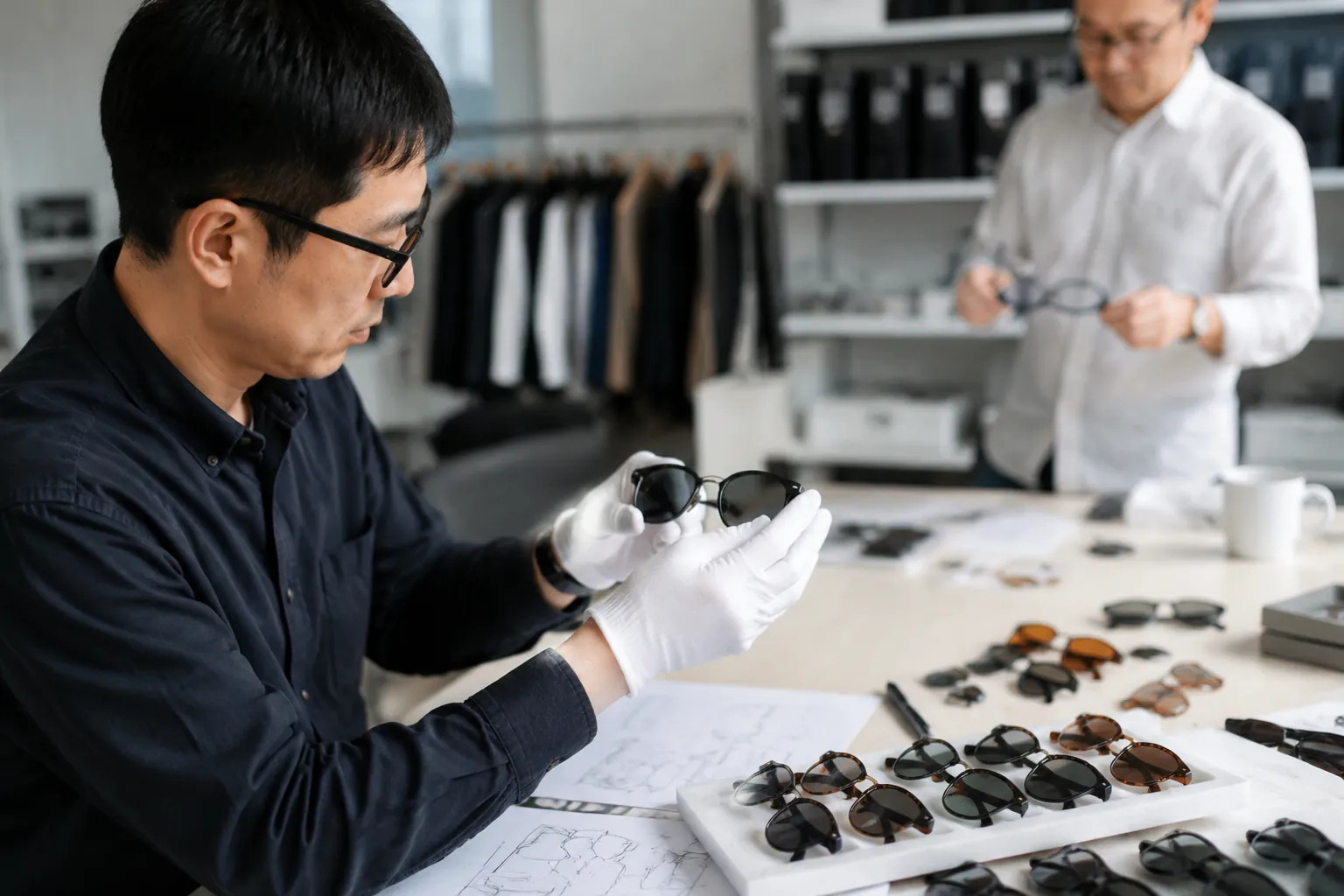
This guide is for brands, importers, distributors, and retailers moving from trial orders to 5,000+ pair repeat production. At that volume, a good sample is not proof. You need evidence that the factory can repeat the approved frame fit, lens performance, color, decoration, packaging, barcode, carton mark, and shipment schedule under normal production pressure. Use this framework before placing a reorder tied to retail launches, seasonal programs, marketplace inventory, or wholesale delivery penalties.
Start With Reorder Risk, Not Sample Quality
A 50-pair trial order answers one question: can the supplier make something close to the target? A 5,000-pair reorder asks a harder one: can the factory repeat it thousands of times without drift?
That is the real test.
In sunglasses production, failure is not always dramatic. It is often small variation that builds across the run. Temple opening force changes after mold maintenance. A brown lens shifts between tint batches. A logo lands 1.5 mm off the approved position. Acetate polishing changes the bridge feel. Hinges loosen after repeated opening and closing. None of this may show in a factory photo. All of it can create returns, chargebacks, retailer complaints, or extra sorting before shipment.
Qualify the manufacturer around repeatability. Ask which steps are done in-house, which are subcontracted, what is measured during production, what records are kept, and who can approve or stop production. In-house injection molding, acetate cutting, CNC milling, lens tinting, decoration, assembly, and QC can reduce handoff risk if they are managed well. If a step is outsourced, the supplier should still know the subcontractor process, approval gate, timing, and inspection method.
Do not overvalue a low MOQ. It helps with sampling, influencer seeding, and small retail tests. It does not prove scale control. Your main question is whether the same design can move through 300, 1,000, and 5,000+ pairs without the frame, lens, decoration, pouch, barcode, or export carton spec changing without written approval.
Map the Processes That Must Stay Controlled
For repeat orders, in-house capability is not a sales point by itself. It is a control point. The more critical steps the sunglasses manufacturer controls directly, the faster it can find and correct defects before goods become packed inventory.
| Process | Why it matters at 5,000+ pairs | What to verify |
|---|---|---|
| Injection molding | Controls frame shape, shrinkage, gate marks, flash, part weight, and consistency for injected materials such as PC or TR90. | Ask for mold identification, cavity count, resin grade, machine setting controls, mold maintenance records, and first-article photos from the production mold. |
| Acetate cutting and CNC milling | Controls front thickness, bevel quality, bridge feel, lens groove accuracy, temple symmetry, and polishing consistency. | Check CNC tolerance targets, polishing stages, acetate sheet lot control, and whether approved color material is reserved or traceable for repeat orders. |
| Lens tinting and edging | Controls visual shade, UV protection claim, lens category, curvature, edge fit, and left-right matching. | Request approved lens master samples, transmittance checks where applicable, tint batch records, edging checks, and lens fit checks after assembly. |
| Decoration | Controls logo position, adhesion, color density, engraving depth, foil or heat-transfer placement, and metal logo plate alignment. | Confirm that laser engraving, pad printing, heat transfer, and logo plate installation use fixtures or measured placement standards, not hand placement alone. |
| Final QC and packing | Stops mixed SKUs, wrong barcodes, loose hinges, surface defects, missing labels, and carton marking errors before export. | Review inspection criteria for alignment, lens retention, hinge movement, surface defects, barcode scans, warning labels, carton marks, and packaging integrity. |
A factory that controls these steps can usually correct problems inside the production window. A factory that outsources lens tinting or logo work may still be capable, but you need buffer time, retained master samples, subcontractor approval gates, and written responsibility for defects. At 5,000+ pairs, even a small defect rate can become a costly sorting or replacement problem. Process visibility matters more than a polished showroom.
Use MOQ and Price Breaks as a Discipline Test
Price breaks are useful. They also show where the factory expects efficiency to come from. For custom sunglasses, savings usually come from spreading setup time, fixture work, mold preparation, decoration setup, lens tint setup, carton printing, and packing-line organization across more units.
Do not treat a low unit price as meaningful until the specification is fixed. A simple injected PC frame with standard UV400 lenses and one-color pad printing is not comparable to acetate with polarized lenses, metal logo plates, a custom case, printed microfiber cloth, hangtag, retail barcode, and mixed carton labels. If the factory changes materials, lens type, packaging, or inspection assumptions to reach a lower tier price, the comparison is useless.
- 50 pairs: Use for design validation, color approval, basic fit, communication quality, and checking whether the supplier follows a written specification.
- 300 pairs: Use for decoration durability, packaging accuracy, SKU separation, and whether the approved sample can be repeated over a small batch.
- 1,000 pairs: Use for line QC, carton labeling, lens batch consistency, defect sorting, and export document discipline.
- 5,000+ pairs: Use only after capacity planning, raw material control, lens batch control, QC gates, packaging rules, and shipment scheduling are written into the order documents.
Ask the supplier to quote each tier against the same spec sheet. The quotation should separate frame material, lens type, logo charge, mold or tooling charge if any, packaging, inspection requirement, and trade terms. If the answer is only a single unit price, push back. You need to know what changes at each tier. Cheaper lenses, thinner pouches, fewer carton marks, or a different logo process can make the lower price a bad deal.
Lock the Technical Spec Before Deposit
A reorder should not rest on a product photo, a model number, and chat history. It needs a controlled specification package. If the supplier cannot work from one, build it with them before paying the deposit.
For sunglasses, the spec should define frame material, lens material, lens category, UV protection requirement, hinge type, screw color, temple length, lens width, bridge width, front width, pantoscopic angle if relevant, logo method, logo position, packaging, barcode rules, carton marks, and target compliance market. Include tolerances. Do not guess them. Finished-frame tolerances depend on material, construction, and measurement method. Acetate polishing removes material. Injected frames can shrink differently depending on resin, mold temperature, cooling time, and wall thickness. TR90 temples may flex differently from PC temples after assembly.
Lens color needs a physical master sample, not just a Pantone reference or screen image. For gradient lenses, define top shade, bottom shade, transition height, and left-right matching. For polarized lenses, require a polarization check during production and final inspection. For mirrored lenses, define acceptable limits for coating pinholes, edge coverage, visible scratches, and color variation. UV protection claims need relevant test reports and production checks. A dark lens without the claimed UV protection is a compliance and safety risk.
Decoration also needs controlled placement. Pad printing should specify ink color, print size, position from a fixed reference point such as hinge edge or temple tip, and adhesion test method. Laser engraving should define position, depth or visual standard, fill color if any, and whether contrast may vary by frame color. Metal logo plates need recess depth, glue method, corrosion resistance expectation, and edge-feel standard. A logo 1 mm too high may look minor in one photo. Across 5,000 pairs, it is a brand consistency problem.
Check Compliance by Market, Not Certificate Count
More certificates do not automatically reduce risk. The document has to match the product, lens type, material, claim, and destination market. For sunglasses, buyers usually need evidence related to UV protection, optical quality, restricted substances, labeling, traceability, and importer documentation.
Common eyewear documents include CE EN ISO 12312-1, ANSI Z80.3, AS/NZS 1067, REACH, FDA registration, ISO 9001, and BSCI. Review them as documents, not badges. Each one answers a different question. None replaces checks on the actual production order.
- EU: CE EN ISO 12312-1 is relevant for sunglasses sold in the European market. Confirm that the tested product, lens category, lens type, and labeling match your order.
- United States: ANSI Z80.3 is relevant for non-prescription sunglasses. FDA registration may support importer documentation, but it does not replace product-specific testing or labeling review.
- Australia and New Zealand: AS/NZS 1067 is relevant for sunglasses sold into those markets. Confirm lens category labeling, warnings, and product claims.
- Chemical compliance: REACH is relevant for products entering the EU and can apply to frame materials, coatings, paints, inks, metal plating, nose pads, pouches, cases, and packaging components.
- Factory systems: ISO 9001 and BSCI relate to management systems and social compliance. They do not prove that a specific sunglasses model passed optical, UV, or chemical testing.
Ask for current certificates, scope pages, and product-related test reports. Compare model references, product description, frame material, lens type, issuing body or lab, issue date, and expiration date where applicable. A report for a different lens color, lens material, or frame material may not support your order. If the product is for children, sport use, polarized lenses, mirrored lenses, prescription-ready frames, or special performance claims, confirm extra testing or labeling before production starts.
Audit QC Gates Before Bulk Production Starts
Final inspection is late. By then, the factory has spent the labor, packed the goods, and often printed carton labels. For 5,000+ pairs, you need checkpoints that catch problems while correction is still practical.
- Incoming material check: Confirm resin, acetate sheets, lenses, hinges, screws, nose pads, logo plates, inks, pouches, cases, barcodes, labels, and cartons against the approved specification.
- First-article approval: Inspect the first finished pieces from the actual production setup, not a hand-built sales sample. Keep signed reference samples at the line and in the QC area.
- In-process inspection: Check frame alignment, lens seating, hinge movement, logo position, lens color, surface scratches, screw tightness, and assembly strength during production.
- Pre-packing inspection: Sort visible defects before pouches, cases, barcodes, hangtags, retail boxes, and export cartons add rework cost.
- Final random inspection: Use an agreed AQL level, defect definitions, sampling plan, and shipment hold rule before balance payment or cargo release.
Define critical, major, and minor defects in writing. A false UV claim, wrong lens category, cracked lens, loose hinge, missing lens, sharp edge, missing warning label, wrong barcode, mixed SKU, missing logo, wrong logo, or non-compliant carton mark should normally be major or critical depending on market risk. Tiny polish marks in a hidden area may be minor if they fit your brand standard. Be direct. Vague QC language creates expensive disputes.
Ask who can stop the line. A QC team that can only report defects after production is weaker than one that can pause assembly and require correction. For repeat orders, also ask for defect data from the previous run: defect rate, top defect types, rework quantity, rejected quantity, and corrective action. A supplier that tracks this can usually improve. A supplier that cannot provide the data is asking you to rely on memory.
Pressure-Test Lead Time and Material Stability
Lead time is not one number. Sampling, material booking, tooling preparation, lens production, decoration, assembly, inspection, packing, and export each have their own timing. A supplier's quoted lead time matters only after the specification is frozen, components are available, artwork is approved, and testing requirements are clear.
For a 5,000+ pair reorder, ask for a production schedule that includes material purchase, mold or tooling preparation if needed, lens production or tinting, frame production, decoration, assembly, QC, packing, final inspection, and shipment booking. If the order includes multiple colors, split the schedule by color. Color changes can slow injection, polishing, printing, lens tinting, barcode application, and packing.
Material stability is a reorder risk. Acetate sheet lots can vary in pattern density and color depth. Lens tint can vary by batch and base lens material. Metal logo plating can vary in shade between production lots. Packaging board, pouch fabric, and microfiber cloth can also vary if they are bought from different batches. Ask whether the factory can reserve material from the same lot for phased deliveries. If not, require approved master samples and batch records for comparison.
For injected frames, ask how mold wear and maintenance are tracked. A mold that runs cleanly for a small batch may show flash, sink marks, or fit issues during longer production if maintenance is weak. Your purchase order should define sample approval date, material readiness date, first-article approval date, inspection date, cargo ready date, and responsibility for delays caused by factory error. If your launch date is fixed, build in time for third-party testing, failed inspection recovery, and peak-season freight booking.
Use a Pass-Fail Scorecard Before Reordering
Use a scorecard before moving from trial order to reorder. It keeps the buying decision grounded. A good sample can make a team optimistic. A scorecard forces the factory to prove repeatability with documents, samples, records, and clear responsibilities.
| Qualification area | Pass standard | Warning sign |
|---|---|---|
| Capacity | Factory can show a line plan, realistic production window, machine or workstation availability, and schedule for your delivery date. | Only gives a promise date with no production steps, bottleneck review, or capacity detail. |
| In-house control | Critical steps such as molding, lens tinting, decoration, assembly, and QC are controlled internally or clearly managed through approved subcontractors. | Cannot explain where frames, lenses, logos, packaging, or inspection are actually handled. |
| Spec control | Approved sample, dimension sheet, lens requirement, logo file, color master, packaging spec, barcode rule, and carton mark are locked before deposit. | Salesperson says the factory will follow the photo, chat history, or previous order only. |
| Compliance | Relevant documents such as CE EN ISO 12312-1, ANSI Z80.3, AS/NZS 1067, REACH, FDA registration, ISO 9001, or BSCI are current and matched to the order where applicable. | Documents are expired, unrelated, incomplete, outside scope, or used as a substitute for product-specific testing. |
| QC | Incoming, first-article, in-process, pre-packing, and final inspection gates are defined with defect classes and shipment hold rules. | Inspection happens only after cartons are sealed or defect definitions are left vague. |
| Commercial terms | MOQ, tier price, sample timing, bulk timing, packaging, inspection, defect remedies, and shipment terms are written into the PI or purchase order. | Key terms remain only in chat messages, screenshots, or verbal promises. |
If a manufacturer passes most of this and responds with specific records, samples, and written controls, they are ready for a serious reorder discussion. If they dodge process questions, keep the order small or qualify another supplier. Scaling a weak process only makes the problem more expensive.
Have a custom sunglasses project in mind?
Send us your styles, target market and quantities and we will return a detailed quote with MOQ, lead time and a sample plan.
Get a QuoteWhy source this from Wenzhou with LumiShades
Wenzhou in Zhejiang Province is widely regarded as China’s eyewear manufacturing capital, producing a large share of the world’s sunglasses. That concentration matters to buyers: a deep local supply chain for acetate sheet, hinges, lens blanks, plating and packaging means shorter component lead times, easier color and material matching, and a workforce with decades of eyewear-specific skill. LumiShades has manufactured in this ecosystem since 2009, and our vertical integration — in-house injection molding, acetate cutting, CNC milling, lens tinting, decoration and quality control — means no part of your order is quietly subcontracted to a workshop you cannot audit.
For international buyers, that vertical control translates into accountability. When a single factory owns every step, defects are traced and fixed at source rather than bounced between vendors, and your specifications survive intact from first sample to bulk. We back this with 15+ years of experience, shipments to 60+ countries, more than 5 million pairs produced per year and a 98.5% on-time delivery rate. Our certifications — CE EN ISO 12312-1, FDA registration, ANSI Z80.3, AS/NZS 1067, REACH, ISO 9001 and BSCI audit — mean the compliance documentation your market requires already exists. Explore our manufacturing capabilities and quality control process to see how this works in practice.
Frequently asked questions
What should I request before placing a 5,000 pair sunglasses reorder? Request the approved physical sample, full specification sheet, dimension tolerances, lens master, color master, logo artwork and placement standard, tiered quotation, production schedule, compliance documents, QC plan, packaging spec, barcode rules, carton marks, and final inspection standard. Confirm that each document matches the exact frame material, lens type, lens category, decoration method, packaging, and destination market for the reorder.
Is a 50 pair MOQ useful if my real target is 5,000+ pairs? Yes, but treat it as a validation order, not proof of mass-production control. Use 50 pairs to test communication, sample accuracy, fit, color direction, logo execution, packaging, and basic quality. Before moving to 5,000+ pairs, run a larger controlled batch or require first-article approval, in-process inspection, material traceability, and a written QC plan for the bulk order.
Which sunglasses certifications matter for overseas buyers? It depends on the selling market and product claim. CE EN ISO 12312-1 is relevant for the EU, ANSI Z80.3 for non-prescription sunglasses in the U.S., AS/NZS 1067 for Australia and New Zealand, and REACH for chemical compliance in the EU. FDA registration may support U.S. importer documentation. ISO 9001 and BSCI relate to factory management and social compliance. Always check that reports and certificates match the exact product, lens type, material, and market.
How long should I allow for custom sunglasses samples and bulk production? Ask the supplier to break lead time into sample making, material booking, tooling or mold preparation if needed, lens production, frame production, decoration, assembly, QC, packing, final inspection, and shipment booking. Do not rely on one headline lead time. Add buffer for artwork approval, third-party testing, failed inspection recovery, new packaging, multiple colorways, holidays, and peak freight periods.
What is a fair way to judge factory pricing at 5,000+ pairs? Compare the same written specification at 300, 1,000, and 5,000+ pairs. Require the quote to identify frame material, lens material, lens category, UV or polarization claim, logo method, tooling charge, packaging, inspection requirement, carton marking, and trade terms. A lower price is only meaningful if the supplier is not changing the lens, material, decoration, packaging, or inspection assumptions to reach it.
What defects should be treated as major for bulk sunglasses orders? Major or critical defects should include false UV or lens category claims, cracked lenses, poor lens retention, sharp edges, loose or broken hinges, wrong color, missing or misplaced logo, mixed SKUs, incorrect barcode, missing warning label, missing required market labeling, non-compliant packaging, and carton mark errors that affect shipment or retail receiving. Define these defect classes before production and connect them to an AQL level and shipment hold rule.
Ready to start?
Explore our rimless sunglasses or request a quote — our sales team replies within 12 hours.
Request a Quote