
How to Secure ODM Sunglasses Exclusivity
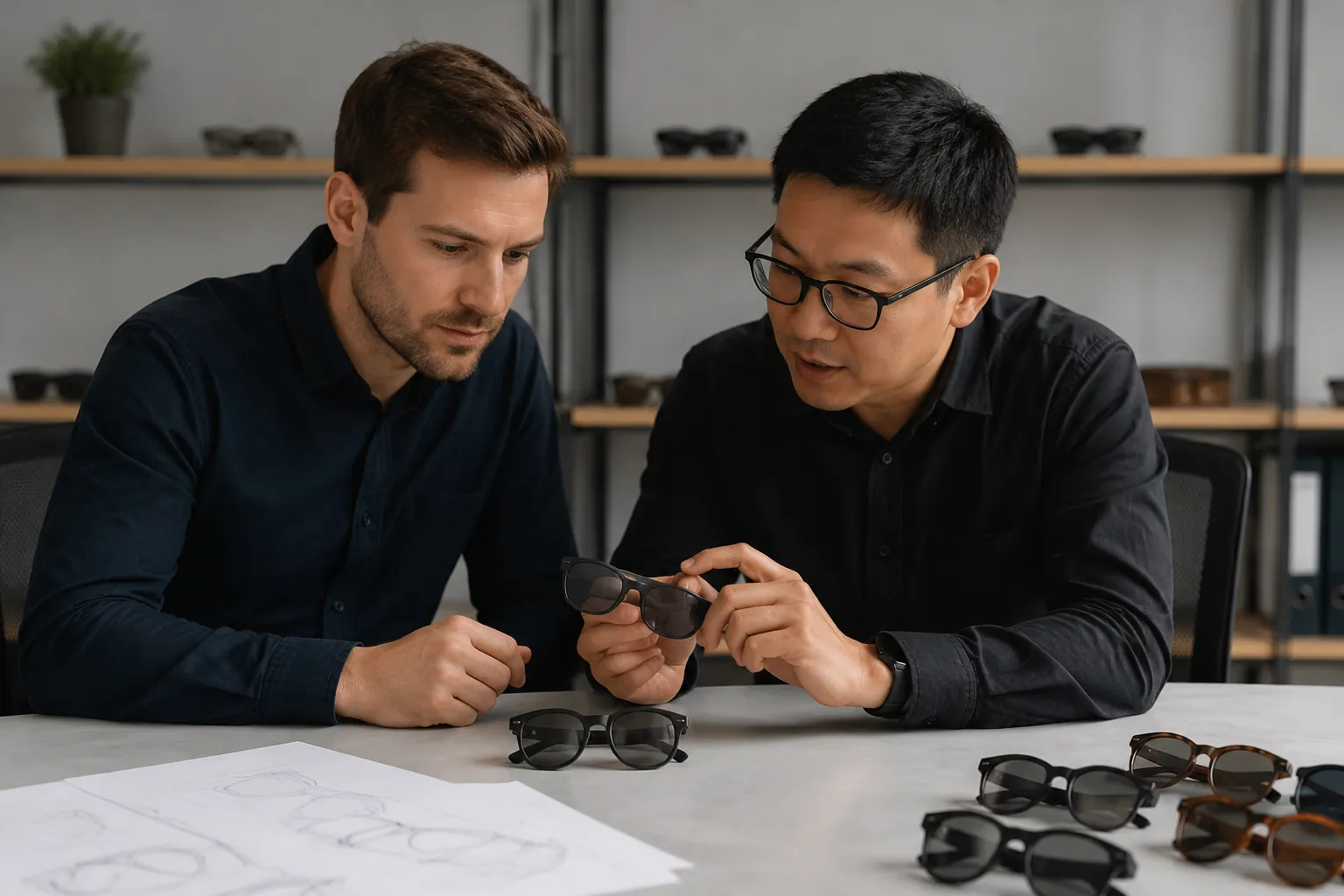
This guide is for overseas brands, importers, distributors, and retail buyers sourcing ODM sunglasses who do not want the same frame in a competitor's range next season. It explains what can be protected, what usually cannot, and what to confirm before sampling and deposit. The aim is simple: fewer channel conflicts, clearer factory obligations, controlled samples, traceable approvals, and fewer disputes once bulk production starts.
Define the exact exclusivity you need
"Exclusive design" is too vague for ODM sunglasses sourcing. A buyer may mean, "Do not sell this frame to any competitor in my market." A factory may hear, "Do not sell this exact black frame with this logo." Those are not the same promise.
Be precise. Price it. Put it in writing.
Most ODM programs use one of four exclusivity models. The wider the protection, the more the buyer usually has to support it with paid development, tooling investment, a defined purchase commitment, or an agreed renewal volume.
| Exclusivity type | What it blocks | Typical use case | Commercial logic |
|---|---|---|---|
| Model exclusivity | Factory cannot sell the same agreed frame front, temple, hinge configuration, and lens shape to other buyers | Brand wants a signature seasonal frame or long-term core style | Usually requires tooling payment, a written term, and a credible purchase commitment because the factory gives up other sales |
| Territory exclusivity | Factory cannot sell the agreed model into named countries or markets | Distributor or retailer needs protection in a specific sales region | Country list, term, minimum purchase, and exceptions must be written clearly |
| Channel exclusivity | Factory cannot sell the agreed model into defined sales channels | Retail chain wants protection from marketplace sellers, promotional buyers, or competing distributors | Requires channel definitions that the factory sales team can check before quoting |
| Private colorway exclusivity | Factory can sell the base frame, but not your exact color, lens, logo, decoration, and packaging combination | Buyer wants differentiation while using an existing ODM frame | Often the most practical route for smaller or first-season programs; the specification must be inspectable |
For many buyers, private colorway exclusivity is the right first move. Full model exclusivity is stronger, but it costs more because the supplier must reserve a design that could be sold to other customers.
Know what an ODM factory can actually protect
An ODM factory can control what it owns and manages: catalog models, showroom samples, internal files, tooling records, sales offers, sample logs, approved colorways, and shipment rules. It cannot stop unrelated factories from making similar public-domain shapes. Aviators, wayfarers, round acetate frames, shield styles, and narrow retro rectangles all have many open-market versions.
Ask which processes are handled in-house and which are subcontracted. This matters. Injection molding, acetate cutting, CNC work, lens tinting, laser engraving, pad printing, metal logo plates, assembly, and QC all affect control over samples, files, tooling, and production records.
Do not accept "we protect your design" as a complete answer. Ask for model numbers, revision codes, approved sample references, and written shipment restrictions.
- Easy to protect: your trademark, private packaging artwork, barcode labels, Pantone combinations, lens tint recipes, temple printing, SKU coding, and sealed sample records.
- Possible to protect with investment: a revised frame front, new temple profile, custom hinge detail, new injection mold insert, metal badge, dedicated logo plate, or acetate CNC program.
- Hard to protect: generic silhouettes, standard black or tortoise catalog frames, and styles already sold or sampled to other buyers before your agreement date.
Ask this before sampling: "Has this exact frame front, temple, hinge, lens shape, and decoration position been sold, sampled, or reserved before? If yes, in which territories or channels is it already committed?"
The factory may not disclose customer names. It should still be able to state whether the style is open, prior-sold, reserved, or available for protection.
Use private colorways when full model exclusivity is too much
A private colorway is not "black frame, brown lens." That is not enough. A useful private colorway is a controlled commercial combination that can be specified, sampled, inspected, and restricted.
For fashion retail, travel retail, promotional ranges, and online brands, this can create real differentiation without paying for full model or tooling exclusivity.
A complete private colorway file should identify the frame material, Pantone or acetate sheet code, lens material, visible light transmission target if relevant, lens category, coating, logo method, screw color, hinge finish, pouch, box, warning card, barcode label, and carton mark.
For example, "TR90 matte Pantone 19-4006 frame, smoke gradient TAC lens, category 3, silver laser logo positioned 28 mm from temple tip, black microfiber pouch with white one-color print" is inspectable. "Black sunglasses with logo" is not.
Confirm lens and labeling requirements before sample approval. If the product will be sold as sunglasses, specify the destination market and required standard or documentation. Common requirements may include CE EN ISO 12312-1, ANSI Z80.3, AS/NZS 1067, REACH, FDA registration, ISO 9001, and BSCI, depending on market, buyer policy, and product scope. Lens category, visible light transmission, warning text, markings, and packaging may change by market.
- Assign one model number and revision code.
- Define material: PC, TR90, acetate, metal, or mixed construction.
- Lock color by Pantone, acetate sheet code, physical chip, or approved master sample.
- Specify lens material, tint, coating, category, and applicable test standard.
- Record decoration: pad print, laser engraving, hot stamp, temple insert, or metal logo plate.
- Approve packaging: pouch, case, cloth, instruction leaflet, warning text, barcode, and carton mark.
- Store dated photos of the front, side, inner temple, hinge, lens, logo, packaging, and carton label.
Negotiate exclusivity before samples, not after deposit
The worst time to ask for exclusivity is after samples are approved and the deposit is paid. By then, the factory may have quoted or sampled the same model to another buyer. Your leverage is lower.
Raise exclusivity during RFQ. Do it before sample work begins and before the final quotation is accepted.
Lead time depends on material, lens tinting, decoration method, packaging, testing requirements, tooling, and factory capacity at the time of order. Catalog-based ODM sampling is usually faster than modified ODM or new-tooling work, but current sample timing and bulk production timing should still be written in the quotation and purchase order.
New molds, custom metal parts, complex acetate milling, special lenses, or compliance testing can extend development before normal bulk production starts.
| Buying path | MOQ and price logic | Lead-time impact | Protection level |
|---|---|---|---|
| Open ODM catalog model | Lowest commitment; MOQ and price depend on available materials, decoration, packaging, and current factory policy | Fastest route when the frame, lens, and packaging are standard | Low; other buyers may be able to purchase the same frame |
| Private colorway | Practical for market testing or seasonal programs; price improves when order volume, materials, and packaging are consolidated | Moderate impact for custom color, lens, logo, and packaging approvals | Medium; protects your exact commercial combination if written clearly |
| Territory-exclusive ODM | Requires a defined territory, term, minimum purchase, and renewal condition | Normal production timing after commercial terms, samples, and documents are approved | Medium to high inside named countries, subject to exceptions |
| Modified ODM with tooling | Higher commitment; cost depends on mold, insert, logo plate, temple part, hinge change, or CNC work | Longer development before production; tooling trials and revised samples may be needed | Higher if ownership, use rights, and restrictions are written |
Break the budget into sample cost, tooling or modification cost, bulk unit price, testing or documentation cost, packaging cost, and exclusivity commitment. Do not bury exclusivity inside the unit price. State what happens if the buyer misses the purchase target or if the supplier receives an inquiry from a restricted territory.
Write territory and channel rules the factory can enforce
Territory exclusivity often fails because the language is too broad. "Europe" may sound clear to a buyer. The factory needs a country list.
Does Europe include the UK, Switzerland, Norway, or Turkey? What about online sales into Europe from a website based elsewhere? If the answer is not written, expect friction.
Use operational language that a sales manager can check before quoting. If every inquiry requires legal interpretation, the rule will not work in daily factory sales.
- Covered products: model number, tooling number if applicable, color code, lens code, logo method, packaging reference, and approved sample date.
- Covered territory: exact country list, not only broad regions.
- Covered channels: retail chains, optical stores, wholesale distributors, Amazon or other marketplace sellers, promotional buyers, duty-free, travel retail, or online direct-to-consumer.
- Term: start date, end date, renewal condition, and treatment of unsold stock or repeat orders after expiry.
- Minimum purchase: seasonal or annual quantity required to keep protection active.
- Exceptions: prior customers, samples already issued, existing inventory, trade show displays, buyer-approved variants, and non-confusing variants.
- Evidence: quotation records, sample logs, sales records, shipment records, and approved sample files available for review if a dispute occurs.
A request for global lifetime exclusivity on a small trial order is rarely realistic. A better structure may be a limited term of private colorway protection for a launch order, renewable when the buyer reaches the agreed reorder volume or annual purchase target.
Tie protection to tooling, tolerances, and QC records
Exclusivity is stronger when it is tied to production evidence. An email promise is weak. A promise linked to tooling records, sealed samples, technical drawings, QC checklists, and shipment controls is easier to monitor.
For injection frames, clarify who pays for the mold, mold insert, logo insert, or temple modification, and who may use it. For acetate frames, clarify whether exclusivity covers the CNC program, acetate sheet combination, temple shape, lamination color, or only the decoration.
Material behavior matters. Acetate varies by sheet batch, and polishing or hand finishing can change edge appearance. TR90 is flexible and lightweight, but decoration adhesion should be checked on the actual surface treatment. PC injection can be cost-effective, but mold control and assembly checks are needed to reduce warpage, sink marks, and lens-fit problems.
Set inspection tolerances before production. Typical controls include:
- Lens fit: no rattle; visible gap should match the approved golden sample or the agreed drawing tolerance.
- Temple alignment: left and right temples should open evenly without twist or rocking beyond the agreed inspection limit.
- Logo position: define the measurement point and allowed deviation according to the decoration method.
- Pad printing: confirm color, edge sharpness, rub resistance expectation, and placement.
- Laser engraving: approve depth, contrast, and burn mark limits on the exact production material.
- Lens tint: compare against a master lens, approved sample, or lab target, especially for gradient, mirror, and fashion tints.
- Packaging: verify warning text, barcode, SKU label, carton mark, country-specific compliance language, and buyer artwork version.
Require incoming material checks, in-process checks where relevant, and final inspection records. Keep one signed golden sample, one approved specification sheet, and one pre-shipment inspection report for every exclusive SKU.
Request the right documents before paying the deposit
The paperwork does not need to be long. It must be specific. A proforma invoice alone rarely protects design rights or commercial exclusivity.
Use a short exclusivity annex attached to the purchase order or supply agreement.
Before deposit, request these records:
- Model status statement: open, reserved, exclusive, or prior-sold, with effective date and known restrictions.
- Exclusivity annex: product numbers, territory, channel, term, MOQ or minimum purchase, renewal condition, and exceptions.
- Specification sheet: dimensions, materials, lens category, decoration, packaging, compliance target, and artwork version.
- Golden sample approval: signed photos and, where practical, one sealed physical sample marked with date, model, revision, and buyer name.
- Tooling agreement: required for new molds, inserts, logo plates, temple parts, hinge parts, or CNC programs.
- Compliance plan: applicable requirement such as CE EN ISO 12312-1, ANSI Z80.3, AS/NZS 1067, REACH, FDA registration, ISO 9001, BSCI, or buyer-specific testing policy.
- QC checklist: inspection points, AQL approach if used, defect definitions, measurement method, photo requirements, and reporting format.
Blunt rule: if exclusivity matters, do not approve bulk production based only on chat messages, catalog screenshots, and a proforma invoice.
The agreement must be usable by sales, production, and QC teams. If it cannot be translated into model numbers, color codes, sample labels, tooling references, inspection criteria, and shipment controls, it is not operational.
Have a custom sunglasses project in mind?
Send us your styles, target market and quantities and we will return a detailed quote with MOQ, lead time and a sample plan.
Get a QuoteWhy source this from Wenzhou with LumiShades
Wenzhou in Zhejiang Province is widely regarded as China’s eyewear manufacturing capital, producing a large share of the world’s sunglasses. That concentration matters to buyers: a deep local supply chain for acetate sheet, hinges, lens blanks, plating and packaging means shorter component lead times, easier color and material matching, and a workforce with decades of eyewear-specific skill. LumiShades has manufactured in this ecosystem since 2009, and our vertical integration — in-house injection molding, acetate cutting, CNC milling, lens tinting, decoration and quality control — means no part of your order is quietly subcontracted to a workshop you cannot audit.
For international buyers, that vertical control translates into accountability. When a single factory owns every step, defects are traced and fixed at source rather than bounced between vendors, and your specifications survive intact from first sample to bulk. We back this with 15+ years of experience, shipments to 60+ countries, more than 5 million pairs produced per year and a 98.5% on-time delivery rate. Our certifications — CE EN ISO 12312-1, FDA registration, ANSI Z80.3, AS/NZS 1067, REACH, ISO 9001 and BSCI audit — mean the compliance documentation your market requires already exists. Explore our manufacturing capabilities and quality control process to see how this works in practice.
Frequently asked questions
Can I get global exclusivity on an existing ODM sunglasses frame? Sometimes, but only if the frame is available for reservation and the factory accepts the commercial commitment. Ask for a written model status statement before relying on global exclusivity. It should confirm whether the frame has been sold, sampled, or reserved before. Then define the exact model, term, territory, channel, minimum purchase, and exceptions. For a small trial order, private colorway protection or territory-limited protection is usually more realistic than full global model exclusivity.
Is a private colorway enough to stop competitors from copying me? It can stop the same factory from selling your approved color, lens, logo, decoration, and packaging combination if that restriction is written in the PO or exclusivity annex. It does not stop another factory from producing a similar public-domain frame or color trend. Treat private colorway exclusivity as practical commercial differentiation, not full legal design protection. If copying risk is high, speak with an IP lawyer about registered designs, trademarks, and market-specific enforcement.
What should be written on the purchase order for exclusivity? At minimum, include the model number, revision code, color code, lens specification, logo method, packaging reference, approved sample date, covered territory, covered channels, start date, end date, minimum purchase, renewal condition, and exceptions for prior sales or existing inventory. If the PO form is too limited, attach a separate exclusivity annex and make the PO state that the annex is part of the order.
Do compliance standards affect exclusive sunglasses designs? Yes. Lens tint, visible light transmission, lens category, markings, warning text, user instructions, and packaging can vary by market. Before sample approval, tell the supplier where the sunglasses will be sold and which requirement applies, such as CE EN ISO 12312-1, ANSI Z80.3, AS/NZS 1067, REACH, FDA registration, ISO 9001, BSCI, or a buyer-specific testing protocol. Do not approve an exclusive colorway until the lens category and market labeling are confirmed.
Who should own the tooling for a modified ODM frame? If you pay for a mold, insert, logo plate, temple part, hinge part, or CNC program, ownership and use rights should be written before payment. State whether the tooling is buyer-owned or supplier-owned, whether the factory may use it for other buyers, whether use is restricted by territory or channel, what happens after the exclusivity term ends, and who pays for maintenance, storage, repair, or replacement.
How early should I ask LumiShades or any ODM factory for exclusivity? Ask at RFQ stage, before samples are made. Send the factory your target territory, sales channel, expected order volume, desired term, and whether you need model exclusivity, territory exclusivity, channel exclusivity, or private colorway protection. Ask the factory to confirm model status before sample approval. Lead times should then be quoted in writing based on the actual material, lens, decoration, packaging, tooling, testing, and production schedule.
Ready to start?
Explore our shield & oversized sunglasses or request a quote — our sales team replies within 12 hours.
Request a Quote