
OEM, ODM, or Ready-Stock Sunglasses: How to Choose
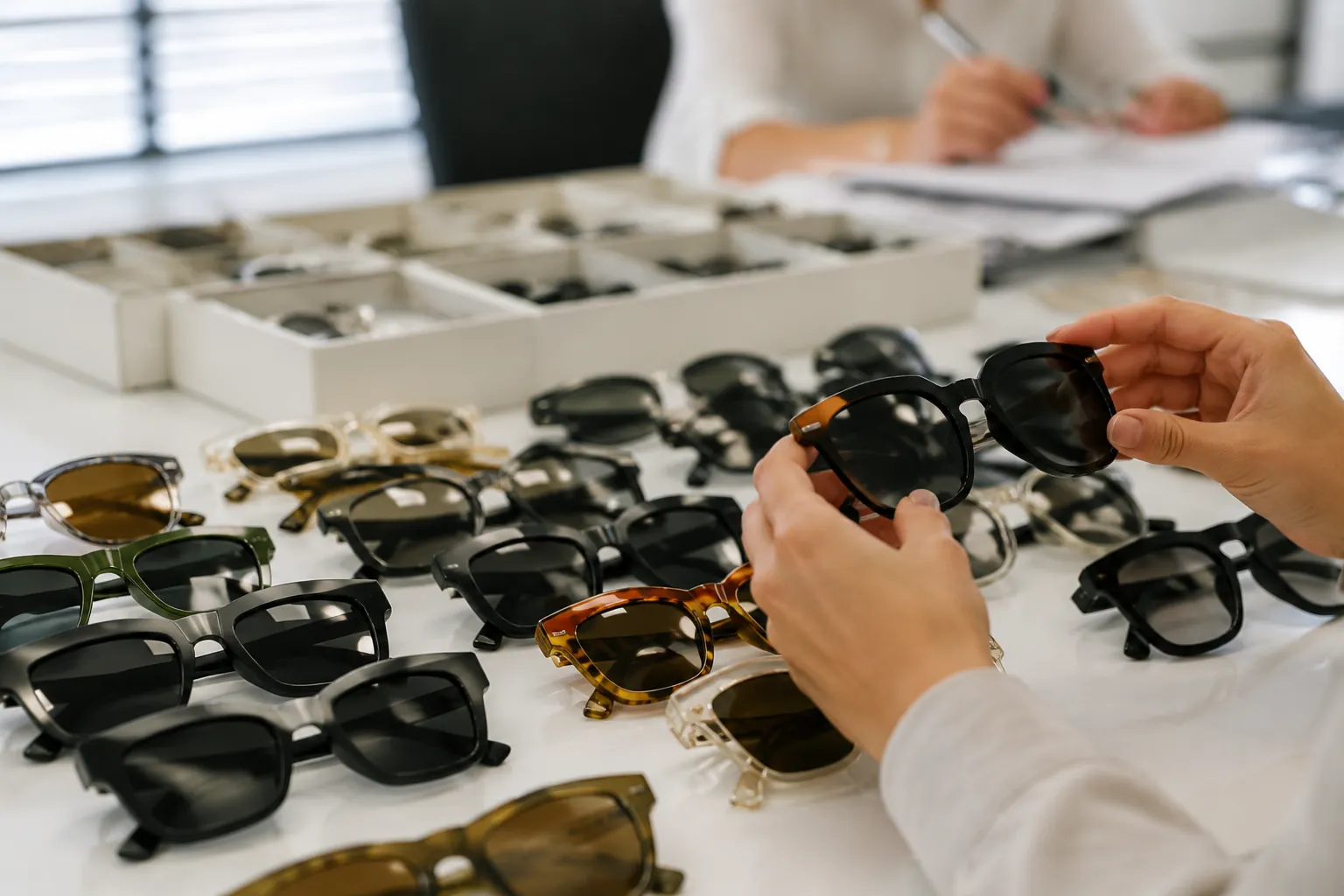
This guide is for eyewear brands, importers, distributors, and retailers choosing a sourcing route for a sunglasses launch. OEM, ODM, and ready-stock are not just quotation labels. They change the sample path, MOQ logic, tooling cost, compliance evidence, inspection plan, and launch calendar. Choose the route first. Then send an RFQ the supplier can quote without guessing from a mood board.
The three routes in plain sourcing language
OEM means you bring the product definition. The supplier manufactures to your drawings, 3D files, reference sample, material specification, lens requirement, logo position, packaging plan, and inspection standard. Choose OEM when the frame shape, temple profile, hinge structure, lens curvature, bridge fit, or brand detail must not look like an open-market product.
ODM means the factory already has a developed or semi-developed model, and you adapt it. You may change frame color, lens tint, temple decoration, printed logo, metal logo plate, packaging, barcode label, and some cosmetic details. You are not starting from a blank CAD file. You are commercializing an existing platform.
Ready-stock means the product already exists in finished or near-finished inventory. You buy available colors and quantities, usually with limited branding. It is the fastest route. It is also the least exclusive. If several buyers choose the same stock frame, several brands may sell very similar sunglasses.
Select the route before sampling. Each route fails in a different way. OEM fails when specifications are vague. ODM fails when buyers treat structural changes as small tweaks. Ready-stock fails when inventory, labeling, compliance documents, or batch condition are checked too late.
Head-to-head: speed, MOQ, tooling, and control
| Sourcing route | Best fit | Typical customization | MOQ and price logic | Lead-time logic | Main risk |
|---|---|---|---|---|---|
| OEM | Brand-owned design, protected retail program, long-term repeat model | Frame shape, lens shape, bridge, temple geometry, hinge, material, color, logo, packaging | Usually higher if new molds, fixtures, components, or development work are required. MOQ depends on material, tooling, color batching, decoration, and inspection requirements. Quote small pilot quantities and high-volume repeat orders separately. | Requires design review, sample or prototype approval, and then bulk production. Lead time increases with new injection tooling, custom metal parts, special lenses, or repeated sample revisions. | Tooling revisions, unclear drawings, late artwork changes, missed tolerance requirements |
| ODM | Private-label launch needing brand feel without full tooling delay | Color, lens tint, mirror coating, logo, temple print, laser mark, metal plate, pouch, case, box | Usually lower than full OEM because base tooling already exists. MOQ depends on color batching, lens type, decoration process, packaging, and SKU split. Mixed colors may be possible but can raise unit cost. | Faster than OEM when the base model is available. Timing depends on model availability, logo artwork, lens selection, packaging, sample approval, and bulk order size. | Buyer expects exclusivity but selects an open factory model |
| Ready-stock | Urgent promotion, seasonal gap, trial order, event sale, market test | Available colors and lenses; sometimes sticker, hangtag, pouch, or simple logo if unfinished stock allows it | Can support smaller purchases, but only within actual stock quantity, batch condition, and rebranding feasibility. Price may change if inspection, repacking, labeling, or compliance work is added. | Fastest if goods are finished and documents are acceptable. Dispatch may still require inspection, carton relabeling, export packing, and document review. | Stock gaps, mixed batches, weak differentiation, documents not tied to the actual model |
Price is not set by route alone. It is driven by material, hinge type, lens category, surface finish, decoration process, packaging, inspection level, compliance requirements, and order volume. A simple injected fashion frame, a TR90 sports frame, an acetate frame with polarized lenses, and a metal frame with plated parts are different products. Do not compare them as if they are the same. Ask suppliers to quote against one clear specification.
Choose OEM if the frame itself is the product
OEM is the route for buyers who need silhouette ownership, fit control, retail differentiation, and long-term repeatability. It also punishes weak briefs. A mood board is not an OEM spec. A reference photo with "make it similar but premium" is a dispute waiting to happen.
A serious OEM RFQ should include:
- Frame material: PC, TR90, acetate, stainless steel, alloy, or mixed construction.
- Key dimensions: front width, lens width, lens height, bridge, temple length, lens base curve, pantoscopic angle if relevant, and target weight.
- Functional tolerances: lens fit, temple opening symmetry, hinge movement, logo placement, color standard, and acceptable variation. If your brand has numeric tolerances, include them in the RFQ and inspection sheet.
- Hinge type: standard pin hinge, spring hinge, metal insert hinge, flex component, or custom part.
- Lens requirement: smoke, brown, gradient, mirror, polarized, UV400, visible light transmission category, and market standard.
- Decoration: pad print, laser engraving, hot stamping, metal plate, recessed logo, foil logo, or embedded badge.
- Packaging: polybag, microfiber pouch, EVA case, paper box, barcode label, instruction leaflet, carton marks, and pallet requirement if any.
- Compliance market: EU, US, Australia/New Zealand, or mixed distribution.
For injection frames, the mold affects parting line position, gate mark visibility, shrinkage, temple straightness, nose-pad detail, surface texture, and lens groove fit. New tooling normally requires trial parts. Adjustments may be needed if shrinkage, warpage, surface marks, or lens fit fall outside the approved standard.
Acetate is different. Cutting, CNC milling, tumbling, and hand polishing affect shape accuracy and surface quality. Acetate can give strong color depth and a premium hand feel, but it is more labor-intensive than many injected materials.
OEM can be the best long-term value when the model will repeat. It is not always the safest first order. If the design is unproven, test a nearby ODM shape first. Check sell-through, returns, fit comments, and price resistance. Then move into OEM with better evidence.
Choose ODM if you need branding without tooling delay
ODM is often the practical middle route. You get an existing structure, known fit, and faster sampling while still making the product look like part of your line. For many importers and retailers, that is enough.
Good ODM changes are controlled changes. Color swaps, lens tinting, temple logos, pad printing, laser marks, and packaging changes are usually practical because they do not change the engineering of the frame. A metal logo plate can add a stronger brand cue, but it needs a defined position, clean recess or surface plan, adhesive or mechanical fixing check, and pull or peel review during QC.
Mirror lenses can change the whole look. Approve real lens samples. Gold, blue, green, and silver mirror coatings can look different under factory lights, sunlight, and camera conditions.
Bad ODM changes are half-OEM changes in disguise. Moving a hinge, narrowing a bridge, changing lens geometry, thinning a temple, or altering the nose fit can affect mold balance, assembly strength, wearing comfort, and drop resistance. If the supplier says a new mold, new fixture, or new component is required, treat the project as OEM work. Ask which changes use the existing tool and which require development.
A disciplined ODM path is simple: model selection, color and lens confirmation, logo artwork check, decoration test if needed, pre-production sample, buyer approval, bulk production, final inspection, and export packing. Confirm sample lead time and bulk lead time in writing. They depend on order size, SKU count, material availability, decoration workload, packaging, and inspection requirements.
Choose ready-stock only if speed beats exclusivity
Ready-stock is useful. It is also easy to misuse. It fits urgent retail gaps, influencer drops, tourist-season promotions, corporate events, and market tests where the buyer needs goods quickly and can accept limited uniqueness.
The key question is not "Do you have stock?" The key question is: what exact stock is available, in which color, lens, quantity, batch, packaging condition, and inspection status? Ask for current inventory photos, batch details, carton counts, packaging status, and whether the sunglasses are finished or can still accept branding.
Finished stock may not allow clean temple printing without rework. Unfinished stock may be more flexible, but it will not ship as quickly. Logo work, pouching, labeling, and final QC still take time.
Inspect ready-stock more aggressively than many buyers expect. Confirm quantity by color, lens scratches, hinge looseness, temple alignment, mixed batches, dust inside packaging, pouch condition, barcode accuracy, and carton marks. If the stock has been stored for a long time, check coating condition, lens film residue, frame deformation, screw condition, and whether temples still open and close smoothly. Cheap goods can become expensive returns.
Ready-stock still requires compliance discipline. For EU sales, sunglasses should be assessed against CE requirements and EN ISO 12312-1 as applicable. For the US, ANSI Z80.3 may be relevant, and FDA registration may apply to the responsible establishment or product route depending on the business model. For Australia and New Zealand, AS/NZS 1067 is the key standard. REACH is relevant for restricted substances in plastics, coatings, colorants, and metal parts sold into the EU. Do not assume an available product is suitable for every market.
Cost drivers to separate before comparing quotes
Many quote comparisons are flawed because buyers compare different products under one price line. A basic injected frame and an acetate frame with polarized lenses, metal logos, and a retail case are not the same specification. Separate the cost drivers first.
- Frame material. PC is commonly used for cost-sensitive promotional and fashion frames. TR90 is selected for flexibility and recovery. Acetate is more labor-intensive and is often chosen for color depth, polish, and perceived value. Metal frames add plating, soldering, and corrosion-control considerations.
- Lens specification. Standard tinted UV400 lenses cost less than polarized, mirror, gradient, photochromic, or specialty color lenses. Lens category and visible light transmission must match the sales market and product claim.
- Tooling and fixtures. Existing molds keep cost and time down. New injection molds, custom hinges, special nose pads, dedicated fixtures, or metal badges add cost, lead time, and revision risk.
- Decoration method. Pad printing is economical for simple logos but needs adhesion checks. Laser engraving is durable on suitable materials but less visible on some colors. Metal plates look stronger but require alignment, bonding, edge control, and inspection for lifting.
- Packaging. A polybag and microfiber pouch are very different from an EVA case, printed box, barcode label, leaflet, retail insert, and export carton specification.
- Volume and SKU split. MOQ and unit cost depend on order volume and how that volume is split across colors, lenses, and packaging versions. Many small SKUs are less efficient than fewer SKUs at the same total quantity.
Ask suppliers to quote by specification, not by vague product name. A lower price may be real. It may also be missing packaging, testing, logo work, inspection, or the correct lens.
Compliance and QC points that change by route
Compliance is not a logo printed on a carton. It is a combination of design, materials, lenses, labeling, documentation, and testing route. For sunglasses, buyers commonly reference CE EN ISO 12312-1 for the EU, ANSI Z80.3 for the US, AS/NZS 1067 for Australia and New Zealand, REACH for restricted substances in EU-bound materials, and FDA registration where applicable. ISO 9001 and BSCI relate to management systems and social compliance. They do not replace product testing.
State the destination market at RFQ stage. A sunglass suitable for one channel may need different markings, warnings, test reports, labeling, or restricted-substance evidence for another. Ask which documents are available for the exact model, lens, material, and batch being supplied. General factory certificates are useful background. They are not model-specific compliance evidence.
For OEM, review compliance before tooling. Lens size, frame coverage, tint darkness, optical quality, and intended use can affect suitability. For ODM, confirm whether the base model has relevant prior test data and whether your lens, coating, material, or color change requires updated testing. For ready-stock, ask for documents tied to the actual model or batch. Not a generic certificate from another style.
QC should match the route. OEM inspection focuses on dimensional accuracy, mold finish, assembly strength, lens fitting, temple opening, hinge torque, logo position, and color standard. ODM inspection focuses on consistency against the approved sample: same color, same lens, same decoration, same packaging, same fit. Ready-stock inspection focuses on scratches, mixed colors, loose hinges, lens defects, dust, quantity shortages, and carton condition.
Use AQL inspection or a written defect standard for bulk orders. Define critical defects such as wrong lens category, broken hinge, sharp edge, missing required label, or wrong logo. Define major defects such as visible scratches, poor printing, lens gap, crooked temple, and color mismatch. Approve a physical sample before bulk production whenever timing allows. Digital renders do not show lens tint, temple pressure, hinge feel, nose fit, mirror coating variation, or real polish quality.
A simple decision path before you request quotes
Use this filter before emailing factories. It saves time on both sides.
- If your launch date is fixed within a few weeks, start with ready-stock. Confirm real inventory, branding limits, inspection plan, packaging status, export packing, and compliance documents before paying.
- If you need your logo, color story, and packaging but can accept an existing shape, choose ODM. Ask which models are open, which parts can change, and whether exclusivity is available by region, time period, or order volume.
- If the shape is central to your brand, choose OEM. Prepare drawings, measurements, target materials, lens standard, reference samples, and destination-market requirements before asking for price.
- If your budget is tight, reduce variables. Use an existing frame, standard lens, simple logo, and lighter packaging. Spend money first on lens quality, QC, and compliance.
- If you plan repeat orders, price the pilot and reorder stages separately. A small launch order can test demand, but reorder economics should be quoted at higher quantities with the same specification.
A good RFQ is short but complete: route, model or drawing, order quantity by color, lens requirement, logo method, packaging, destination market, target ship date, compliance expectation, and inspection standard. Send that, and the supplier can quote a production plan instead of guessing.
Have a custom sunglasses project in mind?
Send us your styles, target market and quantities and we will return a detailed quote with MOQ, lead time and a sample plan.
Get a QuoteWhy source this from Wenzhou with LumiShades
Wenzhou in Zhejiang Province is widely regarded as China’s eyewear manufacturing capital, producing a large share of the world’s sunglasses. That concentration matters to buyers: a deep local supply chain for acetate sheet, hinges, lens blanks, plating and packaging means shorter component lead times, easier color and material matching, and a workforce with decades of eyewear-specific skill. LumiShades has manufactured in this ecosystem since 2009, and our vertical integration — in-house injection molding, acetate cutting, CNC milling, lens tinting, decoration and quality control — means no part of your order is quietly subcontracted to a workshop you cannot audit.
For international buyers, that vertical control translates into accountability. When a single factory owns every step, defects are traced and fixed at source rather than bounced between vendors, and your specifications survive intact from first sample to bulk. We back this with 15+ years of experience, shipments to 60+ countries, more than 5 million pairs produced per year and a 98.5% on-time delivery rate. Our certifications — CE EN ISO 12312-1, FDA registration, ANSI Z80.3, AS/NZS 1067, REACH, ISO 9001 and BSCI audit — mean the compliance documentation your market requires already exists. Explore our manufacturing capabilities and quality control process to see how this works in practice.
Frequently asked questions
Can I start with a small order and later keep the same design for larger orders? Yes, if the design, mold, material, lens, and decoration process are stable and the supplier agrees to keep the same specification. Before placing the pilot order, ask for written pricing at your expected reorder quantities, confirm whether any tooling belongs to you or the supplier, and keep an approved physical sample as the production standard for future runs.
Is ODM exclusive to my brand? Not automatically. ODM usually starts from an existing factory model that may be offered to other buyers. If exclusivity matters, ask whether the supplier can reserve the model by country, sales channel, time period, or annual purchase volume. Put the exclusivity scope, duration, minimum order commitment, and penalty for breach in the purchase agreement.
Do I need new testing if I change only the lens color? Possibly. Lens tint, visible light transmission, mirror coating, polarization, and claimed UV protection can affect compliance and labeling. For EU, US, and Australia/New Zealand sales, confirm requirements against EN ISO 12312-1, ANSI Z80.3, and AS/NZS 1067 as applicable. If the previous report does not cover your exact lens and model combination, ask the supplier or lab whether updated testing is needed.
Which route is best for a retailer with a seasonal deadline? Use ready-stock if the deadline is very close and you can accept available colors, limited branding, and non-exclusive styling. Use ODM if you have enough time for sample approval, logo or packaging work, bulk production, inspection, and shipping. Avoid OEM for tight seasonal timing unless tooling, samples, compliance route, and packaging are already approved.
What should I send to get an accurate OEM quote? Send drawings or reference samples, dimensions, material, lens specification, hinge requirement, logo method, packaging, order quantity by color, destination market, target delivery date, compliance expectations, and inspection standard. If you have tolerance requirements or a target weight, include them. Without these details, the quote may change after sampling.
How do I avoid comparing unfair quotes from different suppliers? Create one RFQ sheet and require each supplier to quote the same frame material, lens type, decoration, packaging, compliance target, MOQ, sample timing, bulk lead time, Incoterm, and QC standard. Ask each supplier to list exclusions. A lower unit price often means the quote is missing packaging, testing, logo work, inspection, or the correct lens specification.
Ready to start?
Explore our sport wrap sunglasses or request a quote — our sales team replies within 12 hours.
Request a Quote