
Mirrored Sunglass Lenses: Coatings, Risks, Specs
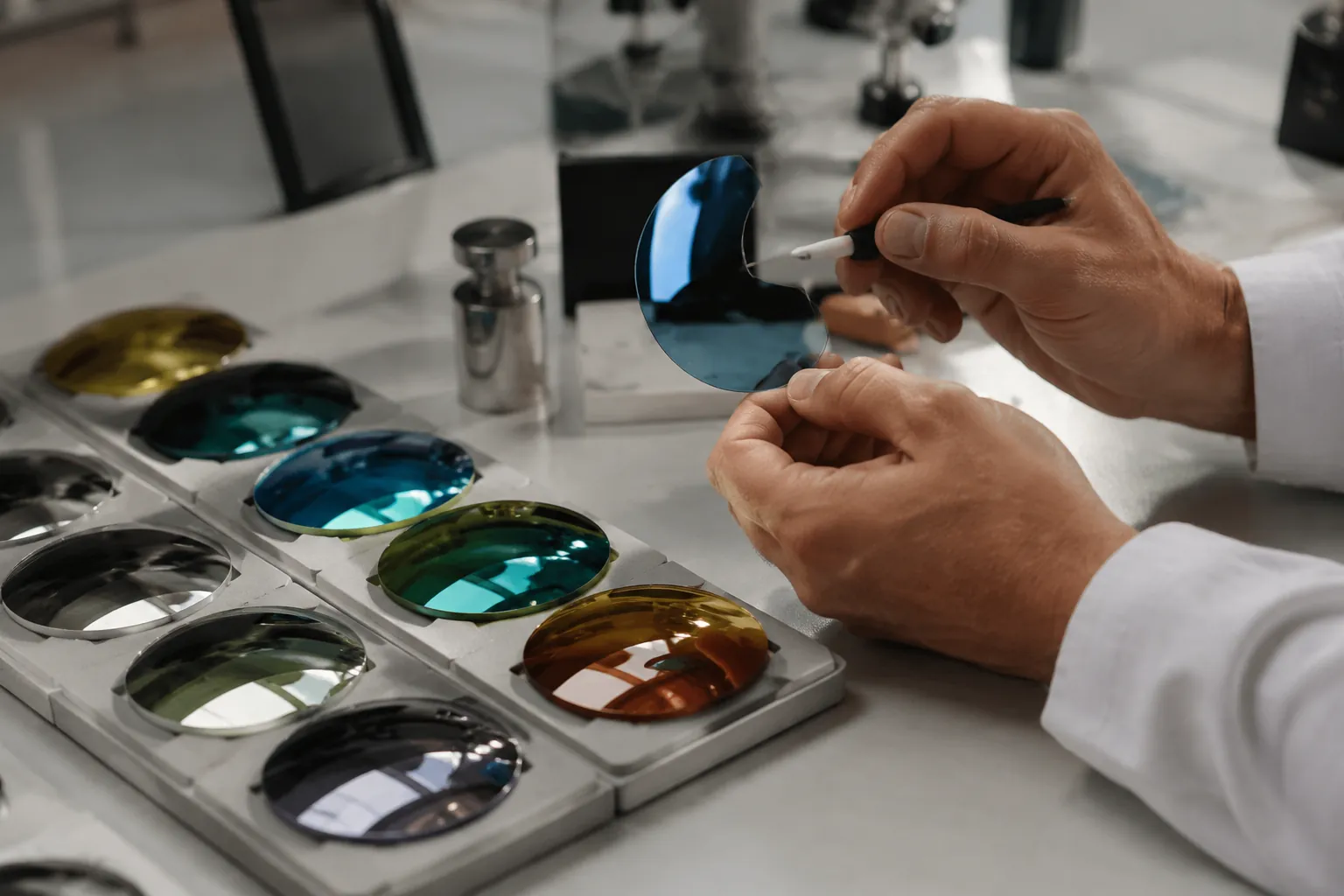
If you buy mirrored sunglasses in volume, the hard part is not picking a color. It is keeping reflectance, base tint, and coating adhesion steady across reorders without peeling, haze, or shade drift. This guide is for brands, importers, distributors, and retailers that need mirror lenses to pass compliance checks, perform in use, and match approved samples from one run to the next. It also shows where a factory can control the process in-house and where the purchase order must do the work.
What mirror coating actually changes
Mirrored lenses are not just tinted lenses with a shiny face. The mirror layer is a thin reflective coating applied to the front, usually over a base tint. That coating changes three buyer-facing things: how much light is reflected, how the lens color reads in daylight, and how visible surface defects are under inspection.
The base tint still drives visible light transmission. The mirror layer mostly affects appearance and glare handling. A gold mirror over a gray base will not test or look the same as a silver mirror over smoke. If you do not define both layers, reorder control gets messy fast.
For bulk orders, name the lens stack in plain terms: substrate material, base tint, mirror color, and any topcoat or hard coat. If you only write "blue mirror," different factories may use different base tints or deposition settings. It can look close in a photo and still be wrong in hand.
Buyer rule: Specify the lens as a stack, not as a color name.
If a factory handles tinting and coating in one flow, it is easier to keep the base shade and the mirror layer aligned from sample to bulk. Fewer handoffs. Less drift.
Common mirror colors and how they read
Mirror color should be chosen for market fit and repeatability, not just for trend photos. Some finishes are more forgiving than others when production varies a little.
| Mirror color | Typical look | What it hides well | Main risk | Best use case |
|---|---|---|---|---|
| Silver | Neutral, highly reflective | Minor base-tint differences | Shows scratches and handling marks easily | Core SKUs and broad retail use |
| Gold | Warm reflective finish | Small cosmetic dust marks | Color shift becomes obvious if the base tint changes | Fashion collections and premium-looking frames |
| Blue | Cool, high-contrast finish | Some yellowing in the base tint | Batch-to-batch color drift is easy to see | Sport and youth styles |
| Green | Deep reflective tone | Light base inconsistency | Can look muddy if deposition is uneven | Classic outdoor styles |
| Rainbow / flash mirror | Strong visual effect | Very little | Highest visual QC rejection risk | Short-run fashion drops |
Silver and gold are usually easier to standardize. Strong color mirrors, especially rainbow or gradient effects, need tighter process control and a clear approved reference sample. Without that sample, "acceptable variation" turns into an argument.
For retail and e-commerce, remember that phone photography can exaggerate small hue differences. A lens that looks fine on a workbench may still draw complaints online if the mirror tone shifts too much between batches.
How the coating is built in production
A stable mirror lens starts with the substrate and the coating sequence. In typical sunglass production, the lens is formed first, then tinted if needed, then coated with the mirror layer, and then protected with a hard coat or top layer if the process calls for it. The order matters. If the surface is contaminated or the tint is unstable, the mirror layer may not bond evenly.
- Prepare the lens surface and remove oil, dust, and release residue.
- Apply or confirm the base tint to the target shade.
- Deposit the mirror layer using the specified coating method.
- Apply any protective topcoat or hard coat.
- Dry, cure, and cool under controlled conditions.
- Inspect reflectance, color, and adhesion before packing.
Factories can use different deposition systems, but the buyer does not need the machine model. You need two verifiable outcomes: the mirror must adhere properly, and the color must repeat against the approved sample. Ask for process controls and inspection criteria. Skip the vague promises.
When tinting, decoration, and QC sit in one production flow, it is easier to catch problems before lenses are packed. That matters because mirror defects often show up at handoff points between separate processes or outside suppliers.
The failure modes buyers should watch
Most mirror-lens complaints fall into a small set of failure modes. They are predictable. That means they can be written into the spec and checked before shipment.
- Peeling at the edge: usually linked to poor surface preparation, weak adhesion, or rough handling during assembly.
- Scratch marking: mirror layers can show scuffing quickly if the topcoat is soft or the packing allows contact between lenses.
- Color shift between batches: often comes from a different base tint, coating thickness, or curing condition.
- Haze or clouding: usually points to contamination, overcoating, or curing problems.
- Patchy reflectance: often indicates uneven deposition or surface defects before coating.
Edge peeling is especially bad on volume orders because it may not show up right away. Heat, transport vibration, and repeated handling can expose it later. If a supplier only checks appearance before packing and does not run a basic adhesion check, the buyer may not see the defect until returns start.
Packaging also matters. Loose lens-to-lens contact inside a bag can mark a mirror surface before the product reaches your warehouse. For high-gloss mirror lenses, ask for lens protection, divider cards, or a bag layout that prevents face rubbing in transit.
Specs to lock before mass production
Your purchase order should not say "mirror lens, blue." That is too vague. Write the spec so the factory can build and inspect to it.
| Spec item | What to state | Why it matters |
|---|---|---|
| Base lens material | PC, TAC, nylon, or other approved substrate | Different materials handle impact and coating differently |
| Base tint | Smoke, gray, brown, amber, etc., with a reference sample | Controls final color and visual depth |
| Mirror color | Silver, gold, blue, green, or a custom reference | Prevents color drift across reorders |
| Visible light transmission target | Range or reference sample | Needed for compliance and market fit |
| Adhesion requirement | Pass/fail after an agreed internal test | Reduces peeling claims |
| Scratch resistance expectation | State hard-coat requirement if needed | Mirror layers are cosmetic and vulnerable without protection |
| Packaging method | Bag, divider, insert, carton count | Helps prevent transit damage |
For color control, keep a retained golden sample signed off by both sides. Keep one for production approval and one for batch comparison. If you approve only by email photo, you leave room for disagreement. Photos change with lighting, camera settings, and screen display.
If the order includes multiple SKUs, standardize mirror colors across frame families where possible. Fewer unique coating setups usually means fewer production variables, fewer resets, and better reorder behavior.
Compliance does not come from the mirror alone
Mirror coating is a surface finish. It does not replace lens compliance. For overseas buyers, the legal and import side is often more important than the visual effect.
The certifications and compliance references that should be checked for a sunglass program are CE EN ISO 12312-1, ANSI Z80.3, AS/NZS 1067, REACH, FDA registration, ISO 9001, and BSCI, where applicable to the supplier and market. Ask for the documents the supplier actually holds and make sure the reports match the exact lens build you are ordering.
Mirror finishes can affect testing indirectly if the base tint or visible light transmission changes. If you approve a silver mirror over a smoke lens and later switch to a darker base tint, the compliance profile may need to be checked again. The mirror color itself is usually not the issue. The full lens stack is.
If you sell into multiple regions, align the lens specification with the strictest required market first. That is usually simpler than managing separate versions after production starts. Ask for the declaration pack, test reports, and revision control on the approved sample.
Cost, MOQ, and lead-time logic
Mirror lenses are not priced like plain clear lenses. Setup, color matching, and reject risk all affect cost. For buyers, the price is mainly driven by order size, the number of unique colors in the program, and whether the coating is standard or custom.
| Order size | Typical pricing behavior | Operational note |
|---|---|---|
| 50 pairs/design MOQ | Highest unit cost | Useful for testing a new style or market |
| 300 pairs | Better setup efficiency | Suitable for a small seasonal run |
| 1,000 pairs | Lower unit cost than small runs | Usually easier to stabilize dye and coating output |
| 5,000+ pairs | Best pricing in many programs | Requires stable forecasting and approved samples |
Sample lead time is often around 7 to 10 days, and bulk production is often around 25 to 35 days, assuming the specification is clear and no new development is required. If you change mirror color after sample approval, the schedule should be reset because the factory must rematch the finish and recheck the process.
Lead time also stretches when a small order is split across too many mirror colors. Three colors on one low-MOQ program can cost more operationally than one larger color block because of setup time, cleaning, and QC resets. Consolidate where you can.
What to ask before you place the PO
Use a short buyer checklist. It saves time and cuts avoidable mistakes.
- Confirm the exact lens stack: substrate, base tint, mirror color, and any topcoat.
- Request a physical approved sample, not only a photo.
- Ask how the factory checks adhesion and scratch resistance internally.
- Define the allowed shade variation against the retained sample.
- Confirm the packing method used to protect the mirror surface.
- Verify the compliance file for the exact lens build, including CE EN ISO 12312-1, ANSI Z80.3, AS/NZS 1067, REACH, FDA registration, ISO 9001, and BSCI where applicable.
- Lock the reorder rule: same formula, same reference sample, same carton spec.
If your supplier manages injection molding, acetate cutting, CNC milling, lens tinting, decoration, and QC in one facility, it is easier to keep finish consistency under control. That does not remove risk, but it reduces handoffs and makes revision tracking clearer when a reorder arrives.
The goal is simple: the mirror lens that lands in month six should match month one closely enough that the customer sees continuity, not a new product. That only happens when the spec is tight, the sample is retained properly, and the factory controls the full process instead of guessing through it.
Have a custom sunglasses project in mind?
Send us your styles, target market and quantities and we will return a detailed quote with MOQ, lead time and a sample plan.
Get a QuoteWhy source this from Wenzhou with LumiShades
Wenzhou in Zhejiang Province is widely regarded as China’s eyewear manufacturing capital, producing a large share of the world’s sunglasses. That concentration matters to buyers: a deep local supply chain for acetate sheet, hinges, lens blanks, plating and packaging means shorter component lead times, easier color and material matching, and a workforce with decades of eyewear-specific skill. LumiShades has manufactured in this ecosystem since 2009, and our vertical integration — in-house injection molding, acetate cutting, CNC milling, lens tinting, decoration and quality control — means no part of your order is quietly subcontracted to a workshop you cannot audit.
For international buyers, that vertical control translates into accountability. When a single factory owns every step, defects are traced and fixed at source rather than bounced between vendors, and your specifications survive intact from first sample to bulk. We back this with 15+ years of experience, shipments to 60+ countries, more than 5 million pairs produced per year and a 98.5% on-time delivery rate. Our certifications — CE EN ISO 12312-1, FDA registration, ANSI Z80.3, AS/NZS 1067, REACH, ISO 9001 and BSCI audit — mean the compliance documentation your market requires already exists. Explore our manufacturing capabilities and quality control process to see how this works in practice.
Frequently asked questions
What mirror lens color is safest for repeat reorders? Silver is usually the safest starting point, followed by gold. Both tend to hide small production variation better than stronger blue, green, or rainbow mirror effects. If reorder stability matters, approve the color against a physical retained sample and keep the same base tint, substrate, and coating process for every repeat order.
How do I reduce peeling complaints on mirrored lenses? Specify the substrate, base tint, mirror color, and any topcoat in writing, and require the supplier to confirm its adhesion check before shipment. Also control packing so lenses do not rub face-to-face in transit, because edge damage and surface wear often begin after packing, not during coating.
Can I approve a mirror lens by photo only? No. A photo is useful for quick comparison, but it is not enough for final approval. Use a physical signed-off sample because lighting, camera settings, and screen display can all change how the mirror color appears, and photos do not show surface texture or minor coating defects reliably.
Does a mirror coating change compliance testing? The coating does not replace compliance, but the full lens stack matters. If the base tint or visible light transmission changes, the compliance profile may need to be checked again against the applicable standard. Ask the supplier for the exact test reports that match the final approved build.
What should I lock in the purchase order? Lock the lens material, base tint, mirror color, target visible light transmission, adhesion expectation, packaging method, and the retained reference sample. If your program has multiple markets, also state which compliance standard applies to each SKU so the factory builds against the correct requirement from the start.
What are realistic sample and bulk lead times? A typical planning range is 7 to 10 days for samples and 25 to 35 days for bulk production when the specification is clear and no new development is needed. If you change the mirror color, base tint, or coating structure after sample approval, the schedule should be updated because the factory must rematch and recheck the build.
Ready to start?
Explore our shield & oversized sunglasses or request a quote — our sales team replies within 12 hours.
Request a Quote