
OEM Photochromic Sunglasses: Specs, Risks, and MOQ
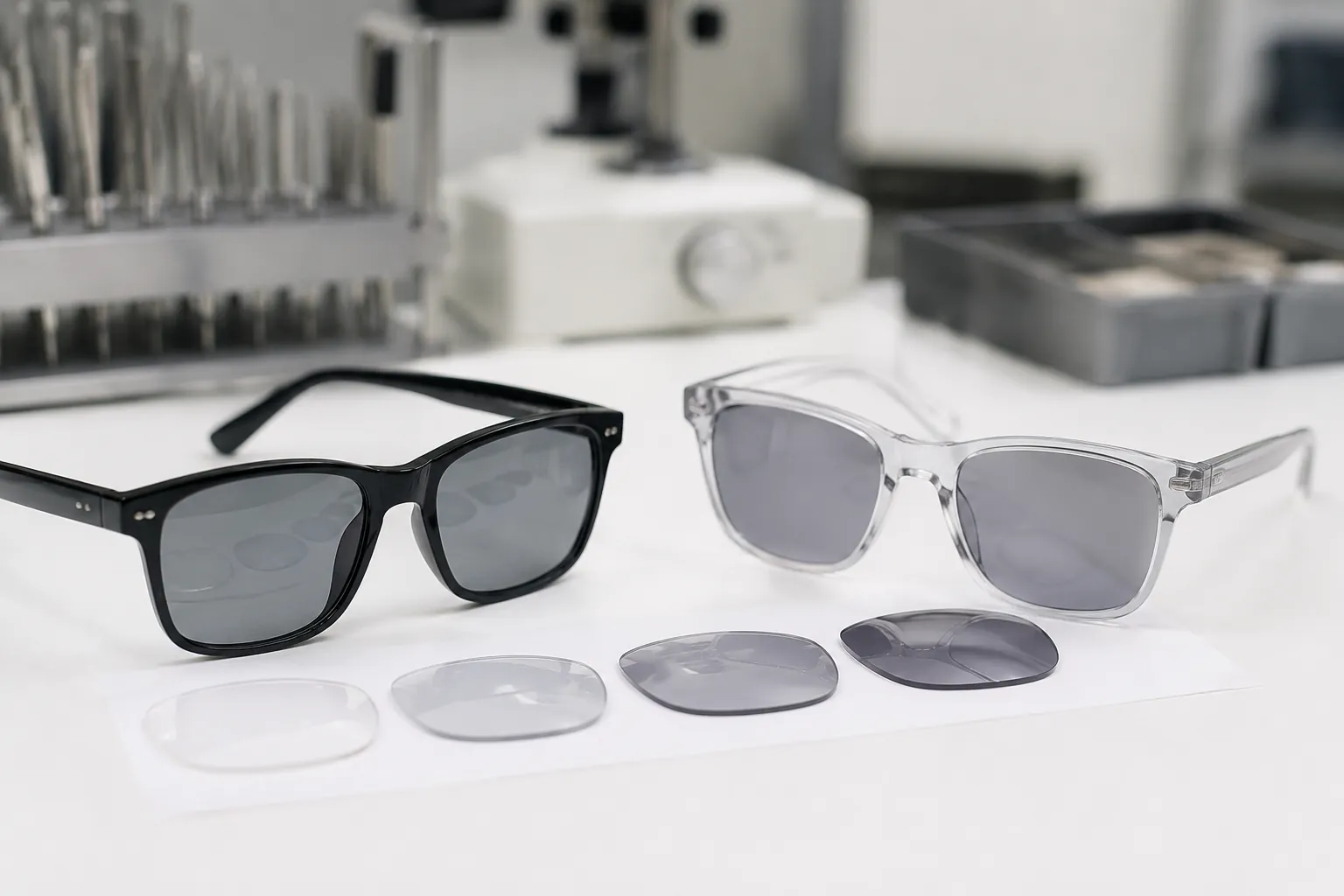
This guide is for brands, importers, distributors, and retailers evaluating photochromic sunglasses as an OEM line. It explains where these lenses work, where they fail, and what to test before you approve bulk production. The goal is practical: fewer rejected samples, cleaner compliance files, and fewer customer complaints after launch.
Start With The Use Case
Photochromic sunglasses are easy to describe. They are also easy to mis-sell. The first question is not "Do you have transition lenses?" It is simpler: where will the wearer use them, how dark must they get, and what will make them fail?
A lens that performs well in open daylight may underperform in a car, on a cloudy winter day, or in hot weather where the chemistry reacts more slowly. That is normal. It still matters.
Before quoting, define the channel and the use case in writing. Lifestyle retail buyers usually want visual comfort and a novelty factor. Sport buyers care more about wrap coverage, stability, and impact resistance. Driving claims carry the most risk because standard photochromic behavior depends on UV exposure, and many windshields block most UV. Optical-channel buyers often want tighter cosmetic consistency, lower distortion, and cleaner paperwork.
A practical OEM classification looks like this:
- Lifestyle sunglasses: workable when the buyer wants an adaptive fashion style and can accept a moderate darkening curve.
- Sport and cycling: useful for variable sunlight, but frame retention, fog control, and impact performance matter more than the transition effect alone.
- Driving use: only suitable when tested behind automotive glass and when marketing claims are tightly limited.
- Kids and value retail: workable, but only with controlled QC, narrow claims, and stricter packaging review.
- Optical-adjacent programs: need more stable lens color, tighter visual acceptance limits, and more disciplined compliance files.
LumiShades usually approves lens behavior first, then finalizes decoration and packaging. That order matters. A logo can move. A lens that darkens too slowly, or not enough, cannot be fixed with better artwork.
Lock The Spec Sheet First
A purchase order that says "photochromic grey lens" is not a usable specification. The factory needs measurable targets, even if the product is non-prescription sunglasses rather than optical lenses. Without numbers, every sample discussion turns into opinion.
At minimum, define visible light transmission in the light state and dark state, activation time, fade-back time, UV protection, lens color, base curve, coating stack, and lens thickness. For many sunglasses programs, buyers target a light-state VLT around 35% to 80% and a dark-state VLT roughly between 10% and 30%, depending on market and category claim. The exact number matters less than having a written range and an agreed test condition.
Practical spec items should include the following:
| Spec Item | What To Define | Buyer Control Point |
|---|---|---|
| Light-state VLT | Transmission before activation, measured under agreed indoor conditions | Prevents lenses that look too dark at retail or in photos |
| Dark-state VLT | Transmission after UV exposure for a fixed time and intensity | Determines outdoor comfort and sunglass category positioning |
| Activation time | Time to reach an agreed dark level, usually measured at 23°C and a defined UV source | Avoids vague "fast transition" promises |
| Fade-back time | Time to return near the light state after UV is removed | Controls indoor comfort and customer perception |
| Lens base curve | Flat, 4-base, 6-base, 8-base, or project-specific wrap curve | Affects fit, distortion, and edge stress |
| Coating stack | Hard coat, anti-reflective layer, hydrophobic layer, and any mirror or flash layer | Determines durability and scratch resistance |
Also define test temperature. Photochromic chemistry is temperature sensitive. In cold conditions, many lenses darken more strongly and fade more slowly. In high heat, they may not reach the same dark shade. Buyers should approve samples at a realistic range, often around 10°C to 35°C, not only in an air-conditioned office.
For acceptance, ask the factory for a lens-only sample report with the exact lens lot, test date, lighting condition, and measurement method. If the same lens is re-supplied six months later, a small shift in coating or resin lot can change performance enough to matter.
Material Choice Changes Everything
Photochromic sunglasses can be built in PC, TAC, nylon, or other lens materials. Each one changes both the wearer experience and the factory process. The cheapest lens is not always the cheapest program. A higher reject rate, more scratches, or lower customer satisfaction can erase a small unit-cost advantage fast.
PC is common for impact resistance and sport-oriented frames. It handles tough use well, but the coating quality has to be disciplined because the surface can be more sensitive to scratches and chemical attack if the hard coat is weak. TAC is often used in polarized eyewear and can look clean in retail, but combining TAC with photochromic function raises process complexity and can narrow sourcing options. Nylon works well for wrap and performance styles because it balances clarity and toughness, though the raw cost is usually higher.
Frame construction matters just as much as the lens. Injection-molded frames can be efficient at scale and hold consistent geometry, while acetate frames need heat and manual fitting during assembly. If a lens sits under edge stress in a tight 8-base wrap frame, the batch may pass visual inspection and still fail later with popping, warping, or stress whitening. For that reason, the lens curve, groove depth, and frame tolerance should be agreed before bulk begins.
Useful production tolerances and checks include these ranges:
- Lens thickness: typically held within about ±0.1 mm to ±0.2 mm on a program basis, depending on material and geometry.
- Temple alignment: keep left-right visual symmetry within about 1 mm at the front view for consumer-facing retail programs.
- Logo placement: define a position tolerance of roughly ±1 mm so printing and metal plates remain visually centered.
- Lens fit: check for edge lift, rattling, and pressure marks after heat cycling and wear simulation.
- Coating adhesion: verify with rub, tape, or cross-hatch style checks on representative samples before full release.
Decoration should not be used to hide product uncertainty. Laser engraving, pad printing, hot-stamped logos, and metal logo plates are all valid methods, but they should come after lens approval. If the lens changes, even a perfect temple print will not fix a poor wearing experience.
For commercial planning, LumiShades usually supports lower-risk development at around 50 pairs per design, then scales through 300, 1000, and 5000+ pairs as the buyer confirms the market. In photochromic programs, a realistic price floor is usually higher than for simple tinted sunglasses because of the lens cost, coating handling, and QC loss. High-volume projects may approach about $2.10 per pair in favorable configurations, but only when the frame, lens, packaging, and decoration are standardized.
Know The Activation Limits
The worst photochromic problem is not total failure. It is a product that works technically but misses the customer's expectation. That gap drives returns, complaints, and markdowns. Buyers should understand the real limits before a claim goes into a catalog or marketplace listing.
Start with the vehicle problem. Standard photochromic lenses rely on UV, and many windshields block a large share of UV radiation. That means a lens can look strong outdoors and still stay relatively light in the car. If driving use is part of the concept, test it in a real vehicle. Do not infer performance from outdoor sun alone.
Temperature is the other major variable. In cold weather, lenses usually darken faster and can reach a deeper state. In heat, the same lens may darken less and return faster. A buyer who validates only in winter may approve a summer product that feels too light. For programs sold across climates, the safer approach is to approve performance at two temperature points and write both into the file.
Other common complaint sources include cloudy weather, where UV exists but visual darkening can appear less dramatic; deep-tint expectations, where a fashion customer wants category-3 style darkness but the lens is designed for adaptive comfort; and slow fade-back, which annoys users entering stores, offices, or public transit. A measured claim is better than a dramatic one.
Keep the language conservative. "Instant," "all-condition," and "perfect for driving" are risky unless the product is specifically tested and documented for those claims. A better approach is to publish measured ranges for activation and fade-back, plus a clear note that performance varies by light intensity, UV level, and temperature.
Compliance Needs Product-Level Evidence
For overseas B2B buyers, compliance has to be planned before mass production. Sunglasses sold into Europe, the United States, Australia, and New Zealand may need different documents, labels, and test reports. A factory certificate alone does not protect the buyer if the final SKU changes after sampling.
For CE EN ISO 12312-1, buyers should confirm filter category, UV protection, optical quality, and any limitations on direct sun observation or artificial light exposure. For ANSI Z80.3, the program should verify non-prescription sunglass requirements such as transmission and optical properties. For AS/NZS 1067, category labeling and consumer information need to align with the shipped product. REACH matters for restricted substances in lenses, frames, coatings, nose pads, and packaging components.
FDA registration is often misunderstood. It supports U.S. market handling, but it does not automatically approve every claim. Eyewear should avoid medical or eye-health promises unless the supporting file is correct. If the product is described as protective, the wording must stay within the scope of the actual test report.
Ask for reports tied to the exact lens, coating, color, and construction. A generic test on a similar frame is not enough if the real product uses a different resin or a different dark-state tint. If you switch from smoke grey to brown photochromic, or add a mirror layer, expect the compliance file to be reviewed again. Small changes can create new test questions.
Good OEM practice is to lock the artwork, warnings, and lens claims only after the final sample is approved. Packaging changes late in the schedule are one of the easiest ways to break a shipment window.
Samples Should Prove The Product
Samples are often treated like catalog props. They should answer production questions instead. If the product is new, the right sequence is lens-only approval, assembled frame approval, then pre-production confirmation. That sequence avoids decorating, boxing, or labeling a product that still has an unresolved lens issue.
A realistic development cycle usually takes 7 to 10 days for samples, depending on lens availability and decoration complexity. Bulk production commonly runs 25 to 35 days after sample approval, final artwork, packaging confirmation, and deposit. If a custom lens is needed, or if the design includes mirror coating, multi-color pad printing, or a special wrapping shape, add time for tooling and revised QC checks.
A strong sample plan should include these reviews:
- Lens-only approval: Confirm light-state color, dark-state color, UV reaction, activation, and fade-back before locking the frame.
- Assembled frame sample: Check lens fit, edge stress, distortion, temple symmetry, hinge feel, and comfort after wear.
- Pre-production sample: Approve logo, package, barcode, warning text, category marking, and inspection limits.
Buyer-side testing can be simple and still effective. Put one lens in direct sunlight and keep another indoors as a control. Photograph both at 0 seconds, 30 seconds, 2 minutes, 5 minutes, and after re-entry indoors. Repeat the test behind a car windshield if driving is mentioned. Record the ambient temperature and the approximate weather conditions. Even without a lab, this exposes bad assumptions quickly.
For QC, define what "good" and "bad" look like before the PO is issued. Most disputes are visual: uneven shade, haze, coating blemishes, logo misalignment, or a lens that feels inconsistent from carton to carton. Buyers usually notice variation faster than a small numerical difference in VLT.
Price, MOQ, And Lead Time
Photochromic programs cost more than standard tinted sunglasses because the lens, coating, handling, and rejection rate are different. The right question is not "What is the lowest unit cost?" It is "What cost profile fits the channel and return risk?" A low-cost unit that creates complaints can be more expensive than a slightly pricier unit with stable performance.
Order size changes cost behavior quickly. Small development runs carry setup cost, while larger orders spread that cost across more pairs and support better carton-level QC planning. For most OEM buyers, 50 pairs per design is a reasonable entry point for market validation. Around 300 pairs per design works for a small retail launch or a regional reorder. At 1000 pairs, the program usually becomes stable enough for better material purchasing and more consistent assembly flow. At 5000 pairs and above, the buyer can usually push toward the lowest realistic unit cost for the chosen spec.
| Order Level | Typical Use | Commercial Logic |
|---|---|---|
| 50 pairs/design | Prototype, influencer drop, distributor sample set | Highest unit cost; best for proving lens behavior and claims |
| 300 pairs/design | Small retail launch or regional test | Setup cost begins to spread out; useful for first sell-through data |
| 1000 pairs/design | Seasonal brand SKU | More stable procurement and QC; better carton consistency |
| 5000+ pairs/design | Distributor or chain retail program | Lowest realistic unit cost; can approach about $2.10 per pair in favorable configurations |
Lead time should also be treated as a function of specification. A simple frame with stocked lens components can move quickly. A custom lens color, a mirror layer, a special base curve, or multiple decorations can add days or even a full approval cycle. If artwork, category wording, or warning text changes late, the schedule usually slips more than the molding or assembly itself.
LumiShades manufactures in Wenzhou, Zhejiang, with in-house injection molding, acetate cutting, CNC milling, lens tinting, laser engraving, pad printing, metal logo plate application, and QC. That helps control lead time because fewer processes leave the building. The factory ships to 60+ countries, produces 5M+ pairs per year, and reports 98.5% on-time delivery, but those numbers still depend on early confirmation of lens procurement, packaging, and final artwork.
The safest commercial rule is simple: do not ask for the lowest quote until the lens behavior, coating stack, and claim language are fixed. Otherwise, the supplier can only lower price by cutting elsewhere.
Approve The PO With A Risk Check
Before issuing a production PO, treat photochromic sunglasses as a performance product, not a decorative accessory. The basic failure modes are predictable and can usually be caught with a short checklist. The buyer's job is to force clarity before the order is locked.
- Claims: Remove words like instant, all-condition, or perfect for driving unless the test file supports them.
- Standards: Match the destination market to CE EN ISO 12312-1, ANSI Z80.3, AS/NZS 1067, FDA handling, and REACH needs.
- Lens category: Confirm the final light and dark transmission values and the wording used on packaging.
- Use environment: Test direct sun, shade, heat, cold, and vehicle use if the product will be sold for driving.
- Frame fit: Check for stress marks, lens popping, groove pressure, and distortion after assembly.
- QC limits: Approve acceptable and unacceptable shade variation, coating defects, logo placement, and frame alignment.
It also helps to define the acceptable range visually, not only numerically. A dark-state VLT window is useful, but buyers often reject shade inconsistency before they reject a small transmission drift. Agree the master sample, the tolerance window, and the carton inspection method. If one carton looks noticeably darker than another, the retail shelf will look inconsistent even if the lab numbers are still technically acceptable.
The safest commercial approach is to launch one or two photochromic SKUs first. Use an existing frame shape that already fits well, select a lens with documented behavior, and keep packaging language narrow. Once sell-through and return reasons are known, expand the line with confidence.
Procurement rule: If the buyer cannot describe lens performance in numbers, the supplier cannot control it in production.
Have a custom sunglasses project in mind?
Send us your styles, target market and quantities and we will return a detailed quote with MOQ, lead time and a sample plan.
Get a QuoteWhy source this from Wenzhou with LumiShades
Wenzhou in Zhejiang Province is widely regarded as China’s eyewear manufacturing capital, producing a large share of the world’s sunglasses. That concentration matters to buyers: a deep local supply chain for acetate sheet, hinges, lens blanks, plating and packaging means shorter component lead times, easier color and material matching, and a workforce with decades of eyewear-specific skill. LumiShades has manufactured in this ecosystem since 2009, and our vertical integration — in-house injection molding, acetate cutting, CNC milling, lens tinting, decoration and quality control — means no part of your order is quietly subcontracted to a workshop you cannot audit.
For international buyers, that vertical control translates into accountability. When a single factory owns every step, defects are traced and fixed at source rather than bounced between vendors, and your specifications survive intact from first sample to bulk. We back this with 15+ years of experience, shipments to 60+ countries, more than 5 million pairs produced per year and a 98.5% on-time delivery rate. Our certifications — CE EN ISO 12312-1, FDA registration, ANSI Z80.3, AS/NZS 1067, REACH, ISO 9001 and BSCI audit — mean the compliance documentation your market requires already exists. Explore our manufacturing capabilities and quality control process to see how this works in practice.
Frequently asked questions
Can photochromic sunglasses replace regular dark sunglasses? Not always. They work well for changing outdoor light, but many styles do not get as dark as fixed category 3 lenses in hot weather or behind car glass. Buyers should approve the darkest state and the use environment before promising replacement behavior.
What MOQ should we use for a first OEM photochromic order? For a new SKU, 50 pairs per design is a practical test run. Move to 300 or 1000 pairs only after lens performance, packaging claims, and channel feedback are confirmed. Higher volumes help with cost, but they should not be the first step.
How long do samples and bulk production take? A normal sample cycle is 7 to 10 days if the lens and frame are straightforward. Bulk production is typically 25 to 35 days after sample approval, final artwork, packaging confirmation, and material readiness. Custom lens work or special decoration can add time.
Which standards should we ask about for export markets? For sunglasses, ask for documentation relevant to CE EN ISO 12312-1, ANSI Z80.3, AS/NZS 1067, REACH, and FDA registration handling where applicable. The exact documents should match the final lens, coating, and packaging claims.
What should we test before approving photochromic samples? Test light-state shade, dark-state shade, activation time, fade-back time, UV protection, lens fit, coating defects, and performance inside a car if any driving claim is planned. It also helps to repeat the test at different temperatures.
Does adding polarization to photochromic lenses make sense? It can, especially for outdoor glare, but it raises cost and QC complexity. Confirm axis consistency, color uniformity, and final transmission before using it in a volume order. For some price points, the added performance is worth the extra control work.
Ready to start?
Explore our round sunglasses or request a quote — our sales team replies within 12 hours.
Request a Quote