
Photochromic Sunglasses Specs for OEM Buyers
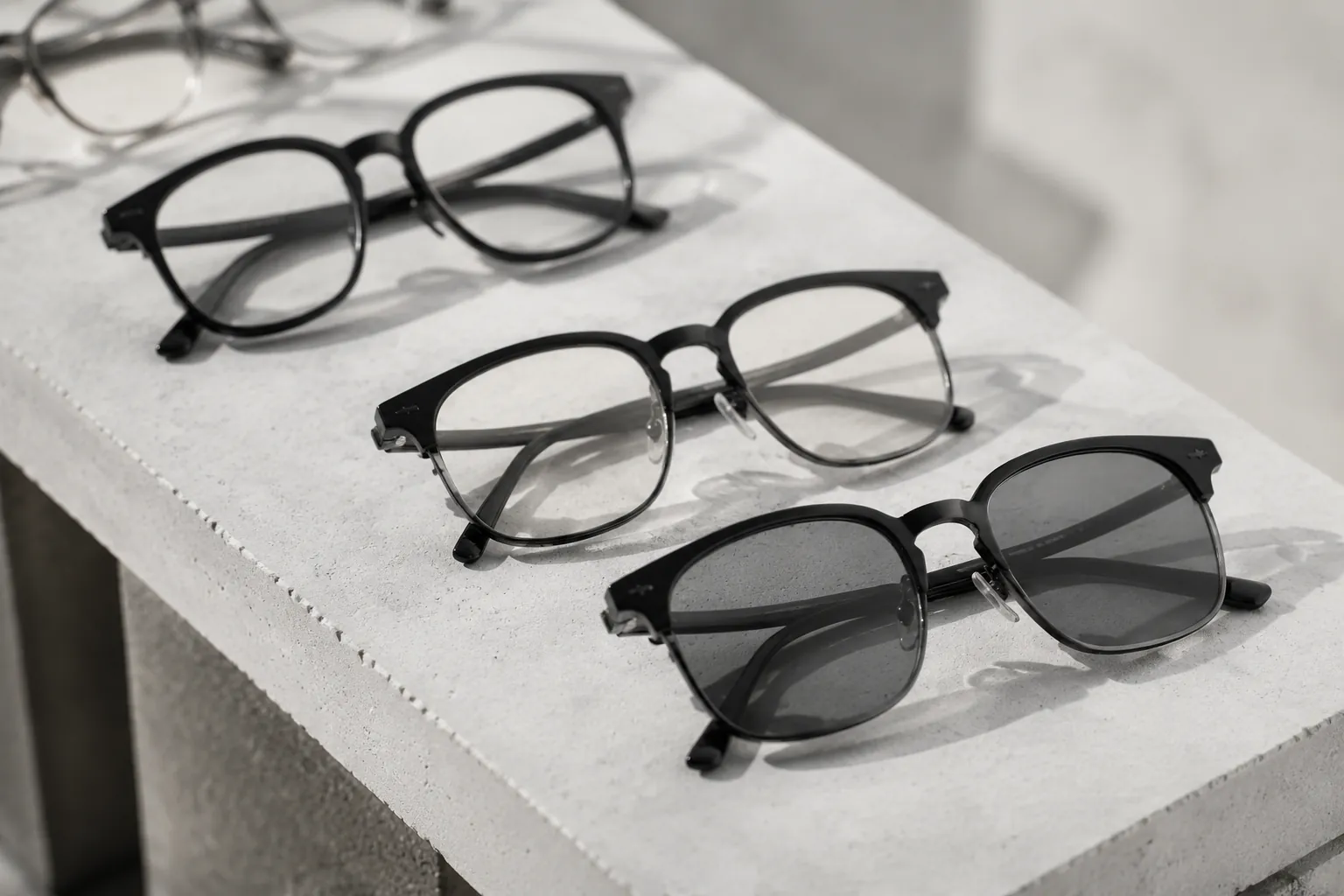
This guide is for brands, importers, distributors, and retailers buying photochromic sunglasses for private label or OEM programs. It turns a vague request like "transition sunglasses" into a factory-ready specification: lens category, VLT range, activation test, UV protection, frame fit, decoration, packaging, MOQ, price logic, and inspection checks. The point is simple. Fewer sample rounds. Fewer bad packaging claims. Fewer returns after launch.
Start with the wearing scenario
Photochromic sunglasses are not one product. A cycling shield, beach fashion frame, kids' promo style, and optical-style acetate frame all need different targets. If the brief is loose, the supplier may quote a basic grey photochromic lens and leave the hard details open.
First, define where the customer will wear the glasses. Most photochromic molecules react mainly to ultraviolet light, not visible brightness alone. So a lens may darken well outdoors in direct sun but stay fairly light inside a car because the windshield blocks much of the UV that activates the lens.
- Outdoor sports: specify impact-resistant lens material, secure grip, anti-slip nose pads, and a usable Category 1 to Category 3 range.
- Daily lifestyle sunglasses: control base tint, activated color, temple logo position, hinge feel, packaging, and batch color.
- Driving: be careful. Standard UV-activated lenses often do not darken enough inside vehicles unless the lens is designed and tested for that use.
- Optical-style frames: confirm lens curve, groove depth, lens thickness, and whether the frame can hold thicker adaptive lenses without stress marks.
- Kids and promotional lines: focus on safety, UV claims, and durability. Do not promise dramatic speed from a value-grade lens.
LumiShades manufactures custom sunglasses in Wenzhou with injection molding, acetate cutting, CNC milling, lens tinting, logo decoration, assembly, and QC under one production setup. For photochromic orders, that helps because lens curve, frame fit, color approval, and branding can be checked together.
Write the lens spec in numbers
A useful OEM spec defines both the clear or base state and the activated state. The key number is VLT: visible light transmission. Higher VLT means a lighter lens. Lower VLT means a darker lens. Sunglass categories are based on transmittance ranges, so the category must match the measured lens, not the marketing plan.
Many commercial photochromic sunglasses use a base state around Category 0 or Category 1 and an activated state around Category 2 or Category 3. The right values depend on the market, lens color, and intended use. A cycling lens may need to stay usable in shade. A beach sunglass may need a darker final state.
| Spec item | Typical OEM target | Recommended tolerance or note |
|---|---|---|
| Base VLT before UV | 45% to 80% depending on design | Agree tolerance, often ±5 VLT points for production control |
| Activated VLT after UV | 8% to 30% for many sunglass programs | Must match category labeling and destination-market rules |
| Left/right lens matching | Same category and similar shade | Keep pair difference within about 3 to 5 VLT points where feasible |
| UV protection | UV400 or required standard result | Claim only after testing the actual lens construction |
| Optical distortion | No obvious warping in wear position | Check after assembly, not only as loose lenses |
The purchase order should state lens material, lens color, base curve, thickness if relevant, coating package, frame model, compliance market, logo method, packaging claims, and approved sample number. Without those details, the factory can deliver "photochromic sunglasses" and still miss the retail expectation.
Define the activation test
Buyers often ask for lenses that darken in seconds and clear instantly. That is not a realistic bulk-production spec for normal photochromic sunglasses. Activation and fading depend on UV intensity, temperature, lens chemistry, lens thickness, coating stack, and whether the lens is loose or mounted. Cold weather often makes many photochromic lenses darken more and fade more slowly. Heat can reduce final darkness.
Set fixed test conditions. For comparison samples, record ambient temperature, UV source or outdoor condition, exposure time, and VLT at defined points. Use photos for discussion only. Do not use phone photos as the acceptance standard. Auto-exposure lies.
| Test point | What to measure | Why it matters |
|---|---|---|
| Before UV exposure | Base VLT and visual color | Confirms indoor appearance and category starting point |
| After 30 seconds UV | Early VLT drop | Shows whether customers notice a quick outdoor response |
| After 2 minutes UV | Functional darkening | Useful checkpoint for sports and daily wear |
| After 10 minutes UV | Near-final activated VLT | Confirms final darkness and category claim |
| 2, 5, and 15 minutes away from UV | Fading VLT recovery | Prevents complaints that lenses stay too dark indoors |
For production approval, keep one signed golden sample with the buyer and one with the factory. Mark the frame color, lens lot, sample date, lens category target, and logo version. This prevents a common dispute: one sample looked darker because it was tested outside on a cool sunny day, while the shipment was checked under weak indoor UV or at a different temperature.
Control tint, mirror, and decoration
Photochromic lenses have two colors to control: the base tint before activation and the activated tint after UV exposure. Grey is usually the safest commercial choice. It changes color perception less and works across many styles. Brown can improve perceived contrast but is less neutral. Green, blue, pink, and other fashion tints are possible, but batch matching gets harder, especially in mixed frame assortments.
Mirror coating adds risk. A silver, blue, red, or gold mirror over a photochromic substrate can look strong in e-commerce images, but it may hide the visible transition because the customer mainly sees surface reflection. A heavy mirror can also make slight left/right shade differences more obvious. If the selling point is visible change, start with no mirror or a lighter mirror.
Plan decoration around the lens and frame structure. Common OEM methods include pad printing on temples, laser engraving on metal or acetate, hot stamping, epoxy badges, metal logo plates, and custom temple tips. For sports frames, logos must not interfere with flex zones, rubber inserts, hinge movement, or lens installation. For acetate frames, decide whether the logo is printed, embedded, riveted, or installed as metal trim. Each method changes cost and lead time.
Lens curve also changes appearance. An 8-base wrap lens can show edge variation and reflection more clearly than a flatter 4-base lens. Approve assembled samples, not loose lens chips. Frame tension, groove mismatch, or uneven lens seating can cause stress patterns, gaps, or shade shifts after mounting.
Choose material and coatings by use case
Lens material affects cost, weight, impact behavior, coating adhesion, optical quality, and assembly yield. Most OEM photochromic sunglass projects use PC, TAC, nylon, or CR-39. None is perfect. Choose based on frame type, price point, sales channel, and compliance needs.
| Lens material | Best fit | Typical behavior | Watch-outs |
|---|---|---|---|
| PC | Sports, kids, safety-oriented value lines | Lightweight and impact resistant | Can show stress if the frame fit is too tight; hard coating quality matters |
| TAC | Value fashion and polarized programs | Thin and economical, common in mass sunglasses | Photochromic options may be limited; check edge durability and delamination risk |
| Nylon | Wrap sports lenses and premium lightweight frames | Good flexibility and optical performance on curved lenses | Higher cost; color and coating consistency need tight control |
| CR-39 | Optical-style fashion sunglasses | Good clarity and tint quality | Heavier and less impact resistant than PC; poor fit for aggressive sports frames |
List coatings separately from the photochromic function. Anti-scratch coating is common for PC and nylon. Hydrophobic or oleophobic coating helps with fingerprints and water marks but adds cost. Anti-reflective coating can improve clarity on optical-style frames, but it must work with the photochromic layer and target price.
Frame material matters too. Injection PC or TR-style frames are common for sports and promo lines. Acetate gives richer color and heavier hand-feel. Metal frames need careful screw, pad arm, rim lock, and groove control because photochromic lenses may be thicker or less forgiving than standard tinted lenses.
Separate compliance from sales claims
Photochromic activation and UV protection are related, but they are not the same claim. A lens can block UV well and still show only mild visible darkening. Another lens can darken noticeably but still need testing before UV400, category, or compliance claims go on packaging. Treat every claim as a document-backed statement. No guessing.
For regulated markets, align lens category, labeling, and warnings with the destination country. LumiShades works with eyewear compliance frameworks including CE EN ISO 12312-1, ANSI Z80.3, AS/NZS 1067, REACH, FDA registration, ISO 9001, and BSCI. The exact test plan depends on product type, material, lens category, and market.
- CE EN ISO 12312-1: relevant for non-prescription sunglasses in many European channels. Check UV transmittance, visible transmittance, filter category, and warnings.
- ANSI Z80.3: commonly used for non-prescription sunglasses in the United States. It covers optical and transmittance requirements.
- AS/NZS 1067: important for Australia and New Zealand, especially category marking and driving-use warnings.
- REACH: relevant to restricted substances in frame plastics, coatings, colorants, plating, and packaging components for EU buyers.
- FDA registration: relevant for U.S. eyewear import programs, but it does not replace product-level testing.
Be careful with driving claims. If the lens does not darken behind a windshield, customers will notice fast. If the product is not suitable for night driving, twilight use, or specific conditions, state that in the instructions and packaging.
Understand MOQ, price, and lead time
Photochromic lenses cost more than standard tinted lenses. Functional material, coating control, and batch testing all add cost. Final unit price depends on lens material, curve, activation performance, coating package, frame material, logo method, packaging, inspection level, and order quantity.
At LumiShades, MOQ starts at 50 pairs per design. That can work for a distributor test, boutique launch, influencer drop, or early market validation. Pricing improves at 300, 1000, and 5000+ pairs because lens purchasing, frame production, packaging printing, and QC setup are spread across more units. High-volume simple programs can reach about $2.10 per pair depending on the actual specification. Do not treat that as a universal photochromic price. A nylon shield with mirror, hard coating, custom rubber parts, and retail box will not price like a basic injected frame with a grey adaptive lens.
| Order stage | Quantity | Commercial logic | Typical timing |
|---|---|---|---|
| Concept sample | 1 to 3 styles | Confirm frame fit, color direction, activation behavior, logo position, and packaging concept | Usually 7 to 10 days |
| Small market test | 50 to 299 pairs per design | Higher unit cost but low inventory risk; useful before tooling or large packaging runs | Commonly 25 to 35 days after approval |
| Retail launch | 300 to 999 pairs per design | Better component purchasing and more stable production planning | About 25 to 35 days if materials are confirmed |
| Volume program | 1000 to 5000+ pairs per design | Best unit price structure; stronger batch records and AQL inspection recommended | Depends on lens lot, decoration load, and packaging volume |
The hidden delay is usually approval, not assembly. Buyers lose time when they change lens color after packaging artwork is finished or approve a frame color before checking the activated lens in that frame. Use this order: freeze lens spec, approve assembled sample, confirm compliance wording, approve artwork, then release bulk.
Run QC before shipment
Photochromic sunglasses need more than a cosmetic inspection. The lens is a functional part. The QC plan must cover VLT behavior, UV protection, lens pairing, mounting quality, coating condition, decoration, and packaging claims. Inspect before balance payment and before cargo leaves Wenzhou, not after goods reach the buyer's warehouse.
- Confirm signed reference samples: keep one buyer sample and one factory sample with date, lens lot, frame color, and logo version.
- Measure base and activated VLT: compare against the agreed range and tolerance, not against photos.
- Check left/right matching: expose both lenses equally and reject obvious shade mismatch.
- Verify UV protection: make sure UV400 or other claims match test data for the actual lens construction.
- Inspect lens fit: no rattling, edge chips, visible gaps, over-tight frame stress, or pressure marks.
- Check coatings: look for mirror pinholes, hard-coat scratches, haze, peeling, stains, or uneven color.
- Review decoration: pad print, laser engraving, metal logo plates, and temple marks must be aligned and durable.
- Audit packaging claims: category, UV, driving warnings, material statements, barcode, country label, and instruction sheet must match the approved product.
- Run AQL inspection: use a sampling plan suitable for order size and channel risk, with functional lens checks included as critical or major defects.
LumiShades reports 98.5% on-time delivery and manufactures over 5 million pairs per year, but buyers should still reserve time for pre-shipment inspection. The rule is blunt: if the photochromic effect is why the customer buys the product, measure it.
Have a custom sunglasses project in mind?
Send us your styles, target market and quantities and we will return a detailed quote with MOQ, lead time and a sample plan.
Get a QuoteWhy source this from Wenzhou with LumiShades
Wenzhou in Zhejiang Province is widely regarded as China’s eyewear manufacturing capital, producing a large share of the world’s sunglasses. That concentration matters to buyers: a deep local supply chain for acetate sheet, hinges, lens blanks, plating and packaging means shorter component lead times, easier color and material matching, and a workforce with decades of eyewear-specific skill. LumiShades has manufactured in this ecosystem since 2009, and our vertical integration — in-house injection molding, acetate cutting, CNC milling, lens tinting, decoration and quality control — means no part of your order is quietly subcontracted to a workshop you cannot audit.
For international buyers, that vertical control translates into accountability. When a single factory owns every step, defects are traced and fixed at source rather than bounced between vendors, and your specifications survive intact from first sample to bulk. We back this with 15+ years of experience, shipments to 60+ countries, more than 5 million pairs produced per year and a 98.5% on-time delivery rate. Our certifications — CE EN ISO 12312-1, FDA registration, ANSI Z80.3, AS/NZS 1067, REACH, ISO 9001 and BSCI audit — mean the compliance documentation your market requires already exists. Explore our manufacturing capabilities and quality control process to see how this works in practice.
Frequently asked questions
Can photochromic sunglasses replace regular dark sunglasses? Sometimes. They work well in changing outdoor light, but a fixed Category 3 sunglass lens may still be better for strong beach sun, snow glare, or customers who want constant darkness.
Will photochromic lenses darken inside a car? Standard UV-activated lenses often darken only mildly inside a car because windshields block much of the UV. Do not make strong driving-darkening claims unless that exact lens has been tested for that use.
What VLT range should I specify for OEM photochromic sunglasses? Many programs use a base state around 45% to 80% VLT and an activated state around 8% to 30% VLT. The right range depends on lens color, category label, market rules, and intended use.
What MOQ should I use for a first OEM photochromic order? Start with 50 pairs per design if you are validating the concept. Move to 300 or 1000 pairs once the lens color, frame fit, packaging, and compliance labeling are approved.
How long do samples and bulk production usually take? At LumiShades, samples are typically 7 to 10 days. Bulk production is usually 25 to 35 days after final approval, depending on lens material, decoration, packaging, and order size.
Which certifications should I ask for? Match the destination market. Common frameworks include CE EN ISO 12312-1, ANSI Z80.3, AS/NZS 1067, REACH, and FDA registration for U.S. programs. Ask for documents tied to the actual product type and lens category.
What is the most common mistake in photochromic sunglass sourcing? Approving appearance without measuring VLT and UV performance. Photos are not enough. Set base tint, activated tint, test conditions, tolerances, and labeling rules before mass production.
Ready to start?
Explore our square sunglasses or request a quote — our sales team replies within 12 hours.
Request a Quote