
Mirror Lens Sunglasses Bulk Coating Control Guide
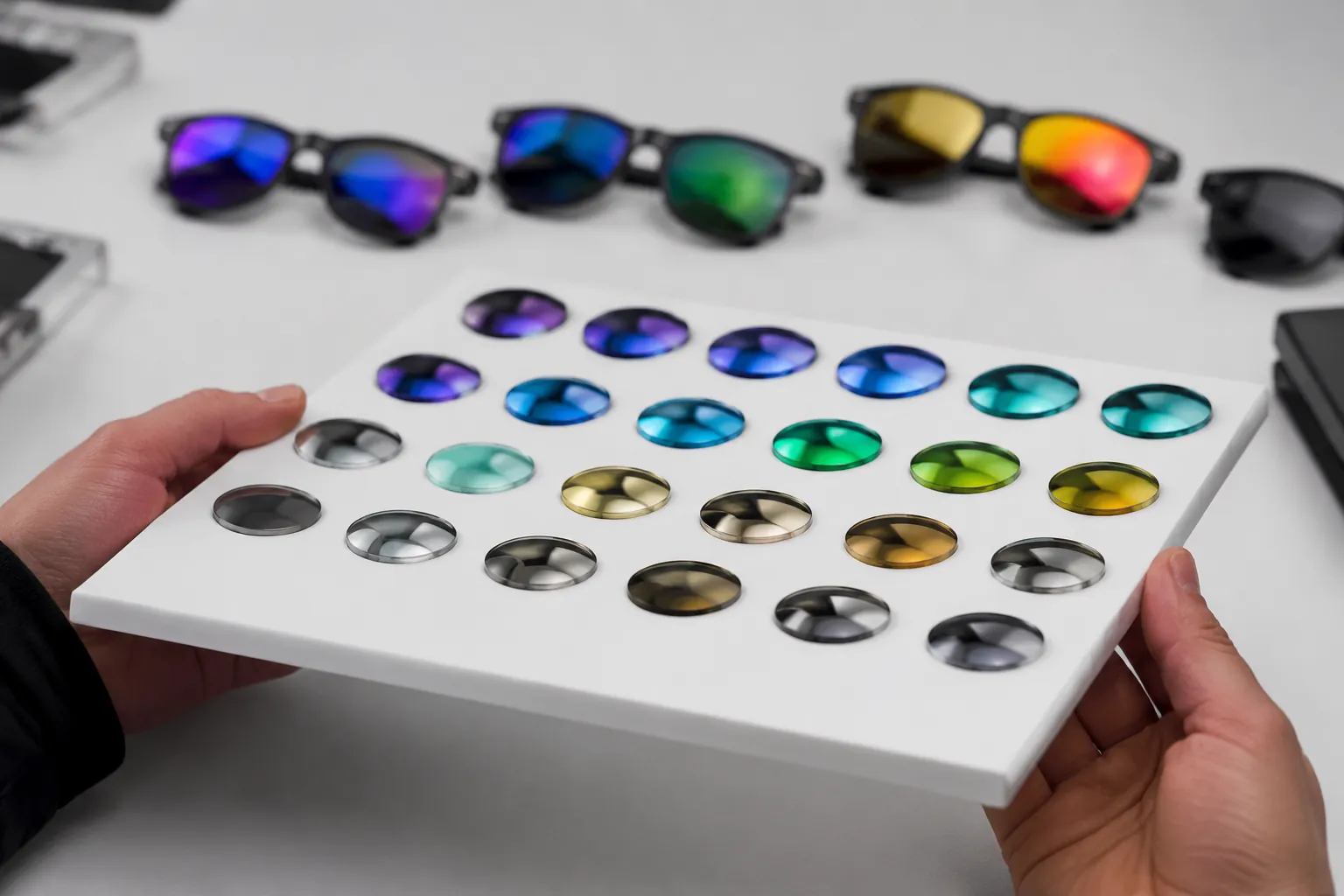
This guide is for brands, importers, distributors, and retailers sourcing mirror lens sunglasses in volume. Mirror lenses can make a basic frame more saleable, but they also add production risk: color drift, weak adhesion, visible scratches, left-right mismatch, and failed lens claims. The job is to lock the lens substrate, approved color, compliance route, MOQ plan, and inspection rules before bulk production starts. A glossy sample is not enough. Buyers need a repeatable coating process that survives cutting, assembly, cleaning, packing, and retail handling.
The buyer problem: mirror lenses fail differently
Mirror lens sunglasses add another visible variable on top of frame material, lens curve, tint, optical quality, logo decoration, and packing. The reflective layer is thin. It shows everything. A small scratch on a smoke lens may be hard to spot at retail distance. The same scratch on a silver mirror lens can be the first thing a customer sees.
For bulk orders, the real question is not whether a factory can make one blue, gold, or silver mirror sample. Most experienced eyewear suppliers can. The real question is whether the factory can repeat the mirror shade across a full order while keeping visible light transmission, UV protection, impact performance, labeling, and cosmetic criteria aligned with the destination market.
One process sheet should control the whole program: frame SKU, lens material, lens base tint, mirror coating color, target lens category, logo method, packing method, carton marking, and final inspection standard. Do not approve a mirror color photo and call it done. That is how sourcing problems start.
MOQ and price logic matter too. Small trial orders help validate the look, fit, and retail response. Larger orders usually lower unit cost because setup, decoration, QC, and packing labor are spread across more units. The exact price break depends on frame material, lens type, coating, logo, packaging, and order complexity. Ask for a written quotation tied to the approved specification. Do not buy from a generic unit price.
Select the mirror system before approving the color name
Buyers often ask for "blue mirror," "green mirror," or "gold mirror." Those are not specifications. Final appearance depends on four variables: lens material, base tint, mirror coating stack, and lens curve. A blue mirror on smoke grey does not look the same as blue mirror on brown. A high-wrap sports lens reflects differently from a flatter fashion lens. A translucent frame can also change how the lens reads on the face.
| Mirror option | Typical base tint | Common VLT target | Main sourcing risk | Best buyer control |
|---|---|---|---|---|
| Silver mirror | Smoke grey or G15-style green | Varies by design and destination standard | Shows scratches, fingerprints, and coating dots easily | Define front-surface scratch limits and protective packing film |
| Blue mirror | Smoke grey, brown, or grey gradient | Varies by design and destination standard | Batch-to-batch color drift is obvious | Approve signed physical master lenses, not screen images |
| Green mirror | Grey, brown, or G15-style green | Varies by design and destination standard | Can look yellow or too dark if base tint shifts | Lock base tint and VLT tolerance before coating |
| Gold mirror | Brown, amber, or smoke | Varies by design and destination standard | Fingerprints and uneven coating are more visible | Use stricter cosmetic inspection on the front surface |
| Red/orange mirror | Grey, brown, or rose base | Varies by design and destination standard | Left-right mismatch stands out at retail distance | Inspect assembled pairs under consistent lighting |
For repeat programs, require a physical master sample made with the final lens curve, final frame color, and final base tint. Keep one signed master sample at your office and one at the factory. The master should be a complete pair, not loose lenses. Frame color, rim thickness, and wrap angle all affect perceived mirror color. A practical acceptance note helps: no obvious left-right color difference at normal handling distance under the agreed QC lighting when compared with the signed master sample.
Material choice changes coating behavior and QC risk
Lens material affects adhesion, cutting behavior, impact performance, weight, and cost. Do not treat PC, TAC, nylon, acrylic, and CR39 as interchangeable just because all can carry a mirror finish. They behave differently during tinting, coating, edging, and assembly.
| Lens material | Typical use | Mirror coating behavior | Buyer note |
|---|---|---|---|
| PC | Sport, kids, promotional, impact-focused sunglasses | Good impact resistance, but surface must be well cleaned before coating | Useful for durable mass-market styles; confirm scratch-resistant coating if needed |
| TAC polarized | Polarized fashion and driving sunglasses | Mirror layer must not create visible waves or interfere with finished lens performance | Check polarization orientation, delamination risk, and VLT after mirror coating |
| Nylon | Premium sport and shield lenses | Good optical quality and flexibility; coating process must match the lens curve | Better for high-wrap designs but usually costs more than basic PC |
| Acrylic | Low-cost fashion and promotional items | Can look good but has weaker impact and scratch performance | Use only where the destination standard and customer expectation allow it |
| CR39 | Optical-style fashion sunglasses | Good clarity, heavier, less flexible than PC or nylon | Confirm impact requirements and frame fit before bulk |
Base tint matters just as much as material. A Category 3 sunglass lens is commonly used for brighter outdoor conditions, but the final classification must be verified against the applicable standard and the finished lens, not assumed from the base lens alone. Mirror coating can change visible light transmission. Test the completed lens. If the marking says one thing and the finished lens measures another, the product file is wrong.
Adhesion risk starts at the edge
Mirror coating failures often start at weak points: lens edges, bevels, drilled holes, shield-lens slots, and areas touched during assembly. The center of the lens may pass visual inspection while the edge is already vulnerable. That is why coating control must be connected to lens cutting, edge finishing, and frame assembly, not treated as a separate decorative step.
A practical production flow is: lens substrate inspection, tint or base color confirmation, approved surface cleaning, mirror coating, curing or stabilization, lens cutting, edge polishing or beveling, assembly, final cleaning, and packing. Problems enter when any step is uncontrolled. Dirty gloves leave marks. A sharp cut edge chips the coating. A frame groove that is too tight scrapes the lens during insertion. Excess pressure during lens fitting can create peeling near the rim.
For bulk orders, ask the supplier how adhesion is checked before full assembly. A practical control is a tape adhesion check or another agreed adhesion test on coated sample lenses, combined with an abrasion or rub check suitable for normal sunglass handling. The exact method, tape type, rubbing cloth, number of cycles, and pass/fail language should be written into the purchase specification. "Good quality" is not a QC standard.
- Edge chipping: inspect cut lenses after assembly, especially on tight TR90, PC, metal, or shield frames.
- Peeling: run adhesion checks before bulk assembly, not after cartons are packed.
- Cleaning marks: confirm approved microfiber cloth and cleaning liquid for QC and packing staff.
- Left-right color mismatch: inspect lenses as assembled pairs, not only as loose lenses.
- Pinholes or coating dots: define maximum size, quantity, and allowed zone before production.
- Pressure marks: check rimless, semi-rimless, and shield styles around screws, clips, and holes.
A disciplined supplier should be able to show where mirror coating is protected from contamination, heat, cutting stress, and assembly pressure. If that control point is unclear, the program is at risk even if the first sample looks good.
Write a mirror lens specification production can follow
A useful mirror lens specification is short, measurable, and tied to the approved sample. It should tell production what to buy, what to make, what to test, and what to reject. It should not read like a mood board.
- Lens material: state PC, TAC polarized, nylon, acrylic, CR39, or another approved material. Do not mix materials inside one SKU unless the buyer signs off.
- Lens base tint: define smoke, brown, G15-style green, amber, rose, clear, gradient, or custom tint by physical sample.
- Mirror color: name the color and link it to the signed master sample and frame SKU.
- VLT and category: confirm the visible light transmission target and any agreed tolerance. The finished lens should be tested, not the uncoated base lens.
- UV claim: state UV400, 100% UVA/UVB, or the specific claim supported by testing.
- Optical and safety standard: specify CE EN ISO 12312-1, ANSI Z80.3, AS/NZS 1067, or another required standard based on destination.
- Surface acceptance: define scratches, pinholes, coating spots, edge chips, bubbles, haze, and left-right color mismatch.
- Packing protection: confirm lens film, pouch, polybag, tissue, hangtag, barcode, inner box, and carton layout.
For cosmetic tolerance, use practical viewing conditions. A common rule is no visible front-surface scratch at normal handling distance under standard QC lighting, no mirror peeling after the agreed adhesion check, no obvious left-right color difference when mounted in the frame, and no coating defect in the central viewing zone. If tiny marks are allowed outside the main viewing area, define the maximum size and quantity in writing.
If you change the base tint, lens curve, frame color, or coating supplier after sample approval, treat it as a new approval. Mirror color is a system result, not a paint code.
Compliance still applies to mirror lenses
Mirror finish is cosmetic and functional, but it does not replace sunglass compliance. Finished sunglasses still need to meet the destination market's requirements for transmittance, UV protection, optical quality, impact expectations, labeling, and restricted substances where applicable.
Buyers should match documents to the sales market. Do not request certificates because they sound impressive. Request the files your customer, customs broker, retailer, or marketplace actually needs. Common frameworks in sunglasses sourcing include CE EN ISO 12312-1, ANSI Z80.3, AS/NZS 1067, REACH, FDA registration, ISO 9001, and BSCI.
| Market or file need | Relevant control | Buyer action before production |
|---|---|---|
| European Union | CE EN ISO 12312-1 and REACH considerations | Confirm lens category, UV claim, CE marking, user information, and restricted substance requirements |
| United States | FDA registration and ANSI Z80.3 often requested by importers | Align product file, labeling, impact expectations, and optical requirements before PO release |
| Australia/New Zealand | AS/NZS 1067 | Confirm category marking and transmittance before bulk packing |
| Retail vendor approval | BSCI, ISO 9001, factory audit files | Request current documents early, not during final shipment booking |
One point matters most: a beautiful mirror sample that fails VLT, UV, labeling, or category requirements is not shipment-ready. Approve appearance and compliance together. If the mirror layer makes the lens too dark, too light, or inconsistent with the product marking, the color approval is irrelevant.
Sampling, MOQ, decoration, and lead-time controls
Mirror lenses need a disciplined sample stage. A typical program should allow enough time to review appearance, fit, compliance alignment, and decoration before bulk release. The exact lead time depends on order size, material availability, coating process, logo method, and packaging complexity, so confirm dates in writing with the supplier.
A complete sample request should include frame model, frame material, lens material, base tint, mirror color, polarization requirement if any, logo method, packaging, destination market, and target order quantity. If the buyer says "send three mirror colors," that is fine for early screening. For production approval, the sample must be exact.
MOQ logic should match commercial risk. A 50-pair test order is useful for retail photography, distributor feedback, pop-up stores, or influencer campaigns. At 300 pairs, buyers can usually justify more controlled decoration setup and more efficient packing. At 1,000 pairs, the bill of materials, master sample, artwork, and QC standard should be frozen before deposit. At 5,000+ pairs, confirm color consistency by production batch and keep retain samples from the first run.
Decoration methods also affect handling risk. Laser engraving is clean and durable but must be positioned so it does not weaken thin temple areas. Pad printing works well for logos on temples and lenses, but ink adhesion and rub resistance should be checked. Metal logo plates create a premium look but need accurate placement and secure fixing. Heat transfer, foil stamping, or printed pouches can add retail value, but they also add lead time and more approval points.
- Day 1-2: confirm spec sheet, artwork, lens target, compliance market, and packaging file.
- Day 3-7: prepare frame and lens samples, including mirror coating and decoration.
- Day 7-10: review sample, request revision if needed, and sign the master sample.
- Bulk day 1-10: material preparation, molding or acetate cutting, lens tinting, coating, and logo setup.
- Bulk day 11-25: assembly, in-line QC, decoration, cleaning, and packing preparation.
- Bulk day 25-35: final inspection, carton marking, document check, and shipment handover.
If your launch date is fixed, build in time for at least one mirror color revision. Blue, gold, and red/orange mirrors often need adjustment after the first sample because screen images and physical retail appearance rarely match perfectly.
Inspection criteria that prevent shipment disputes
The final inspection plan should separate defects by severity. This protects both sides: the buyer avoids unsellable goods, and the factory avoids subjective rejection based on taste after production is finished.
Critical defects include safety and compliance failures: wrong lens category, failed required impact or optical test, sharp edges, incorrect warning label, missing required marking, or lens material different from the approved specification. Major defects include obvious coating peeling, strong left-right color mismatch, visible front-surface scratches, loose lens, crooked temple, missing logo, wrong barcode, wrong pouch, or mixed SKU packing. Minor defects may include small cosmetic marks outside the main viewing zone if they do not affect saleability under the agreed standard.
Inspection lighting matters because mirror lenses change under warm, cool, and outdoor light. Agree on practical conditions: indoor QC light, comparison against the signed master sample, and inspection at a defined distance. For paired lenses, inspect the assembled pair in the frame. Loose lens inspection alone misses many retail-visible problems.
Practical rule: if a consumer can see the mirror defect at normal handling distance before trying on the sunglasses, treat it as at least a major defect unless that defect zone and size were allowed in writing.
For shipment control, request pre-production samples, in-line photos or video for large orders, and final random inspection before balance payment. Clear inspection rules matter more than vague expectations. A good factory can work to a written standard. It cannot reliably work to subjective preferences discovered after packing.
The safest ordering path is staged: start with 50 pairs for testing, move to 300 pairs when the frame-lens combination is proven, and scale to 1,000 or 5,000+ pairs after the master sample, compliance route, packing method, and AQL criteria are fixed. Do not buy mirror sunglasses by color name alone. Buy them by controlled specification, approved physical sample, documented compliance target, and written inspection standard.
Have a custom sunglasses project in mind?
Send us your styles, target market and quantities and we will return a detailed quote with MOQ, lead time and a sample plan.
Get a QuoteWhy source this from Wenzhou with LumiShades
Wenzhou in Zhejiang Province is widely regarded as China’s eyewear manufacturing capital, producing a large share of the world’s sunglasses. That concentration matters to buyers: a deep local supply chain for acetate sheet, hinges, lens blanks, plating and packaging means shorter component lead times, easier color and material matching, and a workforce with decades of eyewear-specific skill. LumiShades has manufactured in this ecosystem since 2009, and our vertical integration — in-house injection molding, acetate cutting, CNC milling, lens tinting, decoration and quality control — means no part of your order is quietly subcontracted to a workshop you cannot audit.
For international buyers, that vertical control translates into accountability. When a single factory owns every step, defects are traced and fixed at source rather than bounced between vendors, and your specifications survive intact from first sample to bulk. We back this with 15+ years of experience, shipments to 60+ countries, more than 5 million pairs produced per year and a 98.5% on-time delivery rate. Our certifications — CE EN ISO 12312-1, FDA registration, ANSI Z80.3, AS/NZS 1067, REACH, ISO 9001 and BSCI audit — mean the compliance documentation your market requires already exists. Explore our manufacturing capabilities and quality control process to see how this works in practice.
Frequently asked questions
Can I approve mirror lens color from photos or video? Use photos and video only for early screening. For production approval, require a physical master sample made with the final frame, lens material, base tint, mirror coating, and lens curve. Keep one retained sample at the buyer's side and one at the factory.
What MOQ makes sense for a new mirror sunglasses design? A practical starting point is a small test order, such as 50 pairs, if the goal is to validate fit, appearance, and market response. If the design performs well, buyers often move to larger runs such as 300, 1,000, or 5,000+ pairs once the master sample, packing, and QC rules are fixed.
How long do mirrored sunglasses samples and bulk orders take? Lead time depends on the frame, lens material, coating, decoration, and packaging. Ask the supplier for a written sample timeline and a written bulk timeline before paying the deposit. Do not rely on a generic estimate if the order includes custom mirror color, polarization, or complex decoration.
Which compliance documents should I request for mirror lens sunglasses? Match the request to the sales market and the actual product. Common frameworks include CE EN ISO 12312-1 and REACH for the EU, FDA registration and ANSI Z80.3 for the US, and AS/NZS 1067 for Australia/New Zealand. Retailers or import programs may also ask for ISO 9001 and BSCI files if the factory has them.
What are the most common mirror coating defects in bulk orders? Common defects include edge chipping, peeling, front-surface scratches, coating dots, pinholes, pressure marks, and left-right color mismatch. Before production, define where the defect is allowed, how large it can be, how many are acceptable per lens, and how it will be inspected.
Does a darker mirror lens always mean stronger UV protection? No. Lens darkness and mirror appearance do not prove UV protection. UV performance and visible light transmission must be tested on the finished lens against the required standard and product category. Always ask for test results tied to the exact finished lens, not a base lens or a color name.
Ready to start?
Explore our round sunglasses or request a quote — our sales team replies within 12 hours.
Request a Quote