
Mirror Sunglass Lenses: Spec, MOQ, and Reorder Control
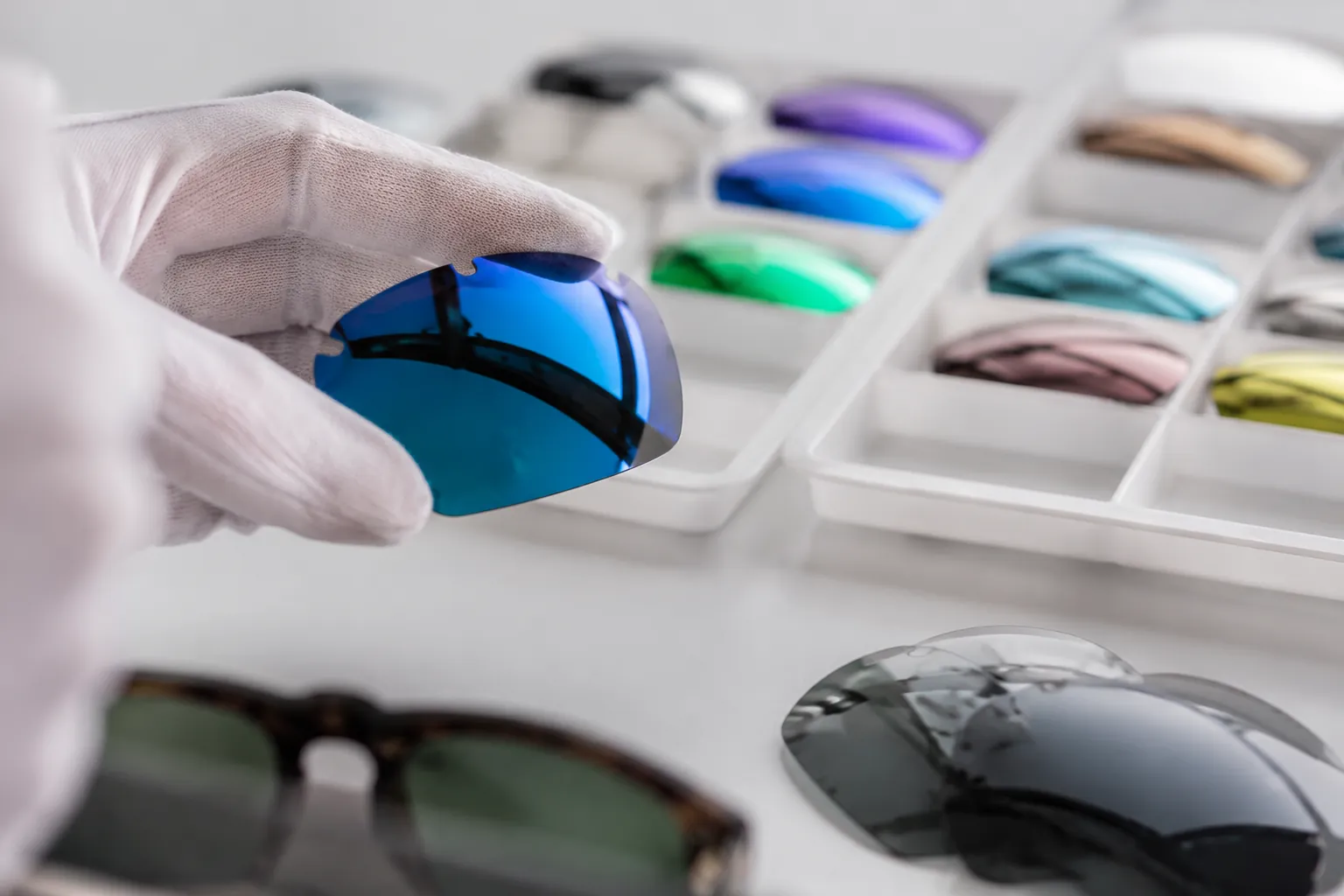
This guide is for brands, importers, distributors, and retail buyers ordering mirror-coated sunglasses in volume. It explains how to specify mirror color, lens material, coating durability, compliance targets, decoration, MOQ, lead time, and reorder controls before production starts. The aim is simple: fewer color disputes, fewer coating complaints, cleaner approvals, and less repeat-order drift between buyer, factory, testing lab, and retail channel.
Mirror Is Not Just a Color
A mirror sunglass lens is not defined by a color name. The final look comes from lens material, base tint, mirror coating color, coating density, lens curve, surface protection, and inspection light. Leave those details out, and the factory may match the general look but miss the retail target.
A blue mirror over a smoke-gray base usually looks cooler and more neutral than the same blue mirror over brown. Gold over brown can look warm and premium. Gold over green may shift toward olive. Curve changes the result too. A flatter 6-base lens and a wrapped 8-base lens can show different edge tone because the coating reflects light at different angles. The product photo may look fine. The wearer may see something else. The tested visible light transmission, or VLT, may also land in a different category.
For B2B orders, the buying spec should include lens material, base tint, mirror color family, target VLT or filter category, coating grade, frame model, lens curve, approved physical sample, and target market standard. In Europe, sunglass filter categories under EN ISO 12312-1 are based on visible light transmission ranges. Category 3 is common for strong sunlight. Category 2 is used for medium sunlight. Category 4 is for very high glare environments and is not suitable for driving.
Mirror lens planning should be coordinated with frame production because tinting, coating, edging, printing, assembly, packaging, and QC all affect timing. A practical sampling window is often 7-10 days after lens color and frame details are confirmed. Bulk production is often planned at 25-35 days after approved sample, deposit, and final packaging files. Timing still depends on order complexity, material availability, and factory schedule. MOQ may start at 50 pairs per design for selected programs, but repeatability is easier when the coating run is not fragmented.
Blunt rule: do not approve a mirror lens from a render alone. Approve a physical lens chip or finished sample under daylight, neutral white retail lighting, and the lighting used for product photography.
Mirror Color Options and What Buyers Receive
Most buyers describe mirror lenses as silver, blue, gold, green, red, orange, or rainbow. That helps with range planning. It is not enough for production. A usable factory spec defines the lens material, base tint, mirror color, target filter category or VLT range, and approved control sample. For a repeat SKU, it should also state whether the same coating route and lens supplier must be used on reorder.
| Mirror option | Common base tint | Typical VLT target | Best retail use | Main sourcing risk |
|---|---|---|---|---|
| Silver mirror | Smoke gray | Often specified around category 3 for sun use | Sport, unisex, corporate, clean retail ranges | Shows fingerprints, pouch marks, and fine scratches quickly |
| Blue mirror | Gray or brown | Often specified around category 2 or 3 depending on channel | Beach, resort, youth, outdoor lifestyle | Shifts strongly with base tint, lens curve, and coating density |
| Gold mirror | Brown, amber, or green | Often specified around category 2 or 3 depending on base tint | Fashion, premium casual, driving-style frames | Batch tone can move from champagne gold to orange gold |
| Green mirror | Gray, G15-style green, or brown | Often specified around category 3 for outdoor use | Outdoor, fishing, classic sport, travel retail | Needs tight master-sample control on later reorders |
| Red or orange mirror | Gray or amber | Often specified around category 2 or 3 depending on product claim | Cycling, festival, youth, promotional programs | Higher complaint risk if the lens becomes too dark, too warm, or visually harsh |
| Rainbow mirror | Usually gray | Often specified around category 2 or 3 depending on coating density | High-impact fashion, kids, novelty, events | Least consistent across curved lenses and small coating batches |
For private-label programs, silver, blue, and green are usually safer repeat colors because they are easier to define against a physical master sample. Red, orange, gold, and rainbow can work well, but they need stricter approval. Small tone shifts are easier to notice. Avoid vague names such as ice blue, fire red, or sunset gold unless each name is tied to a retained physical sample, target VLT or filter category, and written tolerance.
Lens Material, Coating Route, and Decoration
Mirror performance starts with the lens material. PC lenses are common for fashion, sport, and promotional sunglasses because they are light and impact resistant. TAC polarized lenses are used for glare reduction. They need careful lamination, edging, tint matching, and coating control. Acrylic lenses can support cost-driven programs, but they are usually weaker for retail channels with higher durability expectations. Nylon and other higher-performance materials may suit sport programs where flexibility, optical stability, and impact behavior matter more than the lowest unit cost.
The coating route matters. Mirror layers are commonly applied by vacuum coating or similar controlled deposition processes after base tinting and cleaning. A basic promotional coating may focus on appearance and price. A retail coating should be specified for stronger adhesion, more consistent color, and better resistance to normal handling. Higher-spec programs may request a hard coat, hydrophobic top coat, or oleophobic treatment. Do not add processes blindly. Confirm compatibility with the lens material, tint, and compliance target.
A typical route is lens molding or cutting, base tinting, cleaning, mirror coating, optional protective top coat, curing, edging, drilling or grooving where required, logo application if approved, assembly, and final QC. Contamination during cleaning can create pinholes or stains. Weak curing can increase rub-off risk. Aggressive edging can chip the coating at the lens edge, especially on rimless, semi-rimless, and high-wrap sport frames.
Decoration should be specified with the lens, not after it. Frame logos may use pad printing, silk-screen printing, heat transfer, metal plaques, laser engraving, or injected color details depending on frame material and order size. Lens logos are more sensitive because they must not interfere with the wearer's field of view or required markings. On mirror lenses, bright lens marks and reflective coating can fight each other visually. Many retail programs keep lens logos small and place them near the upper corner outside the main sight line.
Durability Risks to Test Before Bulk
Mirror coating complaints usually trace back to early decisions: coating grade, lens edge design, pouch material, cleaning instructions, packing method, and inspection standard. Check these during sample approval. Not after cartons arrive.
The first common failure is fine scratching. Silver mirror and dark base lenses often show scratches quickly because surface contrast is high. A rough pouch, dusty polybag, or abrasive cleaning cloth can mark the lens before the consumer sees it. The second failure is edge flaking, especially on rimless and semi-rimless styles where the coated edge is exposed. The third is chemical damage from sunscreen, sweat, perfume, alcohol wipes, or harsh retail cleaning sprays.
Before approving bulk, ask for repeatable checks on the approved sample lot. They do not need to be complex. They do need to be consistent and recorded in the QC file.
- Visual check: inspect lenses under daylight and neutral white LED light for pinholes, haze, stains, scratches, and uneven mirror tone.
- Rub check: rub with a clean microfiber cloth for an agreed number of strokes using moderate pressure, then compare gloss and visible marks against the control sample.
- Edge check: inspect coated edges after insertion, especially on curved lenses, rimless frames, semi-rimless frames, drilled lenses, and sport wraps.
- Chemical check: wipe one sample with water only and one with the cleaner recommended for retail use; do not use alcohol unless the coating has been approved for it.
- Packing check: pack a finished pair in the final pouch, polybag, inner box, and carton, then recheck the lens surface after courier shipment or vibration handling.
For larger orders, define acceptable defects in the QC plan. AQL inspection can support shipment inspection, but mirror lenses also need a visual standard. A tiny edge speck is not the same risk as a pinhole in the wearer's sight line. For retail programs, define a stricter center-zone standard and a separate edge-zone standard before production starts.
Specification Fields That Stop Reorder Drift
Reorder drift is a common hidden cost in mirror sunglasses. The first shipment looks right. The later reorder is slightly greener, brighter, darker, warmer, or more transparent. Sometimes the factory changed a material or process. Often the original spec was too vague to prove what changed.
A proper lens spec should be attached to the frame spec, not buried in email. Include lens material, thickness range, base curve, base tint, mirror color, target VLT or filter category, coating grade, logo or lens mark requirements, compliance target, approved sample date, retained sample location, and acceptable shade tolerance. If the frame uses PC lenses, state PC. If it uses TAC polarized lenses, state TAC polarized. Do not allow quiet substitution. Material changes can affect appearance, impact behavior, polarization, VLT, labeling, and test results.
For color control, match the approved golden sample under daylight and neutral white LED light, with VLT held within an agreed tolerance confirmed by testing or supplier measurement. Set the tolerance before bulk production. Match it to retail risk. A short fashion drop may accept wider shade variation than a chain-store replenishment SKU. Physical master samples are more reliable than photos because camera exposure, white balance, screen settings, and retouching can distort mirror color.
If retained samples are required, write that into the order file. One sample should stay with the buyer and one with the factory. Bulk QC should compare production against that reference before packing. On reorders, the factory should confirm the same lens material, base tint, coating route, curve, and VLT target before production. For important replenishment orders, or orders delayed by more than one selling season, approve one pre-production pair before releasing bulk.
- Write the base tint: smoke gray, brown, G15-style green, amber, clear fashion tint, or another approved tint.
- Write the mirror target: silver, blue, gold, green, red, orange, or rainbow, tied to a retained physical sample.
- Write the lens material: PC, TAC polarized, acrylic, nylon, or another approved material with thickness range.
- Write the compliance market: CE EN ISO 12312-1, ANSI Z80.3, AS/NZS 1067, REACH, FDA registration where relevant, or another required target.
- Write the reorder rule: match approved sample, same material, same base tint, same coating route, same curve, and same VLT target unless buyer approves a change in writing.
MOQ, Price, and Lead-Time Logic
Mirror lenses add cost through coating setup, coating material, handling, yield loss, inspection time, and packaging control. The reflective layer is only part of the price. Every touch after coating is more sensitive because fingerprints, dust, scratches, and edge chips are easier to see.
MOQ may start from 50 pairs per design for selected mirror sunglass programs, depending on frame availability, lens color, coating route, decoration, and packaging. At low MOQ, common mirror colors are safer because custom coating runs are less efficient and shade variation is harder to absorb. At higher quantities, coating batch control, inspection planning, and packing efficiency are easier to manage. For large repeat programs, plan pre-production samples, retained samples, carton packing, compliance documents, and capacity windows earlier.
| Order level | Best use | Price logic | Mirror planning note | Typical timing |
|---|---|---|---|---|
| 50 pairs/design | Market test, boutique launch, buyer presentation | Higher unit cost because setup, handling, and waste are spread over fewer units | Use common silver, blue, or green mirror to reduce shade and waste risk | Sample commonly 7-10 days; bulk often planned around 25-35 days after approval |
| 300 pairs/design | Small retail run or distributor trial | Better labor and coating efficiency than very small runs | Good point to lock golden sample, lens spec, and final pouch material | Bulk timing depends on approved sample, deposit, packaging files, and factory schedule |
| 1000 pairs/design | Seasonal SKU or regional retail program | Frame setup, decoration, QC, and packing costs are spread more efficiently | Confirm VLT target, logo method, carton packing, and compliance documents before deposit | Plan decoration and lens QC together within the production schedule |
| 5000+ pairs/design | Importer stock, chain retail, repeat program | Better negotiation range, but final price still depends on frame, lens, coating, packaging, testing, and QC requirements | Request pre-production samples, retained samples, and capacity reservation | Confirm production slot early, especially before peak season |
Do not save cost by approving a fragile mirror coating for a retailer with easy returns or strict chargeback rules. A small unit-price saving can turn into replacement pairs, repacking labor, freight cost, failed inspections, and damaged account trust. The real question is whether the coating grade, lens material, packaging, and compliance plan match the sales channel and warranty expectation.
Compliance: Mirror Color Cannot Break the Standard
Mirror coating changes how much light passes through the lens, so compliance is not only about the frame or UV claim. The finished sunglass lens must meet the requirements for the market where it will be sold. A lens can look attractive online and still be wrong if the filter category, UV performance, labeling, warnings, or driving suitability is incorrect.
For Europe, buyers commonly require CE compliance under EN ISO 12312-1 for sunglasses. For the United States, ANSI Z80.3 is commonly referenced, and FDA registration may be relevant depending on supplier and importer requirements. For Australia and New Zealand, AS/NZS 1067 applies. REACH is relevant for chemical safety in frame materials, lens materials, coatings, paints, plating, and decoration. ISO 9001 and BSCI can support factory management and social compliance review. They do not replace sunglass lens performance testing.
Be careful with very dark mirror lenses. They may look strong on the shelf but may be unsuitable for driving depending on filter category and transmission. Also be careful with light fashion lenses that look mirrored but do not support a strong sun-protection claim. Product claims, hangtags, printed packaging, online descriptions, and marketplace listings should match the tested finished lens. Not the marketing idea.
- EU orders: confirm CE EN ISO 12312-1 filter category, UV claim, markings, warnings, and language requirements before packaging print.
- US orders: confirm ANSI Z80.3 expectations, UV performance claims, labeling, importer documentation, and FDA registration relevance.
- AU/NZ orders: confirm AS/NZS 1067 classification, labeling, warnings, and retail documentation before final artwork.
- EU chemical compliance: confirm REACH requirements for frame, lens, coating, paint, plating, printed decoration, and packaging-contact materials where applicable.
Retail Color Planning Without SKU Chaos
A mirror lens range should be planned like a SKU system, not a pile of attractive colors. Too many mirror variants create MOQ pressure, mixed inventory, slower reorders, inconsistent product photos, and more shade disputes. For many importers, a controlled first range uses one safe commercial color, one brighter shelf color, and one channel-specific color.
A practical opening range might use silver mirror for core black or tortoise frames, blue mirror for beach or resort accounts, and green mirror for outdoor or fishing-related retail. Red, orange, gold, and rainbow should be reserved for channels that can sell louder product, such as festivals, youth fashion, events, or promotional drops. Approve those colors with physical samples, not images alone.
Match frame color and mirror color deliberately. Matte black with blue mirror is usually easier to define and repeat than warm tortoise with gold mirror, where both frame and lens carry color variation. Transparent frames with mirror lenses reveal more of the inner lens edge, so edging quality becomes more visible. Rubberized or soft-touch sport frames can create more handling marks during assembly, so lens handling and packing checks should be stricter.
For reorders, do not approve production from last year's website photo. Ask the factory to compare against the retained golden sample, confirm lens material and coating route, check VLT or filter category, and send one pre-production pair if the reorder matters commercially. Higher volume makes written specifications more important, not less. One small color or compliance mistake can repeat across the full production run.
Have a custom sunglasses project in mind?
Send us your styles, target market and quantities and we will return a detailed quote with MOQ, lead time and a sample plan.
Get a QuoteWhy source this from Wenzhou with LumiShades
Wenzhou in Zhejiang Province is widely regarded as China’s eyewear manufacturing capital, producing a large share of the world’s sunglasses. That concentration matters to buyers: a deep local supply chain for acetate sheet, hinges, lens blanks, plating and packaging means shorter component lead times, easier color and material matching, and a workforce with decades of eyewear-specific skill. LumiShades has manufactured in this ecosystem since 2009, and our vertical integration — in-house injection molding, acetate cutting, CNC milling, lens tinting, decoration and quality control — means no part of your order is quietly subcontracted to a workshop you cannot audit.
For international buyers, that vertical control translates into accountability. When a single factory owns every step, defects are traced and fixed at source rather than bounced between vendors, and your specifications survive intact from first sample to bulk. We back this with 15+ years of experience, shipments to 60+ countries, more than 5 million pairs produced per year and a 98.5% on-time delivery rate. Our certifications — CE EN ISO 12312-1, FDA registration, ANSI Z80.3, AS/NZS 1067, REACH, ISO 9001 and BSCI audit — mean the compliance documentation your market requires already exists. Explore our manufacturing capabilities and quality control process to see how this works in practice.
Frequently asked questions
Can I order different mirror lens colors at 50 pairs per design? Yes, if the selected frame, lens material, coating color, and packaging are available for low-MOQ production. Keep the first order to common mirror colors such as silver, blue, or green when possible. For red, orange, gold, rainbow, or custom mirror effects, ask the supplier to confirm coating feasibility, unit price, sample timing, shade tolerance, and reorder repeatability.
What should I approve before bulk production? Approve a finished physical sample with the final frame color, lens material, base tint, mirror coating, lens curve, logo method, packaging, and compliance target. Record the approval date, keep one golden sample with the buyer, and require the factory to retain one matching sample. Do not release bulk production until the written spec and the physical sample match.
Are mirror lenses always UV protective? No. Mirror appearance and UV protection are separate properties. Specify the target market standard, such as CE EN ISO 12312-1, ANSI Z80.3, or AS/NZS 1067, and confirm UV performance on the finished lens after tinting and coating. Make sure hangtags, packaging, and online claims match the tested result.
Which mirror colors are easiest to reorder consistently? Silver, blue, and green are usually easier to control than red, orange, gold, or rainbow, but consistency is not automatic. Reorder control depends on using the same lens material, base tint, coating route, lens curve, target VLT or filter category, and retained physical sample. For important reorders, approve one pre-production pair before bulk.
Do polarized mirror lenses take longer? They can. TAC polarized mirror lenses require confirmation of polarization quality, lamination condition, base tint, mirror coating, edging behavior, VLT or filter category, and final compliance target. Before promising a launch date, ask the supplier to confirm sample timing, bulk timing, testing requirements, and whether the polarized lens is already available in the required color and curve.
How do I reduce mirror coating scratches in retail returns? Specify a coating grade suitable for the sales channel, approve the final pouch or case, test packed samples after shipment or vibration handling, and require clean handling during assembly. Include consumer cleaning instructions that recommend water and microfiber and warn against paper towels, abrasive cloths, alcohol wipes, perfume, sunscreen residue, and harsh retail cleaning sprays unless the coating has been tested for them.
Ready to start?
Explore our rimless sunglasses or request a quote — our sales team replies within 12 hours.
Request a Quote