
Mirror Lens Coatings: Color Control and Scratch Risk
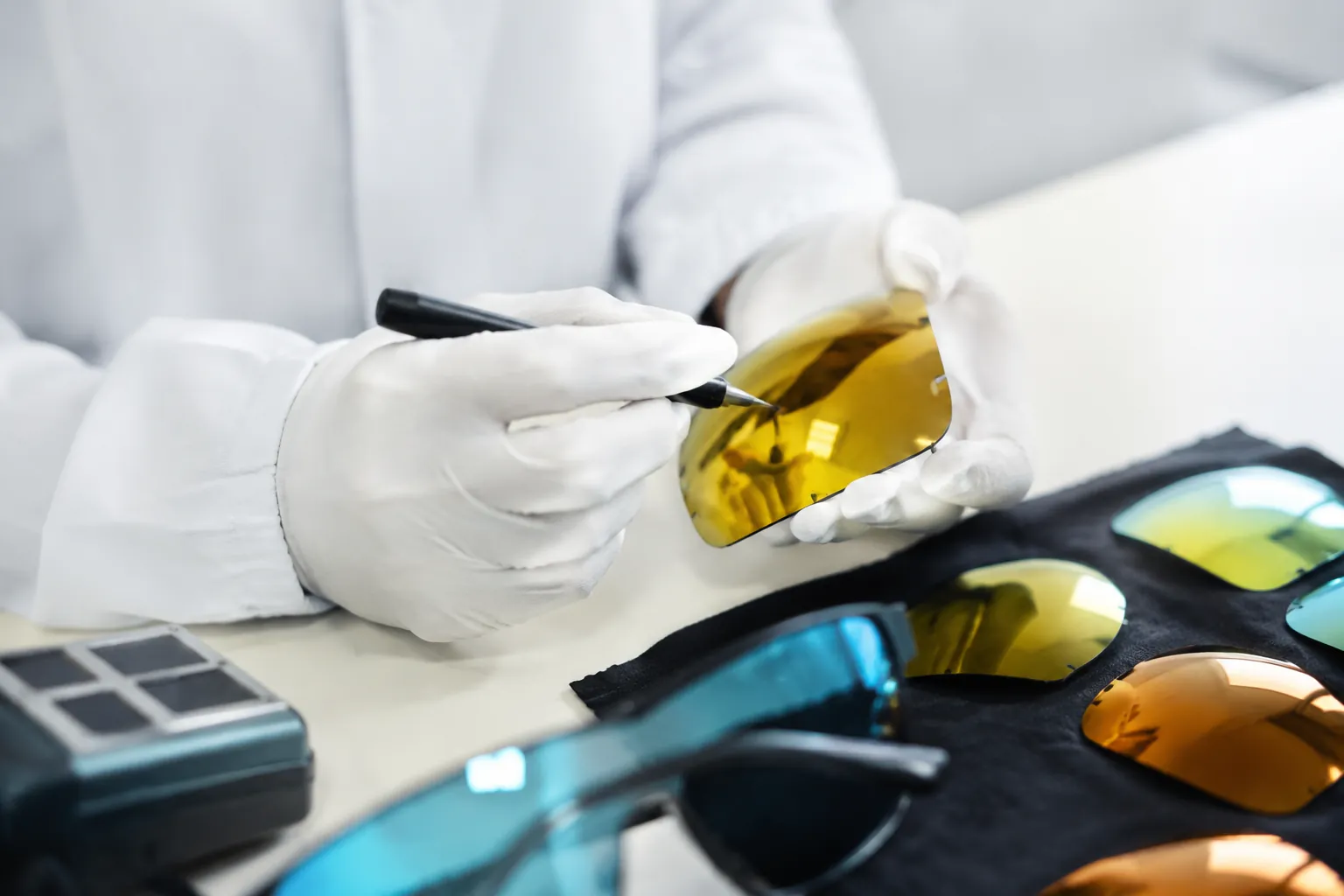
This guide is for brands, importers, distributors, and retail buyers sourcing mirrored sunglasses in volume. It explains why mirror color shifts between samples and bulk, where scratch risk really comes from, and what to put in your purchase spec before production starts. The payoff is fewer rejected cartons, fewer color arguments, and a cleaner handoff between design, factory, and QC teams.
The buying problem: mirror color is not one fixed color
A mirrored lens is not simply a blue, gold, silver, or green lens. It is a lens base color plus a vacuum-deposited mirror layer plus a protective top coat, seen under a specific light source and angle. Change any one of those variables and the result moves.
This is why buyers sometimes approve a sample in the office, then see a different look in outdoor photos, at retail, or in a later reorder. A blue mirror can lean cyan, violet, or steel. A gold mirror can move toward yellow, rose, or bronze. Silver can look neutral on a grey base but slightly brown on a smoke gradient base.
For sourcing, treat mirror color as a controlled range, not a single visual memory. LumiShades normally asks buyers to approve a physical lens standard, not only a rendered image. For custom sunglasses, especially retail programs with multiple frame colors, that standard should be kept at the factory and with the buyer's QC team. Photos help communication, but they are not enough for approval because phone cameras overcorrect reflection and white balance.
The practical rule is simple: approve mirror color on the same lens material, same base tint, same lens curve, and same frame shape planned for bulk. A flat sample chip is useful for early direction. It is not a bulk standard for an 8-base sports lens.
What actually happens in a mirror coating process
Most mirrored sunglass lenses use vacuum coating. The lens is cleaned, racked, placed in a vacuum chamber, coated with thin metallic or oxide layers, then finished with a protective layer. Thickness is tiny, but small variation changes visible color.
- Lens preparation: PC, TAC, nylon, or CR39 lenses are cut, cleaned, and checked for surface contamination. Dust or oil creates pinholes and weak spots.
- Base tint control: The lens tint is made before mirror coating. Grey, brown, green, smoke gradient, and fashion tints all change the final mirror appearance.
- Vacuum deposition: The reflective layer is applied in a chamber. Position in the rack, chamber stability, and lens curvature affect evenness.
- Protective top coat: A clear layer improves wipe resistance but does not make a mirror lens scratch-proof.
- Inspection and assembly: Lenses are checked before fitting because frame pressure can hide edge defects until later handling.
LumiShades has in-house lens tinting and QC, which helps reduce back-and-forth on sunglass programs where the frame, lens tint, logo decoration, and final assembly all interact. For mirror coating itself, the key is not only the coating recipe. It is how consistently the factory controls cleaning, racking, curve matching, and inspection before lenses enter assembly.
Mirror options compared for sourcing decisions
Different mirror finishes create different visual impact, cost, and rejection risk. Buyers often select by catalog photo. That is risky. The table below is a more useful starting point for purchase discussions.
| Mirror type | Typical look | Color control difficulty | Scratch risk | Best use case |
|---|---|---|---|---|
| Full solid mirror | Strong reflective blue, silver, gold, green, red, or rainbow | Medium to high, especially on curved lenses | Medium to high because surface marks show clearly | Fashion frames, sports styles, promotional retail lines |
| Light flash mirror | Soft reflection; base tint remains visible | Medium; less obvious shift than full mirror | Medium; scratches are less visible than on heavy silver | Lifestyle sunglasses where wearability matters more than high reflection |
| Gradient mirror | Mirror stronger at top, lighter at bottom | High; transition line and density must be controlled | Medium; defects near the fade area are noticeable | Women's fashion, oversized acetate styles, resort collections |
| Inner mirror or back mirror effect | Subtle reflection depending on construction | High; design must be tested carefully | Depends on exposed surface and coating position | Special design programs, not ideal for rushed volume orders |
| Polarized mirror lens | Mirror finish over polarized lens | High; polarization film, tint, and mirror must match | Medium to high; rejects cost more | Fishing, driving, outdoor sports, premium retail SKUs |
If your launch date is tight, avoid making the hardest version your first order. A full red mirror on a high-wrap lens with polarization and a gradient base can be done, but it deserves a proper sampling round. Do not treat it like a stock smoke lens.
How to write a mirror lens color spec that factories can follow
A vague order line such as "blue mirror lens" invites trouble. A usable spec tells the factory what must be matched, how it will be judged, and what tolerance is acceptable.
- Lens material: PC, TAC polarized, nylon, or CR39. Do not approve color on one material and order another.
- Base tint: For example smoke grey category 3, brown category 3, G15-style green, or gradient smoke. Include target darkness if known.
- Mirror color standard: Physical approved sample, preferably two pieces marked "master standard" and "working standard."
- Frame reference: Mirror color can look different in black, crystal, tortoise, and bright acetate frames because the wearer and buyer view contrast differently.
- Viewing condition: Check under D65-style daylight booth if available, plus outdoor daylight. Avoid judging only under yellow warehouse lighting.
- Angle: State if color must be judged straight on or at 30 to 45 degrees. Mirror coatings shift at angle by nature.
- Allowed variation: Define acceptable slight shade difference versus rejectable mismatch between left and right lenses.
For larger orders, LumiShades can keep a retained standard against bulk production. This matters for repeat programs. A reorder six months later should not rely on a photo buried in an email thread.
For small MOQ runs, such as 50 pairs per design, buyers still need a standard. The cost of over-specifying every lab detail may not make sense, but left-right lens match and approved sample match still matter.
Scratch risk: what is normal, what is a defect
Mirror coatings are exposed surfaces. They are more scratch-sensitive than the base lens itself, especially with heavy silver, gold, and rainbow effects. A protective top coat improves handling resistance, but it cannot survive rough wiping with sand, paper tissue, or a dusty microfiber cloth.
Buyers should separate three issues: coating adhesion, surface abrasion, and handling damage. Adhesion failure looks like peeling, flaking, or coating lifting at the edge. That is a manufacturing problem. Abrasion appears as fine wipe marks after rubbing. Some risk is normal for mirror lenses, but the acceptable level depends on the price point and claim. Handling damage includes scratches from assembly tables, loose lenses in trays, or frames rubbing in packaging.
Common weak points are lens edges, nose bridge areas, and high points on shield or wrap lenses. During assembly, a metal hinge screw, rough rim groove, or dirty glove can create marks before the product ever reaches a carton. Good QC catches this before packing.
For serious retail programs, include a simple abrasion check in pre-shipment inspection. It does not replace laboratory testing, but it prevents obvious soft-coat problems. The factory should also inspect lenses under consistent light at an angle, because straight-on checks miss fine scratches.
Blunt sourcing note: If you choose a high-reflection mirror lens, a matte black microfiber pouch, and loose bulk packing, you are creating your own scratch complaint. Packaging is part of the lens spec.
Compliance points buyers should not skip
Mirror color is a design choice. Sunglass compliance is not. The lens still has to meet relevant requirements for the destination market, including visible light transmission category, UV protection, optical quality, and labeling.
LumiShades works with the real certifications and compliance frameworks buyers commonly request: CE EN ISO 12312-1 for sunglasses, FDA registration for the United States, ANSI Z80.3, AS/NZS 1067 for Australia and New Zealand, REACH, ISO 9001, and BSCI. Do not ask a supplier to add unrelated certificate logos just to make a carton look impressive. Importers can be held responsible for false claims.
For mirrored lenses, the main practical issue is transmission category. A dark base tint plus heavy mirror can become too dark for general use or fall into a category that needs clearer labeling. A fashion flash mirror may still have moderate transmission depending on base tint. Polarized mirrored lenses also need correct marking if you claim polarization.
Ask for the lens category and applicable test report before bulk if the order is for regulated retail channels. For mixed lens colors in the same PO, do not assume one report covers every color. A smoke silver mirror, brown gold mirror, and blue gradient mirror may need separate confirmation depending on the program.
Sampling, MOQ, price, and lead-time logic
Mirror lenses need a realistic development path. LumiShades' sample lead time is usually 7 to 10 days, with bulk production around 25 to 35 days after approval and deposit. That timeline assumes the buyer gives usable artwork, lens direction, frame choice, and packaging details without repeated changes.
The MOQ starts at 50 pairs per design, useful for limited drops, market testing, or distributor samples. Price improves at 300, 1000, and 5000 pairs or more because material purchasing, setup, coating loss, and QC time spread across more units. On volume, pricing can go down to about $2.10 per pair depending on frame, lens, decoration, packaging, and inspection requirements.
Mirror coating can affect price more than buyers expect because rejects are not always repairable. If the color is off, the lens is usually remade. If the coating scratches during assembly, it is replaced. A difficult mirror lens has higher scrap risk than a standard smoke lens.
| Order stage | What buyer should approve | Typical timing | Risk if skipped |
|---|---|---|---|
| First sample | Frame fit, lens base tint, mirror direction, logo position | 7 to 10 days | Bulk sample looks different from design intent |
| Pre-production sample | Exact lens material, mirror finish, packaging, markings | Before bulk release | Color disputes and compliance gaps |
| Bulk production | Retained standard used by production and QC | 25 to 35 days | Batch variation and left-right mismatch |
| Final inspection | Scratch level, color match, lens category, packing protection | Before shipment | Retail returns or distributor claims |
Avoid approving mirror color at the same time you are still changing frame color. Final appearance depends on both.
Factory QC checklist for fewer batch surprises
A good mirror lens QC plan is short, visible, and used on the production floor. It should not sit only in the sales file. For a custom sunglasses order, the following checks are worth including.
- Incoming lens blank check: Confirm material, curve, tint, surface cleanliness, and basic optical quality before coating.
- Coating batch record: Record lens type, mirror color, rack position, date, and approved standard reference.
- Left-right matching: Inspect each pair together, not as individual lenses in separate piles.
- Angle inspection: Check mirror color straight on and at an angle under controlled lighting.
- Edge and bridge inspection: Look for chips, coating gaps, and pressure marks after fitting.
- Scratch check before packing: Inspect after assembly, not only before assembly.
- Packaging protection: Confirm pouch, polybag, lens film, or insert prevents rubbing during transport.
LumiShades' in-house injection molding, acetate cutting, CNC milling, lens tinting, decoration, and QC make it easier to control the handoff points where mirror lenses are often damaged. The danger points are practical: dirty trays, rushed fitting, mixed standards, and last-minute packaging changes.
If the order is a reorder, compare the new bulk against the retained sample from the previous shipment. Not against memory. Not against a sales photo. Against the physical standard.
Have a custom sunglasses project in mind?
Send us your styles, target market and quantities and we will return a detailed quote with MOQ, lead time and a sample plan.
Get a QuoteWhy source this from Wenzhou with LumiShades
Wenzhou in Zhejiang Province is widely regarded as China’s eyewear manufacturing capital, producing a large share of the world’s sunglasses. That concentration matters to buyers: a deep local supply chain for acetate sheet, hinges, lens blanks, plating and packaging means shorter component lead times, easier color and material matching, and a workforce with decades of eyewear-specific skill. LumiShades has manufactured in this ecosystem since 2009, and our vertical integration — in-house injection molding, acetate cutting, CNC milling, lens tinting, decoration and quality control — means no part of your order is quietly subcontracted to a workshop you cannot audit.
For international buyers, that vertical control translates into accountability. When a single factory owns every step, defects are traced and fixed at source rather than bounced between vendors, and your specifications survive intact from first sample to bulk. We back this with 15+ years of experience, shipments to 60+ countries, more than 5 million pairs produced per year and a 98.5% on-time delivery rate. Our certifications — CE EN ISO 12312-1, FDA registration, ANSI Z80.3, AS/NZS 1067, REACH, ISO 9001 and BSCI audit — mean the compliance documentation your market requires already exists. Explore our manufacturing capabilities and quality control process to see how this works in practice.
Frequently asked questions
Can I match a Pantone color for a mirror lens? Pantone is useful for direction, but mirror lenses are reflective and angle-dependent. Approve a physical lens standard on the same material, tint, and curve planned for bulk.
Are mirrored sunglass lenses more likely to scratch than normal tinted lenses? Yes. The mirror layer is on the surface and fine marks show more clearly, especially on silver, gold, and rainbow mirrors. Use a protective top coat and specify careful packing.
Do polarized mirror lenses need extra sampling? Usually yes. The polarization film, base tint, mirror color, and lens curve all affect final appearance and compliance. Approve a pre-production sample before bulk.
What is a reasonable lead time for custom mirrored sunglasses? At LumiShades, samples usually take 7 to 10 days. Bulk production is typically 25 to 35 days after approval, depending on quantity, lens complexity, decoration, and packaging.
Which certifications are relevant for mirrored sunglasses? Relevant requirements may include CE EN ISO 12312-1, ANSI Z80.3, AS/NZS 1067, FDA registration, and REACH, depending on market. Confirm the lens color and category tested for your order.
What MOQ should I plan for if I need custom mirror colors? LumiShades starts at 50 pairs per design. Pricing improves at 300, 1000, and 5000+ pairs because coating setup, material purchasing, QC, and scrap risk are spread over more units.
Ready to start?
Explore our wayfarer sunglasses or request a quote — our sales team replies within 12 hours.
Request a Quote