
Polycarbonate vs TAC vs Glass Sunglass Lenses
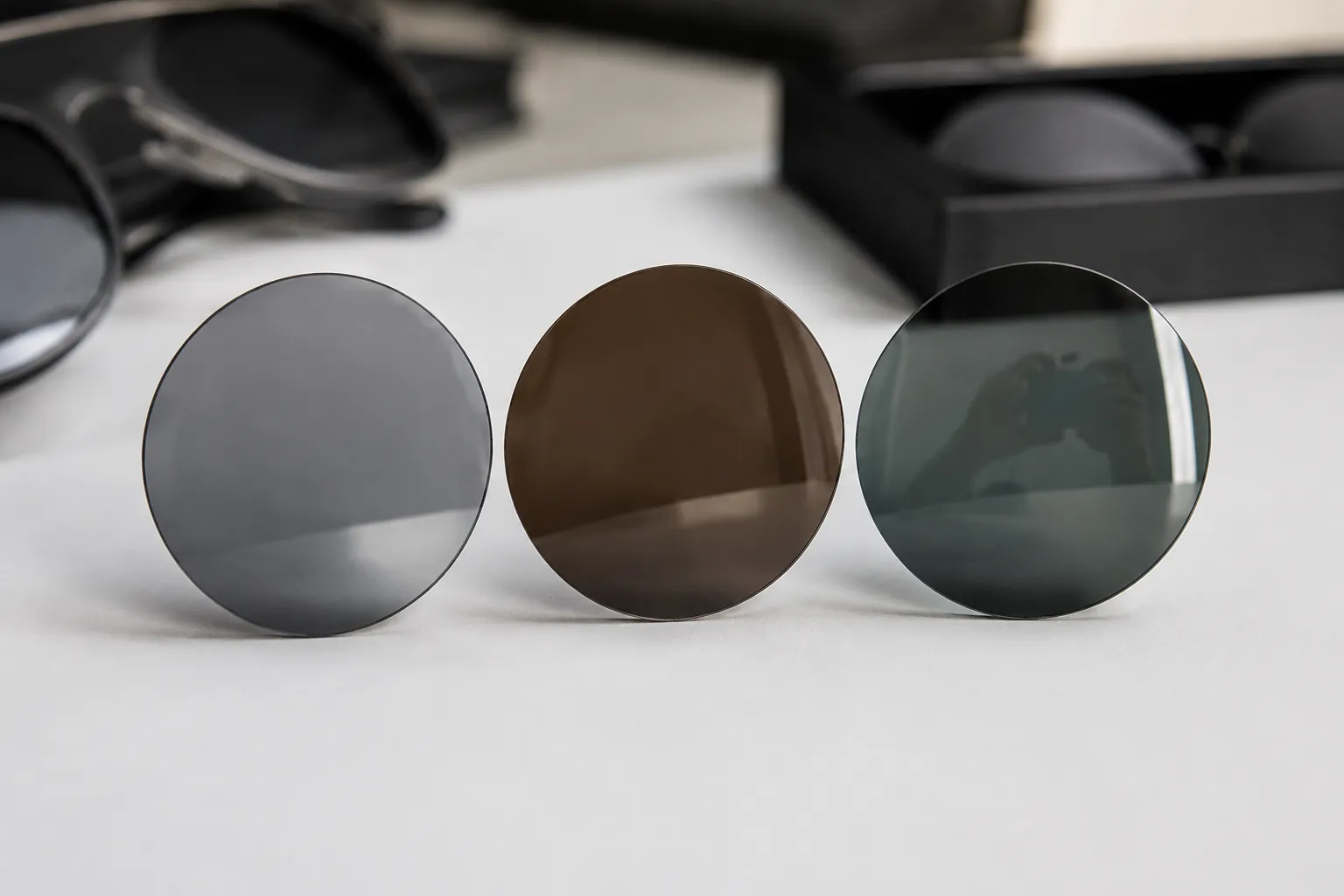
If you buy sunglasses for retail, private label, or distribution, lens material is not a cosmetic detail. It affects impact resistance, weight, scratch resistance, coating options, freight, and how the finished product feels in use. This comparison breaks down polycarbonate, TAC, and glass the way sourcing teams need it: by channel, compliance target, and total landed cost.
Start with the channel, not the lens
The most expensive lens mistakes usually start with the wrong question. A promo program, a sports account, a fashion chain, and a premium boutique all tolerate different tradeoffs. Before you choose a material, define the channel, the target price band, and the failure mode you want to avoid. Is the risk breakage, scratching, customer complaints about optics, or a compliance issue in the destination market?
Polycarbonate is the safest default when impact resistance and low weight matter. TAC is the practical choice when you need polarized sunglasses at a controlled price. Glass makes sense when optical clarity, scratch resistance, or a heavier premium feel are part of the brief and the channel can take the handling risk.
That channel-first approach matters because a lens material never acts alone. The same polycarbonate lens can behave differently depending on base curve, coating stack, tint density, edge finishing, and whether the frame is full-rim, semi-rimless, or rimless. Start with use case. Then narrow the material.
Buyer rule: match lens material to the channel first, then define polarization, coatings, tint, and compliance documents for the destination market.
In practice, a kids' or sports program should usually start with polycarbonate, a mid-price polarized retail line often starts with TAC, and a fashion-led niche line can consider glass if the product story justifies it. The cheapest lens on paper is not always the cheapest unit after rejects, breakage, freight, and returns.
Polycarbonate: the safest default for most programs
Polycarbonate is the workhorse material in wholesale sunglasses. It balances impact resistance, low weight, and manufacturability. That is why it shows up in sports, kids' eyewear, promotional items, and other channels that see frequent handling.
From a production standpoint, polycarbonate lenses may be injection molded in some constructions or cut from sheet stock in others. Buyers should ask for the exact lens specification, including base curve, center thickness, edge thickness, and any hard-coat or mirror layers. Small deviations can create assembly issues, especially in rimless or semi-rimless styles. Thickness and fit tolerances should be confirmed against the approved sample and the actual frame groove or drilling design, not assumed from a drawing alone.
Polycarbonate also supports tinting and UV protection well. It is commonly used in sunglasses designed to meet product-level standards such as CE EN ISO 12312-1, ANSI Z80.3, and AS/NZS 1067 when the finished product is tested and documented correctly. The material helps, but compliance still depends on the complete sunglass, including the frame, lens retention, tint transmission, impact performance, and labeling. "Impact resistant" is not the same thing as certified compliance.
The main compromise is scratch resistance. Bare polycarbonate is more prone to surface scratching than glass, so a hard coat is usually expected in retail use. When sourcing, confirm whether the quote includes a hard coat, an anti-scratch coating, or both. Extra layers such as anti-reflective or mirror finishes may fit some programs, but each added process increases cost and can affect yield if not controlled carefully.
Polycarbonate is also useful when packaging and distribution are rough. It handles shipping better than glass and is less vulnerable to damage during carton compression and store-level try-on. For larger orders, that durability can matter more than a small unit-price difference.
TAC: the practical polarized lens for volume retail
TAC, or triacetate cellulose, is the lens material buyers often link with polarized sunglasses. It is not a direct substitute for polycarbonate. TAC is usually chosen for good polarized performance at a controlled price, not maximum impact resistance. That makes it useful for fashion retail, mid-tier private label, seasonal programs, and driving-oriented styles where glare reduction is part of the value proposition.
The value of TAC is in the lens structure. A polarized TAC lens typically uses a polarizing film sandwiched between layers, then tinted and finished with coatings. That structure supports clear glare reduction and a simple consumer story. It also allows a wide range of tints and mirror finishes, which helps when the same frame family must be sold in multiple colorways.
Factories generally like TAC because it is efficient to produce when the specification is stable. Buyers should still ask about flatness, thickness uniformity, and laminate quality. Problems such as ripple, edge haze, or delamination can appear if process control is weak or if the lens stack is pushed too hard with heavy mirror coatings. For wholesale programs, TAC should still be checked for tint consistency, polarization performance, and surface defects before bulk release.
The downside is durability under abuse. TAC is not the first choice for kids' eyewear, heavy sports use, or any channel where products are likely to be dropped, bent, or handled roughly. It performs well in normal retail use, but it is less forgiving than polycarbonate in impact-heavy environments. If the buying brief is safety-led, TAC usually loses to polycarbonate.
Where TAC shines is price-performance. It often sits between basic plastic and glass: more convincing than a simple non-polarized lens, lower cost than glass, and easier to merchandise than an ordinary lens spec. For a wholesale buyer trying to hit a retail price point while still offering polarization, TAC is often the practical choice.
Glass: clarity and scratch resistance, with tradeoffs
Glass still has a place in wholesale sunglasses, but the use case is narrower than many buyers expect. Its strengths are clear: strong optical clarity and strong surface scratch resistance. For premium fashion styles, heritage-inspired designs, and some boutique collections, those benefits can support a higher retail price and a more substantial product feel.
The tradeoff is weight. Glass makes a frame feel denser, which some customers read as premium, but it also increases shipping weight and can reduce comfort over long wear. It is also more vulnerable to breakage if dropped or stressed, especially during assembly, packaging, and retail handling. In wholesale, every chipped lens or broken carton creates avoidable cost.
Glass also requires tighter process discipline at the factory. Handling, protective packaging, and assembly speed all need to be controlled carefully. If the product includes drilled holes, thin rims, or decorative metal components, the risk rises. Buyers should expect slower assembly than with polycarbonate or TAC, and they should not treat glass as a default material for large-volume distribution.
For sourcing teams, the real question is whether the brand story justifies the operational cost. If the answer is yes, glass can be a strong premium choice. If the answer is only that it looks better on a spec sheet, the material becomes expensive friction. Glass is best reserved for a deliberate product position, not a general-purpose wholesale line.
Head-to-head comparison
| Lens material | Impact behavior | Weight | Optical feel | Scratch resistance | Typical wholesale use |
|---|---|---|---|---|---|
| Polycarbonate | Best of the three for impact resistance and drop survival | Light | Good, but quality depends on molding, curvature, and finishing | Needs hard coat for retail durability | Sports, kids, promo, safety-led retail |
| TAC | Moderate; suitable for normal wear, less forgiving in abuse | Light to medium | Very good for polarized sunglasses and glare reduction | Moderate, usually improved with coating | Polarized fashion and mid-price retail |
| Glass | Breaks more easily if dropped or stressed | Heaviest | Very good, with strong clarity and clean viewing | Excellent | Premium fashion and niche collections |
The table helps, but the real sourcing decision depends on how the lens interacts with the frame. Rimless and semi-rimless styles expose edge quality, drilling accuracy, and stress points more than full-rim designs. Mirrored lenses add coating complexity. Dark tints can hide some optical issues, but they do not remove them. Think in systems, not individual parts.
Volume also changes the decision. At 50 pairs per design, a bad choice is annoying. At 300, 1,000, or 5,000+ pairs, the same mistake becomes inventory risk, rework, and cash-flow pressure. The landed cost of a lens material includes rejects, breakage, packaging, freight, and the labor needed to handle problems after production.
Compliance and spec control buyers should ask for
For overseas B2B buyers, compliance should be built into the purchase order. The relevant standards depend on the destination market, and the document set should be defined before sampling ends. A supplier that serves export markets should be able to provide the documents the buyer needs for the agreed destination.
Do not assume a lens material alone determines compliance. CE EN ISO 12312-1, ANSI Z80.3, and AS/NZS 1067 are product-level requirements. That means the complete sunglass must pass, not just the lens resin. The frame structure, tint transmission, UV performance, lens retention, impact behavior, and labels all matter. REACH addresses chemical compliance, while FDA registration is a separate regulatory category. ISO 9001 and BSCI relate to quality management and social compliance, not product performance standards.
A practical purchase order should separate the technical spec into explicit line items so there is no room for interpretation. Include the following:
- Lens material and exact thickness range
- Coating stack, such as UV400, hard coat, mirror, anti-reflective, or polarization
- Target market for compliance, such as EU, US, Australia, or mixed export
- Document set required before shipment, including test reports and declarations
This level of detail reduces back-and-forth later and helps the factory route the order into the correct QC and testing flow. It also gives procurement a cleaner basis for comparing quotes that may look similar but are not built to the same standard.
What the factory process should look like
Lens choice is only part of the process. The factory workflow determines whether that choice turns into a stable product. A capable factory should be able to manage multiple steps in-house or through controlled processes, including lens cutting or molding, tinting, decoration, assembly, and final QC. The more consistent the workflow, the easier it is to control quality and troubleshoot defects.
A serious factory should verify more than appearance. Before bulk approval, ask how the supplier checks mold fit, lens curvature, tint consistency, edge finish, logo position, and final assembly stress. For decorated styles, the process should also control laser engraving, pad printing, and metal logo plate placement before final inspection so alignment issues are caught early. If the supplier cannot explain the inspection sequence, the order is probably not controlled tightly enough.
Sampling and production timing should also be realistic. For a clear request with a stable spec, sample lead time is commonly about 7 to 10 days. Bulk production often runs about 25 to 35 days, depending on material, coating complexity, and packaging. If the order adds polarization, mirror coating, custom boxes, or multiple lens colors, the timeline should extend accordingly. The point is not to promise the shortest lead time. It is to keep the quote aligned with the actual process.
Buyers should also request tolerance points in writing. For example: lens thickness range, tint density target, frame groove fit tolerance, and acceptable cosmetic defect limits. On a practical production line, those numbers are what QC can actually enforce. If the supplier speaks only in generalities, the order will likely be managed by appearance rather than process control.
How to choose by channel and price point
There is no universal winner. The right lens depends on where the product sells, how it will be used, and what the buyer is trying to protect: margin, safety, or brand position.
- Sports, kids, and safety-sensitive retail: start with polycarbonate for impact resistance and low weight.
- Polarized fashion and mid-price retail: TAC usually gives the best cost-performance balance.
- Premium fashion or niche retro programs: glass can work, but only if the brand accepts the weight and breakage risk.
Price is also tied to volume and specification depth. MOQ, unit price, coatings, decoration, and packaging all affect landed cost. A polycarbonate lens with a hard coat will not cost the same as a polarized TAC lens with a mirror finish and custom branded packaging. Compare like for like before deciding that one material is cheaper than another.
One useful buying test is to evaluate samples the way end users will treat them. Put the frame on face, wipe the lens, place it in packaging, and inspect for coating marks, edge chips, and visible distortion under normal retail lighting. If the lens survives the sample test but fails basic handling, it is unlikely to hold up in the market. If you are buying for multiple countries, keep the documentation aligned by destination so the compliance file is ready before inventory is built.
Polycarbonate wins on safety and utility. TAC wins on polarized value. Glass wins only when the premium story outweighs the operational cost. The best sourcing decision is the one that fits the channel, the compliance requirement, and the real handling environment.
Have a custom sunglasses project in mind?
Send us your styles, target market and quantities and we will return a detailed quote with MOQ, lead time and a sample plan.
Get a QuoteWhy source this from Wenzhou with LumiShades
Wenzhou in Zhejiang Province is widely regarded as China’s eyewear manufacturing capital, producing a large share of the world’s sunglasses. That concentration matters to buyers: a deep local supply chain for acetate sheet, hinges, lens blanks, plating and packaging means shorter component lead times, easier color and material matching, and a workforce with decades of eyewear-specific skill. LumiShades has manufactured in this ecosystem since 2009, and our vertical integration — in-house injection molding, acetate cutting, CNC milling, lens tinting, decoration and quality control — means no part of your order is quietly subcontracted to a workshop you cannot audit.
For international buyers, that vertical control translates into accountability. When a single factory owns every step, defects are traced and fixed at source rather than bounced between vendors, and your specifications survive intact from first sample to bulk. We back this with 15+ years of experience, shipments to 60+ countries, more than 5 million pairs produced per year and a 98.5% on-time delivery rate. Our certifications — CE EN ISO 12312-1, FDA registration, ANSI Z80.3, AS/NZS 1067, REACH, ISO 9001 and BSCI audit — mean the compliance documentation your market requires already exists. Explore our manufacturing capabilities and quality control process to see how this works in practice.
Frequently asked questions
Which lens is safest for wholesale sunglasses? Polycarbonate is usually the safest choice because it offers the best impact resistance of the three. It is the strongest starting point for sports, kids', and other higher-handling programs.
Is TAC good for polarized sunglasses? Yes. TAC is widely used for polarized sunglasses because it supports good glare reduction and a clear retail story at a controlled cost. Ask the supplier to confirm polarization performance, tint consistency, and laminate quality on the approved sample.
Why do some buyers still use glass lenses? Buyers use glass mainly for optical clarity, scratch resistance, and a premium feel. It fits narrower use cases because it is heavier and more breakage-prone than polycarbonate or TAC.
Which lens material is cheapest at volume? There is no fixed winner. TAC is often the best value for polarized retail, while polycarbonate is often the better fit for durable, safety-led programs. Final cost depends on coating stack, tint, decoration, packaging, and order size.
What should I confirm before approving bulk? Confirm the lens material, thickness range, coating stack, compliance target, tint, and the final approved sample. Also confirm the inspection criteria the factory will use for bulk production, including acceptable cosmetic defects and fit tolerances.
Can a supplier support export compliance documents? A qualified supplier should be able to support the documents needed for the agreed market, such as CE EN ISO 12312-1, ANSI Z80.3, AS/NZS 1067, REACH, FDA registration where applicable, and quality or social audits such as ISO 9001 or BSCI. Ask for the specific test reports and declarations before bulk order release.
Ready to start?
Explore our shield & oversized sunglasses or request a quote — our sales team replies within 12 hours.
Request a Quote