
Photochromic Sunglasses: Specs, MOQ, Tolerances, QC
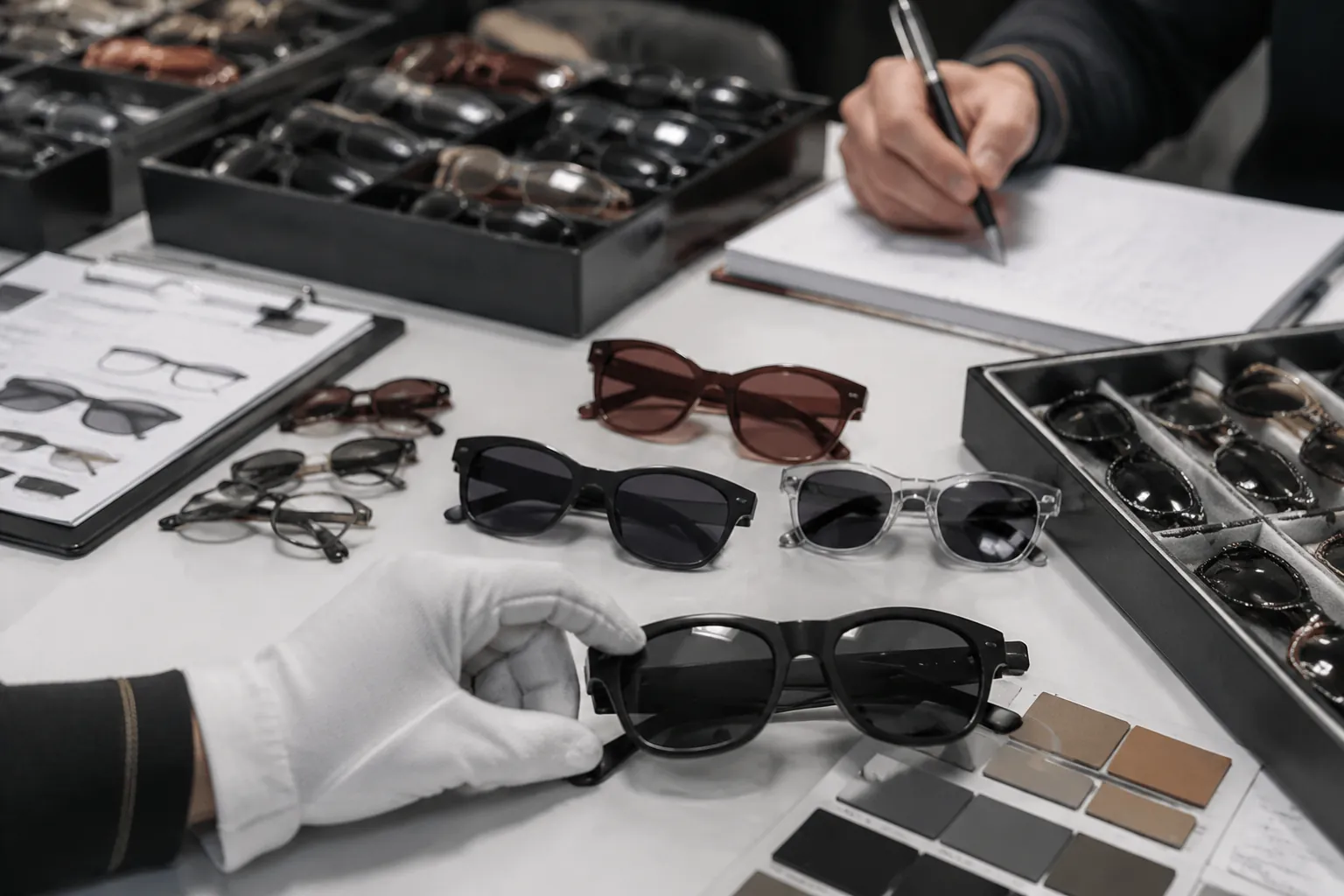
This guide is for overseas brands, importers, retailers, and distributors sourcing private label photochromic sunglasses. It explains where light-adaptive lenses work well, where they disappoint, and which details must be fixed before sampling: visible light transmission, UV protection, base curve, coating stack, decoration method, MOQ, lead time, compliance standard, and inspection tolerance. The aim is simple: fewer vague samples, fewer rejected bulk lots, and a purchase order the factory can make and the buyer can verify.
Use Photochromic Lenses for Real Light Changes
Photochromic sunglasses make sense when the wearer moves through changing light: cycling, golf, hiking, running, fishing in mixed weather, travel retail, kids' outdoor frames, and prescription-ready lifestyle eyewear. The lens darkens under ultraviolet exposure and fades when UV drops. Useful? Yes. Instant? No.
The strongest private label pitch is convenience. One pair can cover cloudy mornings, open sun, shaded trails, and indoor-to-outdoor movement. For sport and outdoor lines, this may reduce SKU pressure because the consumer may not need separate clear, smoke, and medium-tint lenses. For fashion-only sunglasses, the value is weaker. A shopper who wants a dark beach lens for photos may care more about color, mirror finish, and frame shape than fade speed.
Retail copy must state the car limit clearly. Most automotive glass blocks much of the UV that activates photochromic lenses, so the lenses may change only mildly inside a vehicle. Do not claim that the lens "darkens anywhere." Better wording is specific: "darkens outdoors under UV; performance behind windshields is limited." That one line can prevent many marketplace complaints.
Lens Options: Cost, Behavior, and Approval Checks
For private label orders, the choice is not just photochromic or non-photochromic. Material, lens construction, polarization, base curve, coating, and optical quality all affect cost and failure risk. Confirm the lens route before sample tooling, decoration fixtures, and packaging artwork begin.
| Lens option | Typical use case | Commercial advantage | Main limit | Buyer approval check |
|---|---|---|---|---|
| Standard tinted PC | Promo, entry fashion, kids' sunglasses | Low cost and good impact resistance | No light adaptation | UV400 or required UV transmittance, filter category, haze, surface scratches |
| Photochromic PC | Sport, travel, outdoor lifestyle | Impact resistance with flexible price positioning | Transition depends on UV intensity, temperature, lens chemistry, and exposure time | Clear VLT, activated VLT, activation method, fade method, impact requirement |
| Photochromic TAC polarized | Fishing, water sports, glare-reduction retail | Glare reduction plus light adaptation | Lamination, heat resistance, and haze need tighter control | Polarization axis, adhesion, delamination, haze, UV test, VLT range |
| Nylon performance lens | Premium sport frames and curved shields | Better optical stability on some high-wrap designs | Higher unit cost and MOQ discussion | Base curve, prism, distortion, coating stack, color match, VLT range |
Do not approve a lens from a sunny outdoor photo alone. Ask for measured visible light transmission, usually shown as VLT. A practical photochromic sunglass target may be around 55% to 75% VLT in the clear state and 12% to 25% VLT in the activated state, depending on filter category, market, and test method. The final range must match the applicable standard and retail claim. A lens that looks dark on a factory roof at noon may look weaker in hot weather, through glass, or under different UV conditions.
Spec Sheet Items to Fix Before Sampling
A serious purchase order should define the lens before it defines the logo. Photochromic performance has too many variables for chat-message approvals. At minimum, write down the lens material, color, base curve, center thickness, VLT range, UV requirement, coating, frame material, decoration method, packaging, compliance standard, and inspection tolerance.
- Material: PC is common for impact resistance and price; TAC is common for polarized laminated lenses; nylon is often used for higher-end curved sport lenses.
- Color: Gray keeps color perception more neutral; brown can improve contrast but shifts color; green is possible but needs closer approval under indoor light, sunlight, and UV activation.
- Transmission: Define both clear-state and activated-state VLT, not just "light to dark." For sunglasses, the activated state must match the intended filter category.
- UV protection: Specify UV400 or the required UV transmittance under CE EN ISO 12312-1, ANSI Z80.3, or AS/NZS 1067, depending on the destination market.
- Curve and thickness: High-wrap sport frames need distortion and prism checks. A lens that is not designed for the frame curve can cause discomfort even if it looks acceptable.
- Coatings: Confirm hard coating, mirror, anti-fog, hydrophobic, or oleophobic layers. Each layer can affect adhesion, yield, cost, and test results.
- Tolerance: Agree on color shade variation, logo placement tolerance, hinge tightness, lens gap, surface defect limits, and scratch limits before bulk inspection.
Frame material matters too. Injection molded PC is economical but relatively stiff. TR90 is lighter and more flexible, which suits sport frames. Acetate feels more premium but requires cutting, tumbling, polishing, and longer process control. If the supplier offers injection molding, acetate processing, CNC milling, lens tinting, laser engraving, pad printing, or metal logo plate decoration, confirm which steps are in-house and which are outsourced. Accountability depends on it.
Transition Speed, Temperature, and Tolerances
Buyers often ask for a lens that turns dark in seconds and clears just as fast. Most commercial photochromic sunglass lenses do not work that way. Activation usually starts quickly under strong UV, but fuller darkening often takes several minutes. Fading back is normally slower. Temperature also matters: many photochromic dyes darken more in cooler conditions and appear weaker in high heat.
Use a repeatable sampling method. Record the clear lens indoors after at least 10 minutes away from UV. Expose it outdoors under direct sunlight or under a controlled UV lamp for a fixed period, such as 5 minutes. Record the activated shade or VLT. Then bring it indoors and check fade at fixed intervals, for example 2, 5, 10, and 15 minutes. Use the same method for pre-production approval and final inspection. If each team uses a different exposure time, light source, or temperature, the dispute becomes subjective.
A useful tolerance covers shade variation, not just pass or fail. Approve a master lens sample and allow only a defined visual difference under an agreed light box or UV test condition. For many commercial programs, slight batch-to-batch shade variation is acceptable if VLT, UV protection, optical quality, and cosmetic quality stay inside the agreed range. Set priorities early: dark enough for the market, clear enough for intended use, stable enough across the shipment, and consistent enough that mixed cartons do not look like different products.
Decoration, Packaging, MOQ, and Price Logic
LumiShades supports MOQ from 50 pairs per design for selected private label programs. That can work for market testing, photography, influencer seeding, or retailer review. But the unit cost will be higher. Setup time, material purchasing, lens preparation, decoration, packing, and QC are spread across fewer pieces. A 50-pair run can validate frame shape, logo position, packaging fit, and basic lens reaction. It is not a mature landed-cost model.
At around 300 pairs, pricing starts to resemble a small wholesale run. At 1000 pairs and above, the factory can usually plan material purchasing, lens batching, line time, and inspection more efficiently. At 5000+ pairs, the discussion should include yield, carton loading, packaging speed, incoming material control, AQL level, spare parts or replacement allowance, and shipment schedule. Photochromic versions normally cost more than the cheapest standard tinted lens because material cost, activation control, inspection time, and scrap risk are higher. Any quote should be tied to the final frame, lens material, VLT target, coating, decoration, packaging, test requirement, and order quantity.
Decoration affects both unit cost and lead time. Laser engraving is clean and durable for subtle temple logos. Pad printing is economical for color marks but needs adhesion and rub testing. Heat transfer can work for larger graphics but may be less suitable on textured or flexible surfaces. Metal logo plates can look premium on acetate or thicker plastic temples, but they add placement tolerance, insert handling, glue control, and edge-feel inspection. Define logo placement tolerance in millimeters. "Centered" is not enough.
Sampling and Bulk Lead Time
Normal sample timing is often 7 to 10 days when the frame is available, the lens route is confirmed, and the specification is clear. Bulk production is commonly planned at about 25 to 35 days after sample approval and deposit, assuming lens material, decoration, packaging, and compliance wording are fixed. The actual schedule depends on the chosen frame, lens type, order quantity, packaging, and current production capacity.
- Confirm frame drawing, material, lens base curve, lens color, VLT target, UV requirement, and destination standard before sampling.
- Approve decoration method and exact position on temple, lens, pouch, case, hangtag, retail box, and carton if used.
- Test the photochromic sample with the agreed UV exposure method and record readings, photos, temperature, exposure time, and light source.
- Freeze the master sample with signed comments, dated approval file, defect limit reference, and packaging reference.
- Release bulk only after artwork, barcode, warnings, compliance wording, and carton marks are final.
- Inspect incoming lenses, assembled frames, hinge function, lens fit, surface defects, decoration adhesion, photochromic reaction, and final packing before shipment.
The most expensive risk is a late "small" change. A new temple logo may require a new pad, fixture, laser file, or metal insert. A darker lens target may require a different photochromic batch. A new pouch size may change carton quantity. These are production changes, not email edits. Freeze specifications early. Samples get cleaner. Ship dates get safer.
Compliance: Match the Market Before Printing Claims
Compliance claims must match the destination market. For Europe, sunglasses are commonly checked against CE EN ISO 12312-1. For the United States, buyers often request ANSI Z80.3 and FDA registration details. For Australia and New Zealand, AS/NZS 1067 is the key reference. REACH may apply to restricted substances in frame materials, coatings, inks, and packaging components. LumiShades can support projects that require CE EN ISO 12312-1, FDA registration, ANSI Z80.3, AS/NZS 1067, REACH, ISO 9001, and BSCI documentation, but each document must apply to the actual product being ordered.
Do not add badges or claims because a marketplace competitor uses them. FDA registration is not FDA approval. Say it correctly. A test report should match the product type, lens color, construction, coating, and filter category. A report for a black PC fashion sunglass does not automatically cover a brown photochromic polarized model. If the lens construction, coating, tint category, or children's product claim changes, the report may need to change too.
For children's sunglasses, prescription-ready products, polarized claims, mirrored coatings, or high-wrap sport frames, ask the importer, retailer, or test laboratory whether extra tests are required before mass production. Approve compliance wording before packaging printing. Finished goods with the wrong claim may require relabeling and can create import or marketplace risk.
QC Checks That Catch Expensive Failures Early
Photochromic sunglasses need normal eyewear QC plus lens-performance checks. On the frame side, inspect hinge alignment, screw tightness, temple opening angle, frame balance, lens fit, burrs, surface scratches, polishing marks, and decoration adhesion. On the lens side, check UV protection, visible light transmission, color consistency, haze, coating defects, polarization if used, and optical distortion.
For high-wrap sport models, pay close attention to prism and distortion. A lens can pass a quick visual check and still make the wearer uncomfortable. For polarized photochromic lenses, rotate the lens against a test card or screen to confirm axis consistency. For printed logos, run a rub test. For metal plates, check placement, glue control, and edge feel. A sharp plate edge on the temple will cause complaints even if the lens is correct.
A good QC file for photochromic sunglasses should include the approved master sample, clear and activated VLT targets, UV requirement, packaging artwork, defect limit photos, carton mark, AQL level, inspection checklist, and the agreed photochromic test method. If one item is missing, the factory and buyer may be judging different products.
The best bulk orders are predictable. The factory knows what to make. The buyer knows what to inspect. For photochromic sunglasses, replace vague words such as "fast," "dark," "clear," and "good quality" with measured targets, approved samples, and written tolerances.
Have a custom sunglasses project in mind?
Send us your styles, target market and quantities and we will return a detailed quote with MOQ, lead time and a sample plan.
Get a QuoteWhy source this from Wenzhou with LumiShades
Wenzhou in Zhejiang Province is widely regarded as China’s eyewear manufacturing capital, producing a large share of the world’s sunglasses. That concentration matters to buyers: a deep local supply chain for acetate sheet, hinges, lens blanks, plating and packaging means shorter component lead times, easier color and material matching, and a workforce with decades of eyewear-specific skill. LumiShades has manufactured in this ecosystem since 2009, and our vertical integration — in-house injection molding, acetate cutting, CNC milling, lens tinting, decoration and quality control — means no part of your order is quietly subcontracted to a workshop you cannot audit.
For international buyers, that vertical control translates into accountability. When a single factory owns every step, defects are traced and fixed at source rather than bounced between vendors, and your specifications survive intact from first sample to bulk. We back this with 15+ years of experience, shipments to 60+ countries, more than 5 million pairs produced per year and a 98.5% on-time delivery rate. Our certifications — CE EN ISO 12312-1, FDA registration, ANSI Z80.3, AS/NZS 1067, REACH, ISO 9001 and BSCI audit — mean the compliance documentation your market requires already exists. Explore our manufacturing capabilities and quality control process to see how this works in practice.
Frequently asked questions
Can photochromic sunglasses get dark inside a car? Usually not very dark. Most windshields block much of the UV that activates photochromic lenses, so the change inside a vehicle is often limited. If the product is intended for drivers, do not rely on photochromic activation alone. Discuss a fixed tint, polarized option, or separate driving lens, and confirm compliance for the destination market.
What is a sensible MOQ for testing a private label photochromic model? For initial validation, LumiShades can support selected programs from 50 pairs per design. Use that quantity to check frame fit, logo position, packaging, and basic photochromic reaction. For wholesale pricing and more realistic production planning, request quotes at 300, 1000, and 5000+ pairs with the same lens, coating, decoration, packaging, and test requirements.
What VLT range should I request for photochromic sunglasses? Set both clear-state and activated-state VLT in writing. Many commercial sunglass programs may target about 55% to 75% VLT in the clear state and 12% to 25% VLT in the activated state, but the correct range depends on the filter category, market standard, lens color, and product use. Ask the supplier to state the test method, UV exposure time, temperature, and tolerance.
Which compliance standards should I request for the US, EU, and Australia? For the EU, request CE EN ISO 12312-1 documentation for the actual sunglass model and filter category. For the US, ask about ANSI Z80.3 and FDA registration details, using accurate wording because FDA registration is not FDA approval. For Australia and New Zealand, request AS/NZS 1067. For materials and coatings, ask whether REACH restricted substance requirements apply to your market and product.
How long do samples and bulk production take? Samples often take 7 to 10 days when the frame, lens material, VLT target, decoration, and packaging requirements are clear. Bulk production is commonly planned at about 25 to 35 days after sample approval and deposit, but the final schedule depends on order quantity, lens type, coating, decoration, packaging, compliance testing, and current factory capacity.
Can I combine photochromic and polarized lenses? Yes, but approve it as a separate lens construction, not as a simple add-on. Confirm polarization axis, lamination adhesion, heat resistance, haze, UV protection, clear-state VLT, activated-state VLT, coating quality, and delamination limits. For fishing or water-sport products, test glare reduction and visual comfort with the actual frame curve before approving bulk production.
Ready to start?
Explore our round sunglasses or request a quote — our sales team replies within 12 hours.
Request a Quote