
Polarized Sunglasses Wholesale: Margin or Miss?
Polarized lenses are not automatically the better buy. For overseas brands, importers, distributors, and retailers, the real question is whether the added lens cost turns into higher sell-through, better margin, or fewer returns in your target channel. This guide shows where polarized makes sense, where it does not, and how to order the right spec without paying for features your customers will not value.
Start With the Channel
Polarized sunglasses only make sense when the customer can see the benefit and is willing to pay for it. That is a channel decision, not a lens decision. A beach resort shop, fishing retailer, golf pro shop, marine outfitter, or automotive accessory program can usually justify polarized eyewear because glare reduction matches the use case. A fashion-led impulse rack in a discount chain usually cannot.
Start with the job the sunglasses need to do. If the buyer is trying to cut glare off water, roads, snow, chrome, or glass, polarization is functional. If the buyer is choosing by frame shape, lens color, or trend, polarization may be invisible at shelf level. In those programs, you are adding cost without changing conversion.
Ask one blunt question: will the end user notice the difference without a sales associate explaining it? If the answer is no, the upgrade is weak. If the answer is yes, polarization can support a higher retail price and a cleaner product story.
Rule of thumb: add polarization where glare is part of the use case; skip it where style drives the sale.
At LumiShades, polarized programs are common for sports, outdoor, travel, and workwear-style eyewear. For fashion-heavy private label sets, many buyers split the line: non-polarized for entry price, polarized for a higher tier. That gives you a clearer ladder at retail and keeps every SKU from carrying the same cost.
What Polarization Changes
A polarized lens includes a filter layer that blocks horizontal reflected glare. In practical terms, it reduces mirror-like reflection off water, windshields, wet roads, shiny pavement, and metal surfaces. It does not automatically make the lens darker. A 15% visible light transmission polarized lens can look lighter than a 10% non-polarized lens and still perform better outdoors because it filters reflected light, not just brightness.
For wholesale buyers, perception matters. A good polarized lens reduces eye fatigue in outdoor use and makes driving or fishing feel more comfortable. A bad one can trigger complaints about screen interference, color shift, or uneven visual quality. Customers may not know the science, but they know when a dashboard or phone screen looks wrong.
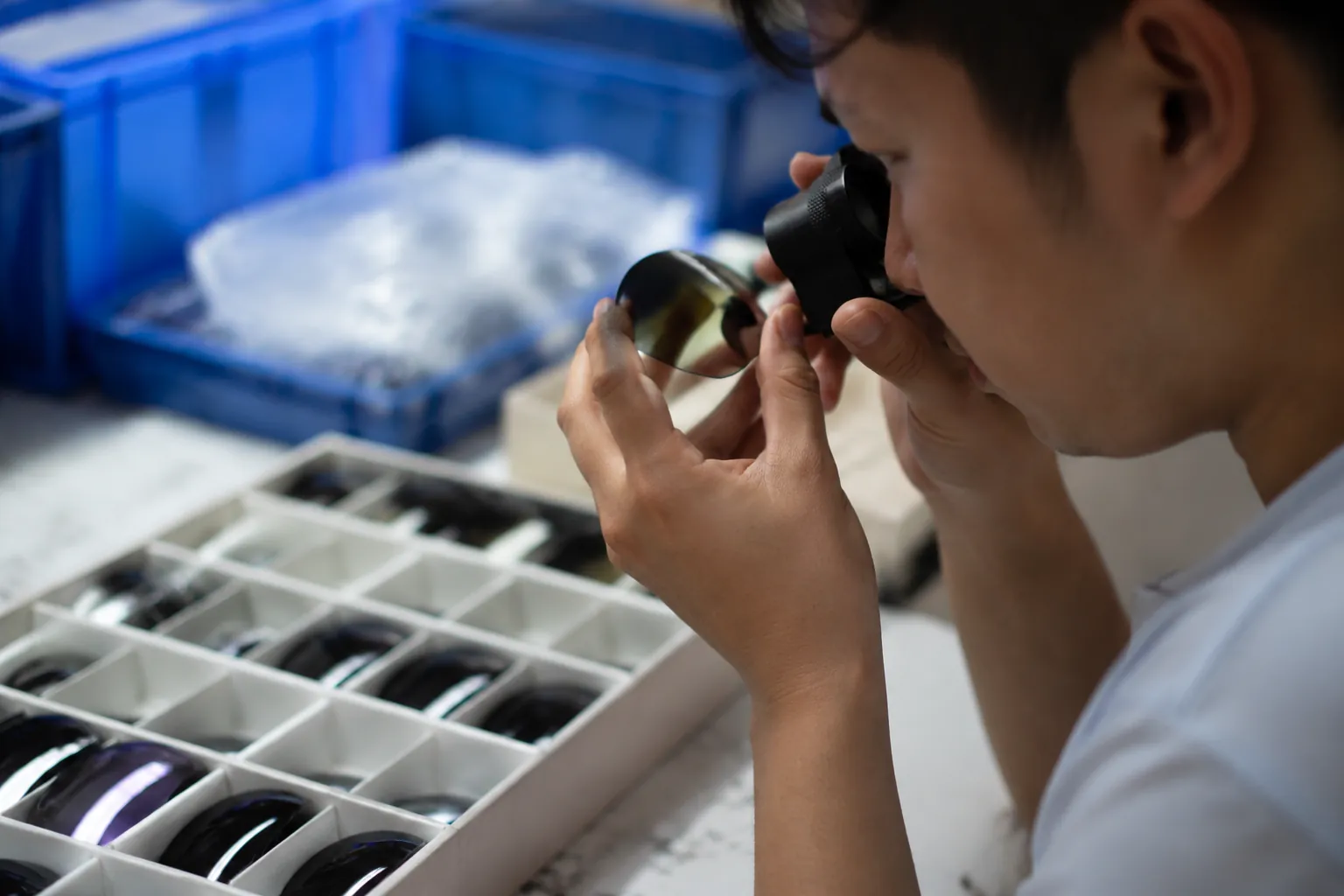
On the production side, polarization adds a material step and usually one more QC checkpoint. The polarized film must be oriented correctly, laminated cleanly, and cut without edge defects. If the process is loose, you can see partial delamination, tint mismatch between left and right lenses, visible stress lines, or optical distortion near the lens edge. Treat the lens spec as a manufacturing control document, not just a sales feature.
Fit still matters. Typical acceptable fit tolerance at the lens-to-frame level is often kept within about 0.2 to 0.3 mm in the groove or rim area for consistent assembly, though the exact target depends on frame type and material. If the gap is too loose, lenses can rattle or pop out in heat. If it is too tight, the frame may stress-whiten, warp, or show asymmetry after assembly. With polarized lenses, those errors are easier to spot because buyers expect a premium feel.
- Best for glare-heavy use: driving, fishing, boating, snow, cycling, and outdoor labor.
- Less valuable for shelf-driven fashion: trend frames, low-ticket promo programs, and casual gift sets.
- Potential drawback: screen interference, slightly higher landed cost, and more demanding QC.
Where Polarized Lenses Add Margin
Polarized units add margin when the market will pay for utility. The strongest cases are mid-tier and premium outdoor programs. Buyers can charge a clear step-up price and usually keep return rates lower because the function is easy to explain and easy to feel in use. In those categories, polarization can become the reason a customer chooses your product instead of a near-identical frame from a competitor.
The economics are best when the frame is already established and the lens upgrade is the main change. If the base frame lands at a price that supports a fast-turn retail offer, the polarized version can often move up one or two price bands without changing the tooling. That means the extra cost is concentrated in the lens, packaging claim, and QC process instead of a full redesign. The same frame can work in two channels: standard UV400 for value, polarized UV400 for higher-margin outdoor use.
For example, if a standard pair lands at a low enough cost to retail aggressively, a polarized version might support a 15% to 30% higher retail price depending on channel, brand strength, and packaging. The spread matters more than the absolute lens cost. If polarization adds a small amount to COGS but allows a meaningful ticket increase, it is worth it. If the retail price cannot move, the feature is dead weight.
At LumiShades, the manufacturing model can help because injection molding, acetate cutting, CNC milling, lens tinting, decoration, and QC are handled in-house. That reduces handoff risk and keeps the frame, lens, and logo program aligned. Fewer subcontractor transfers usually means fewer surprises on tint variation, fit, and final inspection. It also makes pilot runs easier because the factory can compare non-polarized and polarized versions using the same base frame and assembly logic.
| Program type | Typical buyer logic | Margin effect | Best fit |
|---|---|---|---|
| Non-polarized UV400 | Lowest entry price, broad style appeal | Best for volume when price is the main driver | Promo, fashion racks, mass retail |
| Polarized UV400 | Glare reduction, better outdoor utility | Higher unit cost but stronger ticket support | Outdoor, driving, travel, sport |
| Polarized + premium frame finish | Perceived upgrade across lens and frame | Best margin when retail positioning is disciplined | Private label, specialty retail |
| Polarized + mirrored or gradient lens | Utility plus stronger shelf appeal | Higher sell-through potential if visual merchandising is strong | Surf, resort, travel, fashion-outdoor hybrids |
Where They Do Not Pay Back
Do not force polarization into a program if the customer cannot tell the difference or does not care. That happens more often than many buyers admit. Some private label teams ask for every SKU to say polarized because it sounds premium. That is not a strategy. It is a cost increase dressed up as a marketing choice.
Skip polarization in low-price channels where the frame is effectively disposable and the customer buys on color first. Skip it if your target landed cost leaves no room for upgraded optics, packaging claims, and normal freight. Skip it if the assortment depends on broad style breadth rather than functional performance. In those situations, the lens feature does not earn its keep.
There is also a practical inventory issue. Polarized assortments can get messy fast if colors, coatings, and lens families multiply without discipline. A line with 12 frame colors, 2 lens tints, mirrored and matte finishes, and both polarized and non-polarized versions can turn into a SKU maze. That slows buyer decisions and creates dead stock, especially if reorders are small and inconsistent.
A useful rule for many importers is to keep polarized lenses to about 20% to 40% of the assortment and leave the rest standard UV400. That ratio preserves an upsell tier without turning inventory into a warehouse problem. For seasonal lines, the safer move is often to test polarized on the fastest-selling frame shapes first, then expand only after sell-through proves the concept.
Polarization also does not fix weak frame design. If the temples are uncomfortable, the bridge fit is off, or the front shape is too narrow for the target market, a better lens will not save the program. Buyers should not confuse optics quality with product-market fit. That is how companies overpay for a feature and still miss the sell-through target.
Unit Economics Buyers Should Run
Do the math before you approve the spec. Polarization changes lens cost, assembly time, QC checks, packaging copy, and often the final retail strategy. The price delta is not only the lens itself. It also affects labeling, carton marks, and sometimes the return rate because customers expect more from a product described as premium or outdoor-ready.
Use a landed-cost model before sampling goes too far. Start with target wholesale or landed cost per pair, then add the frame, lens, decoration, packaging, freight, duties, and any testing or compliance cost. After that, check the gross margin by channel. If the retail price cannot move enough to absorb the upgrade, standard UV400 usually wins. If the price can move, the polarized spec can be the more profitable choice even if the unit cost is slightly higher.
Volume is the other big lever. For custom sunglasses, MOQ often starts around 50 pairs per design for sample-friendly programs, but pricing usually improves at about 300, 1,000, and 5,000+ pairs. That is where lens and frame setup costs get spread over more units. On larger runs, total cost can fall to around $2.10 per pair on some programs depending on frame material, lens type, finish, and decoration. Polarization is easier to absorb when the run is larger and the production line is stable.
Lead time matters just as much as price. Samples typically take 7 to 10 days. Bulk production is usually 25 to 35 days, depending on the spec and order size. If the selling season is short, a polarized program that misses the ship window is worth less than a lower-cost non-polarized option that lands on time. Buying late can erase the margin you thought you were creating.
As a rough planning exercise, many importers model the upgrade in three layers: lens delta, assembly/QC delta, and retail delta. If the lens upgrade adds a few cents or a modest amount per pair but allows a materially higher price point, the math works. If the channel is locked to a low price, remove the feature.
Spec Details That Prevent Returns
Most complaints are not about the word polarized. They are about sloppy execution. Buyers should lock down lens tint, polarization orientation, optical clarity, and assembly tolerance before production starts. If any of those variables are vague, the factory will make assumptions, and assumptions are expensive once the product is packed and labeled.
Specify lens performance in practical terms. For dark tints, ask for a consistent visible light transmission target by color family. For lightly tinted or clear polarized lenses, check for distortion on flat surfaces and screen readability if the product will be used for driving or retail demos. For mirrored lenses, confirm that mirror uniformity is even across both lenses and that coating thickness does not create edge dulling or patchy color shift.
Frame fit needs the same attention. Lens groove depth, hinge alignment, temple symmetry, and front curvature all affect whether the lens sits correctly. If the frame is acetate, heat and polishing can change dimensions slightly after finishing. If the frame is injection-molded, shrinkage and mold wear can create small but important differences in lens cavity fit. Those differences are tiny on paper and big in the factory.
Decoration also needs to match the polarization spec. Laser engraving works well for precise marks on metal or coated components. Pad printing is efficient for logos and small color details, but ink adhesion and wear resistance must be checked if the product will be handled heavily. Metal logo plates can create a more premium look, but they add process steps and can affect balance if placed poorly. The right choice depends on frame material, target price, and the amount of visual branding the channel expects.
At the factory level, it helps when cutting, tinting, decoration, and QC are under one roof. LumiShades can handle acetate cutting, CNC milling, injection molding, lens tinting, laser engraving, pad printing, metal logo plates, and inspection in-house. That reduces handoff errors and makes approval cycles more predictable. It does not remove buyer-side responsibility; it just lowers the risk of mistakes between subcontractors.
- Confirm UV protection spec on the order sheet, not just in the sales email.
- Define lens color, polarization type, and surface finish before sampling.
- Require pre-production samples for any new frame or logo placement.
- Check packaging copy if you sell into regulated channels.
Compliance Buyers Can Actually Ask For
Do not treat certifications as decoration. Ask for the ones that match your market and channel. LumiShades states the following certifications and compliance references: CE EN ISO 12312-1, FDA registration, ANSI Z80.3, AS/NZS 1067, REACH, ISO 9001, and BSCI. Those are the references you can work from. Do not assume every certificate applies to every SKU or every destination market.
For Europe, CE EN ISO 12312-1 is the key eyewear safety standard for sunglasses. For the United States, FDA registration and ANSI Z80.3 are the practical anchors buyers ask about. For Australia and New Zealand, AS/NZS 1067 is the relevant eyewear safety reference. REACH matters for chemical compliance in the EU supply chain. ISO 9001 indicates process control and quality management, but it is not product approval by itself. BSCI is a useful factory audit signal when your customer cares about social compliance.
Polarization does not replace compliance. A polarized lens that fails clarity, labeling, or chemical requirements is still a problem. Build the compliance ask into the PO, especially if you are mixing markets in one order. If the same frame will ship into Europe and the U.S., make sure the spec, label language, and test references line up before production starts. That is much easier than fixing the paperwork after cartons are booked.
Buyers should also be careful with marketing claims. Do not label a lens as polarized unless the product and supporting documentation actually match that claim. If a style is being sold as category 3, UV400, or impact-resistant, make sure the performance evidence and packaging copy are aligned. Mismatched claims create customs risk, retailer disputes, and avoidable chargebacks.
| Market | Common buyer ask | Relevant document | Note |
|---|---|---|---|
| EU | Safety and chemical compliance | CE EN ISO 12312-1, REACH | Check labeling, category, and test scope |
| US | Sun protection and regulatory basics | FDA registration, ANSI Z80.3 | Match claims to test evidence |
| AU/NZ | Retail legality and safety | AS/NZS 1067 | Confirm category and marking |
| Multi-market | One line sold across regions | Full document set by destination | Do not assume one certificate covers all markets |
A Simple Buying Decision
If you are deciding whether to order polarized sunglasses wholesale, keep it blunt and practical. Polarization is worth paying for when it improves sell-through, reduces returns, or supports a higher retail tier that the channel can actually hold. It is not worth paying for when the customer cannot tell the difference or when the pricing structure cannot absorb the upgrade.
- Choose polarized if your channel sells utility, not just style.
- Choose polarized if the end user deals with glare every day.
- Choose polarized if you can charge enough more to cover the added cost and still protect margin.
- Choose non-polarized if price drives conversion and the feature will not be explained well.
- Split the range if you need both value and premium tiers.
For new programs, a mixed assortment is often the safest route. Sample both versions, test sell-through in a limited market, then expand the winner. With a 50-pair MOQ per design, you do not need to gamble on large inventory before you have evidence. That is the practical advantage of buying from a factory that can handle smaller custom runs without losing process control.
Before you sign off, ask three questions: does the channel value glare reduction, does the retail price move enough to pay for it, and can the supplier hold a stable spec across sampling and bulk? If the answer is yes to all three, polarized makes sense. If not, standard UV400 is usually the smarter buy. Polarized lenses are a tool. Use them where they solve a real problem, and leave them out where they only add cost.
FAQ for Buyers
What MOQ should I expect for a polarized custom sunglass design? LumiShades states MOQ starts at 50 pairs per design. At higher volumes, pricing usually improves around 300, 1,000, and 5,000+ pairs, where setup and overhead get spread across more units.
How much more do polarized lenses usually cost than standard lenses? It depends on frame type, tint, coating, and order volume. The real question is whether the retail price and sell-through can absorb the added cost. On some larger programs, total cost can still fall to about $2.10 per pair, but the exact number depends on specification and finish.
How long does sampling and bulk production take? Samples are typically 7 to 10 days. Bulk production is usually 25 to 35 days, depending on the spec, decoration method, and order size. Custom finishes and tighter QC expectations can extend that window slightly.
Which certifications matter for polarized sunglasses in export markets? Use the certificate set that matches the destination: CE EN ISO 12312-1 and REACH for EU-related programs, FDA registration and ANSI Z80.3 for the U.S., and AS/NZS 1067 for Australia/New Zealand. Ask for the documentation that matches the exact market and claim set.
Should I mix polarized and non-polarized SKUs in one line? Yes, often. Keep polarized for the SKUs where glare reduction helps sell-through, and use non-polarized for price-sensitive or fashion-led styles. That usually keeps inventory cleaner and gives buyers a clear entry tier and premium tier.
What should I lock before production to avoid returns? Approve lens tint, polarization spec, frame fit, logo method, packaging text, and compliance documents before bulk starts. Small errors in lens clarity, groove fit, or labeling create bigger problems than the polarized feature itself.
What decoration methods work best on polarized eyewear? Laser engraving is strong for precise permanent marks, pad printing is efficient for logo color and small graphics, and metal logo plates support a more premium look. The right method depends on the frame material, target price, and wear expectations.
Have a custom sunglasses project in mind?
Send us your styles, target market and quantities and we will return a detailed quote with MOQ, lead time and a sample plan.
Get a QuoteWhy source this from Wenzhou with LumiShades
Wenzhou in Zhejiang Province is widely regarded as China’s eyewear manufacturing capital, producing a large share of the world’s sunglasses. That concentration matters to buyers: a deep local supply chain for acetate sheet, hinges, lens blanks, plating and packaging means shorter component lead times, easier color and material matching, and a workforce with decades of eyewear-specific skill. LumiShades has manufactured in this ecosystem since 2009, and our vertical integration — in-house injection molding, acetate cutting, CNC milling, lens tinting, decoration and quality control — means no part of your order is quietly subcontracted to a workshop you cannot audit.
For international buyers, that vertical control translates into accountability. When a single factory owns every step, defects are traced and fixed at source rather than bounced between vendors, and your specifications survive intact from first sample to bulk. We back this with 15+ years of experience, shipments to 60+ countries, more than 5 million pairs produced per year and a 98.5% on-time delivery rate. Our certifications — CE EN ISO 12312-1, FDA registration, ANSI Z80.3, AS/NZS 1067, REACH, ISO 9001 and BSCI audit — mean the compliance documentation your market requires already exists. Explore our manufacturing capabilities and quality control process to see how this works in practice.
Frequently asked questions
What MOQ should I expect for a polarized custom sunglass design? LumiShades states MOQ starts at 50 pairs per design. At higher volumes, pricing improves at about 300, 1,000, and 5,000+ pairs.
How much more do polarized lenses usually cost than standard lenses? It depends on frame type, tint, coating, and order volume. The real question is whether the retail price and sell-through can absorb the added cost. At volume, total cost can still drop to about $2.10 per pair on some programs.
How long does sampling and bulk production take? Samples are typically 7 to 10 days. Bulk production is usually 25 to 35 days, depending on the spec and order size.
Which certifications matter for polarized sunglasses in export markets? Use the certificate set that matches the destination: CE EN ISO 12312-1 and REACH for EU-related programs, FDA registration and ANSI Z80.3 for the US, and AS/NZS 1067 for Australia/New Zealand.
Should I mix polarized and non-polarized SKUs in one line? Yes, often. Keep polarized for the SKUs where glare reduction helps sell-through, and use non-polarized for price-sensitive or fashion-led styles. That keeps inventory cleaner.
What should I lock before production to avoid returns? Approve the lens tint, polarization spec, frame fit, logo method, packaging text, and compliance documents before bulk starts. Small errors in lens clarity or labeling create bigger problems than the feature itself.
What decoration methods work best on polarized eyewear? Laser engraving, pad printing, and metal logo plates are the most common options. The best choice depends on the frame material, target price, and durability expectations.
Ready to start?
Explore our wayfarer sunglasses or request a quote — our sales team replies within 12 hours.
Request a Quote