
UV, Glare, and Lens Choice for Sunglasses Buyers
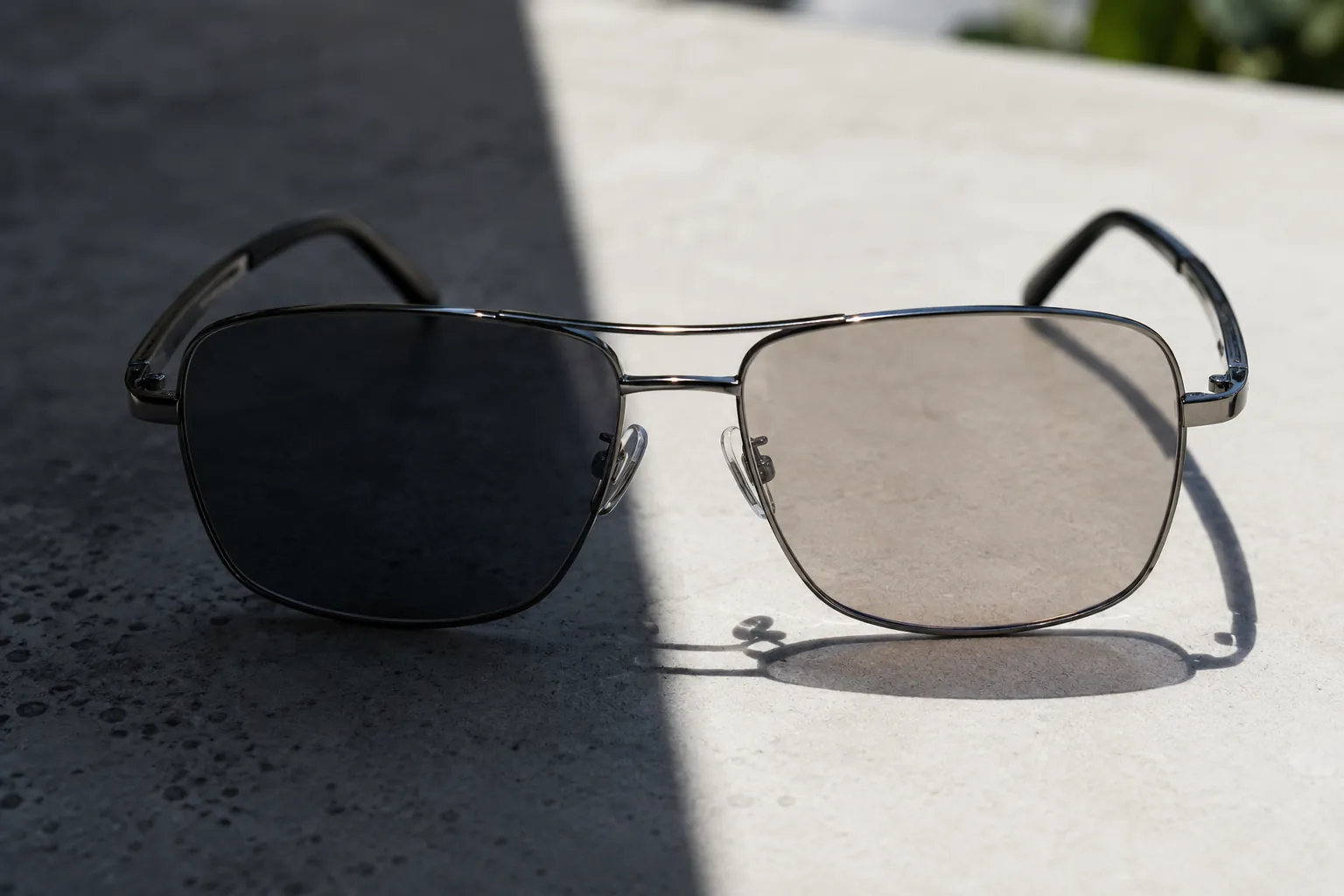
Retail sunglasses are not one product. A gas station display, fashion boutique, sports retailer, and pharmacy chain often need different lens behavior, even when the frame looks similar. Buy for the channel first. The wrong tint, coating, or polarization choice can hurt sell-through, raise returns, and cut margin. This guide explains how to choose lens performance by channel, with practical notes on compliance, factory process, sample approval, and reorder logic.
Start With The Channel
Most buying mistakes start with one error: choosing the lens first and the channel second. It feels efficient. It usually is not. A lens that works in a sports shop can fail in a fashion wall if it does not match how people shop, compare, and decide.
A beach resort shop usually needs strong glare reduction and easy sun comfort. A fashion retailer often needs color accuracy, face coverage, and a clean look on-face. A supermarket or pharmacy buyer usually wants broad appeal, low complaint risk, and a stable price point. The lens spec should support the selling floor. Not the other way around.
Commercial structure follows the same logic. A 50-pair MOQ can be enough to test demand without overcommitting. Once a style proves itself, larger runs such as 300, 1000, or 5000+ pairs usually improve unit cost because setup, tint matching, coating loss, and QC effort are spread across more units. Sample lead time is commonly 7-10 days if materials are ready. Bulk production is commonly 25-35 days when the spec is frozen and no tooling changes are needed.
Before you request samples, define four things: target channel, expected light conditions, price band, and whether the customer is buying for style or function. Those four answers tell you whether to ask for polarized gray, a mirrored fashion tint, a brown contrast lens, or a simple UV-protective smoke lens. Skip that step, and you may approve something that looks fine in a tray but disappoints on shelf.
What UV Protection Actually Does
UV protection is not the same as visible light reduction. A dark lens can still be wrong if it does not block harmful UV properly. A lighter lens can still protect well if the material and coating are correct. For outdoor retail, the baseline is simple: no meaningful UV leak, stable tint, and predictable compliance.
For export buyers, the key checks are market specific. CE EN ISO 12312-1 is relevant for sunglasses sold into the EU market. ANSI Z80.3 is the common reference for the U.S. market. AS/NZS 1067 is used in Australia and New Zealand. REACH matters for restricted substances in materials and coatings. FDA registration is an administrative requirement in some U.S. import workflows, but it is not a lens-performance certification by itself. Match the claim to the document. Not the marketing copy.
In practice, UV protection is a pass/fail feature, while visible light transmission is a merchandising choice. Many buyers aim for about 10% to 20% VLT for strong sunwear, 20% to 40% for softer fashion sell-through, and higher transmission when the channel prioritizes indoor try-on comfort and on-face appearance. The exact target should match the market, the use case, and the customer experience you want on shelf.
At factory level, UV performance depends on lens material, tint uniformity, and process control. Polycarbonate is widely used because it has strong impact resistance and inherent UV blocking properties, but it still needs proper surface treatment and scratch control. TAC and other laminated lens structures can offer strong glare and UV performance, but layer adhesion and edge quality matter. Injection lenses and acetate-cut lenses behave differently during tinting and inspection. If the tint bath is unstable, the cure cycle drifts, or the coating line is contaminated, a lens may still pass a quick visual check while failing consistency batch to batch.
That is why buyers should ask for more than a certificate. Request the test standard, tested transmission range, material specification, coating type, and the actual production sample that will be used for mass production. If the claim is UV400, ask how that claim is verified and whether sample and production lots are controlled to the same process.
Glare Control: Polarized, Tinted, Or Dark
Glare control is where channel differences show up fast. A polarized lens reduces reflected light from water, roads, glass, snow, and metal surfaces. That helps for fishing, marine use, some driving-related applications where allowed, and outdoor sports retail. It matters less on a fashion wall if the customer wants a bright face view, a lower price, and a lens that looks stylish rather than technical.
Plain tinted lenses are simpler and cheaper to sell in volume. They reduce overall brightness but do not reduce reflected glare in the same way. For many retail chains, that is enough. If the customer is buying a summer fashion style and the frame design is doing most of the work, a clean smoke or brown tint may outperform a more functional lens that feels too serious for the channel.
Mirror coatings are another option. They reduce transmitted light and create a stronger visual cue on shelf. In tourist, beach, and sports channels, that signal can support impulse purchase. A mirror lens also photographs well when the finish is clean, which matters for online listings and paid social content. But mirror coatings magnify QC issues. A small dust speck, fingerprint, coating void, or edge chip is easier to see, so buyers should expect tighter appearance standards than on standard smoke tints.
Use a simple rule set for channel planning:
- If the channel sells utility, prioritize polarization or a strong functional tint.
- If the channel sells image, prioritize color, reflection appearance, and shelf impact.
- If the channel sells both, split the range instead of forcing one SKU to do everything.
- If the price point is low, avoid overbuilding the lens spec and wasting margin.
From a sourcing standpoint, polarized lenses usually cost more because of film material, lamination steps, yield risk, and extra inspection time. Standard tints are easier to produce consistently and usually work better at high-volume replenishment. That is why many buyers use polarized lenses only where the use case is obvious enough for the shopper to pay for it.
Color Perception Matters
Color perception is not a soft topic. It affects sell-through. A lens that makes the world look too green, too gray, or too warm can look cheap on-face and disappoint buyers who test samples outdoors. In fashion retail, the lens has to work as both an optical part and a cosmetic surface.
Gray lenses usually preserve color balance best, which makes them a safe default when a buyer wants broad appeal. Brown or amber lenses can improve contrast and are often preferred for variable light, outdoor lifestyle styles, and activewear. Green lenses can feel classic, but the perceived shift depends on dye load, base material, and coating stack. Blue, rose, and other fashion tints can sell well in trend channels, but they often trade away visual comfort and create stronger end-customer preference swings.
The more important question is not only what the lens does to the eye. It is what the customer sees in the mirror and in the camera preview. Some tints flatten skin tone. Others make the frame pop. Some mirror finishes look premium on a display card but too harsh indoors under warm LED lighting. That is why boutique and online channels often need more sample validation than commodity retail channels.
A practical sampling method is to check the lens in three conditions: midday outdoors, under store lighting, and on-face in a mirror or camera preview. Then score three things: color neutrality, glare reduction, and whether facial features still read clearly. If the lens makes every face look dull, the sample may lose the fashion buyer even if the UV spec is correct. If it looks attractive outside but too dark indoors, it will also struggle in many chains because the product must survive the try-on moment before the sale.
For custom development, factories can usually fine-tune color through dye concentration, soaking time, base color, and backing layers. Small changes matter more than buyers expect. A small change in visible transmission can be obvious in side-by-side comparison, especially for fashion tints and mirrored styles. That is why the approved master sample matters so much.
Lens Options By Channel
The right lens depends on the channel, the customer, and the price story. The table below is a practical buying shorthand, not a theoretical ranking of optical performance.
| Channel | Best Lens Priority | Why It Works | Main Trade-Off |
|---|---|---|---|
| Fashion boutiques | Color appearance, moderate tint, mirror options | Customers buy on look first; clean face view matters | Less glare control than polarized options |
| Sports and outdoor retail | Polarization, contrast, stable UV protection | Better comfort in high-reflection environments | Higher cost and stricter appearance QC |
| Pharmacy and supermarket chains | Broad-appeal tint, stable UV protection, low complaint risk | Simple choice, easier merchandising, faster sell-through | Less differentiated on shelf |
| Travel and resort shops | Strong tint, mirror finish, lightweight feel | Impulse purchase behavior favors visible style cues | Returns can rise if tint is too dark indoors |
| Gas station and convenience retail | Low-cost smoke tint or basic polarized option | Fast decision cycle and price sensitivity dominate | Limited room for premium coatings |
This table reflects real buying logic. Not every channel wants the highest-performing lens. Some want the easiest-to-sell lens. That distinction saves money and reduces dead inventory.
Lens choice also changes landed cost. On custom sunglasses, pricing often improves at 300, 1000, and 5000+ pairs because the factory can spread setup, tint matching, coating loss, and packing labor across more units. Standard smoke tints usually price best. Polarized gray and brown typically sit above them. Mirrored polarized lenses, custom gradient tints, and complex logo decoration add cost because they create more process steps and more rejection points.
In practice, the cheapest unit is not always the cheapest program. A more expensive lens that sells faster and returns less can beat a cheaper lens that moves slowly or triggers complaints. Compare gross margin after returns, not only ex-factory cost.
Factory Process And QC
Lenses are not just made. They are processed, measured, and rejected for small defects that customers notice quickly. On a real factory floor, the main variables are tint consistency, coating adhesion, optical clarity, edge finish, and cosmetic uniformity. Those variables are controlled by people, equipment, and sequence, not by the specification sheet alone.
LumiShades handles injection molding, acetate cutting, CNC milling, lens tinting, decoration, and QC in-house. That matters because each step affects lens performance. Injection molds must hold dimensional stability so the lens seats correctly in the frame. Acetate-cut lenses need accurate edge finishing so the bevel is clean and the lens does not chip during assembly. CNC milling matters when the design needs tight geometry, repeatability, or special cutouts for wrap styles.
Tinting is where buyers often miss drift. A small shift in bath time, dye concentration, bath temperature, or drying time changes visible transmission and color cast. For consistent production, buyers should ask what tolerance the factory controls to. A practical expectation is that the factory should define a repeatable acceptance method under controlled light, with batch-to-batch variation kept within a documented range that matches the approved sample. The exact numeric tolerance should come from the supplier's written spec, not a general sales claim.
Decoration steps matter too. Laser engraving, pad printing, hot stamping, metal logo plates, and UV printing can all change handling risk and defect rate. Laser engraving is useful for precise branding but can create visible contrast on mirrored or dark-coated surfaces. Pad printing is flexible and cost-effective, but ink adhesion and cure time must be controlled. Hot stamping gives a premium look, though registration accuracy becomes important. The safest sequence is usually to finish the lens surface first, then apply decoration after the process is stable and the surface is clean.
QC should not be a glance and a thumbprint. At minimum, inspect color consistency under controlled light, check polarization alignment where applicable, verify coating defects, confirm edge quality, and test fit at the frame-lens interface. For mirrored lenses, inspect under multiple angles because defects can disappear head-on and show up only at the edge. For export orders, the paperwork must match the actual product, not a sample card from a prior season.
Buyers should also ask about rework and scrap rates. A factory may quote a low lens price, but if mirror coating yield is poor or the dye line needs frequent resets, the real landed cost changes fast. Process transparency matters as much as the headline price.
Sample Approval Checklist
Sample approval is where many programs either lock in cleanly or drift into trouble. A strong checklist keeps everyone aligned on what the lens is supposed to do, what the acceptable variation is, and what happens if the bulk run differs from the approved sample.
- Confirm target market requirements: CE EN ISO 12312-1, ANSI Z80.3, AS/NZS 1067, REACH, and FDA registration where applicable.
- Define lens purpose: glare reduction, color fidelity, fashion appearance, general sun comfort, or a combination of those goals.
- Choose lens family: polarized, standard tint, mirror tint, gradient tint, or contrast-enhancing tint.
- Lock visible light tone: gray, brown, green, smoke, or a fashion color, and approve under daylight and store lighting.
- Set sample acceptance criteria: color match, coating quality, fit, surface defect tolerance, and acceptable transmission range.
- Agree on bulk timing: sample in 7-10 days, bulk in 25-35 days, assuming no specification changes and materials are in stock.
Be explicit about what you will reject. "Looks good" is not a standard. A buyer should specify acceptable tint deviation, coating speck limit, and lens-to-frame alignment. If your retail channel is premium, hold the cosmetic bar higher. If your channel is mass retail, prioritize consistency, replenishment speed, and low complaint rate. A useful practice is to mark one master sample as the color reference, one as the fit reference, and one as the decoration reference so nobody argues later about which feature was approved.
Also decide whether you need one lens across all SKUs or a small lens matrix by channel. Most serious importers end up with two to four lens specifications, not one. That is normal. It reduces overengineering and keeps replenishment practical. It also helps with forecasting because different channels often reorder at different rates.
Buying Matrix And Reorder Logic
Use this matrix to match lens choice to the customer who actually pays for the product. The winning specification is the one the channel can understand quickly and reorder confidently.
| Buyer Goal | Recommended Lens Direction | Why | Watch Out For |
|---|---|---|---|
| Fast fashion sell-through | Standard tint with strong shelf appearance | Looks easy to understand and keeps unit cost down | Do not over-darken the lens |
| Outdoor utility retail | Polarized gray or brown | Comfort and glare control are visible benefits | Check alignment, optical clarity, and coating quality |
| Price-sensitive chain retail | Simple UV-protective tint | Low complaint risk and stable cost | Keep claims limited to tested performance |
| Tourist and resort shops | Mirror tint or trend color | Impulse appeal is the main driver | Inspect coating quality closely |
| Pharmacy and general merch | Balanced smoke or brown tint | Broad appeal supports fast replenishment | Avoid niche colors that slow sell-through |
The right lens is the one your channel can explain in three seconds. If the sales floor has to educate the customer for one minute, the product is probably too complicated for that placement. A simple product with the right appearance usually outsells a technically stronger product that feels hard to understand.
For overseas B2B buyers, the strongest setup is usually a small range: one fashion tint, one utility polarized option, and one price-led standard lens. That keeps inventory manageable. It also makes reordering easier when the first shipment moves. If a style proves itself, you can then add a gradient option, mirrored version, or upgraded coating without redesigning the whole program.
Good programs are built for the second order, not just the first sample approval. That means you need a specification that can repeat cleanly, a price that still works at reorder volume, and a process that can absorb seasonal changes without resetting the entire line. As a rule of thumb, test with a 50-pair MOQ if you are launching a new channel or color story. If the design performs, consolidate demand into 300, 1000, and 5000+ pair runs to improve pricing and reduce setup cost. Buyers who jump between too many small runs often pay more because each changeover consumes labor, dye time, and QC attention.
When you compare suppliers, ask for three things: a clear MOQ ladder, the price difference between standard tint and upgraded lens options, and the lead-time impact of decoration. A simple tinted lens may be the fastest option. A polarized mirrored lens with custom logo printing may add days because more steps need to be completed and verified. That is normal. Price it correctly.
Have a custom sunglasses project in mind?
Send us your styles, target market and quantities and we will return a detailed quote with MOQ, lead time and a sample plan.
Get a QuoteWhy source this from Wenzhou with LumiShades
Wenzhou in Zhejiang Province is widely regarded as China’s eyewear manufacturing capital, producing a large share of the world’s sunglasses. That concentration matters to buyers: a deep local supply chain for acetate sheet, hinges, lens blanks, plating and packaging means shorter component lead times, easier color and material matching, and a workforce with decades of eyewear-specific skill. LumiShades has manufactured in this ecosystem since 2009, and our vertical integration — in-house injection molding, acetate cutting, CNC milling, lens tinting, decoration and quality control — means no part of your order is quietly subcontracted to a workshop you cannot audit.
For international buyers, that vertical control translates into accountability. When a single factory owns every step, defects are traced and fixed at source rather than bounced between vendors, and your specifications survive intact from first sample to bulk. We back this with 15+ years of experience, shipments to 60+ countries, more than 5 million pairs produced per year and a 98.5% on-time delivery rate. Our certifications — CE EN ISO 12312-1, FDA registration, ANSI Z80.3, AS/NZS 1067, REACH, ISO 9001 and BSCI audit — mean the compliance documentation your market requires already exists. Explore our manufacturing capabilities and quality control process to see how this works in practice.
Frequently asked questions
Should I choose polarized lenses for every retail channel? No. Polarized lenses are best for outdoor utility, glare-heavy environments, and shoppers who understand the benefit quickly. For fashion or price-led channels, a standard tint often sells better and costs less. Ask whether the channel needs glare reduction or mainly needs a clean look and broad appeal.
What certification set should I ask for on export sunglasses? Match the market and ask for the supporting documents, not just a logo on a sell sheet. For EU sales, request CE EN ISO 12312-1 documentation. For the U.S., request ANSI Z80.3-related test evidence if applicable. For Australia and New Zealand, request AS/NZS 1067 evidence. Also confirm REACH compliance where relevant and FDA registration status when needed for import workflows.
How do I reduce color complaints from end customers? Start with gray or balanced brown tints, approve samples outdoors and under store lighting, and keep one master sample for color reference. Make sure the supplier documents the exact production process used for the approved sample, then require the bulk run to match that process. If the lens is for fashion retail, check the product on-face and in a mirror, not only on a sample card.
What is a realistic sampling and bulk timeline? For a custom sunglass program, 7-10 days for samples and 25-35 days for bulk is a reasonable planning window if the spec is final and materials are in stock. Build extra time if you need custom decoration, a new tint match, or a revised lens structure. If the supplier gives a shorter promise, ask what steps are being skipped or compressed.
How should I structure MOQ and pricing for a new lens program? Test with a 50-pair MOQ per design if you need a small launch, then consolidate into 300, 1000, and 5000+ pair runs when demand is confirmed. Compare the price for standard tint, polarized, mirror, and decorated options separately so you can see where the cost increases come from. Use that pricing ladder to decide which lens spec belongs in which channel.
What should I inspect first in a sample? Check fit first, then tint consistency, glare behavior, visible color shift, coating defects, edge quality, and whether the lens matches the target channel. Use daylight and store lighting, and inspect the sample on-face if the product is meant for fashion retail. If the sample does not match the master reference, stop and correct the process before bulk order approval.
Ready to start?
Explore our cat-eye sunglasses or request a quote — our sales team replies within 12 hours.
Request a Quote