
Mirrored Sunglasses Bulk Sourcing Risk Guide
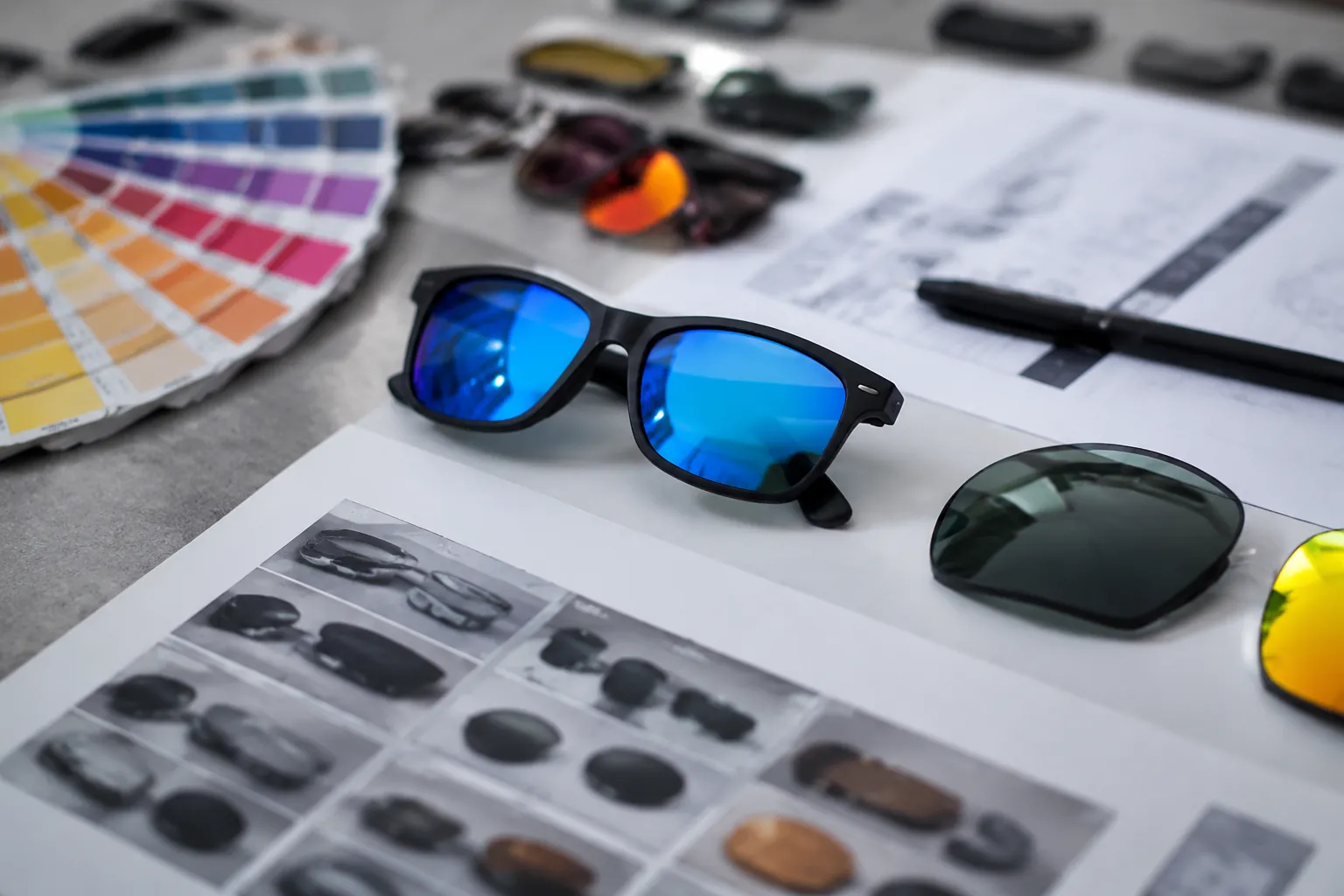
This guide is for eyewear brands, importers, distributors, and retailers ordering mirrored sunglasses in bulk. Mirror lenses often fail because buyers approve the look, while production must control material, tint, coating, handling, assembly, packing, and inspection limits. A vague order such as "blue mirror lens, UV400" is not enough. Use this guide to write clearer specs, approve physical samples, and reduce mismatches between trial orders, bulk runs, and reorders.
Where mirrored sunglass orders fail
Mirror coating looks simple on a sales sample. It is not simple in bulk.
The buyer sees color and shine. The factory must control the lens substrate, base tint, coating recipe, coating equipment, film thickness, curing or drying, cleaning, handling, assembly, and packing. A small change in any step can change the final look.
The failures are common: a blue mirror turns slightly purple, a silver mirror shows pinholes near the edge, a gold mirror gets rubbing marks in packing, or a reorder does not match the first shipment. These problems rarely start at final inspection. They usually start with a weak purchase order.
Separate three variables before you approve anything: lens material, base tint, and mirror layer. A smoke base with blue mirror will not match a brown base with blue mirror. A darker base can hide small coating variation. A lighter base can make color drift obvious.
LumiShades produces custom sunglasses in Wenzhou, with processes that may include lens tinting, injection molding, acetate cutting, CNC milling, decoration, assembly, and QC. For mirrored orders, fewer outside steps can help communication when a shade, surface, or assembly issue needs correction. Still, confirm sample time, production lead time, MOQ, packaging, compliance needs, and pricing in the quotation. These change by frame type, lens type, mirror color, logo method, order quantity, and inspection standard.
Choose the base tint before the mirror color
Mirror color is not a standalone choice. It sits over the base lens.
If the base is too light, the outside may look bright, but the wearer may get more glare than expected. If the base is too dark, the product may feel heavy during retail try-on, even if it performs well outdoors.
For fashion and promotional sunglasses, common base colors include smoke, gray, brown, green, and gradient. Common mirror options include silver, blue, green, red, orange, gold, rose, and rainbow effects. For sport or performance programs, also define visible light transmission, lens category, distortion limits, and polarization.
| Mirror option | Typical visual effect | Bulk production risk | Buyer control action |
|---|---|---|---|
| Silver mirror | Clean reflective surface; works with many frame colors | Shows fingerprints, pinholes, edge voids, and cleaning marks clearly | Use strict handling rules and inspect under angled light |
| Blue mirror | Strong retail color for beach, sport, and promotional styles | Can shift toward purple or cyan if the base tint or coating density changes | Approve against a physical master sample, not a phone photo |
| Gold mirror | Warm premium look on black, tortoise, brown, or clear frames | Fine scratches and rubbing marks are easy to see | Consider lens film, tray separation, or individual sleeves before assembly |
| Red/orange mirror | High-impact fashion and event look | Shade repeatability can be harder across coating batches and reorders | Define acceptable shade range before mass production |
| Green mirror | Outdoor, fishing, and sport appearance | May look dull on the wrong base tint | Confirm both outside reflection and wearer-view color |
Do not approve mirror lenses from studio photos alone. Lighting angle changes the apparent color. Ask for a physical pre-production sample. Keep one signed master sample at the factory and one with your team. Label it with style code, lens material, base tint, mirror color, date, and approver name.
Write a mirror lens spec QC can use
A good spec turns appearance into a production target. It gives QC a reason to reject bad parts. It also protects reorders.
At minimum, your mirror lens specification should include:
- Lens material: PC is common for fashion and promotional sunglasses because it is light, impact resistant, and cost efficient. TAC polarized lenses need separate approval because the layer structure and coating behavior are different.
- Lens thickness: define target thickness and tolerance based on the frame design. Rimless and semi-rimless styles usually need tighter edge and thickness control than full-rim frames.
- Base tint: smoke, gray, brown, green, gradient, or custom tint confirmed by a physical master sample.
- Mirror color: silver, blue, gold, red, orange, green, rose, rainbow, or custom match.
- Visible light transmission: define a target or acceptable range and the lens category required for the selling market. Do not rely on appearance.
- UV protection: confirm UV400 or the UV performance required by the market standard, supported by a valid test report.
- Surface quality: define acceptable and rejectable scratches, dots, coating gaps, edge marks, stains, and fingerprints.
- Handling method: specify trays, sleeves, protective film, bags, glove use, or other controls before final assembly and packing.
A practical cosmetic tolerance may state: no visible scratch in the central viewing zone at the agreed inspection distance, no obvious coating void in the main field of view, and only minor edge defects outside normal view. The exact tolerance depends on price point, retail channel, and AQL agreement. Write it before production.
For EU sunglass sales, CE marking supported by EN ISO 12312-1 testing is commonly required for non-prescription sunglasses. For the US, ANSI Z80.3 is a key non-prescription sunglass standard, and FDA registration or listing obligations may apply depending on the product and the role of the manufacturer, importer, or private labeler. For Australia and New Zealand, AS/NZS 1067 applies. REACH covers chemical substance restrictions for materials and components; it is not an optical performance standard. ISO 9001 relates to quality management systems. BSCI relates to social compliance audits. Neither proves that mirror color, VLT, UV performance, or scratch resistance is correct. Product claims and packaging must match valid reports and the legal rules of the target market.
Control material, coating, and handling
Many promotional and fashion sunglasses use PC lenses. PC is light, impact resistant, and suitable for many injected-frame designs. But a tough lens body does not make the mirror surface scratch-proof.
The mirror layer is a surface finish. It can be damaged by dirty cloths, lens-to-lens contact, rough packing, poor cleaning, or handling the lens instead of the frame.
TAC polarized lenses add more risk points. Polarization layers, lamination, tint density, and coating adhesion must be checked during sampling. If the product will be sold as polarized, confirm the claim with the right lens construction and an inspection method that verifies polarization. A mirrored lens is not automatically polarized.
Mirror coatings are commonly applied by vacuum deposition or a related coating process. Final appearance depends on base tint, coating recipe, layer thickness, equipment condition, process stability, and post-coating handling. Small differences can be visible, especially on red, orange, rose, and gold mirrors. For larger orders, ask whether the full order will be coated in one lot or several lots. Ask how those lots will be identified.
Hard coating can improve abrasion resistance, but it does not make a mirror lens immune to scratches. For high-reflection colors such as silver and gold, use stronger process controls: separated trays, clean gloves, non-abrasive cloths, and no lens-to-lens contact. Prevention beats final re-cleaning.
Approve the lens, not just the frame
A mirrored sunglass sample needs more than one approval. Check the frame fit, lens base tint, mirror appearance, and decoration. Many buyers focus on logo placement and frame color. Then the lens becomes an afterthought. That is risky. On mirrored sunglasses, the lens often carries the whole product.
Use this approval sequence:
- First sample: confirm frame shape, material, lens base tint, mirror direction, decoration method, and general fit. Confirm sample timing in writing because it depends on frame material, lens requirement, logo complexity, tooling, and special components.
- Correction sample: adjust mirror shade, base tint darkness, logo size, hinge feel, or temple print position if needed. Do not approve "almost right" if lens color is central to the product.
- Signed master sample: approve a physical pair as the production standard. Keep one with the buyer and one sealed at the factory.
- Pre-production check: compare the first bulk-coated lenses against the master before full assembly.
- Final inspection: check assembled sunglasses for color consistency, scratches, lens seating, logo quality, hinge function, labeling, and packing.
Decoration can also create problems. Pad printing is cost efficient for temples, but ink and surface treatment must match. Laser engraving is clean on metal or selected coated parts, but it may look subtle on some plastics. Metal logo plates can look higher value, but adhesive or pin fixing must be controlled. Hot stamping and UV printing can work for fashion effects. Test them. Use rub testing or tape testing before approval.
MOQ, price, and lead time: know the trade-offs
A small trial order and a large commercial order should not be managed the same way.
Small MOQs help with market tests, influencer drops, retailer presentations, and private-label trials. Larger quantities can lower unit cost, but they also make mistakes expensive. A small coating issue on a test order may be manageable. The same issue on a chain-retail shipment can become a claim.
LumiShades supports low-MOQ custom sunglass programs. Larger order tiers can reduce unit cost because setup, material purchasing, coating preparation, decoration setup, and packing labor are spread across more units. Ask for a written quotation that separates frame, lens, mirror coating, logo method, pouch or case, barcode labeling, testing, and inspection needs. That makes cost drivers easier to see.
| Order size | Best use | Main mirror lens risk | Recommended control |
|---|---|---|---|
| Small trial order | Market test, sample sale, influencer drop | Buyers may approve color casually because volume is low | Still keep a signed master sample for reorder |
| First commercial batch | Boutique retail run or first paid market launch | Small shade drift becomes visible across cartons | Check first bulk lenses before full assembly |
| Importer or seasonal program | Regional launch, catalogue program, or seasonal retail order | Handling scratches, mixed coating lots, packing variation | Use tray separation, lot labels, and written defect limits |
| Distributor or chain-retail volume | High-volume retail, distributor stock, or repeated program | Batch variation, reorder mismatch, stricter compliance exposure | Lock specs, retain masters, inspect carton spread, document lots |
Count lead time from approved sample, confirmed specification, and agreed payment terms. Do not count from the first inquiry. Custom mirror colors, polarized lenses, special cases, barcode labeling, multiple logo positions, third-party testing, and repeated shade corrections can all extend the schedule. If the delivery date is fixed, freeze the lens standard early. Late tint and coating changes are costly.
Reorders need lot control
Reorder mismatch is one of the most common mirror-lens problems. Buyers assume the factory will repeat the last lens exactly. That is not automatic.
The style code may be the same, but the base tint, coating recipe, raw lens batch, or supplier input may have changed. The difference becomes obvious when old stock and new stock sit together on the same retail shelf.
Build a reorder file for every mirrored sunglass program. Include lens material, lens thickness, base tint, mirror color, frame color, decoration method, logo artwork, packaging, compliance requirements, previous inspection notes, and master sample reference. Photos are useful for communication, but they are not a final color standard. Lighting, camera settings, and screens all distort mirror color.
Ask the factory to compare first reorder output against the retained master before completing the run. If the master sample has aged, scratched, faded, or been lost, approve a fresh standard before mass production.
For programs with multiple shipments, carton and lot labeling helps trace defects. You need to know whether the issue came from one coating batch, one assembly shift, one packing method, or the full order.
Buyer rule: if mirror lens color is part of your brand identity, treat it as a controlled material, not a decoration detail.
Inspect before balance payment and shipment
Final inspection for mirrored sunglasses should cover more than carton counts. Use consistent light. Handle the product by the frame, not the coated lens. Pull samples from different cartons and different parts of the packed order.
Before shipment, check:
- Mirror color consistency: compare random pairs against the signed master sample.
- Lens surface: inspect for scratches, pinholes, coating voids, stains, rubbing marks, and fingerprints under angled light.
- Lens seating: confirm lenses sit correctly in the groove without stress marks, gaps, or twisting.
- Optical basics: check for obvious distortion, wrong tint, mismatched left and right lenses, incorrect VLT category, or unsupported polarization claim.
- Decoration: inspect pad print, laser engraving, UV print, hot stamp, or metal logo plates for position, adhesion, and consistency.
- Compliance labeling: confirm that CE EN ISO 12312-1, ANSI Z80.3, AS/NZS 1067, REACH, FDA registration, ISO 9001, or BSCI references are used only where supported and relevant.
- Packing: verify pouches, cases, polybags, tags, barcode labels, instruction sheets, carton marks, and master carton counts.
If buying for retail, define inspection level and defect limits before production. Visible mirror scratches in the central viewing area should usually be treated as serious cosmetic defects. They affect appearance and user acceptance. Low-cost promotional sunglasses may allow wider tolerance, but the rule still needs to be written. Clear standards reduce disputes after cartons are packed.
Have a custom sunglasses project in mind?
Send us your styles, target market and quantities and we will return a detailed quote with MOQ, lead time and a sample plan.
Get a QuoteWhy source this from Wenzhou with LumiShades
Wenzhou in Zhejiang Province is widely regarded as China’s eyewear manufacturing capital, producing a large share of the world’s sunglasses. That concentration matters to buyers: a deep local supply chain for acetate sheet, hinges, lens blanks, plating and packaging means shorter component lead times, easier color and material matching, and a workforce with decades of eyewear-specific skill. LumiShades has manufactured in this ecosystem since 2009, and our vertical integration — in-house injection molding, acetate cutting, CNC milling, lens tinting, decoration and quality control — means no part of your order is quietly subcontracted to a workshop you cannot audit.
For international buyers, that vertical control translates into accountability. When a single factory owns every step, defects are traced and fixed at source rather than bounced between vendors, and your specifications survive intact from first sample to bulk. We back this with 15+ years of experience, shipments to 60+ countries, more than 5 million pairs produced per year and a 98.5% on-time delivery rate. Our certifications — CE EN ISO 12312-1, FDA registration, ANSI Z80.3, AS/NZS 1067, REACH, ISO 9001 and BSCI audit — mean the compliance documentation your market requires already exists. Explore our manufacturing capabilities and quality control process to see how this works in practice.
Frequently asked questions
Can LumiShades match a mirror lens color from our existing sample? Yes. Send a physical sunglass or loose lens whenever possible. Also provide the target market, lens material preference, polarization requirement, and any VLT or lens-category requirement. LumiShades should make a counter sample for approval, and the approved physical sample should become the production master. Photos can help communication, but they should not be the final color approval.
Which mirror colors are hardest to keep consistent in bulk? Red, orange, rose, and some gold mirrors often show shade differences clearly because small coating or base-tint changes are easy to see. Blue can shift toward purple or cyan if the base tint changes. Silver is more neutral in color, but it reveals scratches, pinholes, fingerprints, and cleaning marks. For these colors, approve a physical master sample and check first bulk lenses before full assembly.
What should a mirror lens specification include? Include lens material, thickness and tolerance, base tint, mirror color, VLT or lens category, UV requirement, applicable compliance standard, polarization requirement if any, surface defect tolerance, handling method, packing method, and signed physical master sample reference. Also state whether the order may be coated in multiple lots and how those lots should be labeled.
Is a small MOQ enough for a custom mirror sunglasses order? It can be enough for a test order, sample sale, influencer drop, or retailer presentation. The risk is that buyers sometimes treat small orders casually and skip documentation. Even for a small run, approve a physical master sample, record the lens material and base tint, and keep the reorder file. If the test succeeds, those records make the larger order easier to reproduce.
How do we prevent reorder mismatch on mirrored lenses? Keep a signed master sample and a detailed reorder file with lens material, thickness, base tint, mirror color, frame color, logo method, packaging, compliance notes, and previous inspection results. Before the reorder is fully assembled, ask the factory to compare first coated lenses against the retained master. If the master is damaged or aged, approve a fresh standard before mass production.
Do mirrored lenses need special packing? Often, yes. High-reflection coatings such as silver and gold show rubbing marks quickly. Use tray separation, individual lens or frame bags, clean gloves, non-abrasive cloths, or protective film when needed. Define these requirements before quotation because added protection can affect packing cost, labor, and lead time.
Ready to start?
Explore our rimless sunglasses or request a quote — our sales team replies within 12 hours.
Request a Quote