
Magnetic Clip-On Sunglasses: OEM Checks to Cut Returns
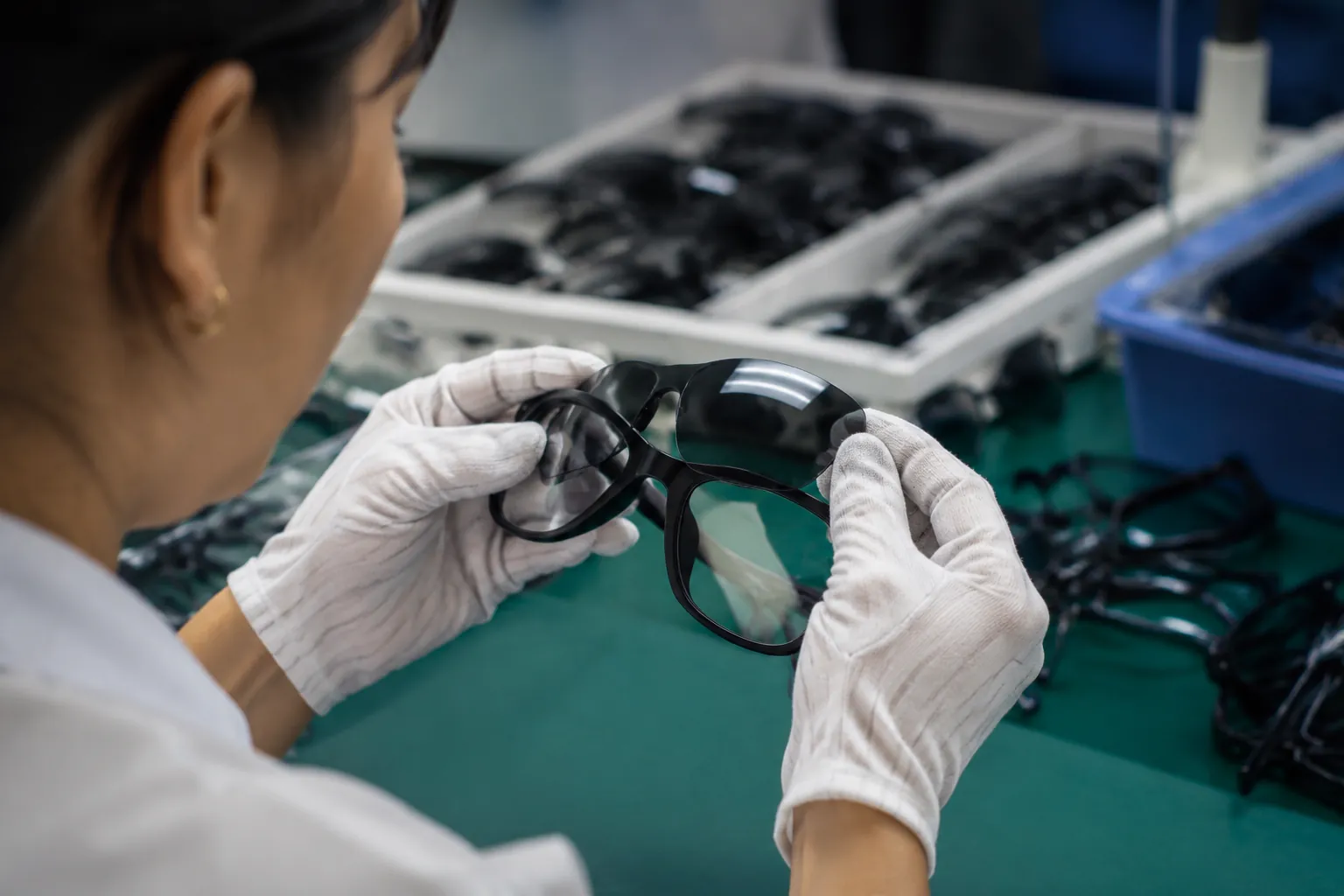
This guide is for eyewear brands, importers, distributors, and retailers developing magnetic clip-on sunglasses for optical-style frames. The product looks simple. It is not. Common failures include reversed magnet polarity, a clip that sits low or crooked, sun lenses touching prescription lenses, and finish wear around contact points. Treat the frame and clip as one fitted system. Do not treat the clip as a loose accessory. Use the checks below before tooling, sampling, and bulk approval so fit, retention, clearance, labeling, and compliance are controlled from the start.
1) Start With the Frame, Not the Clip
Most magnetic clip-on failures start with the base frame. If the optical front is too thin, too flexible, too curved, or inconsistent from piece to piece, magnets will not fix the problem. Review the frame first. Check rim thickness, front curve, bridge geometry, end-piece area, lens groove position, and the space available for magnet seats or locating features.
Acetate fronts usually give more room for recessed magnet pockets, with material around the magnet for support. Injection frames can also work well when the mold has a controlled magnet seat. Trouble starts when magnets are placed by hand into shallow or inconsistent cavities. Position drift follows. Metal fronts need closer review. They may need bridge tabs, end-piece landing areas, welded or soldered features, or a clip design that avoids rubbing plated surfaces during attachment and removal.
Do not approve a clip-on concept from a front photo. Send the supplier a physical master frame or a complete technical package. Include A/B measurements, DBL, front curve, rim cross-section, lens groove depth, hinge height, bridge geometry, and target magnet coordinates. Small bridge or magnet-position errors can create visible asymmetry once the clip is mounted, especially on thin or high-contrast frames.
- Good candidate: an optical frame with stable rim thickness, moderate front curve, repeatable bridge shape, and enough material or hardware area for magnet seating and clip location.
- Risky candidate: ultra-thin metal fronts, aggressive cat-eye peaks, high-wrap fronts, sculpted bridges with no stable landing point, or frame fronts that flex when the temples are opened.
- Common complaint: the clip looks fine on the table but shifts, drops, or rocks once the frame is worn because the base front changes shape under temple tension.
Before sampling, ask the factory three direct questions. Are the magnet locations feasible? Is side clearance likely after finished prescription lenses are fitted? Should the clip follow the rim closely, or sit slightly proud to avoid lens and surface contact? This early review is easier than correcting fit after tooling or decoration has started.
2) Control Magnet Polarity, Retention, and Corrosion
Buyers often ask for stronger magnets. That is the wrong target. The target is controlled retention. Too much force can make removal difficult, twist the optical frame, stress adhesive joints, or pull magnets out of shallow seats. Too little force causes rattling, sliding, or detachment. Uneven force is just as bad.
Most eyewear clip-ons use small neodymium magnets. The supplier must specify the right grade, diameter, thickness, coating, and seat depth for the actual frame construction. A higher magnet grade does not guarantee better performance. If the magnet is buried too deep, installed off-center, paired with the wrong pole, or bonded into a weak seat, the clip will fail.
The drawing should identify magnet quantity, position, polarity direction, exposed or covered installation, adhesive type if used, and any mechanical retention feature. Polarity must be controlled by drawings and fixtures, not by memory.
Corrosion also matters. Neodymium magnets are commonly plated, often with nickel-based coating systems. If the coating is damaged during insertion or polishing, sweat, humidity, and cleaning chemicals can cause staining or corrosion around the magnet area. For export programs, ask the supplier to state the magnet coating and confirm the finished assembly is suitable for the intended wear environment.
| Magnet parameter | What to specify | How to check | Failure if uncontrolled |
|---|---|---|---|
| Polarity | Marked left/right and mating direction on drawings and fixtures | In-process polarity check before final assembly | One side repels, clip sits crooked, or final assembly fails |
| Retention force | Approved feel or measurable pull-force range agreed with supplier | Compare to golden sample or use a defined pull test | Weak attachment, harsh snap, or frame twisting during removal |
| Seat depth and position | Controlled cavity dimensions and magnet coordinates | Fixture check before lens fitting and after finishing | Uneven hold, visible misalignment, or magnet print-through |
| Coating and bonding | Magnet coating, adhesive system, and mechanical retention method | Humidity, sweat, rub, and repeated attach-remove checks as agreed | Corrosion, staining, loose magnets, or pull-out during use |
If you do not have lab equipment, define practical sampling tests. Attach the clip. Hold the frame in a consistent position. Apply a defined light shake. Check for shift, rattle, and detachment. Then repeat attach-remove cycles to confirm magnets do not loosen and finish wear stays within the agreed limit. For larger programs, request a numerical pull-force range or require production to be checked against an approved golden sample with a documented pass/fail method.
3) Define Alignment Tolerances Before Sampling
Alignment is the first thing many consumers notice. The sun-lens outline sits directly over the optical frame. Small errors look careless. Before sampling, agree on visible alignment tolerances for bridge centering, left/right lens height, top-line parallelism, rim-to-clip gap, and rocking.
Separate critical visible areas from less visible areas. Critical areas usually include the bridge, brow line, outer upper corners, and any front-view light gap. Put the tolerance into the drawing or QC standard. Do not rely on comments such as "looks good" or "slightly off." They are not inspection criteria.
A clip can appear centered on a flat table and still sit wrong on the face. The optical front may change slightly when the temples are opened. Use two checks: a bench check on a stable fixture and a wear-position check on a face-form fixture or approved wearer test.
- Approve the master optical frame and the master clip as one matched set, not as separate components.
- Mark the bridge centerline, magnet center points, and lens-height reference on the approved golden sample.
- Measure left/right clip-to-rim gaps after final lens insertion, because lenses can influence the frame front.
- Open and close the temples several times, then recheck clip position and rocking.
- Check the packed set after transit simulation or handling review to confirm the clip has not shifted or rubbed the frame.
Material behavior changes the risk. Injection fronts may vary with molding conditions. Acetate fronts can move during heating, tumbling, polishing, or lens insertion. Metal fronts may hold shape well, but fit errors are obvious if the bridge angle or soldering position is off. These risks are manageable only when the supplier uses fixtures for front forming, magnet insertion, clip pairing, and final inspection.
For premium programs, ask whether the factory pairs each clip to each frame or checks by batch only. Individual pairing adds labor. It can also reduce visible variation on designs with tight gaps, high-contrast colors, or thin rims.
4) Match Lenses by Color, Curve, Thickness, and Standard
The clip lens is not just a tinted copy of the optical lens shape. It must match the frame curve, sit close without touching the prescription lens, provide the intended sun protection, and meet the applicable sunglass requirements for the selling market. Vague instructions cause trouble. "Smoke lens," "grey polarized," and "UV lens" are not enough. Use a physical target sample, written color standard, lens category requirement, and approved viewing conditions.
Common clip-on lens options include solid tinted plastic lenses, polarized lenses, gradient lenses, and mirror-coated lenses. The right choice depends on price point, market, optical quality expectations, scratch-resistance expectations, and compliance requirements. Polarized lenses need consistent axis orientation. Gradient lenses need controlled top-to-bottom color placement. Mirror coatings need stricter handling and packing controls because marks and color shifts are easy to see.
| Lens option | Buyer benefit | Typical caution |
|---|---|---|
| Solid tinted | Cost-effective and easier to repeat across production lots | Confirm lens category, UV claim, color tolerance, and visible light transmission if required |
| Gradient | Fashion appearance for optical retail programs | Check pair-to-pair gradient height and color consistency |
| Polarized | Useful for driving, water, snow, and outdoor retail positioning | Confirm polarization axis, lens marking, and distortion control |
| Mirror coated | Strong shelf impact and premium appearance | Higher risk of handling marks, coating scratches, and lot-to-lot color shift |
Specify destination-market requirements early. Common references include CE marking with testing to EN ISO 12312-1 for sunglasses sold in the EU, ANSI Z80.3 for non-prescription sunglasses in the US, and AS/NZS 1067 for Australia and New Zealand. REACH may apply to restricted substances in materials, coatings, and surface treatments for products placed on the EU market. FDA registration may be relevant to US import and business processes for eyewear products, but it does not replace performance testing to the applicable sunglass standard.
If one style will ship to multiple regions, tell the factory before sampling. Lens category, UV claims, warnings, labeling, user information, packaging text, and test reports must be aligned before mass production. Fixing them after packing is expensive and slow.
5) Design Side Clearance Before Bulk Approval
A magnetic clip-on should sit close enough to look integrated. It must not touch the prescription lens. Lens contact is a common return reason because many approvals focus only on the front view. From the side, the clip lens may touch the Rx lens at the nasal zone, lower rim, bridge area, or outer edge. The risk increases after the optical frame is fitted with real prescription lenses.
Ask for side-view photos and measured clearance checks during sampling. Review the finished frame with demo lenses and, where possible, simulated prescription lens profiles that represent the intended retail use. A clip that clears a thin plano demo lens may fail after an optician fits a stronger plus or minus lens with different center thickness, edge thickness, or base curve.
The safest design indexes the clip from the frame, not from the lens. Magnets, bridge hooks, locating lugs, or controlled landing surfaces should determine the final position. The sun lens must not become the stop point. If the design uses a bridge hook or metal landing feature, inspect repeated-use wear on plating, lacquer, acetate, or printed decoration.
Practical buyer rule: if the product will be sold through optical retail where stronger prescriptions may be fitted, require a conservative side-clearance review before bulk approval. A small increase in standoff is easier to manage than scratched prescription lenses and customer returns.
Put the clearance requirement into the QC standard. State where clearance is checked, whether the check uses demo lenses or simulated Rx lenses, and what counts as a failure. "No visible contact" is too weak if the clip flexes during attachment, removal, or packing.
6) Keep Branding Durable and Clear of Fit Points
Decoration space on magnetic clip-on sets is limited. The consumer handles the clip directly. The front is thinner. Magnets and locating features occupy areas that may normally hold branding. A logo that works on a standard sunglass temple may fail on a clip corner, near a magnet pocket, or on a high-contact bridge area.
Common OEM decoration methods include laser engraving, pad printing, hot stamping, and small metal logo plates. Laser marking can be durable on suitable materials but may have low contrast on dark glossy surfaces. Pad printing offers more color flexibility but needs adhesion and rub checks. Hot stamping can give a premium look, but edge lift and wear must be checked. Metal logo plates can add perceived value, but they add weight and may affect balance or clip fit if placed too close to the edge or magnet seat.
- Put logo location, size, color, and method into the technical drawing, not only the packaging artwork.
- Confirm whether branding appears on the base frame, clip, lens, case, pouch, cleaning cloth, carton, or all components.
- Check logo visibility after final lens assembly; bevels, lens edge thickness, or clip curvature may hide part of the mark.
- Run tape, rub, sweat, or alcohol-resistance checks when the decoration will be touched frequently.
- Keep decoration clear of magnet pockets, flex points, hooks, locating lugs, and areas that contact the frame.
Lock color and finish standards early. If the clip and optical frame are sold as one SKU, define the finish precisely. Black may mean gloss black, matte black, translucent black, gunmetal, or another finish. Small mismatches are more visible on a paired product than on a single frame.
7) Confirm MOQ, Cost, and Lead Time by Stage
Magnetic clip-on sets usually cost more than comparable basic frames because they are matched systems. The set includes an optical frame, a separate clip, magnets or locating hardware, sun lenses, extra assembly, pair matching, and fit inspection. Unit cost depends on frame material, magnet structure, lens type, decoration, packaging, testing, order quantity, and tooling.
MOQ is supplier-specific. Some factories can support small pilot quantities when using an existing frame platform or existing clip tooling. New frame tooling, custom colors, custom lens colors, exclusive hardware, and special packaging usually require higher quantities. Do not ask only for the lowest MOQ. Ask what changes at each quantity level: tooling cost, unit price, sampling fee, color options, lens options, inspection method, and delivery schedule.
| Order stage | Typical buyer deliverable | What commonly delays it | Buyer action |
|---|---|---|---|
| Design review | Frame sample or complete technical file, lens target, logo file, destination market | Missing frame data, unclear lens color, unknown compliance requirement | Send physical samples and drawings before requesting final price |
| Sample making | Approved frame platform, magnet plan, clip outline, lens choice, decoration method | New clip geometry, uncertain magnet position, color matching, tooling changes | Evaluate fit, retention, lens color, polarization if used, and side clearance |
| Pre-production confirmation | Signed golden sample, confirmed packaging, labels, warnings, and inspection standard | Late artwork, missing test requirement, change in lens category or logo | Approve one complete packed set, not only loose components |
| Bulk production | Deposit or payment arrangement, final PO, approved QC plan | Material shortage, revised tint, new mold, decoration rework, missing compliance documents | Avoid mid-production changes and keep golden samples at both factory and buyer side |
Do not compress sampling to save a few days. That is where expensive failures begin: polarity mistakes, poor curve match, hidden lens contact, unstable retention, and packaging rub. A controlled sample stage is cheaper than rework, returns, or rejected shipments.
8) Inspect the Complete Set Before Shipment
Final inspection must cover the complete set: optical frame, clip, magnets, sun lenses, decoration, case or pouch, labeling, and packing. Cosmetic review alone is not enough. If the inspector checks only the base frame, the main product risk has been missed.
Define defect classes before production. Critical defects may include sharp edges, magnet detachment, incorrect lens category, missing required warning or labeling, or materials that do not meet the agreed compliance requirement. Major defects may include obvious misalignment, weak or uneven retention, lens contact, wrong logo, unstable packing, or visible coating damage. Minor defects may include small cosmetic marks outside the agreed visible zone, if they are within the approved standard.
- Fit test: the clip attaches flat, centered, and without rocking on the correct frame.
- Retention test: left and right removal feel or measured pull force matches the approved golden sample or agreed range.
- Clearance test: the sun lens does not touch the optical lens, frame front, logo, or coating in normal use.
- Lens test: tint, UV claim, lens category, polarization if applicable, and visual quality match the approved sample and test requirement.
- Decoration test: logo position, color, adhesion, and scratch or rub resistance meet the approved standard.
- Packing test: the clip cannot rub, scratch, or press against the optical frame or lenses during transit.
Supplier management systems and social-compliance documents can support the program. Relevant documents may include ISO 9001 for quality management and BSCI for social compliance where required by the buyer. Product-related requirements may include CE marking with EN ISO 12312-1 testing for the EU, ANSI Z80.3 for the US, AS/NZS 1067 for Australia and New Zealand, REACH documentation for the EU, and FDA registration where applicable to US eyewear import processes. State the destination market on the purchase order. Confirm documents, test reports, labels, and warnings before production starts.
Keep one approved golden sample at the factory and one with the buyer. If a dispute appears later, a physical matched sample is more reliable than photos, especially for alignment, lens color, retention feel, and clearance.
Have a custom sunglasses project in mind?
Send us your styles, target market and quantities and we will return a detailed quote with MOQ, lead time and a sample plan.
Get a QuoteWhy source this from Wenzhou with LumiShades
Wenzhou in Zhejiang Province is widely regarded as China’s eyewear manufacturing capital, producing a large share of the world’s sunglasses. That concentration matters to buyers: a deep local supply chain for acetate sheet, hinges, lens blanks, plating and packaging means shorter component lead times, easier color and material matching, and a workforce with decades of eyewear-specific skill. LumiShades has manufactured in this ecosystem since 2009, and our vertical integration — in-house injection molding, acetate cutting, CNC milling, lens tinting, decoration and quality control — means no part of your order is quietly subcontracted to a workshop you cannot audit.
For international buyers, that vertical control translates into accountability. When a single factory owns every step, defects are traced and fixed at source rather than bounced between vendors, and your specifications survive intact from first sample to bulk. We back this with 15+ years of experience, shipments to 60+ countries, more than 5 million pairs produced per year and a 98.5% on-time delivery rate. Our certifications — CE EN ISO 12312-1, FDA registration, ANSI Z80.3, AS/NZS 1067, REACH, ISO 9001 and BSCI audit — mean the compliance documentation your market requires already exists. Explore our manufacturing capabilities and quality control process to see how this works in practice.
Frequently asked questions
Can I add a magnetic clip to an existing optical frame design? Often yes, but only after a fit review. Send the supplier a physical frame sample or a complete technical drawing with front curve, rim section, bridge shape, lens groove, hinge height, and intended lens type. Ask the factory to confirm magnet seat feasibility, polarity layout, clip outline, side clearance with finished prescription lenses, and any tooling or frame modification needed. Do not approve the project from photos alone.
What MOQ makes sense for a first magnetic clip-on order? MOQ depends on the supplier, tooling, material, color, lens type, and packaging. For a first order, ask for two quotations: one pilot quantity using the closest existing frame or tooling, and one commercial quantity with the final material, lens, logo, compliance, and packaging requirements. Use the pilot to confirm fit, retention, lens color, decoration, and clearance. Do not assume pilot pricing or timing will match bulk production.
How should I specify magnet strength if I do not have lab equipment? Use a golden sample and a written pass/fail method. Require the clip to attach fully, sit flat without rocking, resist a defined handling or shake test, and remove smoothly without twisting the frame. Compare left and right removal feel against the golden sample. For larger orders, ask the factory to provide a measurable pull-force range and record in-process checks for polarity, magnet position, and retention.
Which standards usually apply to magnetic clip-on sunglasses? The applicable standard depends on the selling market and the product claim. Common references include CE marking with EN ISO 12312-1 testing for sunglasses sold in the EU, ANSI Z80.3 for non-prescription sunglasses in the US, and AS/NZS 1067 for Australia and New Zealand. REACH may apply to materials and coatings for the EU. FDA registration may be relevant to US eyewear import processes, but it does not replace sunglass performance testing or correct labeling.
What is a realistic lead time for OEM magnetic clip-ons? Lead time depends on whether the supplier is using an existing frame platform or creating new tooling. Before confirming a date, ask the factory to separate the schedule into design review, sample making, sample revision if needed, pre-production approval, testing or documentation, bulk production, and packing. Bulk should start only after you approve one complete matched set, including frame, clip, lenses, decoration, labels, and packaging.
Ready to start?
Explore our shield & oversized sunglasses or request a quote — our sales team replies within 12 hours.
Request a Quote