
Rubberized Sunglasses Frames: Cost, Specs, Risks
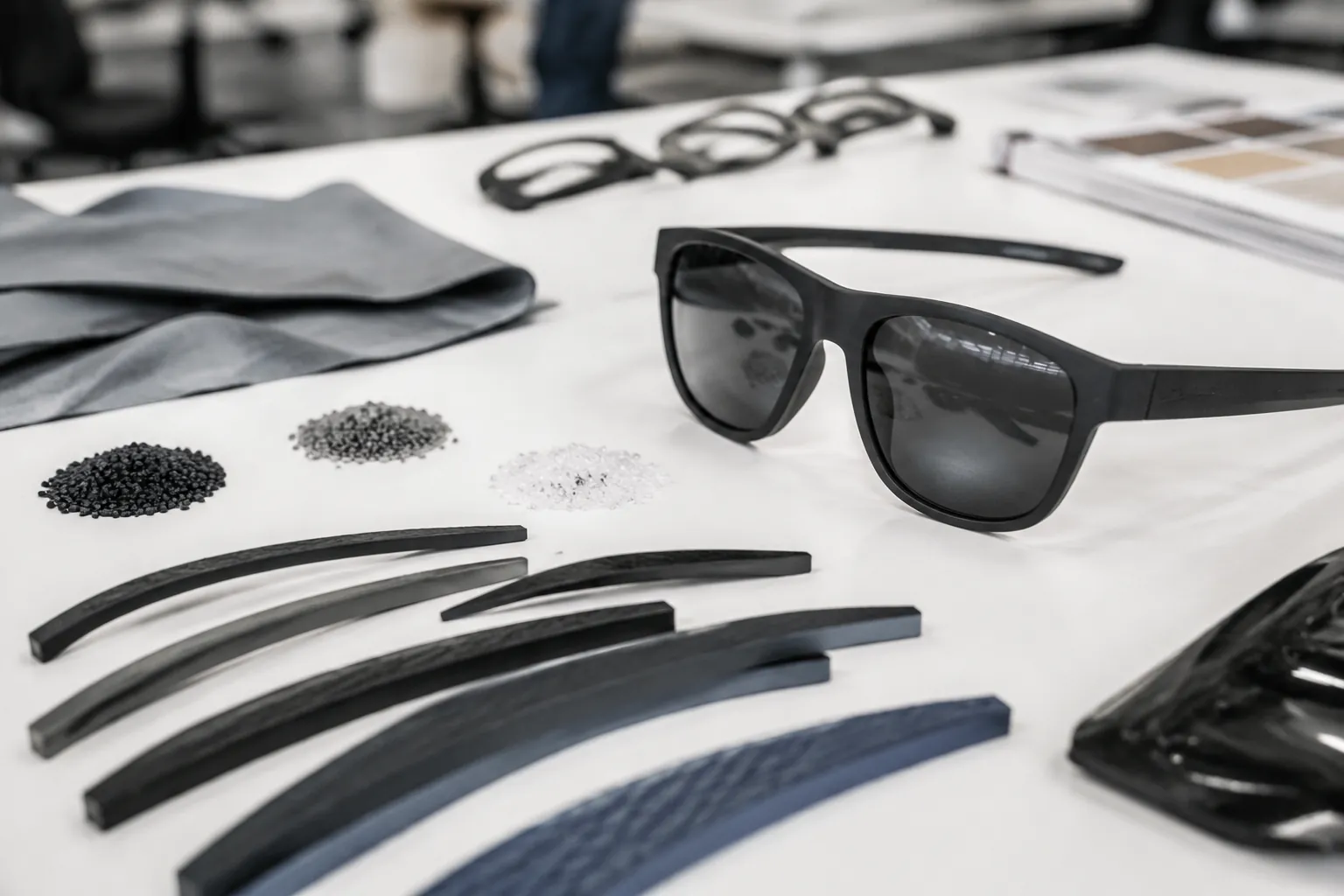
This guide is for brands, importers, distributors, and retailers specifying soft-touch or rubberized finishes on custom sunglasses. It focuses on what buyers can verify before placing a purchase order: whether the coating is worth the risk, which frame materials make sense, where defects start, how decoration and packaging affect durability, and which compliance routes still apply to the finished sunglasses.
Use rubberized coating only when the feel is worth the risk
Rubberized or soft-touch coating changes how a frame feels in the hand. It can make sunglasses feel less slick, lower in gloss, and more tactile. That matters in retail, especially when shoppers handle the product before buying.
But it is not the answer to every matte brief. A molded matte texture can often deliver a low-gloss look without adding a coating process. If the goal is a basic matte black promotional frame, molded matte is usually simpler, cheaper, and safer than a sprayed soft-touch finish.
Most soft-touch programs start with injection-molded plastic frames such as PC or TR90. Parts are molded, cleaned, coated, cured, inspected, and then assembled. Acetate can also be coated, but ask why. Acetate already has its own look and handfeel. Coating it can hide that value and add adhesion risk if polishing compound remains on the surface.
Practical rule: specify rubberized coating only when handfeel, grip, or brand positioning is part of the product value. Do not use it just because the design brief says "matte."
Cost, MOQ, and lead-time logic for soft-touch sunglasses
Soft-touch coating is an added process, not a simple finish swap. It can raise cost because the frame must be prepared, sprayed, cured, protected during handling, and inspected for defects that do not apply to an uncoated molded frame.
The final cost depends on frame material, geometry, coating color, order quantity, logo method, packaging format, and expected rejection rate. Yield matters. A finish that looks good on one sample can still lose money if bulk rejection is high.
MOQ depends on the supplier's production model. In general, coating programs run more efficiently at higher volumes because setup, spray trials, color approval, and QC effort are spread across more units. For a first order, a pilot run is often smarter than a large launch. It lets the buyer test the finish, packaging, and market response before scaling.
Lead time can increase when the coating color is custom matched. A new color usually needs spray-out panels or sample frames for approval under controlled lighting. Decoration can add time too. Logo adhesion, laser contrast, and hot-stamp appearance should be tested on the cured coating, not assumed.
| Finish option | Best use case | Typical MOQ logic | Cost impact | Lead-time impact | Main production risk |
|---|---|---|---|---|---|
| Molded matte, no coating | Budget promotions, event giveaways, simple low-gloss programs | Often easier to run at low and mid volumes | Lowest | Usually follows standard frame production timing | Lower perceived value if texture is not well controlled |
| Standard soft-touch coating | Sports, fashion, private-label, tactile retail programs | Usually more efficient at mid to higher volumes | Higher than molded matte due to coating and extra QC | May fit normal production timing if color and process are already approved | Rub marks, shine variation, edge abrasion |
| Custom-color rubberized coating | Brand color programs and coordinated retail collections | Often more practical at higher volumes because color approval adds setup work | Higher due to matching, sampling, and scrap risk | Can add time for color development and approval | Batch color drift and uneven coating thickness |
| Soft-touch plus logo decoration | Private label, licensed ranges, corporate gifting | Depends on decoration setup and validation requirements | Higher because decoration compatibility must be tested | Can add time for adhesion trials or laser evaluation | Ink lifting, poor laser contrast, edge damage during handling |
The hidden cost is handling discipline. Soft-touch surfaces can mark from pressure, friction, or early packing. Labor and inspection requirements are usually stricter than for standard molded frames.
Where the factory process fails
A good rubberized finish depends on the full process. Not just the coating. Cleaning, spray control, curing, assembly, and packing all affect the result.
Ask the supplier to show the actual process flow. Also ask where coating inspection happens. If defects are found only after final assembly, rework can become slow and expensive.
- Molding or cutting: PC and TR90 parts are usually injection molded. Acetate parts are cut and CNC finished. If possible, keep the substrate color close to the coating color so minor edge wear is less obvious.
- Deburring and edge preparation: gate marks, parting lines, hinge areas, and temple tips should be corrected before coating. Coating will not reliably hide poor molding or rough edges.
- Cleaning: the surface must be free of mold release, oil, fingerprints, polishing compound, and dust. Poor cleaning often causes fisheyes, craters, or weak adhesion.
- Primer control: some substrates and coating systems need primer. Too much primer can affect edge durability, hinge fit, or assembly tolerance.
- Spraying: coating should be applied in controlled passes. Corners, hinge zones, and broad visible areas need close attention. Film build that is too heavy or too light can change both appearance and durability.
- Flash-off and curing: parts should be racked so they do not touch while drying and curing. Cure time depends on the coating system and factory process. Confirm when the frame is safe for decoration, assembly, and packing.
- Decoration: pad printing, laser marking, hot stamping, or metal logos should be tested on the fully cured coating. A logo method that worked on an uncoated frame may fail here.
- Assembly and final QC: lenses, hinges, screws, and packaging should be completed only after coated parts pass appearance and handling checks.
Use a written visual standard. Agree on viewing distance, lighting, and critical appearance areas. Typical critical areas include the front face, bridge, brow line, outer temple surfaces, and visible hinge zones.
Material behavior: PC, TR90, acetate, and mixed frames
The same coating does not behave the same way on every frame material. Do not approve by color alone. Check adhesion, flexibility, fit, and in-use stress.
PC is common for cost-sensitive and mid-range sunglasses because it molds efficiently. TR90 is often used for lighter, more flexible styles, especially sport frames. That flexibility can stress the coating near hinges and bend points. Acetate may already give the premium look and feel the buyer wants, so coating it needs a clear reason.
Mixed-material frames add another issue. Metal and plastic do not always show the same coating color, texture, or gloss. Approve a finished frame, not separate swatches.
Coating thickness can also affect assembly. Film build at hinge seats, screw areas, and lens contact zones can change fit. Check coated parts before assembly and again after assembly.
- PC frames: practical for many volume programs, but adhesion depends on clean surfaces and compatibility between substrate, primer, and coating.
- TR90 frames: useful for lightweight and flexible styles; flex testing is important because repeated movement may reveal cracking or edge lifting.
- Acetate frames: often do not need coating to achieve a premium feel; if coated, surface cleaning after polishing is critical.
- Metal plus plastic frames: appearance can vary across substrates, so approval should be based on a finished sample, not only on separate material swatches.
- Dark substrate under dark coating: usually gives a more forgiving wear appearance if minor edge abrasion occurs in use.
For custom colors, never approve from a Pantone chip alone. Matte and soft-touch surfaces reflect light differently from paper or glossy plastic. Approve a sprayed panel and a finished frame. Keep signed control samples for production.
Specify feel, color, gloss, and decoration clearly
Words such as "rubber finish," "skin feel," and "soft matte" are too loose for production. They sound useful. They are not enough.
A stronger specification includes substrate material, coating description, approved color reference, gloss expectation, decoration method, and visual acceptance standard. If instrument measurement is not practical, the approved production sample becomes the reference.
Color approval should happen under an agreed light source. If the buyer needs instrumental color control, discuss it early. Matte and textured surfaces can be harder to measure consistently than smooth gloss surfaces.
Decoration must be validated on the actual cured coating. Pad printing needs ink that bonds to the coating, not just to the base plastic. Laser marking may expose the substrate color or produce weak contrast. Fitted metal logos can reduce ink-adhesion risk, but they add assembly steps and can fail through glue overflow, misalignment, or weak attachment. Hot stamping may work on some coating systems, but poor control of heat or pressure can create gloss variation.
Write the logo requirement in plain terms: size, position tolerance, color, method, and visual acceptance criteria. Also confirm that decoration is applied only after the coating has fully cured.
Common failure modes and how to prevent them
Most soft-touch failures are visible during inspection. The cause usually starts earlier: poor cleaning, weak coating compatibility, bad cure control, decoration mismatch, or unsafe packaging contact.
Treat coating performance as a system. Substrate, coating, decoration, packaging, and transit exposure all interact.
| Defect | Likely cause | High-risk area | Prevention or test | Suggested acceptance logic |
|---|---|---|---|---|
| Peeling or edge lifting | Surface contamination, incompatible primer or coating system, insufficient cure | Hinges, bridge edges, temple tips, screw areas | Run an adhesion check on pre-production samples and inspect again after folding and handling | No visible lifting on agreed critical appearance areas after agreed handling test |
| White or shiny rub marks | Friction during packing or transit, pressure on not-fully-cured surfaces, rough contact materials | Front corners and outer temple faces | Keep packed samples under realistic pressure and then inspect after unpacking | No obvious mark under the agreed visual standard on A-grade visible surfaces |
| Dust specks or craters | Dirty spray environment, static, poor filtration, inadequate cleaning | Wide temple faces and front surfaces | Define an appearance limit before bulk production and compare against approved control sample | Reject obvious or clustered defects in agreed critical areas |
| Uneven color | Variable film build, inconsistent spraying, batch variation, substrate show-through | Front-to-temple comparison and left-right pair matching | Approve both sample panels and finished frame samples under consistent lighting | No obvious mismatch within one pair under agreed light source |
| Sticky or tacky surface | Incomplete cure, incompatible chemistry, heat exposure during storage or transit | Whole packed frame | Open and inspect retained packed samples after heat exposure or storage simulation | No sticking, transfer, or objectionable tack after agreed check |
Do not approve from photos alone. Photos do not show tackiness, rub sensitivity, minor gloss shifts, or what happens after folding and packing.
Packaging is part of the coating specification
A soft-touch frame can pass final inspection and still arrive damaged. Packaging can cause the failure. Friction, compression, heat, and contact with rough or reactive materials can all mark the surface.
Approve the final packed sample, not only the bare frame. Check whether folded temples touch the front. Check whether the pouch, bag, insert, or printed card rubs high points. Materials that work for glossy frames are not automatically safe for soft-touch finishes.
- Approve the final packed sample, not only the bare frame.
- Check whether folded temples touch the front inside the bag or pouch.
- Hold packed samples for a defined period, then inspect likely rub points.
- Test logo appearance and adhesion after pouch or box contact.
- Confirm that retail boxes prevent movement without creating pressure marks.
- Do not pack before the supplier confirms the coating has reached the required cure stage.
Transit temperature matters too. Heat inside trucks, warehouses, or containers can increase the risk of blocking, transfer, or tack if the coating is not fully cured or if packaging materials react with the finish. For higher-risk orders, request a packed-sample heat check before mass packing starts.
Compliance and the bulk approval checklist
A rubberized coating does not replace eyewear compliance. The finished sunglasses still need to meet the relevant market requirements for lens performance, UV protection, labeling, and applicable chemical restrictions.
Depending on the target market and buyer requirements, the program may need to address CE EN ISO 12312-1, ANSI Z80.3, AS/NZS 1067, REACH, FDA registration, ISO 9001, and BSCI.
For the EU market, EN ISO 12312-1 applies to sunglasses for general use, and REACH may apply to restricted substances in frame materials, coatings, inks, and packaging. For the United States, ANSI Z80.3 is a common reference standard for non-prescription sunglasses, and FDA registration may be part of the supplier's regulatory setup. For Australia and New Zealand, AS/NZS 1067 is the relevant standard. ISO 9001 and BSCI can support supplier qualification, but they do not replace product compliance.
Before bulk production, confirm these points in writing: frame material, coating type, approved color sample, finish reference, logo method, lens specification, required compliance route, packaging materials, visual acceptance standard, and shipping-market labeling requirements. Keep signed control samples with both buyer and supplier.
Soft-touch coating can improve perceived value. It also demands tighter approval. Test the full system: substrate, coating, decoration, packaging, and transit exposure.
Have a custom sunglasses project in mind?
Send us your styles, target market and quantities and we will return a detailed quote with MOQ, lead time and a sample plan.
Get a QuoteWhy source this from Wenzhou with LumiShades
Wenzhou in Zhejiang Province is widely regarded as China’s eyewear manufacturing capital, producing a large share of the world’s sunglasses. That concentration matters to buyers: a deep local supply chain for acetate sheet, hinges, lens blanks, plating and packaging means shorter component lead times, easier color and material matching, and a workforce with decades of eyewear-specific skill. LumiShades has manufactured in this ecosystem since 2009, and our vertical integration — in-house injection molding, acetate cutting, CNC milling, lens tinting, decoration and quality control — means no part of your order is quietly subcontracted to a workshop you cannot audit.
For international buyers, that vertical control translates into accountability. When a single factory owns every step, defects are traced and fixed at source rather than bounced between vendors, and your specifications survive intact from first sample to bulk. We back this with 15+ years of experience, shipments to 60+ countries, more than 5 million pairs produced per year and a 98.5% on-time delivery rate. Our certifications — CE EN ISO 12312-1, FDA registration, ANSI Z80.3, AS/NZS 1067, REACH, ISO 9001 and BSCI audit — mean the compliance documentation your market requires already exists. Explore our manufacturing capabilities and quality control process to see how this works in practice.
Frequently asked questions
Can rubberized coating be applied to any sunglasses frame material? Not on equal terms. PC and TR90 are common substrates, but success depends on compatibility between the base material, primer if used, and coating system. TR90 also needs flex evaluation because repeated bending can stress the coating. Acetate can be coated, but buyers should first decide whether it is necessary. Coating can hide acetate's natural finish and adds adhesion risk if polishing residue remains. Ask the supplier to confirm the exact substrate and provide a coated sample made with the same material and structure planned for bulk production.
How much does soft-touch coating add to the sunglasses cost? There is no reliable universal markup. Cost depends on frame size, geometry, substrate, coating color, order quantity, decoration, packaging, and yield loss. The added cost comes from surface preparation, coating material, spray labor, curing time, handling protection, and tighter inspection. To compare suppliers fairly, request a quotation that separates the base frame cost from the coating cost and states whether logo testing and packaging validation are included.
Will soft-touch coating peel after a few months? It can if the substrate was not cleaned correctly, the coating system is not compatible, the cure was incomplete, or the frame is stressed at edges and flex points. Peeling often starts near hinges, temple tips, bridge edges, or screw areas. To reduce risk, ask for a pre-production sample on the final material, confirm that the supplier has run an adhesion check after curing, and review the packed sample after handling and folding. If the product will be used in hot conditions or shipped through high-temperature routes, request a packed-sample heat check.
Can we print or engrave our logo on a rubberized frame? Yes, but the method must be tested on the final cured coating. Pad printing needs ink that adheres to the coating, not just to raw plastic. Laser marking may expose the substrate color or create weak contrast. Metal logo plates can avoid some ink-bond issues, but they add assembly work and need secure attachment. Before approving bulk production, ask for decorated samples made on the actual coated frame and inspect them after rubbing, folding, and packaging contact.
What MOQ should we choose for a first soft-touch sunglasses order? Choose an MOQ that allows real validation, not just price comparison. For a first soft-touch program, a pilot run is often safest because it gives enough units to check coating consistency, packaging performance, and market feedback without committing to a large volume. Very small runs may be possible with some suppliers, but they can be less efficient and may not reflect repeat bulk stability. Ask whether the MOQ includes full color approval, decoration validation, and packed-sample testing.
How do we avoid packaging abrasion on soft-touch frames? Treat packaging as part of the product specification. Approve the exact pouch, bag, insert, box, and folding condition used for shipment. Check whether the temples touch the front, whether contact materials are smooth, and whether printed cards, coated paper, or plastic touch the finish under pressure. Hold packed samples for a defined period, then inspect for rub marks, shine change, sticking, or logo damage. If the shipment may face high temperatures, ask the supplier to repeat the check after heat exposure.
Ready to start?
Explore our rimless sunglasses or request a quote — our sales team replies within 12 hours.
Request a Quote