
Sunglasses Packaging for Shipping and Returns
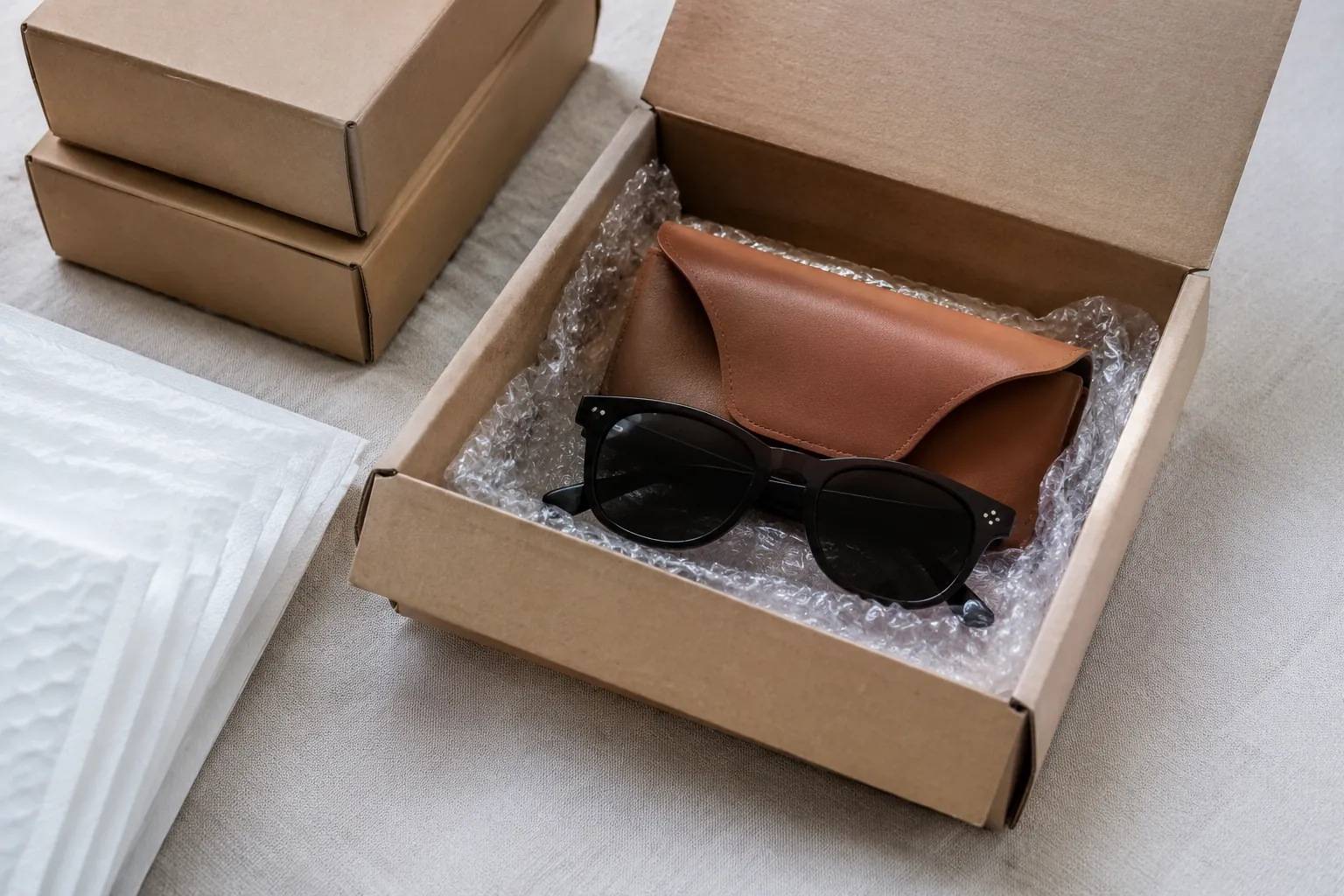
This guide is for eyewear brands, importers, distributors, and online retailers buying custom sunglasses in volume. Packaging is not a decoration task at the end of sourcing. It is part of the product spec. It affects lens abrasion, hinge pressure, carton strength, freight volume, labeling, returns, and sell-through condition. The best pack is rarely the most expensive one. It is the pack that fits the sales channel, frame geometry, product value, return risk, and landed-cost target.
Start With the Shipping Channel
Many buyers start packaging work with logo size, box color, foil stamping, or insert card design. That is the wrong order. First, the pack has to survive the way the product will move. Then it can carry the brand.
A palletized shipment to a retail warehouse faces stacking pressure, vibration, carton handling, and storage conditions. A single pair shipped direct-to-consumer faces parcel drops, mixed-load compression, courier bags, moisture, and customer return repacking. These are different problems. They need different approval standards.
Write the sales channel into the packaging brief before approving materials or artwork. State whether the order is for Amazon FBA, Shopify or brand-site DTC, distributor carton orders, optical retail, travel retail, subscription boxes, event giveaways, or marketplace fulfillment. Also state whether the retail unit must survive parcel shipping by itself or only inside a master carton or outer mailer.
For e-commerce, a practical baseline is a pouch or sleeve inside a fitted paper box, then a corrugated mailer sized so the retail box cannot slide around. For higher-value acetate frames, polarized lenses, mirrored lenses, rimless styles, or sport-wrap sunglasses, an EVA case or hard case may be worth the cost. Quote the case together with carton dimensions and estimated shipping volume. Protective cases can raise freight and storage cost even when the unit price looks acceptable.
LumiShades manufactures in Wenzhou with in-house processes including injection molding, acetate cutting, CNC milling, lens tinting, decoration, and QC. That means packaging fit can be checked against the actual frame during sampling. This matters. A pack approved from a drawing can still fail if the bridge rubs the tray, the temples close under tension, the nose pads press into the lenses, or the lenses sit too close to a card edge.
Failure Modes Buyers Miss
Most packaging failures are predictable. They often appear after the first live shipment, a sales peak, or a return cycle, when the pack is handled less carefully than it was in the sample room.
- Lens abrasion: mirrored, coated, gradient, and dark lenses show small scratches fast. Keep lenses away from tray walls, zipper pulls, metal logo plates, hang tags, card edges, temple tips, and loose accessories.
- Hinge stress: tight cases can force temples inward or twist one side of the frame. This can loosen screws, distort alignment, or deform lower-cost injected frames during storage.
- Crushed retail boxes: paperboard boxes may look fine at the factory but dent in parcel networks unless protected by a suitable corrugated mailer or shipper.
- Accessory movement: cleaning cloths, insert cards, spare nose pads, tags, and silica gel can shift during vibration and rub against lenses unless separated or fixed in place.
- Return damage: customers rarely repack products the way factory workers do. If the original pack protects the sunglasses only when assembled perfectly, returned units may arrive scratched, bent, or unsellable.
Use a simple test. If the frame can move far enough to touch a hard or rough surface, assume it may rub during transport. Polished acetate can dull. Rimless and semi-rimless sunglasses need extra protection at exposed lens edges. Sport wraps need checks for lens curve, temple spring, case depth, and side pressure.
Do not approve packaging by opening one clean sample on a desk. Shake the packed unit. Drop it from desk height on different sides and corners. Put weight on it to simulate compression. Then repack it badly once. That last step is useful because returns are often packed quickly, without the original factory sequence.
Compare Protection, Cost, and Freight
There is no universal best package. A low-cost promotional sunglass and a premium acetate style should not carry the same packaging ratio. Choose the pack by product value, sales channel, handling risk, return process, and freight budget.
| Packaging option | Best use | Typical protection | Cost and freight logic |
|---|---|---|---|
| Microfiber pouch plus polybag | Promotions, events, carton-only distribution | Low crush protection; moderate scratch protection if the pouch is clean and the frame does not move excessively | Lowest unit cost and smallest volume; not suitable as the only protection for single-pair parcel shipping |
| Soft pouch plus printed paper box | DTC brands using a separate corrugated mailer | Moderate protection if the frame fit is controlled and accessories cannot move into the lens area | Good branding area; outer packaging is needed because paperboard can dent in parcel handling |
| EVA zipper case | E-commerce, sports sunglasses, higher return-risk channels | Good crush and abrasion protection when internal height, zipper position, and frame clearance are correct | Higher unit cost and larger shipping volume; often justified for higher-value or fragile styles |
| Hard clamshell case | Optical retail, premium acetate, polarized or mirrored lenses | High protection if the insert avoids lens pressure and hinge stress | Bulky and more expensive; carton count, gross weight, and freight volume must be confirmed before approval |
| Retail display box with inner tray | Retail shelves, distributors, gift sets | Moderate to high depending on board grade, tray fit, insert design, and outer carton strength | Strong presentation; print layout, tray tooling, barcode placement, and master carton packing need early approval |
Online sellers often mistake a beautiful paper box for transport packaging. Usually it is not. A paper box is presentation packaging unless it is designed and tested as a shipper. If the box face matters to the customer experience, protect it with a corrugated mailer or outer shipping carton.
MOQ changes the calculation. LumiShades can support custom sunglasses from 50 pairs per design, which helps with test runs. Branded packaging usually becomes more efficient at higher quantities because printing setup, color matching, insert preparation, and carton planning are spread across more units. Quote the frame, retail packaging, master carton, carton dimensions, gross weight, and estimated shipping volume together. Treat them as one cost model.
Specify Fit Like a Component
Packaging fit should be treated like a product component. Frame width, lens height, base curve, hinge angle, temple thickness, nose bridge height, nose pad position, and decoration thickness all affect how the sunglasses sit inside a case, pouch, box, or tray.
The basic target is clear: lenses should not touch hard surfaces or rough edges. Standard tinted lenses may tolerate slightly more handling than mirrored, coated, rimless, or high-polish acetate styles, but all lens types need real packing checks. The frame should not rattle. It should not be compressed either. If one case or tray must hold several frame sizes, test the smallest and largest dimensions, not only the middle size.
A basic packaging fit specification should include closed frame width, lens height, temple length, maximum hinge thickness, bridge height, lens curve, required lens clearance, pouch or sleeve use, accessory positions, barcode location, retail box orientation, master carton quantity, carton dimensions, gross weight, stacking direction, and SKU separation rules. For mixed-color orders, state whether colors can share a master carton or must be separated by SKU.
Do not let a tray press on the lens front. Do not place metal logo plates, hang tags, folded cards, or silica gel where they can move against a lens. If a cleaning cloth is included, fold it consistently and place it behind the frame or in a separate sleeve. Small details decide whether returned units are resellable.
For thicker acetate frames, allow enough internal height and check temple pressure after the frame has been closed for storage. For thin metal frames, protect the bridge, nose pads, and lens edges. For sport-wrap frames, check case width, depth, and side pressure. The lens curve can make the frame press against the case wall even when the case looks large enough.
Watch Material and Decoration Risks
Branding should not weaken the pack or make the sunglasses easier to scratch. Decoration has to be checked against contact points, ink adhesion, material stiffness, and the bulk packing sequence.
Printed paper boxes provide a clean brand surface, but board strength and construction matter. Thin paperboard can dent even when the sunglasses remain safe. Rigid boxes look premium but add cost, weight, and volume. EVA cases resist crushing better and work well for sports or DTC channels, but zipper pulls must be positioned away from lenses during packing. Microfiber pouches are compact and useful, but heavy ink coverage or poor print curing can stiffen the fabric and reduce cleaning performance.
Laser engraving can work well on temples, metal parts, and selected case surfaces, depending on material. The engraved area should not rub against pouch fabric, tray walls, or adjacent products. Pad printing is useful for logos on frames, lenses, boxes, and cases, but adhesion must be checked on curved, oily, rubberized, coated, or textured surfaces. Metal logo plates can look premium, but they add a hard edge and thickness. Keep them away from lens contact zones and confirm they do not mark adjacent units in carton packing.
Color matching needs physical approval. Pantone targets on paper, EVA, microfiber, injected plastic, and acetate will not look identical because each material absorbs, reflects, or diffuses color differently. Approve samples under neutral light. For online sellers, photograph the packaging sample in the same lighting style used for product pages so delivered color does not surprise customers.
LumiShades offers decoration options including laser engraving, pad printing, and metal logo plates. The practical benefit is coordination. The logo on the temple, case, pouch, box, and insert card can be checked in one sample review instead of being approved as separate items.
Keep Labels and Claims Accurate
Packaging is where compliance mistakes become visible. Do not print claims that the product file cannot support. Depending on destination market and sales channel, sunglasses buyers may request documentation related to CE EN ISO 12312-1, ANSI Z80.3, AS/NZS 1067, REACH, FDA registration, ISO 9001, or BSCI. These documents do not mean the same thing. Do not use them interchangeably.
Match each reference to its real role. CE EN ISO 12312-1 is relevant for sunglasses sold into markets where CE compliance applies. ANSI Z80.3 is commonly referenced for non-prescription sunglasses in the United States. AS/NZS 1067 is relevant for Australia and New Zealand. REACH relates to restricted substances for products entering the European market. FDA registration may be requested by some US buyers, but registration is not product performance testing. ISO 9001 relates to quality management systems, and BSCI relates to social compliance. Neither replaces product test reports.
Keep compliance text editable until the product file is confirmed. Packaging may need model number, SKU, barcode, lens category, UV claim support, country of origin, importer details, warning text, recycling marks, and marketplace labels. Amazon FBA and distributor cartons may also require specific carton labels, readable barcodes, suffocation warnings for polybags where applicable, and carton weight or dimension limits.
Avoid vague claims such as "certified safe," "UV approved," "approved worldwide," or "medical grade" unless the exact claim is supported by the right documents and is acceptable in the destination market. If the packaging says it, the document file should support it with the correct model reference, test standard, and issue date.
Use the 7-10 Day Sample Window
LumiShades can produce samples in 7-10 days, with bulk production typically 25-35 days after approval. Use the sample stage to test the full packed unit, not only frame color, lens tint, and logo placement.
A focused sample review should use the intended bulk packing sequence. Pack the sunglasses as workers will pack them. Then shake the unit and inspect every contact point. Drop the packed unit from desk height on the front, back, sides, and corners. Place several packed units under weight to simulate carton compression. Open, remove, and repack the product multiple times. Scan the barcode, check sticker adhesion, inspect insert position, and confirm accessories cannot move into the lens area.
For e-commerce, test the outbound pack too: the sunglasses package inside the mailer or shipping carton. A rigid inner case inside a weak or oversized mailer can still arrive with scuffed corners or a crushed sleeve. A fitted paper box inside a correctly sized corrugated mailer can outperform a loose case in an oversized shipper.
Send the factory photos or videos of failure points, not vague comments such as "improve packaging." Mark the rubbing area, crushed corner, loose insert, barcode issue, pressure point, or carton dent. Good feedback is visible, measurable, and tied to the packing method. The supplier should be able to reproduce the problem and correct it before bulk production.
Lock the Final Packing Spec
Once the sample passes, lock the packing method in writing. Do it before bulk production starts. Small packing-line changes can create large return problems later.
The final packing specification should state the inner packing sequence, sunglasses orientation, pouch or sleeve use, accessory placement, retail box direction, SKU label position, master carton quantity, carton board requirement, carton markings, moisture control, pallet requirement if any, and photo standard for packed units. For large orders, even a small increase in case size can affect carton count and freight volume. Confirm carton dimensions and gross weight before shipment booking.
Quality control should inspect packaging as part of the product. Ask for checks on lens scratches after packing, frame movement inside the pack, hinge pressure, logo position, barcode readability, accessory placement, box dents, master carton count, carton sealing, and carton drop condition where applicable. For ocean freight or long storage, confirm dry packing conditions, suitable export cartons, and desiccant use where required.
Good branded packaging is practical first. It protects the sunglasses, keeps the retail box presentable, supports returns, matches documentation requirements, and stays within the target cost. Only then does the logo have a fair chance to work.
Have a custom sunglasses project in mind?
Send us your styles, target market and quantities and we will return a detailed quote with MOQ, lead time and a sample plan.
Get a QuoteWhy source this from Wenzhou with LumiShades
Wenzhou in Zhejiang Province is widely regarded as China’s eyewear manufacturing capital, producing a large share of the world’s sunglasses. That concentration matters to buyers: a deep local supply chain for acetate sheet, hinges, lens blanks, plating and packaging means shorter component lead times, easier color and material matching, and a workforce with decades of eyewear-specific skill. LumiShades has manufactured in this ecosystem since 2009, and our vertical integration — in-house injection molding, acetate cutting, CNC milling, lens tinting, decoration and quality control — means no part of your order is quietly subcontracted to a workshop you cannot audit.
For international buyers, that vertical control translates into accountability. When a single factory owns every step, defects are traced and fixed at source rather than bounced between vendors, and your specifications survive intact from first sample to bulk. We back this with 15+ years of experience, shipments to 60+ countries, more than 5 million pairs produced per year and a 98.5% on-time delivery rate. Our certifications — CE EN ISO 12312-1, FDA registration, ANSI Z80.3, AS/NZS 1067, REACH, ISO 9001 and BSCI audit — mean the compliance documentation your market requires already exists. Explore our manufacturing capabilities and quality control process to see how this works in practice.
Frequently asked questions
What packaging should I choose for sunglasses sold direct-to-consumer online? Use a protective inner package and a separate shipping package. A practical starting point is a pouch or sleeve inside a fitted paper box, then that box inside a corrugated mailer or shipper. For acetate, mirrored, polarized, rimless, or sport-wrap sunglasses, request an EVA or hard case sample and test it with the actual outer mailer before approval. Confirm carton count, gross weight, and shipping volume before locking the packaging.
Can I use only a microfiber pouch for e-commerce orders? Not as the only protection. A microfiber pouch can help prevent light surface rubbing, but it provides weak crush protection and does not control hinge pressure, lens-edge impact, or accessory movement. If you use a pouch for online orders, put it inside a fitted box or other protective structure and then inside a corrugated mailer or shipping carton.
How much clearance should sunglasses have inside a case or tray? The lenses should not touch hard surfaces, rough fabric edges, zipper pulls, tags, cards, tray edges, or accessories. During sampling, check the actual frame in the closed position and confirm that the temples are not forced inward. Mirrored, coated, rimless, and high-polish acetate styles need stricter clearance checks because small rubbing marks are more visible.
How early should packaging be sampled with custom sunglasses? Sample the packaging at the same time as the sunglasses whenever possible. During the 7-10 day sample window, review the complete packed unit: frame fit, lens clearance, hinge pressure, logo placement, insert position, barcode scanning, accessory movement, outer mailer fit, and repacking after opening. Do not wait until bulk production to test packaging.
Which compliance marks can be printed on the packaging? Only print marks and claims supported by the product file and destination-market requirements. Depending on the order, relevant references may include CE EN ISO 12312-1, ANSI Z80.3, AS/NZS 1067, REACH, FDA registration, ISO 9001, or BSCI. Match each printed claim to the correct model number, test report, declaration, registration, or factory document. Avoid broad claims such as "approved worldwide" unless they are specifically documented and legally appropriate.
How does MOQ affect branded packaging cost? LumiShades can start custom sunglasses from 50 pairs per design, which is useful for testing. Branded packaging normally becomes more efficient at higher quantities because printing setup, color matching, inserts, labels, and carton planning are spread across more units. Ask for a quote that includes the sunglasses, retail packaging, master carton quantity, carton dimensions, gross weight, and estimated shipping volume.
What should I inspect before approving bulk shipment? Inspect the complete packed product, not only the sunglasses. Check lens condition after packing, frame movement, hinge pressure, accessory placement, logo position, barcode scan, SKU label accuracy, box dents, master carton count, carton sealing, carton markings, moisture control, and final packing photos. For e-commerce orders, also check that the retail package fits securely inside the mailer or shipper.
Ready to start?
Explore our cat-eye sunglasses or request a quote — our sales team replies within 12 hours.
Request a Quote