
Private Label Sunglasses for Hotel Retail
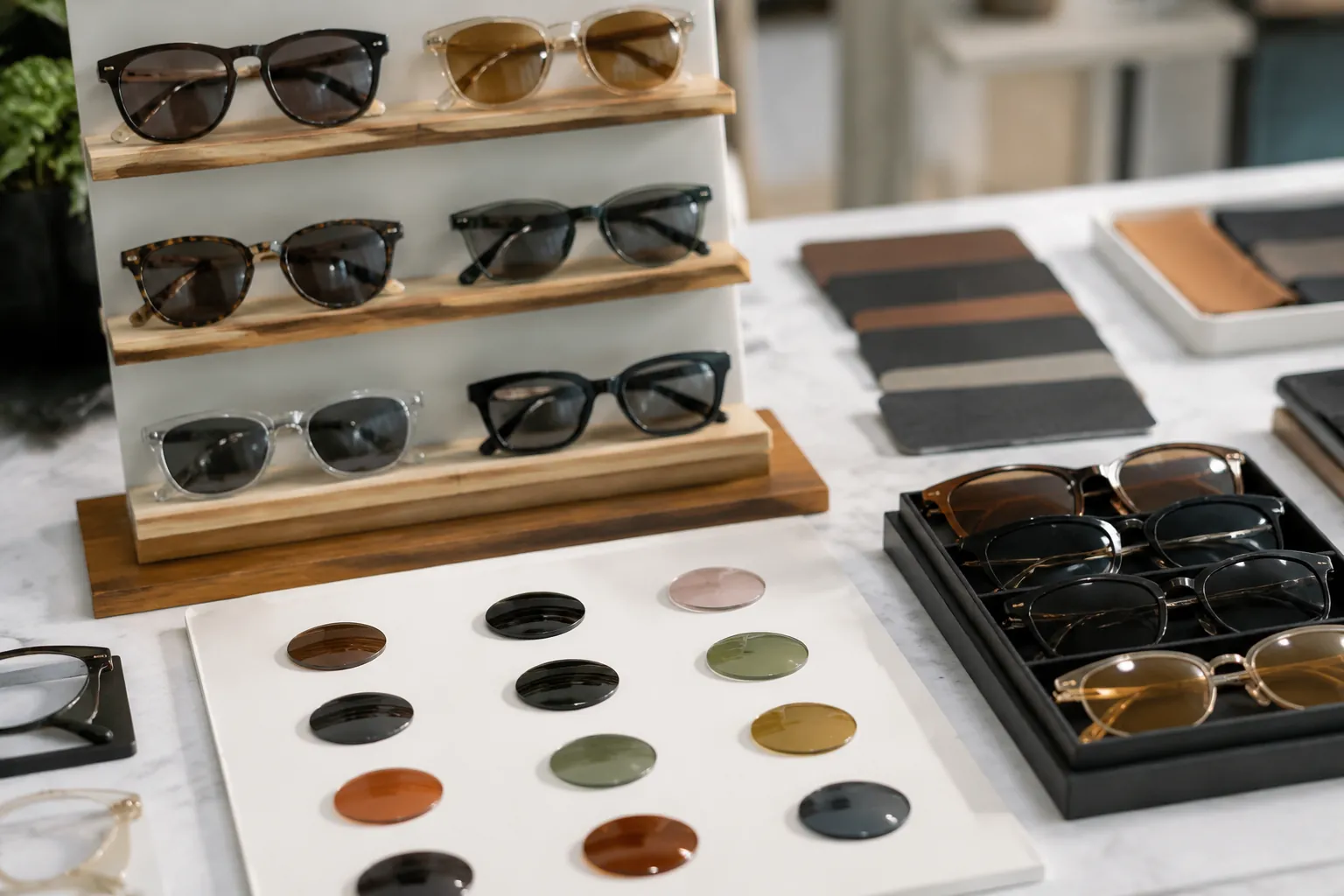
Hotel and resort sunglasses are not simple promo items. They must look good on a retail display, survive heat, sunscreen, salt air, and repeated guest handling, and still leave margin at the counter. This guide is for hotel groups, resort buyers, destination retailers, importers, and brand owners building private label sunglasses programs. It focuses on decisions you can verify: sellable frame selection, UV and lens requirements, color control, branding placement, market compliance, QC checks, packaging, pricing, and reorder timing before peak-season demand drains the display.
Start With the Selling Location
Do not start with twenty fashion shapes. Start with the place of sale. Who is buying? How fast must they understand the offer? A pool shop, lobby boutique, golf pro shop, cruise terminal, beach club counter, and airport resort kiosk each need a different mix of frame shapes, packaging, and price points.
A pool shop should prioritize UV protection, stable hinges, finishes that tolerate sunscreen handling, and colors that sit naturally beside swimwear. A lobby boutique can support acetate-look frames, metal trim, better pouches, and higher retail prices. A golf shop needs lens clarity, good nose fit, and low-slip temples more than loud branding. A souvenir counter can carry brighter colors and destination graphics. The frame still has to feel wearable after checkout.
For a first program, three to five SKUs are usually easier to manage than a broad assortment: one unisex square frame, one softer round or cat-eye style, one sport or wrap option, and one junior frame only if family traffic is proven. Keep lens choices simple. Smoke category 3, brown category 3, green category 3, and one mirror accent can cover many resort uses. Polarized lenses make sense for beach, boating, fishing, marina, and driving locations, but they add cost. Tie the upgrade to a retail price that supports it.
- Entry retail: injected PC frame, UV400 lens, microfiber pouch, hangtag, barcode.
- Mid-tier retail: TR90-style or improved PC frame, better hinge, optional polarized lens, printed pouch or soft case.
- Boutique retail: acetate or acetate-look frame, metal trim or logo plate, premium pouch or compact hard case.
- Family resort add-on: junior sizing, compliant labeling, lighter colors, and durable hinges.
How Resort Specs Differ From Fashion and Promo Orders
Fashion sunglasses chase seasonal style. Promotional sunglasses chase low landed cost and fast distribution. Resort retail sits between the two. The product must be attractive enough to sell at margin, durable enough for vacation use, and simple enough for staff to restock without eyewear training.
| Channel | Main buying trigger | Recommended frame approach | Branding level | Packaging priority |
|---|---|---|---|---|
| Hotel and resort retail | Forgotten need, souvenir, vacation impulse | Proven shapes, UV400 lenses, stable hinges, 3 to 5 core SKUs | Small temple logo, lens corner mark, or pouch branding | Hangtag, barcode, compact case, easy counter display |
| Fashion wholesale | Trend, collection fit, brand story | Seasonal shapes, acetate, metal, mixed materials | Brand-led and more visible | Presentation box, case, perceived value |
| Promo giveaway | Low cost and fast distribution | Basic injected PC frame and simple lens | Large printed logo common | Polybag or basic pouch |
| Destination souvenir shop | Location memory and gift purchase | Bright colors, place graphics, compact price points | Place name, coordinates, icon, or event mark | Hang-ready, barcode-visible, theft-resistant where needed |
For private label resort programs, injected PC or TR90-style frames are common for entry and mid-tier SKUs. Acetate and acetate-look designs are better suited to boutique retail. PC is cost-effective and impact resistant, but weak mold quality or poor hinge geometry can make a frame feel stiff. TR90-style materials are usually lighter and more flexible, which helps in hot climates. Acetate gives richer color depth and stronger boutique perception, but it needs more processing and manual finishing. Expect higher cost and longer lead times.
Review material behavior before production approval. Matte coatings can show sunscreen marks faster than gloss finishes. Rubberized soft-touch coatings can feel premium, but they need heat and humidity checks for adhesion. Metal parts should be reviewed for nickel and restricted-substance requirements where relevant. Screws need consistent torque. Display handling should not loosen temples before the product is sold.
Build a Color Story That Reorders Cleanly
Color creates inventory risk. A sample board may look strong in a meeting room while the display sells mostly black, tortoise, and one destination color. Travel retail needs discipline. Reorders must be predictable and easy for staff to understand.
A practical first order uses one neutral core, one warm vacation color, and one destination accent. For example: matte black with smoke lens, tortoise with brown lens, and ocean blue with smoke or green lens. If the property has a strong brand palette, use it as an accent. Do not force the whole frame into a difficult color unless the sell-through case is clear. A small inner-arm message, temple print, pouch color, or hangtag can carry the destination identity without making the sunglasses hard to wear after the trip.
Use Pantone references for injected colors and physical acetate chips for acetate programs. For injected frames, agree on realistic color tolerance before mass production because resin lots and surface finishes can vary. For acetate, sheet variation is normal, especially in tortoise, horn, marble, and transparent patterns. Approve a tolerance range, not one perfect sample.
A useful first-order ratio is 50 to 60 percent core colors, 25 to 35 percent vacation colors, and 10 to 15 percent destination accents. If ordering 600 pairs across four SKUs, that might mean 300 black or tortoise, 180 warm neutrals, and 120 accent colors. Reorders should follow sell-through data, not the original design preference. If ocean blue sells slowly but black square frames sell weekly, reorder black. Protect the margin.
Branding Methods That Hold Up
Branding should help the guest remember the property without making the sunglasses feel like staff merchandise. Subtle branding usually supports everyday wear better than a large exterior logo. Larger graphics can work for souvenir shops, event drops, and destination kiosks. In boutique resort retail, they can reduce full-price appeal.
Common decoration methods for private label sunglasses include pad printing, laser engraving, metal logo plates, lens marks, and branded pouches or hangtags. The right method depends on frame material, surface finish, logo size, retail price, and setup-cost tolerance.
| Method | Best use | Typical tolerance target | Watch point |
|---|---|---|---|
| Pad printing | Temple logo, place name, small graphic | Position within about +/-0.5 mm after approval | Ink adhesion on matte, rubberized, or curved surfaces |
| Laser engraving | Metal trims, logo plates, selected lens or temple marks | Artwork size and placement confirmed in millimeters | Contrast can be subtle on dark or brushed parts |
| Metal logo plate | Boutique resort retail and higher ticket frames | Consistent plate seating and glue or pin alignment | Tooling, assembly time, and edge finish |
| Lens corner mark | Small retail brand cue | Kept outside the normal optical viewing field | Must not create visual distraction or compliance issues |
Supply artwork as vector files. Specify final logo width and height in millimeters. Confirm left temple, right temple, outer arm, inner arm, lens, pouch, and hangtag artwork as separate placements. A 2 mm logo shift may look acceptable on a wide sport temple and wrong on a narrow fashion arm.
For pad printing, request adhesion checks during pre-production, especially on coated surfaces. For metal plates, approve both the logo finish and the way the plate sits in the frame. A raised edge can catch hair or make the product feel poorly finished. Small details matter here.
Packaging Must Work at the Counter
Hotel and resort packaging has two jobs: protect the product and help staff sell it quickly. Large boxes can look premium, but they take shelf space, increase freight volume, and slow handling. For many programs, a microfiber pouch, hangtag, barcode label, and compact case for higher price points work better than a bulky gift box.
The packaging decision should follow the fixture. A peg wall needs reinforced hang holes and hangtags that do not tear easily. A locked case needs visible style and color codes so staff can find the right pair quickly. A drawer system needs barcode labels and color descriptions on the outside. A basket display needs scratch control, so each frame should be bagged or pouched.
- Confirm the retail fixture: peg wall, counter tray, locked case, drawer, basket, or rotating rack.
- Choose pouch, soft case, or hard case according to retail price, freight budget, and display method.
- Assign barcode, SKU code, color code, lens category, country of origin, and warning text before artwork approval.
- Check that UV, compliance, and language requirements match the destination market.
- Review a fully packed sample, not only a loose frame.
Packaging artwork is often approved too late. That creates avoidable delays. Before bulk production, confirm barcode data, translations, retailer label rules, country of origin marking, lens category wording, and market-specific warnings. Sample and production timing should be stated in the quotation because timing can shift with material availability, decoration method, packaging complexity, testing needs, and inspection requirements.
Compliance and QC Are Part of the Spec
Sunglasses are regulated eyewear, even when sold beside sunscreen and sandals. A buyer importing into the EU, US, Australia, or New Zealand should confirm the required documentation before placing a bulk order. Cartons are the wrong time to discover a compliance gap.
Request only the certifications and declarations that apply to the product and market. Common requirements and support documents may include CE EN ISO 12312-1 for sunglasses sold in Europe, ANSI Z80.3 for non-prescription sunglasses in the United States, FDA registration for eyewear entering the US regulatory system, AS/NZS 1067 for Australia and New Zealand, and REACH for chemical restrictions in the European Union. Factory-level documents such as ISO 9001 or BSCI may support quality management or social compliance review. They do not replace product-specific eyewear compliance.
At a minimum, define UV protection, lens category, frame material, lens material, coating, nickel or restricted-substance requirements where relevant, country of origin, and labeling language. CE EN ISO 12312-1 applies to sunglasses for general use in Europe. ANSI Z80.3 is the common US standard for non-prescription sunglasses. AS/NZS 1067 is relevant for Australia and New Zealand. REACH matters for restricted chemicals in the EU market. FDA registration is relevant for eyewear shipped into the US regulatory system.
Write QC into the approval file. Check lens tint consistency, visible distortion, mirror coating uniformity, hinge opening and closing, screw tightness, temple alignment, surface scratches, logo position, barcode scan, pouch print, carton marks, and packed assortment. For mass production, many buyers use AQL inspection with critical, major, and minor defect categories. The exact AQL level should match order size and retailer requirements. Agree on it before production starts.
MOQ, Price, and Lead-Time Planning
Travel retail demand comes in waves. A beach resort may sell heavily during school holidays and shoulder seasons. A ski property may need winter sun protection. Cruise and airport operators may reorder according to route, passenger flow, or port season. The first order should be built for learning. The second order should be built for margin and replenishment efficiency.
MOQ and price depend on frame material, existing mold availability, lens type, polarization, hinge choice, decoration method, packaging, testing, and inspection requirements. Low MOQs can help with pilot runs, property-specific colors, and new shop tests. Unit cost is usually higher because setup, decoration, purchasing, and QC are spread over fewer pairs. Pricing normally improves as volume increases and the buyer repeats the same frame, lens, color, and packaging specifications.
| Order stage | Suggested quantity | Best purpose | Commercial logic |
|---|---|---|---|
| Pilot | 50 to 150 pairs per design | Test shape, color, retail price, display method | Higher unit cost, lower inventory risk |
| Opening order | 300 to 1000 pairs across core SKUs | Launch hotel group or seasonal program | Better pricing and more stable production planning |
| Reorder | 1000 to 5000+ pairs | Repeat proven colors and top-selling frames | Best cost improvement if specs stay unchanged |
| Property special | 50 to 300 pairs | Limited location logo, event drop, VIP shop test | Keep decoration simple to avoid slow replenishment |
Build the reorder calendar backward from the shelf need date. Add sample confirmation, packaging approval, material purchasing, production, inspection, international freight, customs clearance, warehouse receiving, and allocation to each property. Ocean freight needs a longer planning window than air freight. Air freight can solve urgent replenishment, but the landed cost rises fast. For peak season, reorder decisions often need to happen while the first shipment is still selling. Empty shelves mean the decision came too late.
Approval Workflow Before Shipment
A clean private label order is controlled by samples, spec sheets, artwork files, compliance documents, and inspection points. Verbal approval is not enough. The factory needs measurable standards, and the buyer needs a record that can be used for future reorders.
Use this workflow for hotel and resort sunglasses programs:
- Brief: define channel, target retail price, countries of sale, frame count, lens needs, packaging, and branding locations.
- Quotation: compare pricing at relevant order quantities. Include packaging, decoration, testing, inspection, and freight assumptions, not only the frame cost.
- Sample: review fit, hinge tension, lens color, lens category marking, logo size, packaging, barcode, hangtag content, and display method.
- Pre-production approval: freeze frame color, lens category, logo placement, packaging artwork, compliance documents, and assortment ratio.
- In-process QC: check injection or cutting quality, lens tint consistency, decoration alignment, screw tightness, hinge movement, and surface defects.
- Final inspection: review AQL level, carton marks, barcode scan, packed quantity, assortment ratio, pouch or case quality, and random wear checks before shipment.
LumiShades can support private label sunglass programs with frame production, lens tinting, decoration, packaging coordination, and QC review. The process works best when the approval file is disciplined. Keep one final approved sample set at the factory and one with the buyer. For reorders, reference that exact sample set. Do not reopen every design decision unless sell-through data proves a change is needed.
Have a custom sunglasses project in mind?
Send us your styles, target market and quantities and we will return a detailed quote with MOQ, lead time and a sample plan.
Get a QuoteWhy source this from Wenzhou with LumiShades
Wenzhou in Zhejiang Province is widely regarded as China’s eyewear manufacturing capital, producing a large share of the world’s sunglasses. That concentration matters to buyers: a deep local supply chain for acetate sheet, hinges, lens blanks, plating and packaging means shorter component lead times, easier color and material matching, and a workforce with decades of eyewear-specific skill. LumiShades has manufactured in this ecosystem since 2009, and our vertical integration — in-house injection molding, acetate cutting, CNC milling, lens tinting, decoration and quality control — means no part of your order is quietly subcontracted to a workshop you cannot audit.
For international buyers, that vertical control translates into accountability. When a single factory owns every step, defects are traced and fixed at source rather than bounced between vendors, and your specifications survive intact from first sample to bulk. We back this with 15+ years of experience, shipments to 60+ countries, more than 5 million pairs produced per year and a 98.5% on-time delivery rate. Our certifications — CE EN ISO 12312-1, FDA registration, ANSI Z80.3, AS/NZS 1067, REACH, ISO 9001 and BSCI audit — mean the compliance documentation your market requires already exists. Explore our manufacturing capabilities and quality control process to see how this works in practice.
Frequently asked questions
What is the safest first assortment for a resort sunglasses program? Start with three to five SKUs that cover the main guest needs: one black or tortoise unisex frame, one softer fashion shape, one sport or wrap option, and one controlled destination color. Use UV400 lenses and clear lens category labeling. Add kids sunglasses only if the property has strong family traffic and the labeling, sizing, and compliance requirements are confirmed for the sales market.
Can we private label sunglasses at 50 pairs per design? Often yes, if the design uses an available frame, simple decoration, and standard packaging. A 50-pair order is best for pilots, property-specific tests, and limited event drops. Expect higher unit cost than larger runs because setup, decoration, purchasing, and QC are spread over fewer pairs. Ask the supplier to quote the same spec at 50, 300, 1000, and 5000+ pairs so the reorder economics are clear before launch.
Which logo method is best for hotel sunglasses? For most hotel and resort retail, a small temple logo is the safest choice because it keeps the sunglasses wearable after the guest leaves the property. Pad printing works for many plastic temples, while laser engraving is useful on metal trims or suitable logo plates. Metal logo plates fit higher retail prices but add tooling and assembly considerations. Approve logo size and placement in millimeters, and request adhesion or finish checks before bulk production.
What compliance documents should we request? Request documents that match the destination market and product. For Europe, ask about CE EN ISO 12312-1 and REACH where applicable. For the United States, ANSI Z80.3 and FDA registration may be relevant for non-prescription sunglasses. For Australia and New Zealand, request AS/NZS 1067 documentation. Factory-level documents such as ISO 9001 or BSCI may support supplier review, but they do not replace product-specific eyewear compliance.
How early should we reorder before peak season? Plan backward from the date the sunglasses must be on the retail display, not from the date stock runs out. Include sample or reorder confirmation, packaging approval, production, inspection, freight, customs clearance, warehouse receiving, and property allocation. Ocean freight programs need a longer planning window than air freight. Use weekly sell-through data from the first shipment to place reorders while inventory is still available.
Should resort sunglasses use polarized lenses? Use polarized lenses when the guest use case and retail price support the upgrade, especially for beach, boating, fishing, driving, and marina locations. For lower price points, a good UV400 non-polarized lens with accurate lens category labeling may deliver better margin. Do not treat polarization as a substitute for UV protection; specify both the UV requirement and whether the lens is polarized.
Ready to start?
Explore our cat-eye sunglasses or request a quote — our sales team replies within 12 hours.
Request a Quote