
Custom Temple Tips and End Caps for Sunglasses
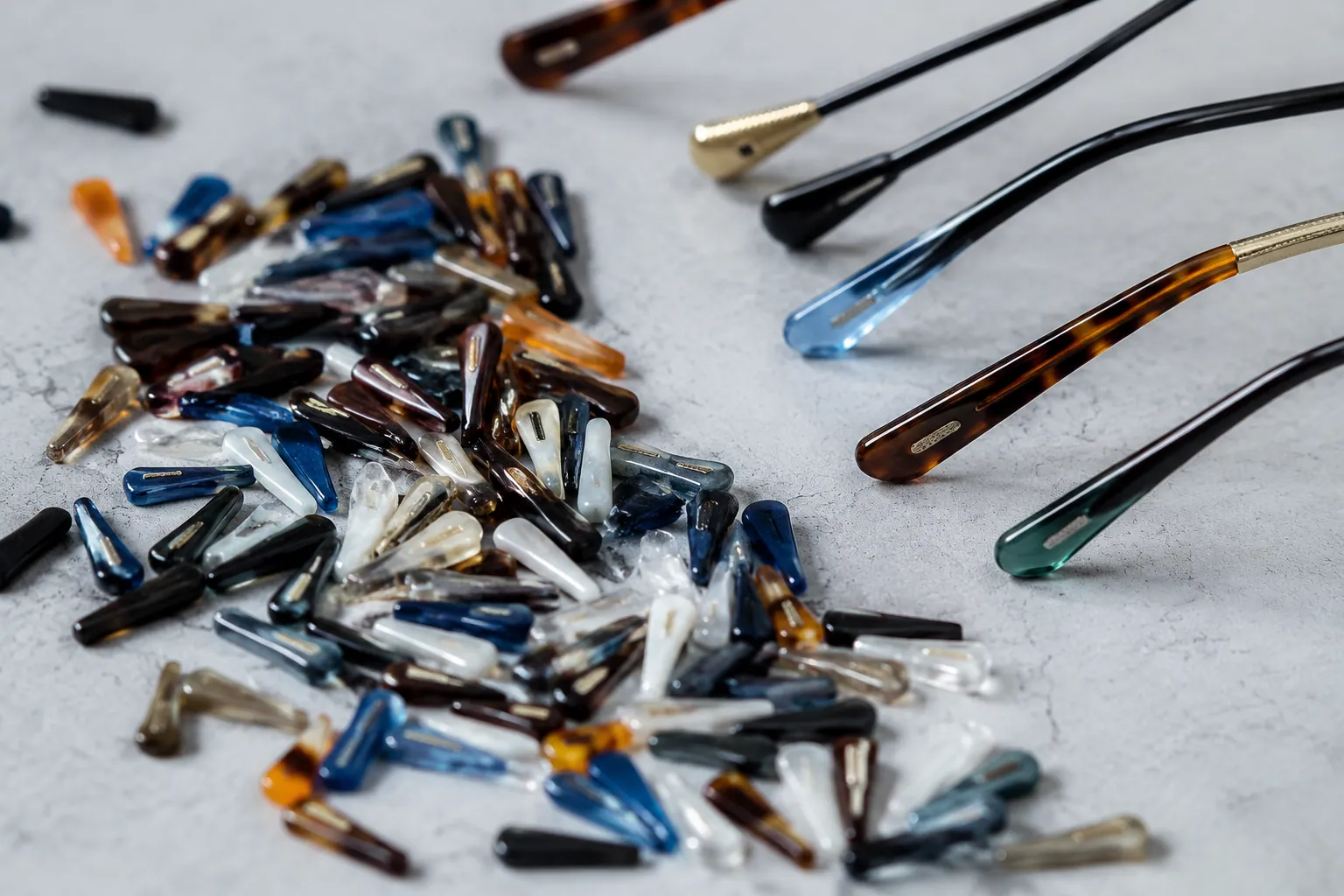
For brand owners, importers, and eyewear buyers, custom temple tips and end caps can make an existing sunglass style feel proprietary without opening a full new frame mold. These parts are small. The risk is not. A temple end can carry a signature color break, logo plate, molded profile, grip surface, or tactile detail that buyers notice on shelf and in hand. But weak draft can delay sampling. A loose tip can shift after heat exposure in transit. A raised metal plate can catch on fabric and lift during pouch abrasion. Treat the part as a functional component. Define the attachment method. Control the tolerance stack. Choose decoration for the real wear zone. Approve physical samples before bulk production.
Choose the right customization level
Most buyers do not need a new frame front to create brand ownership. If the existing lens shape, bridge, hinge, and temple geometry already meet the brief, the temple end is often the lower-risk place to customize. It changes the side view, folded view, and hand-feel without disturbing lens geometry or front-frame tooling.
Start with one decision: should the brand cue sit on the temple tip, the end cap, or the full temple? A temple tip affects comfort and fit behind the ear. An end cap usually affects visual identity at the tail of the temple. A full temple change affects side profile, hinge balance, logo placement, tooling cost, and approval time.
| Option | Best use | Typical tooling impact | Unit cost impact | Key risk |
|---|---|---|---|---|
| Custom end cap only | Signature tail shape, color insert, small logo plate | Low to moderate; depends on whether the cap is molded, machined, or inserted | Low once stable | Loose fit, glue bleed, plate alignment, visible parting line |
| Custom temple tip | Comfort change, grip surface, dual-color ear area | Moderate; fit to metal core, TR temple, acetate temple, or plastic stem must be checked | Low to moderate | Heat-cycle loosening, pressure points, left-right inconsistency |
| Tip plus cap system | Collection-wide brand architecture across multiple fronts | Moderate; best when reused across SKUs with compatible temple sections | Moderate | Color consistency, fit variation between temple designs |
| Full custom temple | New side silhouette, hinge-zone branding, structural change | High; larger mold or cutting program and more sampling rounds | Higher | Balance, hinge fit, temple opening angle, longer approval path |
Use a simple rule. If the goal is recognition at normal retail handling distance, start with the end cap. If the goal is comfort, anti-slip performance, or ear pressure control, start with the temple tip. If the same detail must carry across aviator, square, cat-eye, and wrap styles, build a repeatable cap or tip system instead of redesigning each SKU.
Treat the part as functional
A branded temple tip or end cap is not just decoration. It is handled during assembly, folded into cartons, exposed to warehouse and transport heat, rubbed by pouches, and touched by consumers. Before styling begins, issue a short performance brief that separates visual intent from functional requirements.
- Recognition: state whether the detail must be visible in side view, folded view, retail tray view, or all three.
- Attachment: define press-fit, adhesive-fit, thermal insertion, mechanical lock, screw-fixed plate, pin, or overmold.
- Comfort: for temple tips, control ear-contact radius and edge rounding; avoid sharp transitions in areas that contact skin.
- Retention: require the part to stay fixed after repeated opening and closing, pull checks, twist checks, and heat exposure suited to the transport route.
- Decoration durability: keep pad print and exposed coating away from corners that contact fingers, fabric pouches, cleaning cloths, or skin.
- Compliance: coatings, adhesives, plating, colorants, and soft-touch materials must support the destination-market requirements.
Good small parts need enough wall thickness, clean draft, and a repeatable seating surface. Very thin fins, deep blind pockets, and abrupt wall-thickness changes create molding defects, sink marks, weak edges, and inconsistent fit. For press-fit and snap-fit parts, tiny dimensional changes can decide whether the component assembles cleanly, rattles after handling, or cracks during insertion.
Also define what must not change. If the temple opening angle, hinge screw position, lens fit, and wearing balance are already approved, freeze those areas. The point of a small branded part is to create ownership without dragging the whole frame back into development.
Match material to use and volume
The right material depends on the base frame, order volume, target price, required finish, and brand effect. There is no single best answer. A molded plastic cap may be the most stable route for a high-volume fashion frame. Acetate may suit a higher-value optical-sun collection that needs depth, polish, or patterned material.
| Construction route | Typical use | Advantages | Main controls |
|---|---|---|---|
| Injected plastic cap or tip | TR, PC, and fashion frames; repeat color programs | Fast repeat production, stable geometry, suitable for dual-color effects when designed correctly | Resin choice, shrinkage, sink, gate mark position, parting line, color lot matching |
| Acetate cap or tip | Higher-value styles needing depth, polish, lamination, or tortoise effects | Rich visual finish, strong hand-feel, good match for acetate frames | CNC accuracy, polishing loss, small-part scrap, sheet variation, bonding method |
| TPR or soft-touch tip | Grip and comfort behind the ear | Higher friction, softer feel, sport or performance positioning | Shore hardness, oil migration, tackiness, bonding to substrate, aging behavior |
| Recessed metal logo plate | Discreet higher-value branding on cap or temple end | Strong perceived value, better abrasion resistance than exposed print when properly recessed | Plate thickness, plating specification, pocket tolerance, glue bleed, corrosion resistance |
| Pad print, laser, or molded relief | Logo identification on MOQ or mid-volume runs | Flexible cost and fast execution depending on method | Wear-zone placement, contrast, registration tolerance, surface preparation |
For injection-molded parts, confirm resin, shrink behavior, draft angle, wall thickness, gate position, and visible parting-line location before tooling. Do not place a gate scar on the focal end face unless that look has been approved. For acetate, allow for machining and polishing removal. A sharp CAD edge will become softer after finishing. For soft-touch tips, specify hardness by Shore value and confirm it on physical samples. Words such as soft or rubbery are not specifications.
Metal plates work best when the surrounding part has a controlled recess and enough bonding area. A proud plate may look strong in a render. In use, it can catch on fabric and lift. If the plate is plated metal, confirm plating requirements for the destination market, including nickel-related restrictions where applicable.
Write a spec sheet that prevents resampling
Many sampling delays start with vague instructions: a logo file, a reference photo, and a note asking for a nicer temple end. That is not enough. The factory needs to control the part, the interface, the approved appearance, and the inspection priorities.
A useful small-part spec sheet should include:
- Base frame reference: model number, temple material, cross-section drawing, hinge type, and left-right orientation.
- Overall dimensions: length, width, height, visible end-face size, and target weight if balance matters.
- Fit dimensions: cavity size, insertion depth, channel width, rib height, pin hole, screw boss, snap detail, or mechanical lock.
- Tolerance priorities: identify which dimensions control appearance and which control fit; fit-critical dimensions usually need tighter control than cosmetic outside dimensions.
- Material target: resin grade, acetate sheet reference, metal grade, Shore hardness, adhesive type, or approved equivalent.
- Finish: gloss level, matte texture, polish standard, edge radius, and acceptable parting-line or polish-line limits.
- Decoration: vector artwork, logo size, engraving depth, print color, plate thickness, plate recess, and acceptable registration shift.
- Assembly method: adhesive amount, curing time, press force, thermal insertion temperature, screw size, or snap-fit sequence.
The most important instruction is priority. If logo centering is critical, say so. If the comfort curve matters more than exact overall length, say that. A supplier can control a part more efficiently when it knows which dimensions affect fit, which affect appearance, and which can move.
Do not approve first samples from photos alone. Ask for measured sample reports or marked drawings when a correction is needed. On a temple end, a small dimensional error can hide in a close-up image and become obvious when the frame is folded, packed, or worn.
Choose decoration by wear zone
Decoration must be chosen according to where the part is touched and rubbed. The end of the temple is a high-contact area. It meets fingers during folding, fabric during packing, and sometimes skin or hair during wear. A logo method that works on the outer temple may fail faster on the end cap.
Pad printing is usually the fastest and lowest-cost option for simple logos. Place it on protected flat areas, not exposed corners. Laser engraving is cleaner and often more durable, especially on darker molded parts or metal plates, but contrast depends on material and finish. Molded relief is durable because the mark is part of the component, but it needs tooling commitment and enough surface area for readability. A recessed metal plate gives a strong value signal, but alignment, plating, corrosion resistance, and adhesive control must be checked.
Small logos need simplified artwork. Very fine strokes can fill, blur, polish away, or lose contrast. If the brand mark has thin typography, use a symbol on the cap and keep the full wordmark for the outer temple, lens mark, case, or packaging. For two-color caps, approve color against physical chips or production material samples. Screen references are not reliable for molded plastic, acetate, plating, or soft-touch finishes.
The most repeatable branded details are often restrained: a shaped cap profile, one material contrast, and one durable logo execution. That combination is easier to produce consistently than a tiny surface carrying print, metal, texture, and multiple color changes at once.
Plan MOQ, price, tooling, and timing
A custom temple-end part is usually manageable in unit cost after the design is stable. Development gets expensive when geometry, material, attachment, or decoration changes after tooling or fixtures begin. Separate development cost from unit cost. Also identify which changes require new samples, new tooling, or only artwork adjustment.
MOQ depends on the supplier, construction route, material availability, decoration method, and whether the buyer is modifying an existing frame or opening new tooling. Some suppliers can support low pilot quantities for existing-frame customization. Custom molded parts, plated metal details, special colors, and multi-SKU systems usually require higher commitments. Ask for MOQ by line item: frame, custom part, decoration, lens, packaging, and spare parts.
Plan the budget in four buckets:
- Engineering and drawing cost: CAD cleanup, part interface review, tolerance review, and artwork preparation.
- Tooling or fixture cost: small injection cavity, CNC fixture, plate stamping tool, color fixture, or assembly jig.
- Unit adder: material, molding or CNC time, decoration, plate insertion, adhesive, finishing, and inspection labor.
- Change cost: resampling, tool adjustment, scrap, delayed color approval, missed production slot, or packaging rework.
Quote lead time against a complete input package, not an idea. A practical schedule separates design review, first sample making, sample correction, pre-production sample approval, material purchase, bulk production, inspection, and packing. Ask which steps can run in parallel and which sit on the critical path.
The timeline stretches when buyers change plate size after a cavity is cut, approve color from a screen instead of a physical standard, switch from glue-fit to snap-fit midstream, or request a softer tip without changing the material specification. Freeze the temple-end part before final purchase order release. If the part changes SKU identity or packing labels, freeze it before carton artwork is locked.
Test the final configuration
Custom tips and caps must be reviewed on the final sunglass, not as loose parts only. They may not change the lens category, but they can affect material compliance, edge safety, coating stability, plating requirements, assembly retention, and return risk. The pre-production sample should use the actual material, finish, decoration, adhesive, and assembly method intended for bulk.
For sunglasses, confirm which standards and registrations apply to the destination market and product type. Common references include CE EN ISO 12312-1, ANSI Z80.3, AS/NZS 1067, REACH, and FDA registration where applicable. Factory management and social compliance documents may include ISO 9001 and BSCI. Do not rely on a catalog logo. Request current certificates, test reports, scope details, issuing body, and product coverage.
For the temple-end part itself, verify:
- Edge condition: no sharp flash, exposed burr, raised plating edge, or uncomfortable transition in skin-contact areas.
- Retention: tip or cap stays fixed after pull, twist, and repeated opening and closing checks agreed in the inspection plan.
- Heat stability: no loosening, warping, tackiness, adhesive bleed, or color transfer after heat exposure suited to storage and transport conditions.
- Decoration adhesion: print, engraving fill, plate, coating, or plating survives routine handling and pouch abrasion checks.
- Chemical screening: substrate, coating, adhesive, plating, and colorant support REACH and other destination-market requirements.
- Symmetry: left and right caps align visually when the frame is folded and when it is worn.
Ask the supplier for a short pre-production check record. It should document dimensions, fit, retention, appearance, material, decoration, and defect limits. Beauty photos are not enough. A small part can look correct in a close-up and still fail during assembly, packing, or wear.
Use one repeatable development sequence
The cleanest process is direct. Pick a proven base frame. Define one brand cue. Choose the construction route. Issue a measured spec sheet. Approve physical color and material standards. Review first samples against dimensions and wear-zone logic. Mark corrections on drawings with measured values. Approve a pre-production sample that uses the real assembly method. Confirm compliance documents and inspection criteria. Inspect early in production before final packing.
The strongest commercial move is often to build one small branded system that can be reused across multiple SKUs. A shared end cap family can carry across compatible aviator, square, cat-eye, and wrap styles. That spreads development cost, improves retail recognition, and reduces the number of fit and decoration variables the supplier must control.
The common mistakes are predictable. Buyers overcomplicate geometry with tiny hollow logos, zero-draft walls, or knife-edge fins. They put pad print on high-wear corners. They forget to recess metal plates. They approve color before confirming fit. They change the detail for every SKU and lose the collection signal. They ignore left-right symmetry until final inspection, when correction is expensive.
If the objective is exclusivity without full-frame redevelopment, stay disciplined. Make one visible detail. Engineer the attachment. Choose decoration that survives the wear zone. Repeat it consistently. Small parts do real branding work when they are recognizable, durable, compliant, and manufacturable at the required volume.
Have a custom sunglasses project in mind?
Send us your styles, target market and quantities and we will return a detailed quote with MOQ, lead time and a sample plan.
Get a QuoteWhy source this from Wenzhou with LumiShades
Wenzhou in Zhejiang Province is widely regarded as China’s eyewear manufacturing capital, producing a large share of the world’s sunglasses. That concentration matters to buyers: a deep local supply chain for acetate sheet, hinges, lens blanks, plating and packaging means shorter component lead times, easier color and material matching, and a workforce with decades of eyewear-specific skill. LumiShades has manufactured in this ecosystem since 2009, and our vertical integration — in-house injection molding, acetate cutting, CNC milling, lens tinting, decoration and quality control — means no part of your order is quietly subcontracted to a workshop you cannot audit.
For international buyers, that vertical control translates into accountability. When a single factory owns every step, defects are traced and fixed at source rather than bounced between vendors, and your specifications survive intact from first sample to bulk. We back this with 15+ years of experience, shipments to 60+ countries, more than 5 million pairs produced per year and a 98.5% on-time delivery rate. Our certifications — CE EN ISO 12312-1, FDA registration, ANSI Z80.3, AS/NZS 1067, REACH, ISO 9001 and BSCI audit — mean the compliance documentation your market requires already exists. Explore our manufacturing capabilities and quality control process to see how this works in practice.
Frequently asked questions
Can I add a custom temple tip or end cap to an existing stock frame? Often yes, but only after the supplier checks the existing temple section. Ask for confirmation of temple material, cross-section, insertion depth, attachment area, left-right fit, hinge clearance, and whether the part affects folding or packing. If the stock frame already fits well and the custom part does not change hinge geometry, lens fit, or temple opening angle, this route can reduce tooling risk compared with a full new frame.
What MOQ should I expect for custom temple-end projects? MOQ varies by supplier and construction method. Ask for MOQ separately for the frame, custom cap or tip, decoration, lens, packaging, and spare parts. Low pilot quantities may be possible when modifying an existing frame with simple decoration. Custom molded parts, special colors, metal plates, plated finishes, or multi-SKU systems usually require higher commitments. For a firm quote, provide drawings, artwork, material target, finish, destination market, and expected annual volume.
How long does sampling and production usually take? Ask the supplier to quote time from receipt of complete files, not from the first discussion. A complete package should include base frame reference, dimensions, artwork, material, color standard, attachment method, finish, and inspection requirements. Sampling time depends on whether the change is decoration-only, CNC-machined, molded, plated, or tool-related. Bulk timing should be confirmed only after pre-production sample approval, material availability, packaging approval, and deposit terms are clear.
Which branding method lasts longest on a temple end? For high-touch temple ends, molded relief or a properly recessed metal plate is usually more durable than exposed pad print. Laser engraving can also perform well, but contrast depends on the substrate and finish. Pad print can be acceptable for cost-sensitive programs if it is placed on a protected flat area and passes adhesion and abrasion checks. Before approval, test the actual sample with pouch rubbing, handling, and the cleaning method expected in normal use.
What tolerances matter most for temple tips and end caps? Fit-critical features matter most: cavity width, insertion depth, locking ribs, screw holes, pin holes, snap details, plate pockets, and seating surfaces. Cosmetic outside dimensions can often be controlled more loosely than attachment features, but the supplier should state proposed tolerances by material and process. Ask which dimensions will be measured during incoming part inspection and final frame inspection, and require a marked drawing for approval.
Do custom tips and caps affect sunglass compliance? They can. The lens performance category may not change, but added parts can affect REACH compliance, plating requirements, coating stability, adhesive safety, edge safety, and retention. For destination-market review, request relevant documents such as CE EN ISO 12312-1, ANSI Z80.3, AS/NZS 1067, REACH documentation, FDA registration where applicable, ISO 9001, and BSCI if required by the buyer. Check certificate scope, issue date, product coverage, and whether the final customized configuration is covered.
Ready to start?
Explore our cat-eye sunglasses or request a quote — our sales team replies within 12 hours.
Request a Quote