
Sunglasses Packaging: Cost, Risk, and Retail Fit
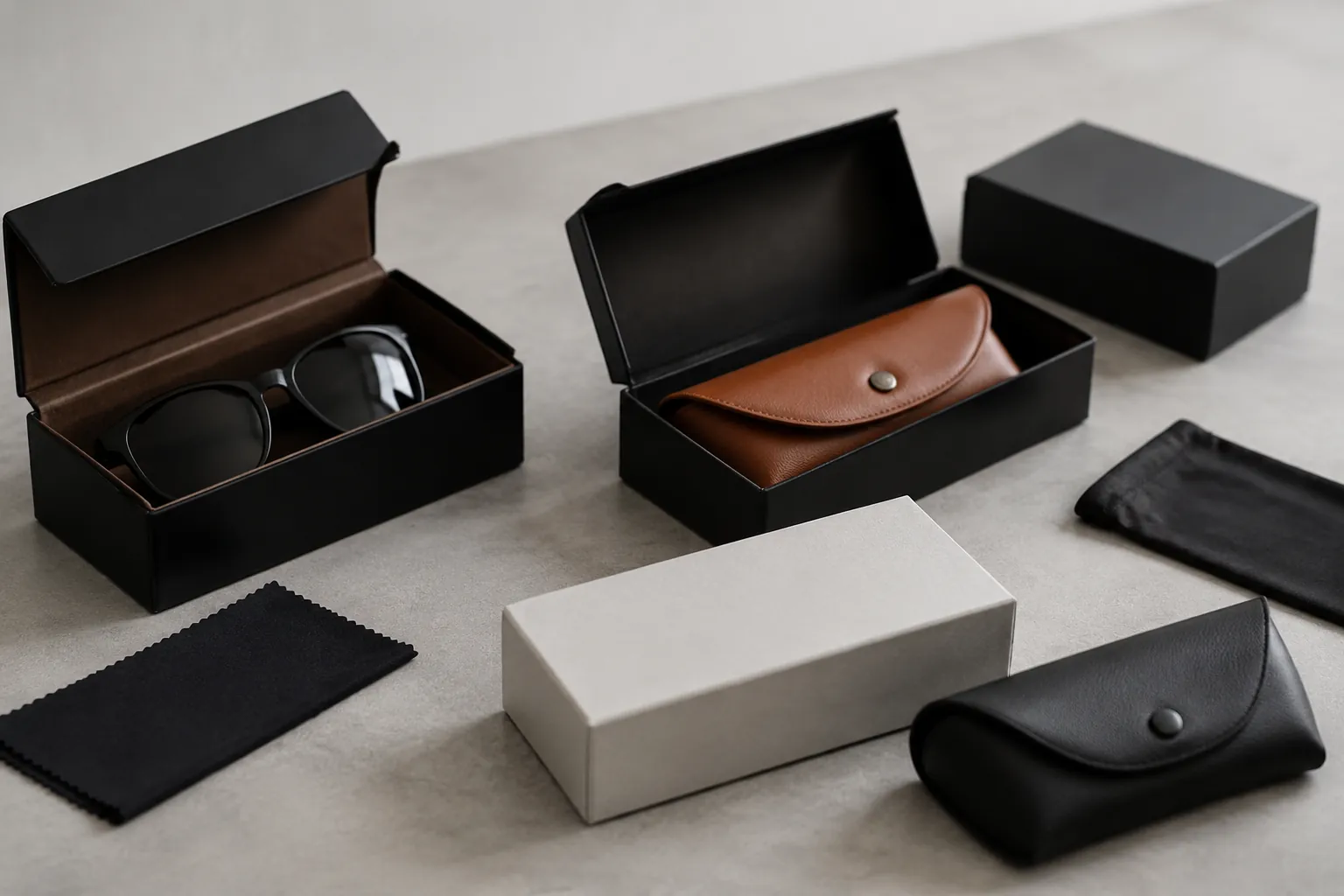
This guide is for brand owners, importers, distributors, and retail buyers sourcing custom sunglasses in volume. The goal is simple: pick the packaging that protects the product, fits the sales channel, and preserves margin after freight, handling, storage, and claims. Not the package that looks nicest in a sample box. A rigid case can reduce deformation and crush risk, but it usually adds carton volume. A microfiber pouch can cut surface contact and carry branding, but it will not stop every transit problem if the folded frame still moves. Sometimes the right answer is no retail packaging at all—just a controlled bulk pack that prevents scuffs and sorting mistakes. Use the framework below to decide by channel, frame construction, finish sensitivity, carton efficiency, and total landed cost.
Start with the sales channel
Most packaging mistakes start early. A buyer approves a case, pouch, or box before defining how the sunglasses will move from factory to customer. That is backwards.
Packaging for e-commerce is not the same as packaging for shelf retail. Packaging for a low-cost promotional frame is not the same as packaging for acetate sunglasses with polarized lenses, metal logo plates, or a higher retail price.
Start with four operating questions:
- Where will the sunglasses be sold? Shelf retail, e-commerce, duty-free, promotional giveaway, or distributor bulk resale.
- How many handling events happen before the customer receives them? Factory packing, pallet loading, sea or air freight, deconsolidation, warehouse storage, pick-and-pack, retail staff handling, and shopper touch all add stress.
- What protection level does the frame actually need? Injection-molded PC and TR-style promotional frames often handle rougher packing better than glossy acetate or mixed-material frames with plated parts. But poor packing can damage any frame.
- What landed margin must remain after freight and claims? Packaging cost has to be reviewed with freight cube, damage rate, labor, and sell-through impact.
A practical split works for many programs. Use rigid cases for higher-ticket styles, acetate, polarized products, mirrored lenses, and channels with rough handling or frequent try-on. Use microfiber pouches for mid-tier retail, e-commerce inserts, and giftable programs where branding matters but freight efficiency also matters. Use paper boxes when shelf presentation, gifting, or accessory organization matters. Use no retail packaging for promotional bulk, distributor repacks, or programs where the sunglasses will be packed into another kit after import.
Product details should drive the call. A matte PC frame with basic pad print presents different risks than a glossy acetate front with polished edges, mirrored lenses, and metal temple plates. Exposed metal parts create hard-contact points. High-gloss acetate shows fine marks under store lighting. Mirror coatings make rub damage obvious. Choose packaging against those risks, not against a rendered concept image.
Case, pouch, box, or none
The best packaging is usually the one that balances protection, cube efficiency, and retail need. Not the one that looks most premium in a meeting.
| Option | Best use | Protection level | Typical unit add-on cost | Freight impact | Main risk if underspecified |
|---|---|---|---|---|---|
| Rigid case | Premium retail, acetate, polarized, mixed-material frames | High crush and deformation protection | Varies by material, construction, and branding | Usually highest due to added volume and lower units per carton | Poor fit, excess empty space, weak hinge or shell construction |
| Microfiber pouch | Mid-tier retail, e-commerce, gift programs | Low to medium; mainly scratch and dust protection | Varies by fabric weight, print method, and quantity | Usually low | Frame movement, temple pressure marks, weak seams, poor print durability |
| Paper box | Shelf display, gift sets, branded unboxing | Medium if board grade and insert are correct | Varies by board grade, structure, insert, and finish | Medium to high depending on size and construction | Corner crush, humidity softening, print rub, weak insert support |
| No retail packaging | Promotions, distributor bulk, local kitting | Depends on inner pack design | Lowest in many programs | Usually lowest | Scuffing, mixed assortments, lens-to-lens contact, sorting errors |
Two rules keep decisions honest. First, if the package must help justify the retail price on shelf, it has to do selling work. That may justify more cost and more freight volume. Second, if the buyer will not see the package until after purchase, reduce empty air and spend only on the protection needed to prevent claims and unsellable units.
Also, do not confuse unit packaging with a shipping solution. A rigid case protects the pair inside the unit, but the case still needs the right inner-pack quantity, carton layout, and master-carton strength. A paper box can look premium and still fail in export transit if the board grade, insert, or outer carton is wrong.
How packaging changes landed cost and MOQ
Many buyers compare only ex-factory unit prices. That is a mistake. Packaging changes unit dimensions, units per master carton, carton count, pallet use, and for air shipments, chargeable weight. The frame cost may stay flat while landed cost per sellable pair shifts sharply.
At low MOQs, packaging can take up a disproportionate share of cost because setup, printing, and waste are spread over fewer units. At higher volumes, packaging cost per unit often improves. That still does not mean you should jump to a rigid case or premium box. Rework total landed cost at each realistic order tier.
- Rigid cases usually cut units per carton the most and often add freight cube.
- Pouches usually preserve better pair-per-carton ratios and are often the most efficient branded option.
- Paper boxes vary widely; a slim folding carton and a rigid gift box behave very differently in freight planning.
- Bulk pack can be the lowest-cost route, but only if orientation, sleeves, tissue, or dividers prevent cosmetic damage.
Ask the supplier for these numbers before approval:
- Unit pack dimensions in mm
- Units per inner and master carton
- Master carton dimensions in cm
- Gross and net weight per carton
- Pallet pattern if the order will move palletized through a warehouse network
Then compare total landed cost, not packaging cost alone. A pouch route that keeps higher carton density may beat a rigid-case route even if the case looks better. This is common in tight-margin programs and long-distance freight. In many cases, a modest spend on a pouch, tissue wrap, divider, or sleeve prevents most cosmetic claims while preserving carton efficiency.
Failure modes to expect and prevent
Choose packaging by failure mode, not by appearance. Common sunglasses transit failures include:
- Lens abrasion. This often shows up on mirrored, gradient, and dark-tint lenses when the lens contacts rough fabric, printed inserts, another frame, or trapped debris. Soft microfiber helps, but only if print placement, seam location, cleanliness, and frame fit are controlled.
- Temple pressure marks on lenses. This happens when folded temples rest against the lens and shift under vibration. A pouch alone may not stop it. Fold control, tissue, or a separator usually works better.
- Frame deformation. Thin temples, metal bridges, and lightweight plastic frames can distort under top-load if cartons are stacked too high or packed too tightly. Rigid cases and shaped supports reduce this risk best.
- Acetate scuffing. Polished acetate surfaces mark easily, especially near edges and bevels. Rivets, logo plates, zipper pulls, and exposed hinges should not contact glossy surfaces during transit.
- Box crush and corner collapse. The eyewear may survive, but the retail pack becomes unsellable. This is common when decorative packs are designed for looks first and export stacking second.
- Humidity warp and print rub. Paperboard can soften in long sea transit or damp storage. Poor coating, lamination, or curing can also cause rub, offsetting, or scuff transfer.
Decoration choices matter too. Pad printing can scuff if cure and adhesion are not well controlled. Laser engraving adds no raised surface and is generally lower risk in contact areas. Metal logo plates look premium, but they also create scratch points inside loose packaging. Often the fix is simple: control orientation inside the pouch, add a paper wrap, or use a fitted insert.
For compliance-sensitive orders, keep labels readable after transit. Product standards such as CE EN ISO 12312-1, ANSI Z80.3, and AS/NZS 1067 apply to the eyewear and labeling requirements of the target market, while REACH may apply to chemical compliance for materials sold into the EU. Packaging does not replace product compliance. But unreadable labels, mixed assortments, or missing warnings can still create customs, warehouse, and retail problems.
Match packaging to material and finish
Frame material changes packaging requirements. Injection-molded styles are often more tolerant of pressure and light rub than glossy acetate, but they are not damage-proof. CNC-milled acetate with polished edges usually needs more protection because cosmetic defects show immediately. Metal or mixed-material frames add hinge, bridge, and paint-rub risk.
Use this material guide:
- PC or TR-style promotional sunglasses: pouch or bulk pack can work if master-carton packing prevents lens-to-lens contact and uncontrolled rotation.
- Acetate sunglasses: pouch is often the minimum for retail routes; a rigid case is often the safer choice for higher-ticket programs, longer distribution chains, or highly polished finishes.
- Metal or mixed-material frames: protect hinges, bridge areas, and plated surfaces from compression and rubbing.
- Mirrored or polarized lenses: reduce movement inside the unit pack because surface damage is more visible and often more costly to reject.
Decoration method affects the choice as well:
- Pad printing: common and economical, but printed temples should not be pressed hard against rough seams or abrasive inserts.
- Laser engraving: durable and low-profile, generally easier to pack safely.
- Metal logo plates: premium appearance, but higher scratch risk if the pair can move freely.
- Hot foil or metallic decoration on packaging: visually effective, but more prone to rub if not protected during transit.
Fit tolerance matters more than many buyers expect. An oversized case or box can perform worse than a properly sized one because the folded frame can shift, rotate, and create repeated contact points. Ask to see the folded pair inside the proposed packaging, not just the empty package sample.
A sourcing process that avoids surprises
Approve packaging with the sunglasses, not after them. That is the safest way to avoid freight surprises and preventable claims.
- Lock the product specification first. Material, lens type, frame width, fold position, and decoration all affect pack fit.
- Request 2 to 4 packaging routes. For example: pouch only, pouch plus folding carton, rigid case, and controlled bulk pack.
- Compare total pack-out data. Unit dimensions, units per master carton, carton size, gross weight, and, if needed, pallet pattern.
- Ask for photos of the folded pair inside each option. Review temple-to-lens clearance, logo-plate contact points, and bridge position.
- Approve print and label content early. Barcodes, assortment labels, warnings, country of origin, and market markings should not be left to the end.
- Run practical checks. For e-commerce or long sea routes, basic drop and compression checks on the packed unit are worth doing.
- Freeze the packing method in the PO. State inner quantity, dividers, sleeves, tissue, desiccant if used, carton standard, and shipping marks.
Lead time matters. A packaging change after sample approval can trigger new fit checks, revised print files, carton recalculation, and sometimes a new production schedule. MOQ matters too. A frame MOQ does not mean every custom packaging option is efficient at the same quantity. Printed pouches, sleeves, and cartons often become more economical when one packaging format is shared across several SKUs.
If supplier qualification is part of your process, ask what management systems or audit standards are in place. For example, ISO 9001 can indicate a documented quality management system, and BSCI may matter for social compliance review. These do not guarantee correct packaging. They can still help when judging process discipline and documentation quality.
Buyer scenarios and final approval checks
The same sunglass can require different packaging depending on the sales channel and handling risk.
Scenario A: promotional giveaway. The buyer wants the lowest landed cost and plans to insert the sunglasses into another branded kit locally. Best choice: no retail box, with a sleeve or pouch only if the lens finish or decoration marks easily. Priority: carton efficiency, assortment control, and minimal added cube.
Scenario B: online lifestyle brand. The buyer wants a clean unboxing experience without paying the freight penalty of a rigid case. Best choice: microfiber pouch plus a slim information card, provided the frame fit prevents movement and temple pressure. Priority: presentable delivery, basic surface protection, and efficient carton density.
Scenario C: boutique retail. The buyer is selling acetate styles at a higher retail price and expects in-store handling. Best choice: rigid case or a well-specified paper box with internal support, depending on shelf format and display needs. Priority: retail presentation, protection during repeated handling, and fewer cosmetic rejects.
Before bulk production, run this checklist:
- Is the packaging chosen for the actual sales channel rather than appearance alone?
- Do you have unit pack size, units per carton, carton dimensions, and gross weight for each option?
- Have you reviewed likely failure modes: lens rub, temple pressure, frame deformation, box crush, and humidity effects?
- Does the package fit the folded frame, including logo plates, hinge shape, and raised decorations?
- Are warning labels, SKU labels, assortment labels, and market markings approved and positioned correctly?
- Has the full packing method been written into the purchase order?
- Are sample and bulk timelines still valid after the final packaging choice?
Good packaging protects margin in two ways. It reduces unsellable units, and it avoids paying freight on unnecessary volume. If your supplier controls frame production, decoration, and QC in-house, ask for packed samples, not just product samples. That gives you a better view of what is likely to arrive at your warehouse.
Have a custom sunglasses project in mind?
Send us your styles, target market and quantities and we will return a detailed quote with MOQ, lead time and a sample plan.
Get a QuoteWhy source this from Wenzhou with LumiShades
Wenzhou in Zhejiang Province is widely regarded as China’s eyewear manufacturing capital, producing a large share of the world’s sunglasses. That concentration matters to buyers: a deep local supply chain for acetate sheet, hinges, lens blanks, plating and packaging means shorter component lead times, easier color and material matching, and a workforce with decades of eyewear-specific skill. LumiShades has manufactured in this ecosystem since 2009, and our vertical integration — in-house injection molding, acetate cutting, CNC milling, lens tinting, decoration and quality control — means no part of your order is quietly subcontracted to a workshop you cannot audit.
For international buyers, that vertical control translates into accountability. When a single factory owns every step, defects are traced and fixed at source rather than bounced between vendors, and your specifications survive intact from first sample to bulk. We back this with 15+ years of experience, shipments to 60+ countries, more than 5 million pairs produced per year and a 98.5% on-time delivery rate. Our certifications — CE EN ISO 12312-1, FDA registration, ANSI Z80.3, AS/NZS 1067, REACH, ISO 9001 and BSCI audit — mean the compliance documentation your market requires already exists. Explore our manufacturing capabilities and quality control process to see how this works in practice.
Frequently asked questions
Is a rigid case always worth it for private label sunglasses? No. Use a rigid case when the product value, finish sensitivity, or handling conditions justify the added cost and freight cube. It is often the safer choice for acetate, mirrored lenses, polarized lenses, mixed-material frames, and retail programs with repeated try-on. Before approving it, ask the supplier for unit pack dimensions, units per carton, carton size, and photos of the folded frame inside the case. Then compare it against a pouch or box route using total landed cost and expected damage risk, not appearance alone.
Can I use no retail packaging and still avoid damage? Yes, if the bulk-packing method is clearly specified and tested. The key controls are pair orientation, separation between lenses and hardware, assortment identification, and master-carton stacking strength. Ask for the exact packing method in writing: inner quantity, whether sleeves or tissue are used, how pairs are layered, whether dividers are included, and how assortments are labeled. Request packed sample photos or a pilot carton before bulk production. Most bulk-pack damage comes from undefined packing details, not from the absence of a retail box.
How early should packaging be decided in the sourcing process? During sampling, not after product approval. Packaging fit depends on frame width, fold position, lens type, decoration, and any raised hardware. If packaging changes late, you may need new fit checks, revised labels, updated carton counts, and a new freight calculation. A practical step is to approve the product sample and the packed sample together, then freeze the packing method in the purchase order and final approval records.
What product types need more protective packaging? Products that show cosmetic damage easily or deform under pressure usually need more protection. Common examples are glossy acetate, metal or mixed-material frames, mirrored lenses, polarized lenses, and frames with raised metal logo plates. These constructions are more vulnerable to visible scuffing, rub marks, pressure points, or bending. Ask the supplier to identify likely contact points on the folded frame and show how the proposed packaging prevents those contacts during transit.
Do packaging choices affect compliance? Yes, indirectly. Packaging does not replace product compliance, but it affects whether required labels, warnings, assortments, and market information remain correct and readable on arrival. For sunglasses, confirm the product and labeling requirements for the destination market, which may include CE EN ISO 12312-1, ANSI Z80.3, AS/NZS 1067, REACH, or FDA registration where applicable. Also confirm where country-of-origin labels, warnings, and SKU labels will be placed, and check that they will not rub off, detach, or become unreadable in transit.
Ready to start?
Explore our shield & oversized sunglasses or request a quote — our sales team replies within 12 hours.
Request a Quote