
Injection vs Acetate vs Mixed-Material Frames
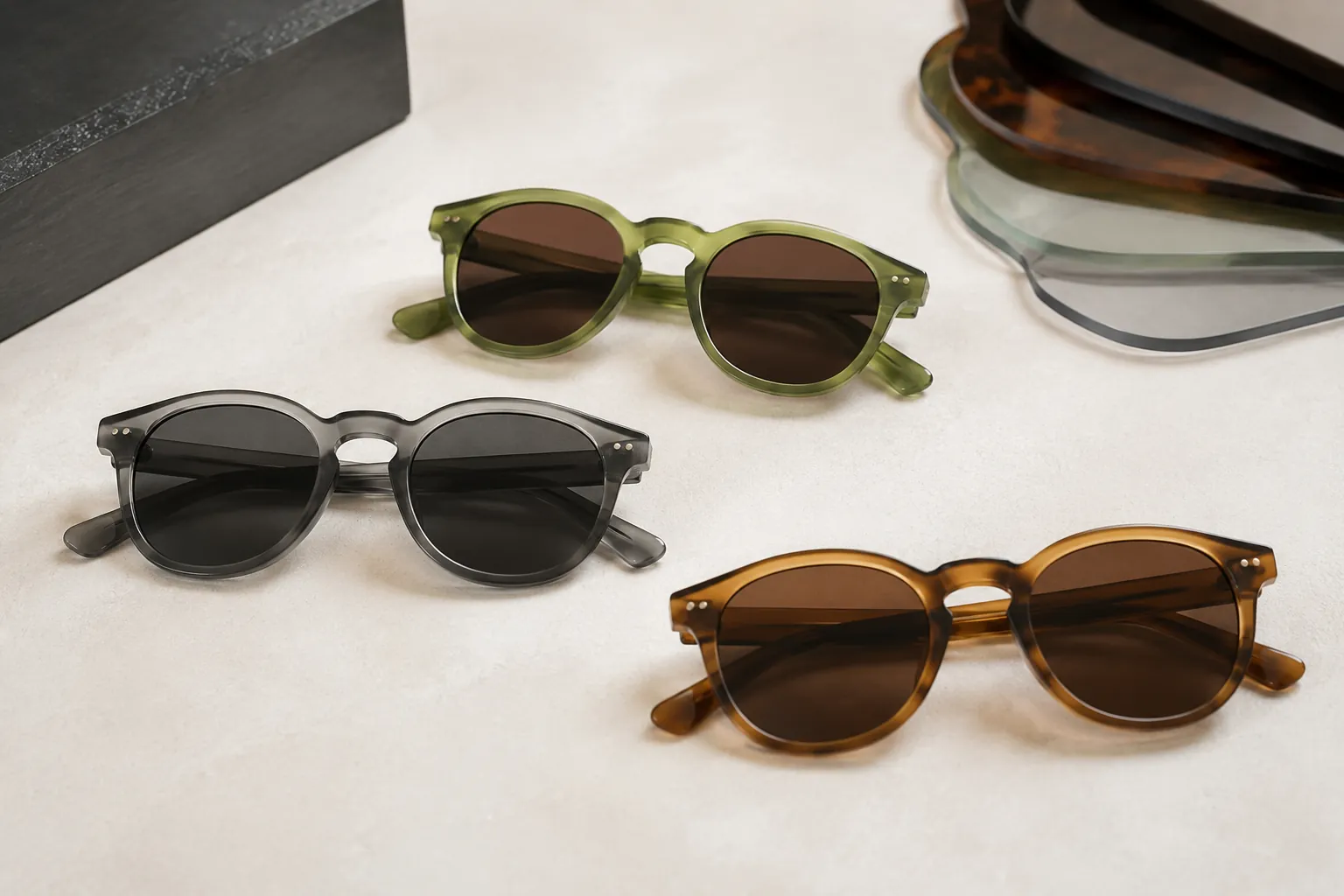
If you buy sunglasses for a brand, chain, or distributor, frame material is not a style choice. It affects tooling, unit cost, lead time, weight, finish quality, and the price band the product can support. This comparison breaks down injection, acetate, and mixed-material frames by buying target, not by design theory. The goal is simple: choose the material that fits your margin and channel. Not the one that only looks good in a render.
The buying question: what are you really paying for?
In eyewear sourcing, material choice drives three things buyers feel fast: tooling commitment, production cost, and perceived value. Injection frames usually sit at the lowest-cost end of the range. Acetate brings a denser feel and stronger color depth. Mixed-material frames sit between them, or above them, depending on how many parts, finishes, and assembly steps they need.
The real question is not "which material is best?" It is "what retail price target am I trying to support, and what will the customer expect at that price?" A low-priced promo style can work with a simpler frame and basic packaging. A mid-market retail style needs cleaner finishing, more consistent hardware, and better visual presence. A higher-priced style usually needs both tactile quality and tighter control.
Material choice also changes the factory route. Injection requires tooling and controlled molding. Acetate requires block cutting, shaping, polishing, and assembly. Mixed-material frames add coordination between different materials and processes, such as metal parts, plating, bonding, engraving, or printed decoration. Each route has different tolerance risks. Check front symmetry, temple length consistency, hinge alignment, and lens fit before bulk approval. If the supplier cannot hold those basics, the frame will feel off even if the render looked premium.
LumiShades works across injection molding, acetate cutting, CNC milling, lens tinting, and decoration in-house. That matters because each material changes the process chain. If a factory must outsource tinting, plating, or logo work, cost and schedule become harder to control. Internal process control also makes it easier to hold dimensions, keep color consistent across reorders, and match decoration from sample to bulk.
Injection frames: lowest cost, fastest to scale
Injection frames are the most common choice for volume-led programs. The material is usually TR90, nylon, or another injection-grade polymer. These materials are lightweight and resilient, and they can be produced efficiently once the tooling is stable. TR90-style materials are often chosen for flexibility and low weight. Harder nylon blends can improve rigidity.
For buying teams, injection is usually the easiest route when the target retail sits in the entry to lower-mid market. The economics are straightforward: once the mold is approved and cycle time is stable, unit cost can drop as volume rises. Final cost still depends on lens spec, decoration, packaging, and mold complexity. A simple frame can be much cheaper than a molded style with multiple textures, tight corners, or secondary branding.
Injection also supports lighter frames that ship well and reduce breakage risk in transit. It fits sport-inspired silhouettes, youth lines, promo programs, and private-label basics. For test-and-learn runs, a smaller MOQ can be practical because it lets you validate shape, color, and branding before a larger order. If you need multiple colors, one mold with several small color runs is usually more efficient than separate builds for each option.
Watch the hidden costs. Thin walls can create scrap or sink marks. Sharp internal corners can create stress around the hinge area. Over-polishing can expose flow lines instead of hiding them. Injection looks best when the design uses a controlled matte texture, a satin finish, or a clean gloss supported by a well-made mold. If the frame is visually simple, details such as a two-tone shot, an embossed logo, or a small metal badge can improve perceived value without changing the structure.
Decoration methods for injection are usually efficient: pad printing, hot stamping, laser marking on inserted badges, painted logo fill, or overmolded color accents. Specify these early. Each one can affect cycle time and rejection rate. If you need a fast launch, injection is usually the most forgiving choice on lead time, but only if the tooling and finish standard are realistic.
Acetate frames: higher perceived value, more handwork
Acetate is a strong choice when the product needs a premium hand-feel and rich color. The material polishes well and creates a thicker visual profile, which suits fashion-led retail. Buyers often choose acetate when they want a frame that feels substantial in hand and holds shape on the face without looking bulky.
Acetate usually costs more to process because it is cut, shaped, milled, tumbled, polished, and assembled rather than simply molded and ejected. The work is more labor-heavy and more sensitive to setup errors. A front that looks right in CAD can still need rework once the first blocks are cut, especially around lens groove depth, hinge pocket alignment, and temple matching.
Acetate gives buyers more room to use the material itself as part of the value story. Front thickness varies by design, but acetate commonly supports a thicker visual profile and deeper color effect than injection can easily match. That said, acetate does not automatically mean premium. If the polish is uneven, the edges are rough, or the temple-to-front fit is off, the frame still looks cheap. Material helps. Workmanship decides.
For price positioning, acetate usually belongs in the mid to higher retail bands. It can work at lower prices if the shape is simple and decoration is limited, but it is usually chosen because the customer can feel the difference. This is the frame type buyers use when they want more weight on the nose, deeper color, stronger translucency, and a premium signal without moving to full metal construction.
Because acetate is a cut-and-finish process, lead time is more exposed to rework than injection. Changes in lens opening, bridge width, or hinge position can affect cutting programs and assembly fit. Buyers should expect tighter control on drawings and first samples. Check temple symmetry, lens groove depth, and hinge placement before bulk approval. If the line includes laminated acetate, tortoise layers, or complex color blocks, allow extra time for color matching and polishing consistency.
Decoration on acetate can be more refined than on injection. Options include laser engraving, foil stamping, enamel-filled logos, metal plaques, embedded wire cores in temples, and custom surface lamination. Each adds cost and can add one or more production steps. If you want a premium effect without major cost creep, the best approach is usually one strong brand cue executed cleanly rather than several decorative techniques fighting for attention.
LumiShades' in-house acetate cutting and CNC milling help because temple fit, front symmetry, and hinge alignment are not minor details. For bulk production, a 25 to 35 day window is a reasonable planning range, but acetate styles with complex polish, custom lamination, or decorated metal parts should sit toward the longer end.
Mixed-material frames: where margin and perceived value meet
Mixed-material frames combine two or more constructions, commonly acetate fronts with metal temples, injection fronts with metal brow bars, or acetate with injected temple tips and nose components. These are not automatically premium. They are premium only if the mix is functional, visually clean, and mechanically stable.
This category helps when a buyer wants more shelf presence than straight injection but cannot justify a full acetate or full-metal program. Mixed-material designs often look more expensive because they break up the silhouette and add contrast. A brushed metal temple, a laser-etched hinge plate, or a metal logo insert can all raise perceived value, but only if the finish is controlled and the alignment is consistent on both sides.
The cost downside is assembly complexity. Mixed-material frames add more parts, more checkpoints, and more chances for tolerance stack-up. Different materials expand differently under heat and load. If the hinge spec is loose, the front can twist. If the bonding point is weak, the temple can loosen after repeated opening and closing. If plating quality is inconsistent, the product can show visible color variation between sample and bulk. That is why mixed-material sourcing should include frame drawings plus material callouts for plating finish, screw specification, and any adhesive or locking method used in assembly.
Mixed-material is often the right answer for fashion-led private label, gift sets, and retailers that need better perceived value than injection but do not want the full cost structure of acetate. It is also the material path where decoration matters most, because branding is part of the product story rather than a minor label. Metal logos, edge printing, engraving, and contrasting temple tips can all strengthen the design, but the factory must control alignment precisely and keep finish consistent across both material streams.
If you are building a mixed-material frame, ask how the supplier manages plating color, hinge torque, and assembly sequence. A good mixed-material product depends on process control more than expensive raw material alone.
Head-to-head: cost, lead time, tolerances, and what each material hides
| Frame type | Typical buying use | Cost position | Lead time profile | Typical tolerance / process focus | Buyer risk |
|---|---|---|---|---|---|
| Injection | Entry price, volume basics, promo programs | Lowest | Fastest after tooling approval | Mold fill, gate marks, hinge alignment, color consistency | Looks cheap if finish is weak |
| Acetate | Premium look, color-rich fashion styles | Mid to higher | Moderate; more finishing time | Cut accuracy, polish quality, front symmetry, hinge pocket fit | Fit and polish problems show fast |
| Mixed-material | Higher perceived value without full premium cost | Mid to high | Moderate to slower due to assembly | Part matching, plating control, assembly tolerance, logo placement | More parts, more alignment issues |
Use the table as a filter, not a quote. Final unit price still depends on frame size, hinge type, lens type, decoration, packaging, and quantity tier. A simple injection frame with basic tint and no extra logo work can be much cheaper than a complicated acetate style with metal hardware and multi-step branding. A mixed-material frame with one clean metal accent can be more efficient than a heavily decorated acetate build.
A useful rule: if the product has to land near a sharp price point, injection is usually the safer start. If the product sells story and feel, acetate earns its place. If the goal is to make a lower-to-mid retail item look more expensive without fully changing the cost base, mixed-material is the middle road. Match the structure to the channel. Promo, chain retail, independent optical, fashion e-commerce, and corporate gifting all tolerate different levels of finish and cost.
How to match material to your retail price target
The target retail price should drive the frame choice. Not the other way around. A simple way to map the decision is below:
- Sub-$20 retail: Injection usually fits best. Keep the shape simple, reduce secondary decoration, and avoid overbuilding the frame.
- $20-$50 retail: Injection with better finish, or mixed-material if the retail story depends on contrast and stronger shelf presence.
- $50-$100 retail: Acetate or well-executed mixed-material. This is where polish, hardware quality, and consistent branding matter more.
- $100+ retail: Acetate with stronger detailing or a mixed build with tight assembly and consistent branding. The product needs to justify its price through feel and finish.
Gross margin logic is simple. If landed cost is too high for the shelf price, teams usually cut packaging, lens spec, or QC later. That is usually the wrong place to save money. A better move is to simplify the frame construction at the start. For example, replacing a complex three-piece mixed build with a cleaner two-piece design can reduce labor and defect risk. Choosing a simpler temple shape can also reduce tooling complexity and stabilize output.
For custom programs, sample timing matters too. Use the sample stage to test appearance, hinge torque, temple alignment, and overall hand-feel. A good sample can still fail the math if finishing steps are too expensive for the target volume. Ask for a revised quote if the first sample includes labor-heavy details that are not essential to the SKU's retail position.
What changes in the factory: process steps by material
Material choice changes the factory route. That is where many buyers lose time. With injection, the main bottleneck is mold readiness and stable cycle output. With acetate, the work moves into block cutting, shaping, tumbling, polishing, and final assembly. With mixed-material, you add coordination between separate material streams and more quality checks.
- Injection: mold validation, first article check, color matching, cycle stability, gate mark review, and final trim quality.
- Acetate: block cutting, CNC shaping, hinge setting, tumbling, polishing, surface inspection, and fit adjustment.
- Mixed-material: part matching, assembly tolerance control, metal finish check, logo placement, screw retention, and final alignment.
These process differences explain why small engineering choices affect lead time. A new mold for injection can take longer upfront but then scale efficiently. Acetate is less tooling-heavy in the same way, but it is more exposed to finishing time and rework. Mixed-material often requires coordination of separate suppliers or internal departments, especially if plating, engraving, or pad printing sit on different lines. One supplier with in-house molding, cutting, milling, decoration, and QC usually has an edge when deadlines are tight.
LumiShades' in-house functions matter here because injection molding, acetate cutting, CNC milling, lens tinting, decoration, and QC sit under one roof. That reduces delay between sample approval and bulk production. It also helps when a buyer wants laser engraving, pad printing, or a metal logo plate, because those details are handled as part of the production flow rather than as an afterthought.
Compliance should be checked at the product stage, not after shipment. Relevant standards and registrations can include CE EN ISO 12312-1, ANSI Z80.3, AS/NZS 1067, REACH, FDA registration, ISO 9001, and BSCI, depending on the target market and channel. Ask for the exact document set before final spec approval. Compliance can affect material selection, test timing, and labeling.
How to specify the right frame in your RFQ
If you want useful quotes, do not ask for "best material." Ask for a build that matches a price target and market. A good RFQ should include frame type, target retail, target landed cost, lens color and category, branding method, packaging style, and compliance requirement. The supplier can then tell you whether injection, acetate, or mixed-material fits the brief.
To speed quoting, be explicit about volume and use case. A small test run with simple packaging and a low opening price is usually best quoted as injection. A statement style for an independent optical chain may justify acetate with controlled polish and a stronger hinge spec. If you want a richer shelf presence without full acetate economics, mixed-material is worth quoting. For metal parts, ask whether the supplier uses plating, anodizing, or painted finish, and whether the finish stays stable across batch runs.
A practical buyer checklist:
- State your retail target before asking for a quote.
- Confirm MOQ early and make sure it matches your launch plan.
- Ask for sample timing and use samples to test fit, finish, and hinge feel.
- Ask for bulk timing, then check whether decoration adds time.
- Request material-specific tolerances for fit, alignment, and finish.
- Confirm which compliance standard your market needs.
- Approve finish samples under natural light, not only under office lighting.
Short version: choose injection for cost control, acetate for premium feel, and mixed-material when you need stronger shelf appeal without paying for a full premium build. If the frame material does not fit the retail math, the rest of the product usually ends up compromised.
Have a custom sunglasses project in mind?
Send us your styles, target market and quantities and we will return a detailed quote with MOQ, lead time and a sample plan.
Get a QuoteWhy source this from Wenzhou with LumiShades
Wenzhou in Zhejiang Province is widely regarded as China’s eyewear manufacturing capital, producing a large share of the world’s sunglasses. That concentration matters to buyers: a deep local supply chain for acetate sheet, hinges, lens blanks, plating and packaging means shorter component lead times, easier color and material matching, and a workforce with decades of eyewear-specific skill. LumiShades has manufactured in this ecosystem since 2009, and our vertical integration — in-house injection molding, acetate cutting, CNC milling, lens tinting, decoration and quality control — means no part of your order is quietly subcontracted to a workshop you cannot audit.
For international buyers, that vertical control translates into accountability. When a single factory owns every step, defects are traced and fixed at source rather than bounced between vendors, and your specifications survive intact from first sample to bulk. We back this with 15+ years of experience, shipments to 60+ countries, more than 5 million pairs produced per year and a 98.5% on-time delivery rate. Our certifications — CE EN ISO 12312-1, FDA registration, ANSI Z80.3, AS/NZS 1067, REACH, ISO 9001 and BSCI audit — mean the compliance documentation your market requires already exists. Explore our manufacturing capabilities and quality control process to see how this works in practice.
Frequently asked questions
Which frame material is best for a sub-$15 retail sunglasses line? Injection is usually the best starting point for this price band because it supports lower unit cost, lighter weight, simpler decoration, and efficient production. Keep the shape simple, avoid multi-step branding, and confirm that the finish standard is realistic for the price target.
Is acetate always more expensive than injection? Usually yes, because acetate requires cutting, shaping, polishing, and more hand finishing. Final landed cost still depends on design complexity, hardware, decoration, packaging, and order quantity, so compare full specifications rather than material alone.
When should I choose mixed-material instead of pure acetate? Choose mixed-material when you want a stronger shelf presence than injection, but full acetate would push the price too high. It works well when a metal accent, contrast temple, or branded detail helps the product sell at mid-market retail without requiring a full acetate build.
What MOQ should I expect for custom frame programs? MOQ depends on the frame structure, color count, and decoration method. For a low-risk test program, ask the supplier for the smallest practical order by design and color, then confirm whether the mold or decoration setup changes that number. If you need to test multiple colorways, ask for one mold and separate color runs rather than multiple molds.
What tolerances should I ask for on sunglasses frames? Ask for tolerances on front symmetry, temple length, hinge alignment, lens groove fit, and overall assembly consistency. The exact numbers should come from the design and construction. What matters most is that the supplier states measurable checks in the tech pack and confirms how they are inspected before bulk approval.
What compliance documents should I ask for on sunglasses? Ask only for the standards relevant to your market and channel. Common references include CE EN ISO 12312-1 for the EU, ANSI Z80.3 for the U.S. market, AS/NZS 1067 for Australia and New Zealand, REACH for chemical compliance in applicable markets, FDA registration where required for U.S. selling, plus ISO 9001 and BSCI if you want to review quality and social compliance systems. Request the exact documents and test reports before order confirmation.
How fast can I get samples and bulk production? Ask the supplier to quote sample lead time and bulk lead time separately, because the answer changes with material, decoration, and tooling status. Request a calendar-based production plan that shows sample approval, decoration, packing, and final inspection milestones. That gives you a realistic launch date instead of a generic promise.
Ready to start?
Explore our shield & oversized sunglasses or request a quote — our sales team replies within 12 hours.
Request a Quote