
Sunglasses Frame Geometry Guide for Buyers
If you buy sunglasses for brands, distributors, or retail chains, frame geometry is not a design detail. It affects fit, sell-through, return rates, carton density, tooling cost, and how quickly a line can scale by channel. This guide shows how to choose shapes, widths, lens heights, bridge sizes, and base curves for different face markets, then links those choices to material behavior, tolerances, decoration methods, MOQ, lead time, and compliance so you can source with fewer mistakes.
Start with the market, not the sketch
Most weak eyewear buys start with a shape reference and end with dead stock. The right sequence is the opposite. Define the target market, the retail channel, the price point, and the wearing context first. Then choose geometry.
A frame that works in a fashion boutique can fail in pharmacy, airport, or mass retail. The customer profile is different. So is the shelf time. So is the fit tolerance.
For overseas buyers, the real question is not "Is this frame attractive?" It is "Will this width, bridge, and lens height fit enough heads in this market to move at my target channel?" Look at three things together: face proportion, wearing behavior, and shelf presentation. A frame can be visually right and commercially wrong if the temple pressure is too high, the bridge sits too low, or the lens height makes the product look oversized on shelf.
In production, frame geometry is usually controlled through a spec sheet and a sample confirmation process. The exact tolerance depends on the material, construction, and finishing steps. Ask the factory which dimensions are critical and which can move slightly after polishing, assembly, or lens fitting. Do not approve a design from a CAD screenshot alone. Ask for a dimension sheet, a sample on a sizing board, and a wear test on real faces in the target market. That is how you catch a bridge shift or front-width change that looks minor on paper but causes fit problems in practice.
Simple rule: treat geometry as a technical decision. Not just a design decision. If you change front width, bridge structure, lens groove depth, or hinge position, expect the sample to be rechecked before bulk approval.
The geometry pieces that actually move sales
Buyers often focus on lens shape and ignore the rest. That is expensive. The style may keep the same name in a sales deck, but the commercial result changes when front width, bridge, and temple geometry shift by only a few millimeters.
Here is what matters in practice:
- Front width: the main fit gate. Too narrow and the temples flare outward. Too wide and the frame slides down and looks loose on face.
- Lens height: affects face coverage, trend signal, and shelf presence. A small increase can make a frame read more fashion-led or more protective, depending on the silhouette.
- Bridge width and shape: controls nose fit. This matters more in low-bridge markets and for acetate fronts without adjustable nose pads. A bridge that sits too high can create gaps and sliding.
- Temple length and angle: determines whether the frame stays stable behind the ear or feels tight after wearing. Temple length is only part of the fit. Bend angle and drop matter too.
- Base curve: flatter fronts work better for optical-style fashion. Deeper curves help with wrap and sun protection. Push the curve too far without matching lens design, and you can create distortion or a heavy-looking front.
For injection frames, small changes are easier to industrialize and repeat. For acetate, geometry changes can affect cutting yield, polishing time, and alignment at the hinge area. A sharper corner or thinner bridge may need slower milling and more manual finishing. On a tight-margin program, those extra minutes matter. If you source from a factory with in-house molding, milling, tinting, and decoration, geometry changes can be tested faster because the program does not need to move between separate vendors.
One more point: if a geometry change affects the hinge position, bridge structure, or lens groove depth, treat it as a technical revision. Not a color swap. That means new sample confirmation, updated QC points, and fresh packaging checks.
Which shapes fit which face markets
No market is uniform, but some geometry patterns are reliable. Use these as buying filters, not as absolutes. Good buyers use regional shape logic to narrow the assortment before they start sampling.
| Market / wearer tendency | Geometry that usually sells | Why it works | Watch-outs |
|---|---|---|---|
| East Asian markets with lower nose-bridge preference | Medium-width fronts, lower bridge geometry, flatter or better-seated fit | Sits better on a lower nasal bridge and reduces sliding | A bridge that is too high can create immediate comfort complaints and return risk |
| North American mass retail | Broad selection of wayfarer, square, and sport-inspired silhouettes in medium to large widths | Consumers compare shape first, then comfort, and prefer familiar proportions | Overly narrow fronts get pushed aside on shelf and may look too fashion-specific |
| European fashion channels | Sharper squares, slim cat-eye, oval, and small-to-medium fashion proportions | Style signal matters; smaller geometry can read premium when the proportions are controlled | Too much curvature or oversized lens height can make the frame look dated or heavy |
| Sport and outdoor channels | Wrap fronts, wider temples, higher lens coverage, secure nose fit | Coverage and retention matter more than trend cues | Base curve and lens tint must stay inside compliance targets and visual comfort expectations |
| Travel retail | Universal-fit core shapes with moderate lens height and clean side profile | Shoppers want quick recognition and low return risk | Overly niche silhouettes may not convert in short decision windows |
If you buy for multiple regions, do not force one master frame into every market. Make regional geometry variants. A small bridge adjustment or front-width variant can be the difference between a regional best seller and a slow mover.
When you compare market sets, ask for the factory's actual sample board measurements. Two frames can be described as the same style. They are not the same if one has a 52 mm lens width and the other is 54 mm. The fit changes. So does shelf presence.
Channel-by-channel merchandising rules
Retail channel changes the ideal geometry more than many buyers expect. A style that looks good in a brand showroom may underperform on a drugstore peg hook. Shoppers make faster decisions in low-engagement channels. They only forgive fit issues when staff can explain the product.
- Fashion boutiques: pick sharper silhouettes, smaller lens heights, and stronger frame identities. These stores can support more niche geometry because staff can explain the product and styling context.
- Mass retail: use familiar, medium-proportion shapes. Keep the front width forgiving and the bridge comfortable. The frame has to read well in a short viewing window, so silhouette recognition matters more than subtle design details.
- Travel retail: prioritize universal fit, moderate lens coverage, and clean side profiles. Buyers want low return risk, durable hinges, and pack-out efficiency. A box-friendly shape with stable temple closure is usually easier to merchandise than a highly sculpted front.
- Online DTC: use geometry that photographs clearly and include measurements that are easy to understand. Consumer confusion drives returns more than shape itself. If you sell online, list lens width, bridge, temple length, lens height, and front width on the product page.
- Workwear, outdoor, and promo channels: favor stable fit and bigger coverage. A slightly heavier frame is acceptable if it stays on the face and survives handling.
For e-commerce, the biggest mistake is hiding the dimensions. List measurements in millimeters and use simple fit language: narrow, medium, or wide. If your target customer is likely to wear a cap, helmet, or mask, say so. Those use cases affect bridge choice and temple angle.
Also consider packaging geometry. A deep wrap frame may need a larger case or more carton height. That changes freight efficiency. For large programs, it can alter landed cost and pallet utilization. Check packaging together with the frame spec.
Material choice changes geometry behavior
Geometry does not behave the same in every material. That is where sourcing teams get caught. Two frames can share the same CAD outline and still wear differently because the material reacts differently at the bridge, hinge, and temple bend.
Injection frames are efficient for larger volumes and consistent repeatability. They hold dimensions well and suit medium-price programs. If you need several thousand units across a few colors, injection often gives the cleanest cost structure. It also supports clean repetition on tighter radii. The tradeoff is feel. Without upgraded finish and hardware, it can feel less premium.
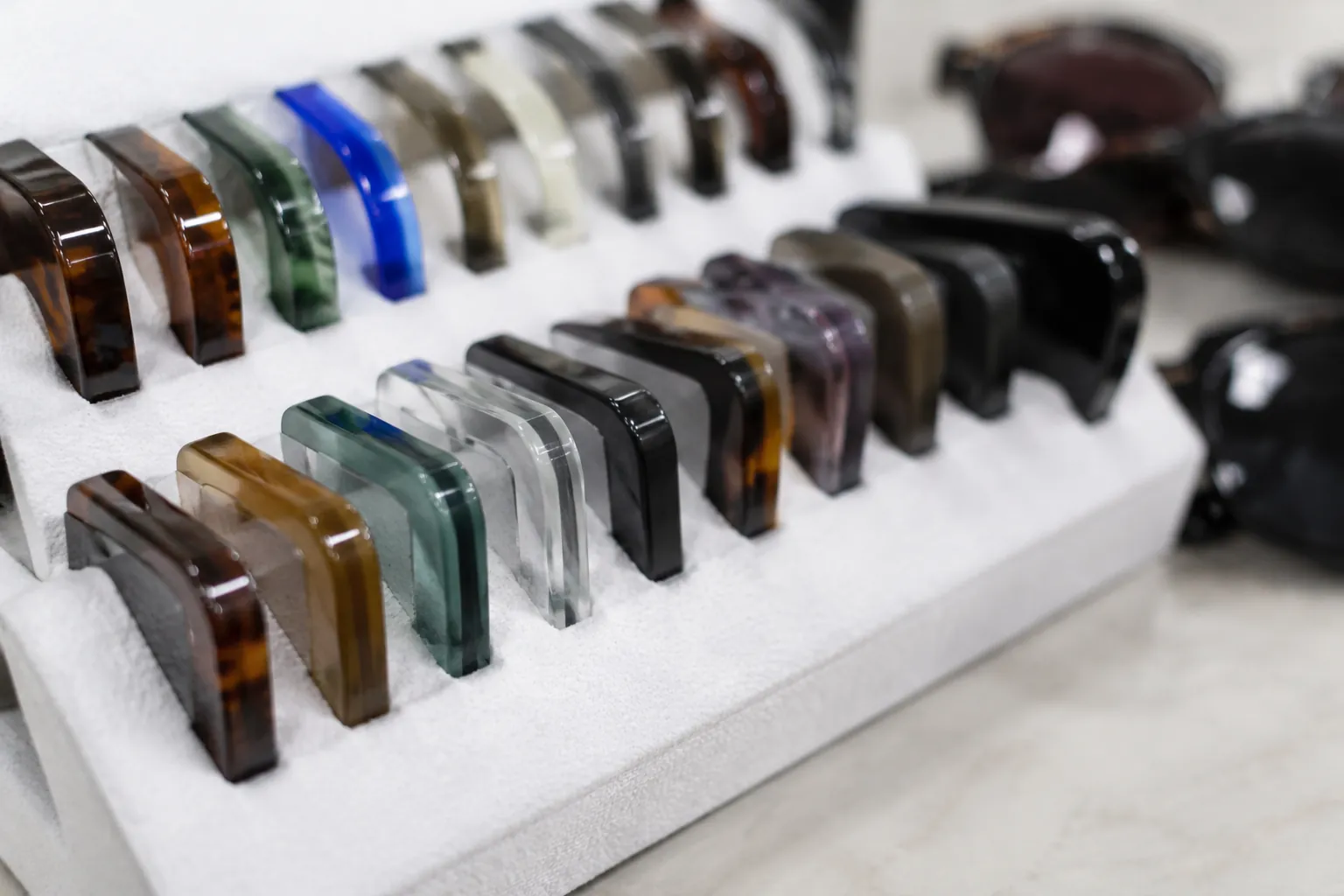
Acetate frames give better depth in color and a more substantial hand feel. They are strong in premium retail, but they can be less forgiving on very thin bridge areas and aggressive angles. Thin temples and narrow bridges need careful control during cutting and polishing. A bridge that measures correctly before finishing can still shift slightly after polishing, so good factories confirm final dimensions after surface work, not only after milling.
Metal or metal-acetate combinations support finer geometry and adjustable fit, but they add parts and assembly points. That means more QC checks: nose pad alignment, screw torque, temple symmetry, and plating consistency. Good for premium channels. Less useful if the price target is tight or if the customer does not need adjustable hardware.
Ask how the factory measures critical points. A serious plant will have a repeatable system for front width, lens width, bridge, temple length, and hinge symmetry. Even a small left-right mismatch can be visible on a slim-front sunglass.
For planning, ask the factory to confirm sample lead time and bulk lead time in writing. Lead time depends on style complexity, tooling status, lens specification, decoration, and packaging approval. Straightforward styles are usually faster than programs that need new hardware, special tint matching, or multiple decoration steps.
A practical buying matrix by style family
Use the following as a working shortlist. It is not fashion advice. It is a buying tool for reducing assortment risk and matching the frame to the channel.
| Style family | Typical fit profile | Best use case | Commercial note |
|---|---|---|---|
| Wayfarer / square | Medium to broad faces, stable all-around fit | Core line for mass and online channels | Lowest-risk style for first-time orders and easiest to scale across colors |
| Round / oval | Narrower or softer faces, fashion-led buyers | Boutique and trend programs | Needs careful sizing; too small feels toy-like, too large loses the vintage signal |
| Cat-eye | Fashion-oriented female assortment | Retail and DTC capsules | Front width and lens height must be controlled or the style looks unbalanced |
| Wrap / sport | Activewear and outdoor users | Performance and travel retail | Lens curvature, retention, and compliance testing matter more than color alone |
| Slim geometric | Style-first buyers with lower functional need | Fashion drops and limited editions | Higher style appeal, but narrower wear window and more size sensitivity |
If you want a safer first order, buy one core geometry and one regional variant. That is usually smarter than launching many styles with shallow quantities. A small MOQ can help you test the market. The goal is not to buy the cheapest sample run. It is to prove fit and sell-through before you commit to larger volume.
At low quantities, unit cost is usually higher because tooling, setup, tint confirmation, decoration setup, and manual QC are spread across fewer pairs. Once the style is approved and the packing spec is locked, the same model becomes more efficient to repeat. That is why the first order should prove geometry and channel fit, not just fill a purchase plan.
Compliance and testing cannot be an afterthought
Geometry affects compliance. That is not optional. A frame with a deep wrap, tinted lens, or certain coverage profile may need a different test approach than a casual fashion frame. Even small shifts in base curve can change optical performance, coverage, and labeling requirements depending on the destination market.
For export programs, align the product with the right standard before tooling locks. The commonly used references buyers should discuss with their supplier are CE EN ISO 12312-1, ANSI Z80.3, AS/NZS 1067, and REACH. In the United States, sunglasses suppliers often also work within the scope of FDA registration requirements where applicable. Quality systems such as ISO 9001 and social compliance systems such as BSCI are not product certifications, but they are useful supplier credentials to verify when selecting a factory.
What buyers should check before approving geometry:
- Lens tint category matches the channel and target market.
- Frame coverage does not create obvious fit, glare, or visibility problems.
- Materials are compatible with REACH expectations for restricted substances.
- Marking, labeling, carton traceability, and country-of-origin requirements are planned before bulk production.
- Any logo plate, foil stamp, laser engraving, or pad print sits clear of stress points and hinge movement.
Decoration method matters too. Laser engraving is clean for metal and some coated parts, but it is limited by substrate and finish. Pad printing works well for logos and small marks, though it can wear if placed on high-contact areas. Foil stamping and heat transfer can look better on packaging or certain frame surfaces, but they add process control. If the design uses metal logo plates or mixed-material temples, confirm the decoration area early. Late artwork changes can interfere with QC, shift cost, or delay bulk packing.
For compliance-sensitive programs, ask for pre-production samples with the final lens tint and final artwork. A frame can pass a shape review and still fail a commercial review if the finished tint looks too dark for the channel or the branding placement blocks required marking.
A simple sourcing process that avoids dead stock
Use this sequence. It is boring. It works.
- Define the channel: boutique, mass retail, travel, online, or outdoor.
- Pick the target wearer profile: face width band, nose bridge preference, and style tolerance.
- Select 2-3 geometry families: for example, square core, slim cat-eye, and one regional-fit variant.
- Request samples with full measurements: front width, lens width, bridge, temple, lens height, base curve, and hinge position.
- Check fit on real heads: not just a drawing. Use actual wear tests long enough to catch pressure points and sliding.
- Confirm the tolerance plan: ask what dimensions are critical and what finishing step can shift them.
- Lock compliance path: CE EN ISO 12312-1, ANSI Z80.3, AS/NZS 1067, REACH, FDA registration where applicable, and any market-specific labeling needs.
- Scale by proven sell-through: move from a test order to a larger order only after fit and channel response are confirmed.
Bluntly: do not order a large run because the CAD render looks good. Order because the shape fits, the channel wants it, and the cost structure makes sense. If you want lower unit cost, use the volume break. If you want fewer returns, control geometry first.
Before you approve bulk, ask for three final documents: a signed sample confirmation, a packing spec with carton counts and case dimensions, and a production checklist showing decoration, lens tint, and compliance marks. Those three items prevent most avoidable disputes later.
What to ask your factory before you place the order
Ask direct questions. Good factories can answer directly, and the answers should be numeric or clearly defined, not vague.
- What are the exact measurements for the chosen frame, not just the style name?
- What tolerance do you hold on front width, bridge width, temple length, and left-right symmetry?
- Can you adjust bridge height or temple angle without a full new mold?
- Which material gives the best result for this geometry at my target price?
- What is the sample lead time, and which changes reset it?
- Which compliance standard is relevant for my destination market?
- What is the landed cost difference between a test quantity and a larger repeat quantity?
- Which decoration method is best for this frame: laser, pad print, foil, or a metal plate?
For volume buyers, geometry is a commercial tool, not decoration. The right shape reduces returns, improves shelf fit, and supports repeat orders. The wrong one ties up cash. Keep the first range tight. Expand only after you have real sales data, not just enthusiastic sample feedback.
If you want the safest path, start with one core shape, one region-specific fit variant, and one premium version with a different finish. That gives you a testable matrix without flooding the channel with too many options.
Have a custom sunglasses project in mind?
Send us your styles, target market and quantities and we will return a detailed quote with MOQ, lead time and a sample plan.
Get a QuoteWhy source this from Wenzhou with LumiShades
Wenzhou in Zhejiang Province is widely regarded as China’s eyewear manufacturing capital, producing a large share of the world’s sunglasses. That concentration matters to buyers: a deep local supply chain for acetate sheet, hinges, lens blanks, plating and packaging means shorter component lead times, easier color and material matching, and a workforce with decades of eyewear-specific skill. LumiShades has manufactured in this ecosystem since 2009, and our vertical integration — in-house injection molding, acetate cutting, CNC milling, lens tinting, decoration and quality control — means no part of your order is quietly subcontracted to a workshop you cannot audit.
For international buyers, that vertical control translates into accountability. When a single factory owns every step, defects are traced and fixed at source rather than bounced between vendors, and your specifications survive intact from first sample to bulk. We back this with 15+ years of experience, shipments to 60+ countries, more than 5 million pairs produced per year and a 98.5% on-time delivery rate. Our certifications — CE EN ISO 12312-1, FDA registration, ANSI Z80.3, AS/NZS 1067, REACH, ISO 9001 and BSCI audit — mean the compliance documentation your market requires already exists. Explore our manufacturing capabilities and quality control process to see how this works in practice.
Frequently asked questions
What frame geometry is safest for a first sunglasses order? A medium-width square or wayfarer style is usually the safest starting point. It is broadly wearable, easy to merchandise, and easier to restock than narrow fashion shapes or deep wrap frames. Ask for the exact width, bridge, temple, and lens-height measurements before you approve it, and test it on the target buyer profile instead of relying on style name alone.
How many geometry variants should I launch for one market? For most buyers, two or three is enough: one core style, one fashion-led or premium variant, and one regional fit adjustment if the market needs it. More than that often spreads inventory too thin. Start with the variant that solves the biggest fit risk first, then expand only after sell-through data supports it.
Can you change bridge fit without redesigning the whole frame? Sometimes, but only within a limited range. Small bridge or temple-angle adjustments may be possible through tooling or fitting changes, while a larger shift usually requires a new sample approval and sometimes new tooling. Ask the factory whether the bridge is molded into the front, built with a separate component, or adjustable through pads, because that determines how much change is realistic.
Which standards should I request for export sunglasses? Ask your supplier which standard applies to your destination market and channel. Common references are CE EN ISO 12312-1, ANSI Z80.3, AS/NZS 1067, REACH, and FDA registration where applicable. Also verify whether the factory has ISO 9001 and BSCI if those supplier credentials matter to your sourcing policy. Do not assume one market's documentation covers another market.
What is the MOQ and how does price improve with volume? MOQ depends on the factory, construction, and decoration, so confirm it in writing. A practical test quantity is often low enough to validate fit and demand, while larger repeat quantities usually reduce unit cost because tooling, setup, tint matching, labor, and packaging are spread across more units. Ask for quoted pricing at test quantity, repeat quantity, and larger volume so you can compare the cost curve before you commit.
How long should I plan for samples and bulk production? Lead time depends on style complexity, material, lens spec, decoration, and whether the tooling already exists. Ask for two dates: sample readiness and bulk readiness. Also ask what changes will reset the clock, such as a new lens tint, new logo method, or packaging revision. That is more useful than a generic promise because it lets you plan approvals and launch timing realistically.
Ready to start?
Explore our cat-eye sunglasses or request a quote — our sales team replies within 12 hours.
Request a Quote