
How to source sunglasses with steady temple tension
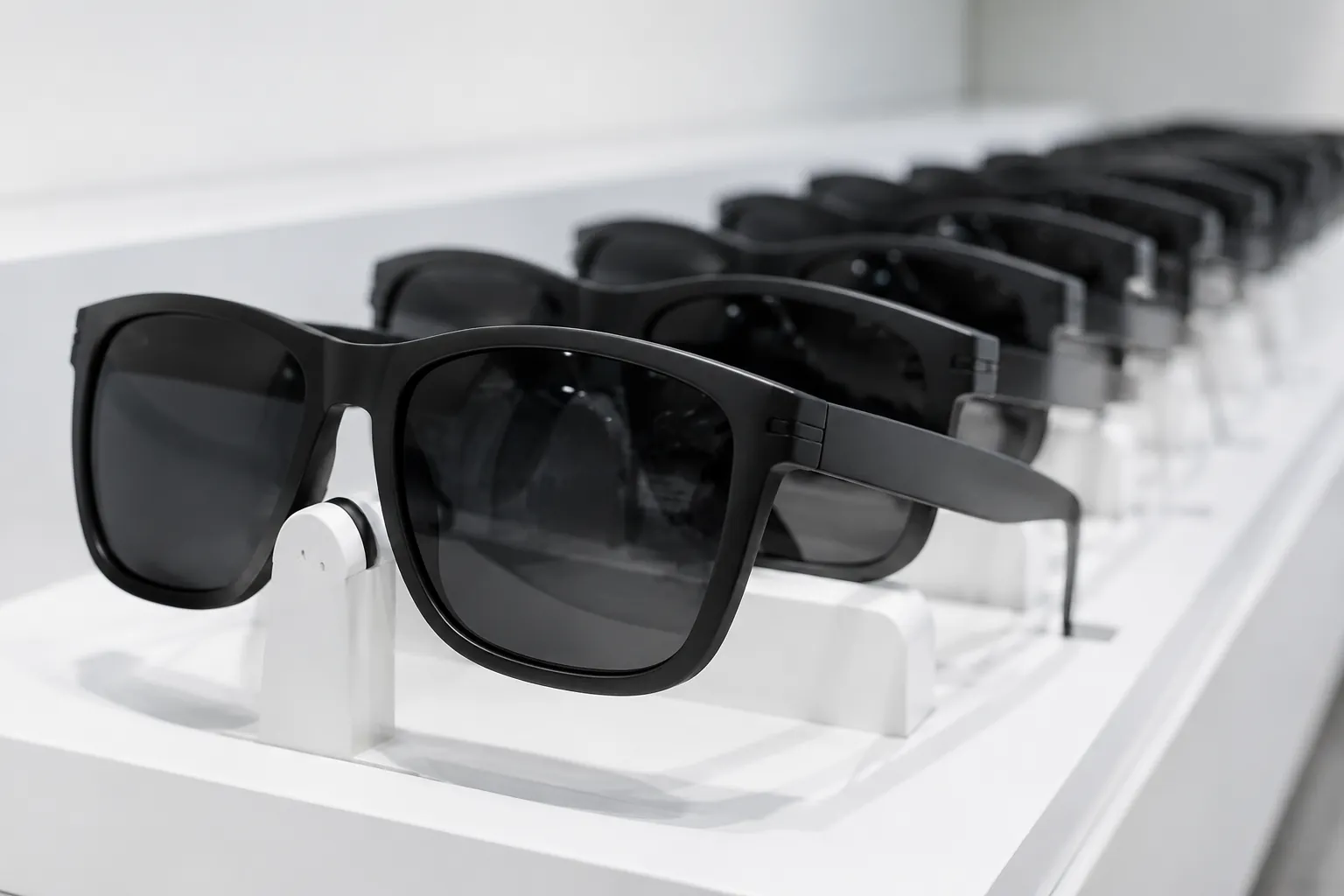
If you buy custom sunglasses for a brand, retail chain, or distribution program, temple tension is not a minor detail. Too loose, and the frame feels cheap. Too tight, and you get pressure points, hinge fatigue, and returns. This guide shows how to specify, test, and control hinge and temple tension at factory level so you get more consistent comfort and fewer breakage claims.
Why temple tension affects reorder rates
Temple tension is not just "how stiff the arm feels." It comes from hinge design, screw torque, barrel alignment, spring action if used, temple material behavior, and assembly control. If those inputs are not controlled, the frame can feel different from pair to pair and lot to lot.
For volume programs, repeatability is the real test. A small sample order can look fine. A pilot order can still hide problems. A repeat order shows whether the factory can hold the same hinge feel across lines, shifts, and material lots. Buyers should treat temple tension as a controlled specification, not a subjective finish check.
Temple feel affects three things buyers notice fast: comfort, perceived quality, and durability. If the temple opens too freely, the frame can feel underbuilt. If it resists too much, wearers may force it open. That can speed up screw loosening and barrel wear.
Blunt truth: if the hinge feel varies in hand, customers will notice on face.
For repeat business, the question is not whether the factory can make one good sample. It is whether it can make the same feel on every pair, after repeated opening and closing, with no drift after shipment.
Where variation starts in the hinge assembly
In factory-direct sunglasses, hinge feel comes from a small set of parts and processes. Most complaints are not caused by one major failure. They come from small tolerances stacking up.
- Hinge type: standard metal hinge, spring hinge, or integrated plastic hinge. Standard hinges rely heavily on screw torque and barrel fit. Spring hinges add recovery force, but also add another mechanical element that must be controlled.
- Screw torque: too low and the temple can loosen during shipping or use; too high and the barrel can bind or the screw can strip. On small eyewear screws, torque should be defined by the factory for the specific hinge design, not judged by hand alone.
- Barrel alignment: if the barrels are not parallel, the temple can rub or bind. That creates uneven tension from left to right. Even a small offset can be felt because the temple path is no longer symmetrical.
- Temple material: acetate, TR90, injected nylon, and metal temples behave differently. Acetate can feel stable but is sensitive to heat and finishing. TR90 and nylon can feel springy, but the final behavior depends on molding and cooling control. Metal temples are precise, but they transmit alignment errors directly to the wearer.
- Front geometry and drilling accuracy: a misaligned front changes how the temple sits on the head. Buyers often blame the hinge, but the root cause can be frame symmetry, drill angle, or front-to-temple positioning.
- Decorative finishes: plating, paint, laser engraving, and pad print layers can change clearance near the hinge if they are applied too close to moving parts.
In Wenzhou production, these steps are usually controlled at different stations. That matters. A good hinge part can still become a bad finished frame if drilling position, screw locking, or final adjustment is off. If a factory keeps key steps in-house, it is easier to trace where variation starts and correct it before bulk production continues.
For example, if the hinge seat is milled off-center, final hand adjustment may improve the look but will not fully fix the geometry. Ask not only what hinge is used, but also how the factory verifies drilling distance, barrel centerline, and left-right symmetry before mass assembly.
What to write on the PO before production starts
If you want consistent temple tension, do not write "good hinge quality" on the purchase order. That is too vague to enforce. Use measurable language. The factory needs a target, a test method, and an acceptance rule.
A practical PO note should include the following details:
- Frame type and hinge style: state whether the model uses standard metal hinges, spring hinges, or a mixed construction. If spring hinges are used, specify whether you want a softer comfort feel or a firmer retail-display feel.
- Opening resistance target: describe the feel in plain language and, if possible, anchor it to a signed sample. Example: "Temple opens with firm but smooth resistance, no grinding, no free play, left/right matched."
- Angle and retention behavior: define how far the temple should open and how it should hold position. For most sunglasses, the temple should open normally for wear and remain stable without sudden loosening or overextension.
- Screw locking method: ask whether the factory uses threadlocker, nylon patch screws, heat staking, or another retention method. If the supplier cannot explain how it prevents screw back-out, that is a warning sign.
- Symmetry requirement: left and right temple tension must feel matched. Mismatch is a common source of customer complaints, especially on premium retail programs.
- Cycle test requirement: ask for a pre-production open-close durability check. A practical control is to inspect sample units after repeated manual opening and closing, then increase that check on pilot lots.
- Finish interaction: if the style uses plating, paint, rubber coating, laser engraving, or pad printing near the hinge, specify that decoration must not interfere with movement or create rubbing points.
If you buy by size/color pack, add a note that tension must stay consistent across all colorways. Different paint, plating, or temple decoration can change friction around the hinge area. Small change. Real effect.
For small custom programs, define the production stage clearly too. A low-MOQ order is useful for development and pilot verification. It is where you lock the feel before scaling. Once you move into a larger run, late spec changes are more disruptive and more expensive.
How a factory should test hinge feel
A serious factory does not wait until final packing to discover hinge problems. It checks at sample stage, pre-production, inline, and before shipment. The goal is to catch drift before cartons are sealed.
The best test is not a vague hand-feel note. It is a repeatable routine that compares the development sample, the production sample, and the bulk output against the same reference. That means testing the hinge under the same conditions, with the same operator instructions, and with the same reference sample at the bench.
| Test point | What to check | What failure looks like | Typical buyer action |
|---|---|---|---|
| Development sample | Temple opening feel, symmetry, screw hold, return force, finish clearance | One side stiffer, audible grind, loose hinge after manual cycling | Revise hinge spec or reject sample |
| Pre-production sample | Same feel versus signed sample, tooling consistency, material lot match, decoration clearance | Feels different from approved sample | Hold production until corrected |
| Inline QC | Sample from first output, middle run, and end of line; cycle check and screw-back check | Progressive loosening or binding over the run | Stop line, adjust torque or parts |
| Pre-shipment inspection | Random carton sample, open-close feel, visible hinge wear, screw back-out, hinge symmetry | Loose temples, mismatched stiffness, damaged barrels | Rework or sort before shipment |
Separate "visual acceptable" from "functional acceptable." A frame can look perfect in a tray and still have a hinge that catches near the end of opening. Ask the factory to record any units that require abnormal force. Those are often the units that turn into complaints later.
For volume programs, request photos or video of the first-off sample and the QC bench setup. If the factory only says "passed" without showing the method, that is weak evidence. A factory that can document the test angle, sample count, and pass/fail threshold gives you a process, not a promise.
Keep one signed golden sample and one secondary reference sample. If the primary reference is damaged in sample-room handling, teams will argue about what "correct" feels like. Two references reduce that risk. If you run seasonal or annual programs, retain one sample per colorway, because feel can change slightly between finishes even when the structure is the same.
Which materials and constructions hold tension best
The best hinge strategy depends on the frame material and target price. There is no single answer. Lower-cost programs and premium retail programs have different failure modes, so the right choice is the one that controls the most likely complaint.
Acetate is often used for premium-looking sunglasses because it can be adjusted at assembly, but it is sensitive to heat during polishing and to shrinkage if the temple blank is not stabilized well. TR90 and injected nylon are lighter and more flexible, which can help comfort, but if the molding or cooling process is inconsistent, the final feel can vary from batch to batch. Metal temples are stable and crisp, but they transmit any alignment error directly to the wearer.
| Construction | Strengths | Weak points | Best use case |
|---|---|---|---|
| Injection frame with metal hinge | Stable unit cost, good for large runs, fast tooling | Hinge seat alignment must be controlled tightly | Mass-market styles, promotional programs |
| Acetate frame with metal hinge | Good hand feel, easy to tune at assembly, strong retail appeal | Heat and polishing can affect temple alignment | Brand programs, optical-inspired sunglasses |
| Spring hinge design | Better comfort range, less pinch, good recovery | More parts, more variance, higher defect risk if not controlled | Premium comfort-focused models |
| Metal temple with fixed hinge | Sharp feel, clean cosmetic finish, good dimensional stability | Less forgiving if the front is out of square | Fashion-led, minimalist collections |
At volume, the cheapest hinge is not always the cheapest frame. If loose hinges create returns, the landed cost goes up quickly. A model that looks good at a low unit price can still become expensive if you sort, rework, replace cartons, or handle customer complaints after delivery.
For buyers placing a small MOQ, use that run to lock the hinge feel before scaling. The pilot order is for process validation as much as product approval. Once a design is confirmed, retooling or late spec changes become more costly. Fix the feel early. Do not chase it after production starts.
If your style includes rubberized tips, injected temple sleeves, or plated logo inserts, ask whether those additions change weight near the temple end. Extra weight can make the hinge feel looser on face even if the hinge itself is within spec. That is one reason the same frame can feel different after decoration.
A buyer workflow that cuts hinge complaints
Use a fixed process. Do not skip steps because the price looks good or the calendar is tight. Most hinge problems happen when buyers approve too quickly and assume the bulk will behave exactly like the sample.
- Send a real reference: provide a signed sample, target hinge type, preferred opening feel, and any known pain points from your previous supplier.
- Ask for a development sample set: request at least one or two variants if the factory suggests different hinge or temple structures.
- Test by hand and by wear: open and close each sample several times, then wear them for a period of time. Temple tension issues often show up after initial wear, not just in the first few seconds.
- Approve only after symmetry check: left and right temples should feel matched. Check the same sample more than once and compare the first-open feel with repeated-open feel.
- Lock the QC note into the PO: specify the acceptable feel, screw-retention rule, decoration clearance, and what counts as a reject.
- Inspect the first mass run: compare first-off bulk units to the golden sample before full production continues. If possible, inspect samples from the beginning, middle, and end of the run.
- Keep one retained sample per order: this matters if a repeat order comes back different later.
- Review carton and packing effects: confirm that cartons, polybags, and stacking pressure are not forcing temples open or closed during transit.
For overseas buyers, communication lag is expensive. If you wait until shipment arrives to complain about loose hinges, you have already lost time and maybe a sales window. A factory that keeps injection molding, CNC milling, and assembly under one roof can usually correct issues faster because the problem can be traced and adjusted within one site rather than across multiple subcontractors.
Ask the supplier to report the root cause if any deviation appears during production. Was screw torque changed? Did a new material lot arrive? Was the hinge supplier switched? Were the decoration masks adjusted? Those answers tell you whether the issue is one-off or structural.
Compliance and documentation to tie to the order
Hinge tension does not make a sunglass compliant, but the same factory discipline that controls hinge feel should also support regulatory consistency. For overseas programs, request the correct testing or documentation for the target market, not a generic stack of papers.
Only use certifications and registrations that are actually relevant to your order. The commonly referenced items are CE EN ISO 12312-1, ANSI Z80.3, AS/NZS 1067, REACH, FDA registration, ISO 9001, and BSCI. Match the standard to the target market and the product type. Do not treat registration or certification as a substitute for product testing where testing is required.
CE EN ISO 12312-1 is relevant to EU sunglasses requirements. ANSI Z80.3 is the key U.S. sunglass standard. AS/NZS 1067 applies to sunglasses in Australia and New Zealand. REACH concerns restricted substances. FDA registration is part of the U.S. facility compliance context, not a pass/fail shortcut for product performance. ISO 9001 relates to a quality management system. BSCI is a social compliance initiative.
Do not mix compliance with hinge comfort. A frame can pass a market standard and still be unpleasant to wear. You need both. If you are ordering custom sunglasses with laser engraving, pad printing, hot stamping, foil logo plates, or UV printing, confirm that the decoration does not interfere with temple closing or create rubbing at the hinge area. A thick print build near the hinge can catch under the temple after repeated cycling, and a heavy metal logo plate can change balance enough to alter perceived tension.
For repeat orders, keep the same approved material spec, hinge type, screw type, finish process, and decoration method. Changing from matte to gloss, or from plated metal to painted metal hardware, can change friction and perceived tension. Small change. Real effect. If the program is strategic, freeze the full build spec, not just the appearance.
Also ask for packaging confirmation if the order travels long distance. Compression in stacked cartons can force temples into a stressed position, especially on spring hinge styles. If the factory knows the shipment route and outer carton count, it can suggest safer pack-out choices before the order leaves the line.
Bottom line for volume buyers
Consistent temple tension is a sourcing control issue, not a styling detail. If you want fewer breakages, better comfort, and repeat orders that do not drift, treat hinge feel like a written spec with a sample reference and a factory test plan.
Start with a small order, lock the feel, then scale. Use the same golden sample, the same material spec, and the same QC language every time. That is simple. It works.
If a factory cannot explain how it controls screw torque, alignment, and sample-to-bulk consistency, keep looking. If it can explain the process and show it at sample, inline, and pre-shipment stages, you have a real basis for approval. The best suppliers do not just make sunglasses. They control variation at the points where a customer can feel it.
In practice, the winning formula is clear: define the feel, verify the mechanism, document the tolerance, and keep the same reference sample for the life of the program. Do that, and temple tension stops being a headache and becomes one more controlled part of your brand experience.
Have a custom sunglasses project in mind?
Send us your styles, target market and quantities and we will return a detailed quote with MOQ, lead time and a sample plan.
Get a QuoteWhy source this from Wenzhou with LumiShades
Wenzhou in Zhejiang Province is widely regarded as China’s eyewear manufacturing capital, producing a large share of the world’s sunglasses. That concentration matters to buyers: a deep local supply chain for acetate sheet, hinges, lens blanks, plating and packaging means shorter component lead times, easier color and material matching, and a workforce with decades of eyewear-specific skill. LumiShades has manufactured in this ecosystem since 2009, and our vertical integration — in-house injection molding, acetate cutting, CNC milling, lens tinting, decoration and quality control — means no part of your order is quietly subcontracted to a workshop you cannot audit.
For international buyers, that vertical control translates into accountability. When a single factory owns every step, defects are traced and fixed at source rather than bounced between vendors, and your specifications survive intact from first sample to bulk. We back this with 15+ years of experience, shipments to 60+ countries, more than 5 million pairs produced per year and a 98.5% on-time delivery rate. Our certifications — CE EN ISO 12312-1, FDA registration, ANSI Z80.3, AS/NZS 1067, REACH, ISO 9001 and BSCI audit — mean the compliance documentation your market requires already exists. Explore our manufacturing capabilities and quality control process to see how this works in practice.
Frequently asked questions
What is a practical way to specify temple tension to a sunglasses factory? Reference a signed sample and write the feel in plain terms: smooth, firm, no grinding, no free play, and left-right symmetry required. Add a simple opening and retention check, and note any decoration near the hinge that must not interfere with movement.
Does a spring hinge always mean better quality? No. A spring hinge can improve comfort, but it adds parts and more opportunities for variation. If assembly control is weak, a standard hinge may be more repeatable and easier to control across larger runs.
What usually causes one temple to feel tighter than the other? Common causes are barrel misalignment, uneven screw torque, a front frame that is out of square, or finish build-up on one side. It is often an assembly or geometry issue rather than a raw material issue.
How can I reduce hinge complaints on repeat orders? Keep the same approved hinge type, material, finish, screw type, and QC wording. Retain one reference sample from each order, inspect first-off bulk units, and compare bulk against the golden sample before shipment.
Which compliance items matter for factory-direct sunglasses? For this manufacturer, the relevant items are CE EN ISO 12312-1, ANSI Z80.3, AS/NZS 1067, REACH, FDA registration, ISO 9001, and BSCI. Match the standard to the target market and keep compliance separate from comfort specifications.
Ready to start?
Explore our shield & oversized sunglasses or request a quote — our sales team replies within 12 hours.
Request a Quote