
Source Custom Sunglasses from China Without Losing Control
This guide is for brand owners, importers, distributors, and retailers buying custom sunglasses from China in volume. The aim is simple: prevent weak samples, vague promises, and bulk orders that drift from approval. Control the spec, the process, and the checkpoints. Do that, and you get repeatable product without chasing every shipment.
Start with the product, not the factory
Most sourcing problems start with a weak brief. If you ask for "a nice acetate sunglass," you will get the factory's interpretation. Not your product. Start by defining the exact build: frame material, lens type, coating, finish, logo method, target market, and target price at your first and second volume tiers.
Be clear about intended use. A fashion pair for retail display can tolerate different weight, lens darkness, and temple flexibility than a performance-style sunglass sold for outdoor use. TR90 injected frames usually weigh less and flex more than acetate, which makes them useful for mass retail and promotional programs. Acetate often feels more premium and takes a deeper polish, but it also requires sheet cutting, heating, shaping, tumbling, and hand finishing. More labor. More room for variation if the factory does not control the process well.
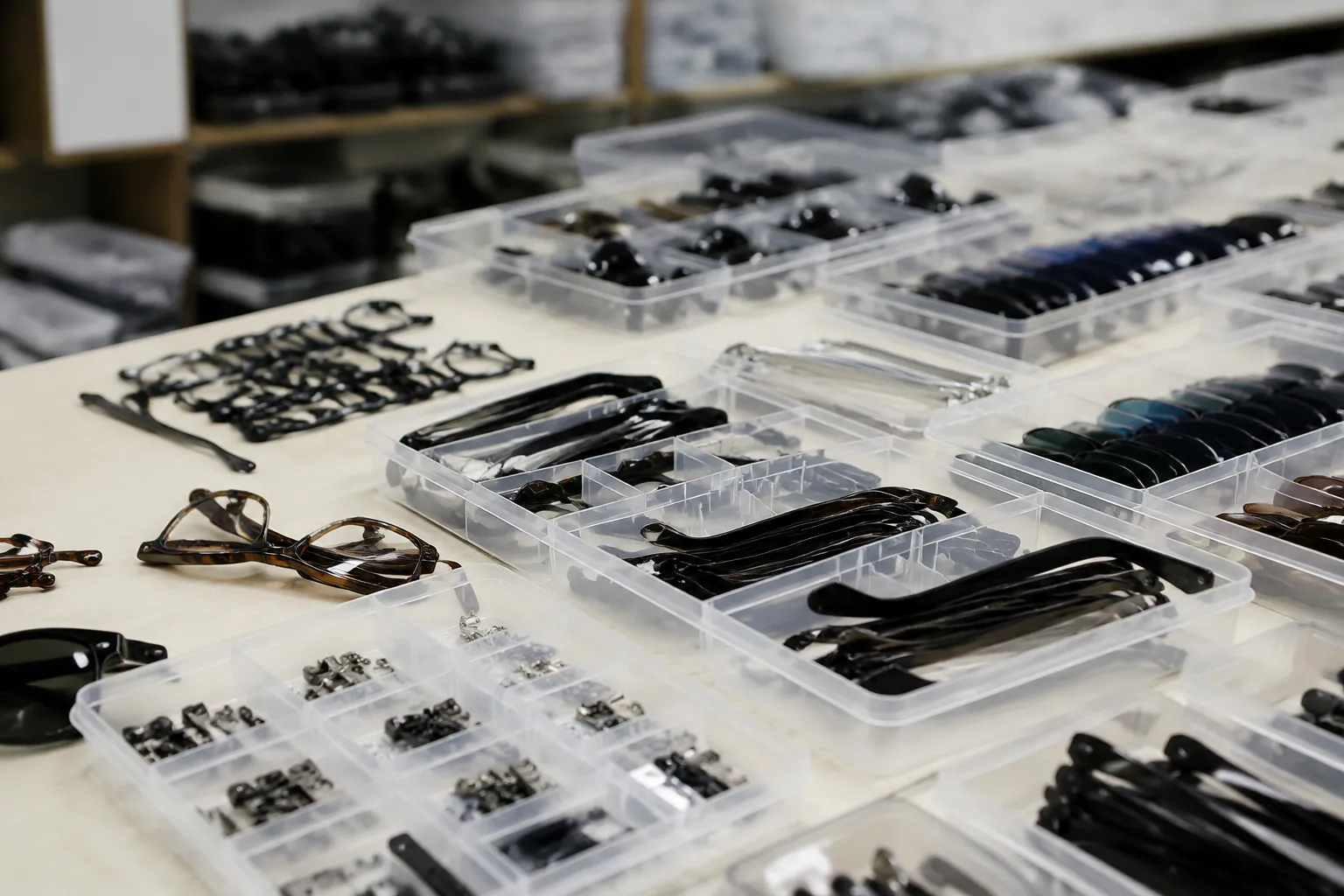
If the supplier runs more core processes in-house, consistency usually improves. A factory that handles injection molding, acetate cutting, CNC milling, lens tinting, decoration, and QC under one roof keeps more decisions inside one production flow. That matters. Every handoff adds risk. Even a capable outsourced partner can drift if temple cores, lenses, or decoration methods change between orders.
Before you request quotes, define the basics in writing:
- Frame material and finish: injected plastic, acetate, metal, or mixed build
- Lens type: CR-39, polycarbonate, TAC, or polarized if required
- Compliance target by market: CE EN ISO 12312-1, FDA, ANSI Z80.3, AS/NZS 1067, REACH
- Logo method: laser engraving, pad printing, heat transfer, or metal logo plate
- Target color count per style and which parts can be shared across styles
- Order pattern: trial order, repeat order, or seasonal rollout
Also define frame weight target, hinge feel, and lens tint range. For a fashion acetate frame, for example, you might set a finished weight range, require smooth and even hinge action, and match lens darkness to the approved master sample. The more you define up front, the less you pay for interpretation later.
Qualify the factory on capability, not sales talk
Ask direct questions. Then ask for proof. A factory that can handle custom sunglasses properly should be able to show where each core process happens, what it controls, and what it outsources. Outsourcing is not automatically a problem. Hidden outsourcing is.
In eyewear, in-house capability often means less variation. Injection molding affects fit and shrinkage. CNC milling affects bevel accuracy and lens seat consistency. Acetate cutting affects symmetry, edge finish, and heat response. Lens tinting affects batch-to-batch color match. Decoration affects logo placement and wear resistance. QC ties it all together. If the supplier does not control these points, you are more likely to see drift in hinge alignment, lens fit, and color.
Ask for documents and records, not broad claims. A responsible factory should be able to show:
- Photos or video of molding, cutting, polishing, tinting, assembly, and inspection
- Its quality management certificate, if available, such as ISO 9001
- Its social compliance audit status, if relevant to your program, such as BSCI
- Inspection checkpoints used on each style, including in-process and final inspection
- How it controls repeat orders so the approved master sample remains the reference
One blunt rule: if the supplier cannot explain how it keeps left and right temples aligned within a practical tolerance, keep looking. A cosmetic product still needs engineering discipline. The real question is not "Can you make it?" It is "Can you make it the same way next time?"
A good factory should also talk in measurable terms. Ask how it controls:
- Temple symmetry: left and right sides should match the approved drawing and sample
- Front frame width: kept within the agreed drawing tolerance
- Lens seating: no visible rocking, no edge lift, and no stress whitening
- Logo location: centered within the agreed placement window
Compare suppliers by the jobs they can actually do
Factories are not interchangeable. Some are strong in low-cost injected frames. Some are better with acetate. Some decorate well but struggle with lens consistency. Pick the supplier that fits your product mix, target market, and tolerance for variation.
| Capability | Why it matters | What to verify | Typical buyer use |
|---|---|---|---|
| Injection molding | Supports repeatability, short cycle time, and volume pricing | Tooling ownership, shrink control, sample-to-bulk stability, color match | Mass retail, promotional lines, broad distribution |
| Acetate cutting | Produces a premium feel, but needs careful shaping and polishing | Edge finish, symmetry, sanding control, warp resistance after heat forming | Fashion lines, higher-ticket private label programs |
| CNC milling | Improves part consistency on precise shapes and lens seats | Lens groove fit, hinge hole accuracy, bridge geometry, repeatability | Complex frames, tighter spec programs, slimmer profiles |
| In-house decoration | Controls logo placement, durability, and visual consistency | Laser depth, pad print adhesion, plate fixing, scratch resistance | Private label, brand programs, retail-ready packaging |
| Lens tinting and coating | Affects color match, visual comfort, and compliance | Tint uniformity, polarized performance, test documentation for required markets | Performance eyewear, fashion tint programs, market-specific SKUs |
Read price against volume and process. Some factories quote lower at higher quantities because setup, molding, decoration setup, and QC labor are spread across more units. If a supplier quotes very low at a small quantity, ask what gives. Usually it is margin, inspection time, or process discipline. Sometimes all three.
Do not compare unit price alone. Compare total landed risk: sample timing, defect handling, lead time, and how much rework you may absorb. A lower quote means little if the bulk order arrives with print shifts, lens scratches, or uneven temple tension.
Ask each supplier the same three questions:
- What parts are made in-house versus sourced externally?
- What changes when the order moves from a small trial to a larger repeat order?
- What is the most common cause of remake on your custom sunglass orders?
Build your spec sheet like a production document
A spec sheet is not a brochure. It is the document production, QC, and packing should follow. Keep it simple. Keep it specific. Two operators on different shifts should read it the same way.
At minimum, include frame dimensions, lens dimensions, temple length, bridge width, material, finish, color codes, logo location, logo method, packaging, and test requirements. If you want consistency, define acceptable variation. For example: lens tint must match the approved master sample within the agreed color standard; logo print must be centered within a defined placement window; hinge action must open and close without binding or visible skew.
Use hard tolerances where they matter, and tie the rest to the approved drawing and master sample. A practical spec might say:
- Lens width/height: use the agreed drawing tolerance for the style
- Bridge width: use the agreed drawing tolerance for the material and construction
- Temple length: use the agreed drawing tolerance unless the design is highly fitted
- Lens decentering: no visible misalignment to the naked eye, and not beyond the approved drawing tolerance
- Surface defects: no scratches in the primary wear area, no bubbles, no burn marks, no pinholes in coating
Set the compliance target at the start. CE EN ISO 12312-1 is relevant for sunglasses sold in the EU. ANSI Z80.3 is used for sunglasses in the U.S. AS/NZS 1067 applies in Australia and New Zealand. REACH covers chemical substance restrictions for the EU market. FDA registration is part of U.S. market setup for many eyewear businesses. Do not assume one test report covers every market. It usually does not.
Use a simple approval structure:
- Golden sample: the approved reference kept by both buyer and factory
- Pre-production sample: confirms color, lens, logo, and assembly before bulk starts
- First article inspection: checks the first output from the line
- Shipment inspection: confirms the bulk lot against the approved standard
Skip those four checkpoints and you are relying on memory. That is weak control. The goal is repeatable approval even if the buyer, merchandiser, or factory contact changes later.
Understand samples, bulk lead times, and where delays happen
Good factories can move quickly. But only if the design is clear and the process is stable. A typical custom sunglass program can move from sample to bulk in a few weeks, though exact timing depends on tooling, materials, decoration, and whether components are already available.
Lead time usually slips for a few predictable reasons: late logo approval, color-matching disputes, lens tint changes, hinge or screw substitutions, and packaging revisions. Small changes are not small in production. A different temple tip color may require a new material mix. A new logo plate may need another tooling step. A minor tint adjustment can force a full batch recheck if the order must match the approved sample exactly.
Here is the practical sequence most buyers should expect:
| Order stage | What should happen | Common delay cause | Buyer control point |
|---|---|---|---|
| Sampling | Prototype built and checked against brief | Color not approved, artwork unclear, missing reference | Approve artwork, color references, and sample comments quickly |
| Pre-production | Factory confirms final materials and decoration method | Component swaps, unconfirmed lens tint, packaging revisions | Freeze the spec before bulk starts |
| Bulk production | Repeat build using approved standard | Machine drift, operator variation, material batch differences | Use first article checks and in-process inspection |
| Final packing | Count, pack, and carton mark to order | Incorrect assortment or carton labeling | Define pack-out instructions and carton count clearly |
If your program is seasonal, build in buffer. Production lead time is not door-to-door lead time. Freight, customs, and inspection sit outside factory production days. If you need stock on shelf by a fixed date, plan backward from launch.
Also ask what happens if the sample is approved but the bulk lot is not. The answer should include a correction or remake process, not just "we will check." Good suppliers know where delays start because they have had to fix them before.
Put QC checkpoints in writing before you send money
Quality control is not one final inspection. That is too late. You need control points that catch problems while the order is still fixable. For custom sunglasses, QC should start with incoming materials and continue through assembly, decoration, packing, and carton labeling.
A practical eyewear QC plan should cover:
- Incoming material check: frame resin, acetate sheet, lenses, screws, hinges, and cases
- First article inspection: one complete pair from each style and color
- In-process checks: temple alignment, lens fit, print placement, hinge torque, and cosmetic finish
- Final inspection: random pull against AQL or your agreed inspection plan
- Packing verification: barcode, count, polybag, case, insert, carton mark
Ask the factory what it inspects in-house. If it says QC is internal, ask what defects it tracks and how those defects are recorded. The useful categories are straightforward: lens scratches, frame twist, print shift, hinge looseness, color mismatch, coating defects, and warped arms. If the supplier only talks about "appearance," that is not enough.
For functional checks, a few controls go a long way. You do not need laboratory-level complexity for every order, but you do need repeatable standards. Typical checks include:
- Temple opening and closing: smooth action with no grinding or visible offset
- Hinge feel: consistent across the batch, with no loose swing or excessive stiffness
- Lens fit: seated evenly, no rattle, and no stress marks at the rim
- Logo durability: pad print should survive normal handling; laser engraving should be clean and readable
Decide what is acceptable before production starts. A slight cosmetic mark hidden under a temple may be acceptable. A lens scratch in the wear area is not. A logo slightly off on one unit may pass on a promotional order, but not on a premium private label line. Put those decisions in the PO and spec sheet, not into a dispute after shipment.
If you want tighter control, ask for inspection photos tied to batch numbers. Better suppliers can show lot code, defect type, and corrective action. That makes repeat orders easier to manage.
Use pricing tiers to shape the buy, not just negotiate
Price breaks are not just bargaining tools. They should shape how you buy. If you spread small quantities across too many styles, you pay setup cost over and over. If you can consolidate styles or share components, you can lower cost without lowering quality.
The logic is simple:
- Small trial orders: useful for testing a new style, market reaction, or a limited regional launch
- Mid-size orders: where setup cost begins to spread more sensibly
- Larger repeat orders: better suited to stable retail or distributor programs
- Volume orders: where price matters most and process discipline should be strongest
Ask for pricing by style, color, and decoration method. Laser engraving does not cost the same as a metal logo plate. A simple clear-lens style is not the same as a tinted or polarized version. Packaging changes the number too. Keep the comparison clean, or you will be comparing different products.
It also helps to understand what drives cost in practical terms:
- Tooling and setup: mold changes, fixture changes, and artwork setup
- Material choice: acetate, TR90, metal, or mixed build
- Labor intensity: polishing, sanding, assembly, and hand decoration
- QC intensity: more checkpoints, more photo confirmation, more rework prevention
- Packaging complexity: case type, insert card, barcode sticker, polybag, and carton spec
Ask one more useful question: what parts of the spec stay fixed across the line? Shared hinges, temple cores, lens base curves, and packaging can all reduce cost and lead time. That is how you protect margin without changing the consumer-facing look too much.
If your buying plan includes both trial and scale, do not expect the same unit cost at both levels. A sample program is a qualification cost. A larger reorder is a production program. Treat them differently.
Buyer checklist before you place the PO
Before you send a purchase order, make sure the commercial terms and the technical file match. This is where many buyers lose control. They rush payment before they freeze the spec.
Use this checklist:
- Approved golden sample is signed off and retained by both sides
- Final spec sheet includes dimensions, tolerances, materials, lens type, and decoration method
- Compliance target is written for the exact destination market
- Lead time is tied to approved artwork, approved color, and confirmed packaging
- Inspection plan is defined: in-process, final, and packing checks
- Payment terms reflect milestone control, not just upfront trust
- Carton markings, barcodes, and case inserts are specified before production
If the factory will not agree to these basics, treat that as a warning sign. Strong suppliers do not resist documentation. They use it to avoid disputes. The goal is not to slow the job down. The goal is to make it repeatable, so you can reorder without renegotiating the product every season.
Buy custom sunglasses from China like a production program, not a commodity purchase. Clear specs, measurable tolerances, realistic lead times, and written QC checkpoints keep control in your hands.
Have a custom sunglasses project in mind?
Send us your styles, target market and quantities and we will return a detailed quote with MOQ, lead time and a sample plan.
Get a QuoteWhy source this from Wenzhou with LumiShades
Wenzhou in Zhejiang Province is widely regarded as China’s eyewear manufacturing capital, producing a large share of the world’s sunglasses. That concentration matters to buyers: a deep local supply chain for acetate sheet, hinges, lens blanks, plating and packaging means shorter component lead times, easier color and material matching, and a workforce with decades of eyewear-specific skill. LumiShades has manufactured in this ecosystem since 2009, and our vertical integration — in-house injection molding, acetate cutting, CNC milling, lens tinting, decoration and quality control — means no part of your order is quietly subcontracted to a workshop you cannot audit.
For international buyers, that vertical control translates into accountability. When a single factory owns every step, defects are traced and fixed at source rather than bounced between vendors, and your specifications survive intact from first sample to bulk. We back this with 15+ years of experience, shipments to 60+ countries, more than 5 million pairs produced per year and a 98.5% on-time delivery rate. Our certifications — CE EN ISO 12312-1, FDA registration, ANSI Z80.3, AS/NZS 1067, REACH, ISO 9001 and BSCI audit — mean the compliance documentation your market requires already exists. Explore our manufacturing capabilities and quality control process to see how this works in practice.
Frequently asked questions
What is a realistic MOQ for custom sunglasses from China? A practical MOQ for many custom programs is often around 50 pairs per design for sampling or small launches, but the right number depends on material, decoration, and whether the factory is using existing tooling or creating new tooling. For a first order, focus less on the headline MOQ and more on whether the supplier can repeat the same result on reorder.
How long should custom sunglasses take to sample and produce? The timeline depends on the design, but many custom programs move through sampling and bulk production in a few weeks when the spec is clear and materials are available. Ask the factory for separate timelines for sample approval, pre-production confirmation, bulk production, and packing so you can see where delays may happen.
What tolerances should I ask for in eyewear specs? Use tighter tolerances for premium or fitted styles and looser ones for basic promotional frames. In practice, specify tolerances on the drawing for every critical dimension, then tie visual acceptance to the approved golden sample for areas such as color, finish, and logo placement.
Which decoration method is best for private label sunglasses? It depends on the look and durability you need. Laser engraving is usually a strong option when the material supports it and you want a permanent mark. Pad printing works well for colored logos but needs adhesion control. Metal logo plates can create a premium look, but they add cost and assembly steps.
How do I reduce risk when ordering from a new supplier? Start with a detailed spec sheet, approve a golden sample, require a pre-production sample, and define inspection checkpoints before bulk begins. Also verify whether the factory controls the key processes you need, such as molding, cutting, decoration, and QC. Ask for ISO 9001 or BSCI only if the factory actually has those documents and they are relevant to your program.
Ready to start?
Explore our wayfarer sunglasses or request a quote — our sales team replies within 12 hours.
Request a Quote