
How to Price Custom Sunglasses Programs
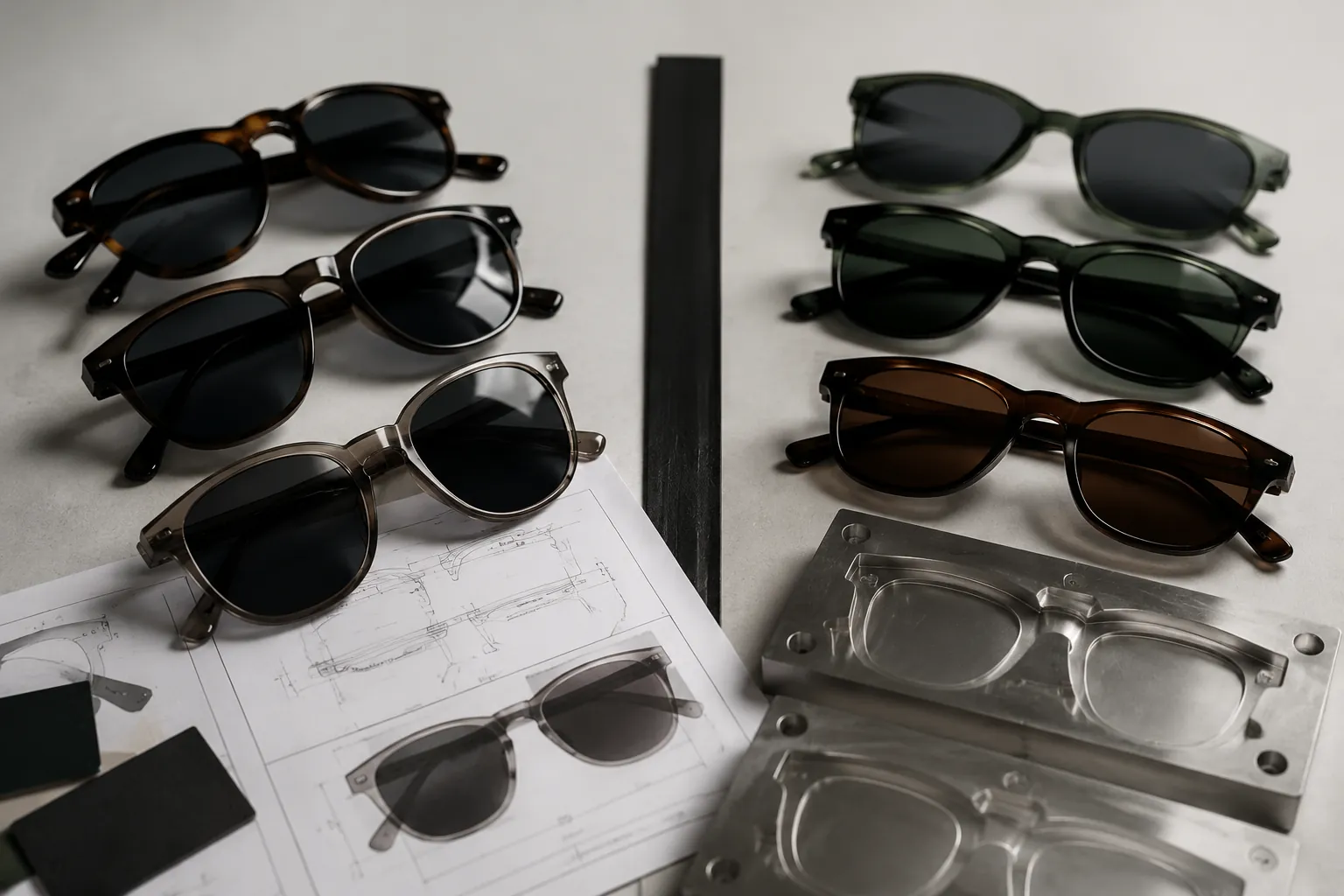
If you buy custom sunglasses for a brand, chain, or distribution program, the factory quote is only the starting point. The real number is landed cost. Then margin. Then the cost of warranty claims, freight swings, and channel discounts. This guide breaks the model into pieces buyers can verify before they place an order. It is for importers, retailers, distributors, and brand owners who need a working pricing model, not theory.
Start with the selling price, not the factory quote
Most buyers start with the factory quote and try to build a retail or wholesale price on top. That usually creates a margin gap. Factory price is only one part of the economics. Start with the target channel price and required gross margin, then work backward to a landed-cost ceiling.
Example: if your wholesale selling price is $12.00 and your target gross margin is 65%, your maximum landed cost is $4.20. That figure has to cover the frame, lenses, decoration, packaging, freight, duty, inland handling, and a reserve for defects or rework. If you sell direct to consumer at a higher price point, you may absorb more cost per pair. You also need to budget for returns, customer service, and higher packaging expectations. No free lunch.
For custom sunglasses, the cost stack usually includes:
- Frame base cost and tooling or setup charges
- Lens cost, tint specification, and coatings
- Decoration cost and artwork setup
- Packaging cost and carton efficiency
- Freight, duty, and destination handling
- QC losses, rework, and a defect reserve
Price the program using the quantity you will actually buy, not the quantity you hope to reach later. A pilot order and a replenishment order do not have the same economics. Treat them separately.
Build the frame cost by material and process
Frame material and manufacturing route drive the first major cost difference. Injection-molded frames are usually the lowest unit-cost option at volume after tooling is spread across the run. Acetate typically costs more because the material is denser, the production cycle is slower, and polishing adds labor. Metal and mixed-material builds can cost more still because they add stamping, bending, soldering, plating, and more inspection points.
The frame quote should separate material, process, and any tooling or setup charges. A simple injected frame may have a low per-unit price, but a new mold can add a one-time cost that must be amortized across the order. A 50-pair pilot can carry a heavy setup burden. A larger repeat order spreads that cost more efficiently.
| Frame route | Typical cost behavior | Best for | Watch-outs |
|---|---|---|---|
| Injection molded TR90 / PC | Usually the lowest unit cost at volume after tooling is amortized | Fashion programs, mass retail, promotions, repeat SKUs | Tooling quality, gate marks, warpage if cooling is uneven |
| Acetate cut and polished | Higher unit cost because of material density, machining, and finishing labor | Premium looks, thicker temples, richer color depth | Color consistency, polishing time, edge alignment |
| Metal or mixed-material build | Mid to high cost depending on plating, solder points, and assembly count | Technical silhouettes, lightweight premium styles | Scrap risk, plating defects, tolerance stack-up |
Typical tolerances matter because they affect fit and rework. As a starting point, many sunglass programs define frame-width tolerance around ±0.5 mm to ±1.0 mm and temple-length tolerance around ±1 mm. The exact number is less important than the discipline behind it. The supplier should state the tolerance for each key dimension, explain how it is measured, and identify where tighter internal controls are used for lens seating and hinge alignment.
Ask for the frame cost split separately from decoration and packaging. A clear quote should show material, process, and any mold or setup charges. If the supplier blends everything into one number, you cannot tell whether a design change is expensive because of the shape, the finish, or the tooling burden.
Price the lens correctly or the margin gets eaten
Lens cost is not just "lens cost." Base material, thickness, tint density, optical clarity, polarization, mirror coating, and anti-scratch finish all affect the number. The more complex the lens stack, the more you pay in both material cost and rejection risk. A basic tinted lens is straightforward. Add polarization, a mirrored front coating, or a gradient tint and the unit cost rises.
The lens material also affects performance and use case. TAC lenses are commonly used for polarized sunglasses because they are lightweight and suitable for laminated constructions. Polycarbonate is impact resistant and is often used in active or youth-oriented programs. CR-39 can offer good clarity in fashion-oriented styles. The right choice still depends on visual performance, impact requirements, and cost target.
Compliance belongs in the lens section because the market standard determines the test path and sometimes the build itself. If you need CE EN ISO 12312-1 for Europe, ANSI Z80.3 for the US market, or AS/NZS 1067 for Australia and New Zealand, the lens spec must be set before production. REACH matters for restricted substances in the EU supply chain. FDA registration may apply to the manufacturing operation and import process for the US market, depending on the product and business setup. These requirements are not labels to add later. They affect material choice, tint selection, documentation, and testing.
A practical lens pricing model looks like this:
- Choose the lens base material: CR-39, polycarbonate, TAC, or another agreed material.
- Set visible light transmission, tint shade, and whether a gradient is required.
- Add coatings: mirror, anti-scratch, hydrophobic finish, or polarization.
- Lock the compliance standard before sample approval and color master confirmation.
On volume programs, lens rejects often come from color mismatch rather than optical failure. If your brand needs a specific smoke gray or amber tone, approve a master sample early and define the acceptable shade window in writing. Lens pricing should always reflect the exact visual target, not a generic "gray lens" description.
Decoration is cheap until the artwork gets difficult
Decoration looks minor on paper, but it can become a cost trap quickly. Laser engraving, pad printing, hot stamping, in-mold labeling, and metal logo plates each have different setup costs, cycle times, and failure modes. The right method depends on the frame substrate, finish, and order quantity.
Laser engraving is often the cleanest choice for metal parts and some coated surfaces. It gives a crisp, permanent mark, but it depends on the substrate and may look weak on certain dark matte coatings. Pad printing is often the most economical path for simple logos and multi-color branding, but it requires proper surface preparation and ink adhesion can be inconsistent on curved or low-energy surfaces. Hot stamping can work well on some acetate or coated components, but registration must be controlled. Metal logo plates create a premium look, yet they add material cost, attachment steps, and more opportunities for assembly defects.
Decoration quotes should separate setup from unit price. A logo that needs a cliché, screen, or laser program may carry a one-time charge that should be amortized over the order. On a 50-pair pilot, that setup can dominate. On a 5000-pair run, it may have little impact on unit cost. The more placement constraints you add—inner temple, outer temple, lens edge, both arms—the more likely cost and reject rates will rise.
- Single-color pad print: usually the lowest decoration cost for simple branding
- Laser engraving: durable and clean, especially on metal or coated parts
- Metal plate or badge: higher cost, stronger premium signal, more assembly time
- Multi-color wrap print: higher setup sensitivity and greater alignment risk
For a 300-unit test run, decoration can change the economics materially. A lower-cost frame with a complex wrap print may cost more than a better frame with a simpler logo. That is why decoration should be quoted as a separate line item with the actual placement, size, number of colors, and finishing method clearly defined.
Packaging and freight are not small numbers
Packaging is one of the easiest places to underestimate cost. Buyers approve a pouch or rigid box late in the process, then discover that the packed cost is higher than expected. Packaging also changes carton size, carton count, pallet efficiency, and freight. The chain is simple: more packaging usually means more cube, and more cube usually means higher shipping cost per pair.
At minimum, price the following:
- Individual inner packaging: pouch, microfiber cloth, folding box, rigid box, insert card
- Master carton dimensions and strength rating
- Barcode, SKU label, or retail sticker application
- Drop-test, compression-test, or transit-test requirement
For air freight, carton dimensions matter because dimensional weight can exceed actual product weight. For ocean freight, carton efficiency still matters because poor palletization lowers container utilization and increases freight cost per pair. A 50-pair pilot often has worse packaging economics than a larger run because the inner pack cannot always be optimized as aggressively and the carton plan is less efficient.
Freight should be modeled at three levels: sample shipping, bulk shipping, and destination handling. Bulk lead time is usually production time plus transit time. Samples usually move faster because they ship by express service. For planning, many buyers include a defect reserve and a separate cash-flow line for in-transit inventory. That matters because a slow program can be profitable on paper and still strain working capital in practice.
Use volume tiers the right way
Volume pricing only helps if the design is stable. If you keep changing temple tips, lens color, logo size, or box style, you lose the savings from scale. A practical pricing structure should show how the unit cost changes at each purchase tier while the spec stays fixed.
At LumiShades, the pricing model starts at 50 pairs per design, then improves at 300, 1000, and 5000+ pairs. A 50-pair order is useful for launch testing, but the unit price at that level usually includes heavier setup costs and less process efficiency. On a mature build, the unit cost can fall materially at higher volume, but the exact number depends on the frame route, lens spec, decoration method, packaging choice, and compliance scope.
Here is the logic buyers should use:
| Order level | What usually changes | Buyer use case | Pricing effect |
|---|---|---|---|
| 50 pairs | Setup cost is heavy; less room for optimization; sample-like economics | Market test, small launch, buyer approval run | Highest unit cost |
| 300 pairs | Setup spreads better; some packaging and labor efficiency appears | Channel trial, regional launch | Noticeable drop |
| 1000 pairs | Better material buying, line efficiency, and fewer changeovers | Core SKU replenishment | Strong improvement |
| 5000+ pairs | Best labor, sourcing, and freight efficiency; more leverage on packaging | Retail program, wide distribution | Lowest cost band |
Not every component scales at the same rate. Frame cost may improve faster than decoration. Packaging may flatten earlier than lenses. Freight can improve with better carton and pallet optimization, while compliance and testing costs may remain relatively fixed. Ask the supplier to price the same SKU at the four breakpoints with the same locked specification so you can see the actual cost curve.
Use a landed-cost formula you can actually verify
Keep the model simple and visible. A spreadsheet full of hidden assumptions is less useful than a clear worksheet that shows every line item.
Landed cost per pair = factory unit price + decoration + packaging + inland handling + freight + duty + import charges + defect reserve
Then compare that landed cost with your target gross margin to calculate the selling price or confirm whether the program is viable. If your wholesale price target is $12.00 and your gross margin target is 60%, your landed-cost ceiling is $4.80. If the real landed cost comes in at $5.20, you need to raise price, reduce spec, increase volume, or accept a lower margin.
A useful buyer worksheet should include these inputs:
- Factory price by tier: 50, 300, 1000, 5000+
- Decoration setup and unit cost
- Packaging unit cost and carton utilization
- Freight mode, transit time, and dimensional weight assumptions
- Duty, tax, and customs broker fees by destination
- Defect reserve and replenishment allowance
The key question is not "What is the cheapest factory price?" It is "What is the lowest stable landed cost that still meets compliance and quality requirements?" A lower quote that creates rejects, delays, or repeated rework can cost more than a cleaner quote from a factory with stronger process control and better documentation.
How to brief the factory so the quote is real
If you want a usable quote, send a spec sheet that removes ambiguity. A vague brief gets a vague number, and then you spend time revising it. The best RFQs are not long, but they are specific enough that two suppliers would price them the same way.
Your RFQ should state:
- Frame material, finish, and color code
- Lens type, tint, coatings, and compliance target
- Logo method, size, placement, and number of colors
- Packaging spec and whether a retail-ready box is required
- Target quantity, forecast tiers, and reorder expectation
- Destination market and required certification standard
- Target sample date and bulk delivery window
Also ask for measurable production details. Request tolerance ranges on frame width, temple length, and lens fit; ask whether the factory inspects 100% or samples to an accepted quality level; and confirm what happens if the final shade drifts outside the approved master sample window. If the supplier cannot answer those questions clearly, the quote is not complete enough to rely on.
A factory with in-house molding, cutting, CNC, tinting, decoration, and QC can reduce handoffs and simplify timing. That only helps if the specification is locked before production starts. If the brief changes after approval, the cost and lead time usually move with it.
Final check: if your target margin only works at 5000+ pairs, say that now. If your launch needs 50 pairs to test sell-through, price that separately. Mixing pilot economics with replenishment economics leads to bad decisions. Price the pilot as a pilot. Price the replenishment as replenishment.
Have a custom sunglasses project in mind?
Send us your styles, target market and quantities and we will return a detailed quote with MOQ, lead time and a sample plan.
Get a QuoteWhy source this from Wenzhou with LumiShades
Wenzhou in Zhejiang Province is widely regarded as China’s eyewear manufacturing capital, producing a large share of the world’s sunglasses. That concentration matters to buyers: a deep local supply chain for acetate sheet, hinges, lens blanks, plating and packaging means shorter component lead times, easier color and material matching, and a workforce with decades of eyewear-specific skill. LumiShades has manufactured in this ecosystem since 2009, and our vertical integration — in-house injection molding, acetate cutting, CNC milling, lens tinting, decoration and quality control — means no part of your order is quietly subcontracted to a workshop you cannot audit.
For international buyers, that vertical control translates into accountability. When a single factory owns every step, defects are traced and fixed at source rather than bounced between vendors, and your specifications survive intact from first sample to bulk. We back this with 15+ years of experience, shipments to 60+ countries, more than 5 million pairs produced per year and a 98.5% on-time delivery rate. Our certifications — CE EN ISO 12312-1, FDA registration, ANSI Z80.3, AS/NZS 1067, REACH, ISO 9001 and BSCI audit — mean the compliance documentation your market requires already exists. Explore our manufacturing capabilities and quality control process to see how this works in practice.
Frequently asked questions
What is the fastest way to lower the unit cost on a custom sunglasses program? Increase quantity first, then simplify decoration and packaging. Ask the supplier to quote the same SKU at 50, 300, 1000, and 5000+ pairs so you can see where the real cost breakpoints are. Small cosmetic changes usually do less for price than a higher order tier or a simpler build.
What tolerances should I ask about when buying custom sunglasses? Ask for frame width, temple length, lens seating, hinge alignment, logo placement, and tint variance. Do not stop at a single overall tolerance statement. Request the supplier's measured tolerance for each key dimension, how it is checked, and what happens if the master sample shade is not matched.
Should I ask for a factory quote before I define compliance requirements? No. Put the target market and compliance standard in the RFQ first. CE EN ISO 12312-1, ANSI Z80.3, and AS/NZS 1067 affect the lens specification and testing path. REACH affects restricted substances in the EU supply chain. If your US program requires FDA registration or import-related documentation, confirm that before sample approval.
What cost items do buyers most often forget? Packaging, freight, duty, inland handling, customs brokerage, import charges, and a reserve for defects or rework. Buyers also forget that packaging can change carton size and therefore freight cost. Those items are often what turn a good factory quote into a weak landed-cost result.
Is a 50-pair MOQ useful for serious programs? Yes, if you use it as a pilot or market test. It is not the right cost basis for a full rollout. Treat the pilot and the replenishment order as separate pricing exercises, because setup charges and process efficiency are very different at those two levels.
How should I compare two eyewear suppliers on pricing? Compare the same SKU at the same quantity tier, with the same frame material, lens spec, decoration method, packaging, compliance standard, tolerance expectations, and delivery terms. Ask each supplier to break out tooling, setup, unit cost, and freight assumptions. If those inputs are different, the prices are not comparable.
Ready to start?
Explore our rimless sunglasses or request a quote — our sales team replies within 12 hours.
Request a Quote