
ODM vs OEM Sunglasses: Speed, MOQ, Margin
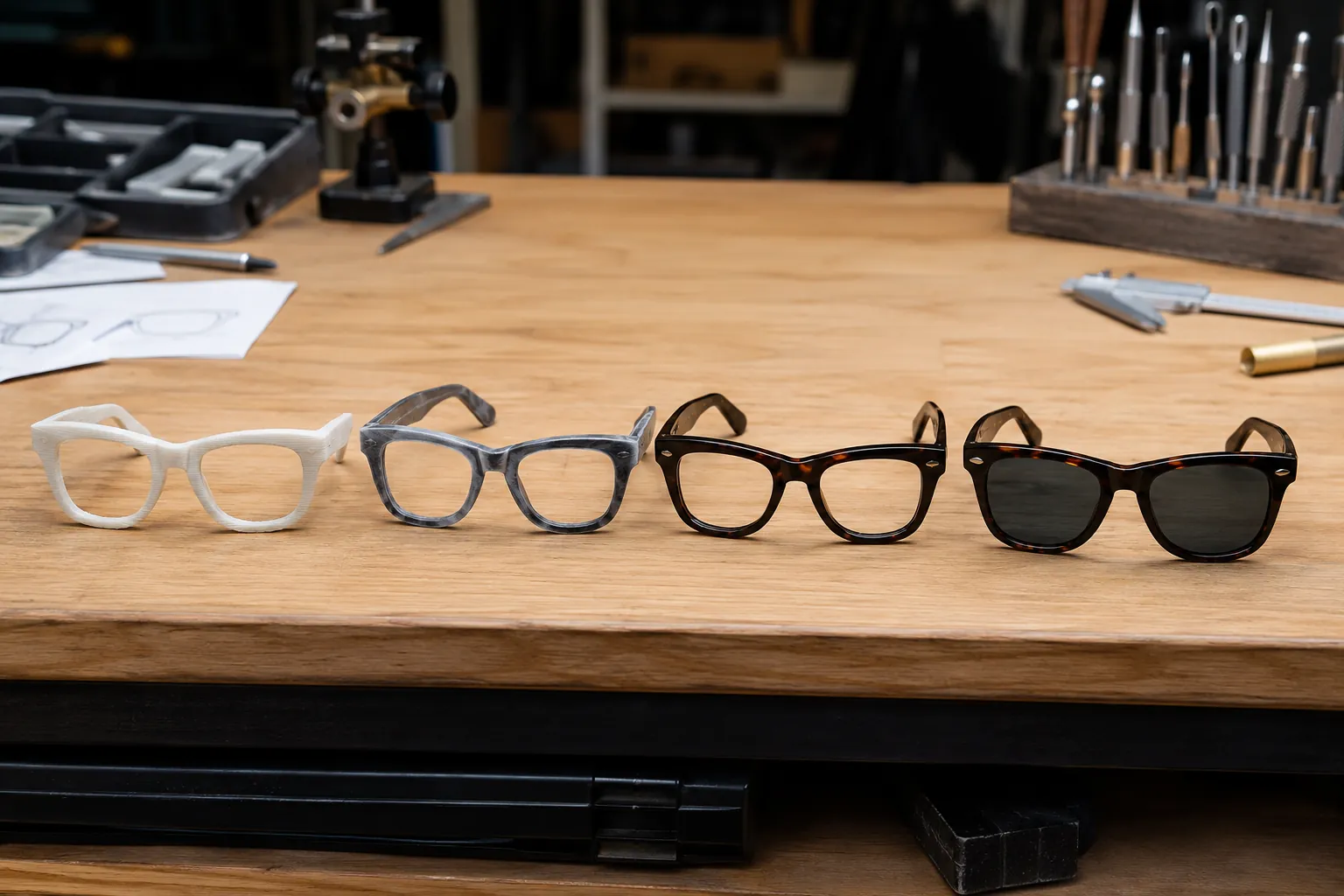
If you buy sunglasses for a brand, chain, catalog, or distribution business, the real question is not whether a factory can make them. It is which route gets product to market fastest without creating avoidable quality, compliance, or margin problems. This guide compares ODM and OEM sunglasses at 50, 300, and 1,000+ pairs, focusing on the decisions buyers actually need to make: tooling, sampling, dimensional tolerances, decoration methods, compliance, and unit cost.
Start with the buying decision, not the catalog
ODM and OEM are different manufacturing routes. They do not behave the same on time, cost, or control. ODM starts from an existing frame platform, so the factory already has the core geometry, fit, and production process in place. You usually customize color, lens tint, logo, surface finish, and packaging. OEM means the product is built to your specification. That gives more control over silhouette, fit, and brand identity, but it usually adds more engineering, more sample rounds, and more chances for delay.
For sunglasses, the big costs are often not the raw material. They are mold setup, lens matching, decoration alignment, QC, and the time spent approving samples. A vertically integrated supplier can reduce handoffs by keeping more processes under one roof, such as molding, CNC work, lens tinting, decoration, assembly, and inspection. That helps, but only if the brief is clear.
Before you ask for quotes, define the launch math:
- 50 pairs: a market test or influencer drop. Speed and low MOQ matter most.
- 300 pairs: a serious trial order. Selective customization can support a better retail offer.
- 1,000+ pairs: a scale program. OEM can make sense if the style is meant to reorder.
If you do not know sell-through yet, do not overcommit to a complex custom program. A polished first run can still be the wrong commercial move if it is too slow, too expensive, or too hard to reorder.
What ODM usually gives you at 50 pairs
At 50 pairs per design, ODM is usually the fastest path to market because the factory is working from a proven frame structure. The front curvature, hinge placement, temple angle, and lens seat are already defined. You are choosing commercial variables instead of inventing the product from scratch.
That usually means frame color, lens color, logo treatment, surface finish, accessories, and carton design. Small changes are easier to handle. A color shift on an existing platform may only require confirmation of the color reference, logo placement, and packaging artwork. If the frame geometry stays inside the factory's existing tooling, you avoid new mold development and the extra review that comes with it.
Timing depends on how much changes. A sample can move quickly when the request stays within an existing platform and materials are available. Bulk lead time then depends on approval, material readiness, and the complexity of decoration and packaging. Ask for three things early: sample timing, bulk timing, and the likely delay points. No guessing.
ODM is best for:
- Brand tests and seasonal drops.
- Private label programs that need fast assortment refreshes.
- Promotional orders where speed matters more than structural uniqueness.
- Buyers who want to test demand before paying for tooling.
The trade-off is plain. ODM rarely gives you a fully ownable silhouette. You can differentiate through color, packaging, lens tint, and decoration, but the frame architecture is still shared. That is fine for many launches. It is less useful if your value proposition depends on a unique protected design or a signature shape.
Where OEM makes sense at 300 and 1,000+ pairs
OEM becomes more rational once you have evidence that a style can sell again. At 300 pairs, it may be worth adding light tooling, custom fixtures, or controlled part changes if they improve fit, brand recognition, or retail value. At 1,000+ pairs, the economics improve further because setup and development costs can be spread across more units.
OEM sunglasses are most useful when the goal is not just to make the product custom, but to make it repeatable and distinct. That can include changes to frame thickness, temple length, hinge style, bridge height, lens shape, temple-tip profile, or metal decoration. These adjustments can create a more ownable product and may reduce direct price comparison with off-the-shelf alternatives.
The engineering details matter. In eyewear, a small dimensional change can affect both comfort and manufacturability. If temple length or angle is off, the fit at the ear can feel wrong. If lens seat depth or front width shifts, you can create assembly stress, visible gaps, or lens movement. Tolerances should be agreed before bulk production, not after the first batch arrives.
When you discuss OEM, ask the supplier what tolerance range it can hold consistently on the critical points for your design, including hinge alignment, front width, bridge dimensions, temple length, and lens fit. The exact target depends on material and construction method. The key question is simpler: can the factory repeat the same result across the order?
Use OEM when:
- You expect repeat orders, not just a one-time test.
- You need a differentiated silhouette or stronger design ownership.
- You can accept a longer approval path.
- You want long-term margin from product control, not only from logo placement.
If you cannot forecast a second order with reasonable confidence, OEM can become an expensive first-run structure. In that case, a light ODM or light OEM approach is usually safer.
Side-by-side: MOQ, tooling, lead time, and margin
The clearest way to compare the routes is to look at the production logic behind each one. ODM uses what already exists. OEM adds custom engineering. That can improve product value, but it usually increases approval time and execution risk.
| Route | Typical starting point | Sample speed | Bulk lead time | Tooling / process risk | Margin logic |
|---|---|---|---|---|---|
| ODM | 50 pairs/design | Often faster because the base platform already exists | Depends on materials, decoration, and approval timing | Lower if using an existing frame platform; main checks are logo, color, tint, and packaging | Best for fast launch and small tests; unit cost may be higher than a larger OEM program |
| Light OEM | 300 pairs/design | Typically longer than ODM if any part changes are added | Depends on final approval and whether any tooling or fixture work is needed | Moderate; small geometry or finish changes may require one extra review cycle | Useful when customization supports a higher sell price or reduces direct competition |
| Full OEM | 1,000+ pairs/design | Longer because spec validation and revisions are more involved | Depends on final approval and any new tooling | Higher; mold mismatch, lens fit issues, or finish defects can add time and cost | Best per-unit economics if volume is real and repeat orders are likely |
Price should be checked by component, not just by the unit number on the quote. Depending on build and order size, some programs may reach much lower unit pricing at higher volume, but there is no universal price floor. Frame material, lens type, decoration, packaging, and compliance needs all affect cost.
Ask the supplier to break the quote into frame, lens, logo method, packaging, and any special processes. A one-line price hides the drivers. That makes comparison harder and mistakes more likely.
What changes the numbers: materials, decoration, and lens work
Two sunglasses that look similar on a mood board can behave very differently in production. Material choice affects how the factory cuts, molds, finishes, and inspects the part. It also affects how many revisions may be needed before approval.
Injection frames are efficient for repeatability. Once the mold is correct, output can be stable and cycle times are predictable. They fit higher-volume programs well because per-unit cost generally improves as volume rises. The trade-off is mold lock-in. If the bridge, temple, or front shape is wrong, the fix may require tooling changes.
Acetate frames can feel more premium and often support a richer surface finish, but they require more machining, polishing, and manual finishing. Color layers, translucency, and polish quality need tighter process control. Thickness variation matters too because it affects hinge mounting and balance.
CNC milling is useful when a design needs tighter contour control, sharper detailing, or a thicker premium look. It is usually slower than standard injection, but it can improve consistency on certain complex shapes.
Decoration methods also behave differently:
- Laser engraving: clean and durable, especially for small logos or text.
- Pad printing: efficient for color logos and quick setup, but ink adhesion and placement consistency must be controlled.
- Metal logo plates: more premium visually, but they add sourcing, attachment, and QC steps.
- Hot stamping / foil effects: useful on packaging and sometimes on temples, but more sensitive to heat, pressure, and surface texture.
Lens work matters just as much. Tint color, UV performance, visible-light transmission, and optical clarity need to match the target market and applicable standard. A fashion lens for light retail use is not the same as a lens intended for stronger sun exposure.
For compliance, the supplier should be able to produce to the standards relevant to the destination market, such as CE EN ISO 12312-1, ANSI Z80.3, AS/NZS 1067, REACH, FDA registration, ISO 9001, and BSCI. These are not substitutes for your brief. They are part of supplier qualification and compliance control.
The sample path: where most projects lose time
Sample delays in sunglasses usually come from unclear instructions, changing requirements, and unapproved assumptions. A factory may make a reasonable first sample that still gets rejected because one key detail was not specified early enough.
To keep the sample cycle tight, send a structured brief. At minimum, include:
- Frame material and build method: injection, acetate, metal, or mixed construction.
- Target market and required standard: CE EN ISO 12312-1, ANSI Z80.3, AS/NZS 1067, REACH, FDA registration where applicable.
- Lens tint, visible-light transmission target, and any mirror or gradient effect.
- Logo method and exact placement on the temple or lens.
- Packaging structure: pouch, box, insert card, barcode, and master carton requirements.
- Target order size: 50, 300, or 1,000+ pairs.
- Target price and landed-cost ceiling.
Approval is faster when you control variables. Approve the frame first, then confirm the lens, then lock the decoration and packaging. Changing all three at once is one of the fastest ways to turn a quick sample into a long exchange.
Also ask how the supplier checks critical sample points such as hinge feel, lens fit, visible gaps, and color variation between sample and bulk. Those controls matter. If the factory cannot explain them clearly, the program is riskier than the quote suggests.
Even with integrated processes, the buyer controls pace through the quality of the brief and the speed of feedback.
How to choose the right route by launch stage
The right route depends on where the product sits in its life cycle. Early launch, proven seller, and scale-up programs should not be handled the same way.
| Launch stage | Best route | Why it fits | Main caution |
|---|---|---|---|
| Market test | ODM | Low MOQ, faster approval, lower upfront risk | Limited structural uniqueness |
| First serious retail buy | ODM or light OEM | Enough customization to stand out without heavy tooling | Keep the specification disciplined to avoid delays |
| Core line expansion | OEM | Better control over brand identity, fit, and repeat orders | Tooling and revision loops can slow launch |
| Seasonal or color-driven extension | ODM with selective customization | Fastest route to refresh assortment without rebuilding the product | Watch for color variation and packaging inconsistency |
For 50 pairs, the decision is usually simple: get something saleable in hand and learn from the market. For 300 pairs, ask whether the added customization will improve sell-through, perceived value, or retail margin. For 1,000+ pairs, evaluate tooling payback rather than only the quote price.
Also assess repeatability. A supplier should be able to explain how it controls color consistency, logo placement, lens tint variation, hinge function, and final inspection. If it cannot explain those controls clearly, the program is riskier than the quote suggests.
A buyer checklist before you send RFQ
Use this checklist before requesting a quote. It reduces back-and-forth and helps the supplier price the right level of complexity.
- Decide whether the first run is a market test, a replenishment order, or a line extension.
- Choose ODM if speed matters more than frame uniqueness.
- Choose OEM if repeat orders and brand differentiation matter more than launch speed.
- Set the quantity at 50, 300, or 1,000+ pairs so the supplier quotes the correct scale.
- State required standards up front: CE EN ISO 12312-1, ANSI Z80.3, AS/NZS 1067, REACH, and FDA registration where relevant.
- Specify frame material, lens type, decoration method, and exact logo location.
- Ask for guidance on critical fit points, especially hinge alignment and lens seat.
- Request sample timing, bulk timing, and the most likely delay points.
- Confirm packaging, carton quantity, and barcode needs before approval.
- Ask how pricing changes at the next volume step, not only at your current order size.
The best RFQ is not the shortest one. It is the clearest one. A supplier will often quote the cheapest interpretation of a vague brief, and that is how buyers end up with product that is technically acceptable but commercially wrong.
ODM buys speed. OEM buys control. The right answer depends on whether your priority is testing the market or building a reorderable product line.
Have a custom sunglasses project in mind?
Send us your styles, target market and quantities and we will return a detailed quote with MOQ, lead time and a sample plan.
Get a QuoteWhy source this from Wenzhou with LumiShades
Wenzhou in Zhejiang Province is widely regarded as China’s eyewear manufacturing capital, producing a large share of the world’s sunglasses. That concentration matters to buyers: a deep local supply chain for acetate sheet, hinges, lens blanks, plating and packaging means shorter component lead times, easier color and material matching, and a workforce with decades of eyewear-specific skill. LumiShades has manufactured in this ecosystem since 2009, and our vertical integration — in-house injection molding, acetate cutting, CNC milling, lens tinting, decoration and quality control — means no part of your order is quietly subcontracted to a workshop you cannot audit.
For international buyers, that vertical control translates into accountability. When a single factory owns every step, defects are traced and fixed at source rather than bounced between vendors, and your specifications survive intact from first sample to bulk. We back this with 15+ years of experience, shipments to 60+ countries, more than 5 million pairs produced per year and a 98.5% on-time delivery rate. Our certifications — CE EN ISO 12312-1, FDA registration, ANSI Z80.3, AS/NZS 1067, REACH, ISO 9001 and BSCI audit — mean the compliance documentation your market requires already exists. Explore our manufacturing capabilities and quality control process to see how this works in practice.
Frequently asked questions
Is ODM always cheaper than OEM for sunglasses? Not always. ODM is usually cheaper to start because it uses an existing frame platform and less development work, but the per-pair price depends on quantity, lens type, decoration, and packaging. OEM usually costs more upfront because of design and tooling work, but it can become more efficient over repeat orders if the style is intended to reorder.
Can I start with 50 pairs and still make changes later? Yes. That is one of the main advantages of ODM. You can launch with a small quantity, test demand, and then adjust the design on the next order. If the product performs well, you can move to light OEM or full OEM later, once you know which changes are worth paying for.
What usually slows down a sunglasses sample order? The biggest delays usually come from unclear specifications and too many changes at once. If you change frame shape, lens tint, logo method, and packaging in the same round, the cycle usually gets longer. A cleaner brief, staged approvals, and fast feedback from the buyer are the simplest ways to reduce delays.
Which route is better for retail private label? For most private label programs, ODM is the fastest entry point because it lowers development risk and gets product to shelf sooner. If a style sells well and you want better differentiation or stronger margin control, move that proven item into OEM on a later order.
What compliance documents should I ask for? Ask for documentation relevant to your market and product, such as CE EN ISO 12312-1, ANSI Z80.3, AS/NZS 1067, REACH, and FDA registration where applicable. If you need supplier-system documents, also request ISO 9001 and BSCI records as supporting materials.
Ready to start?
Explore our aviator sunglasses or request a quote — our sales team replies within 12 hours.
Request a Quote