
Questions to Ask Before First Sunglass Production
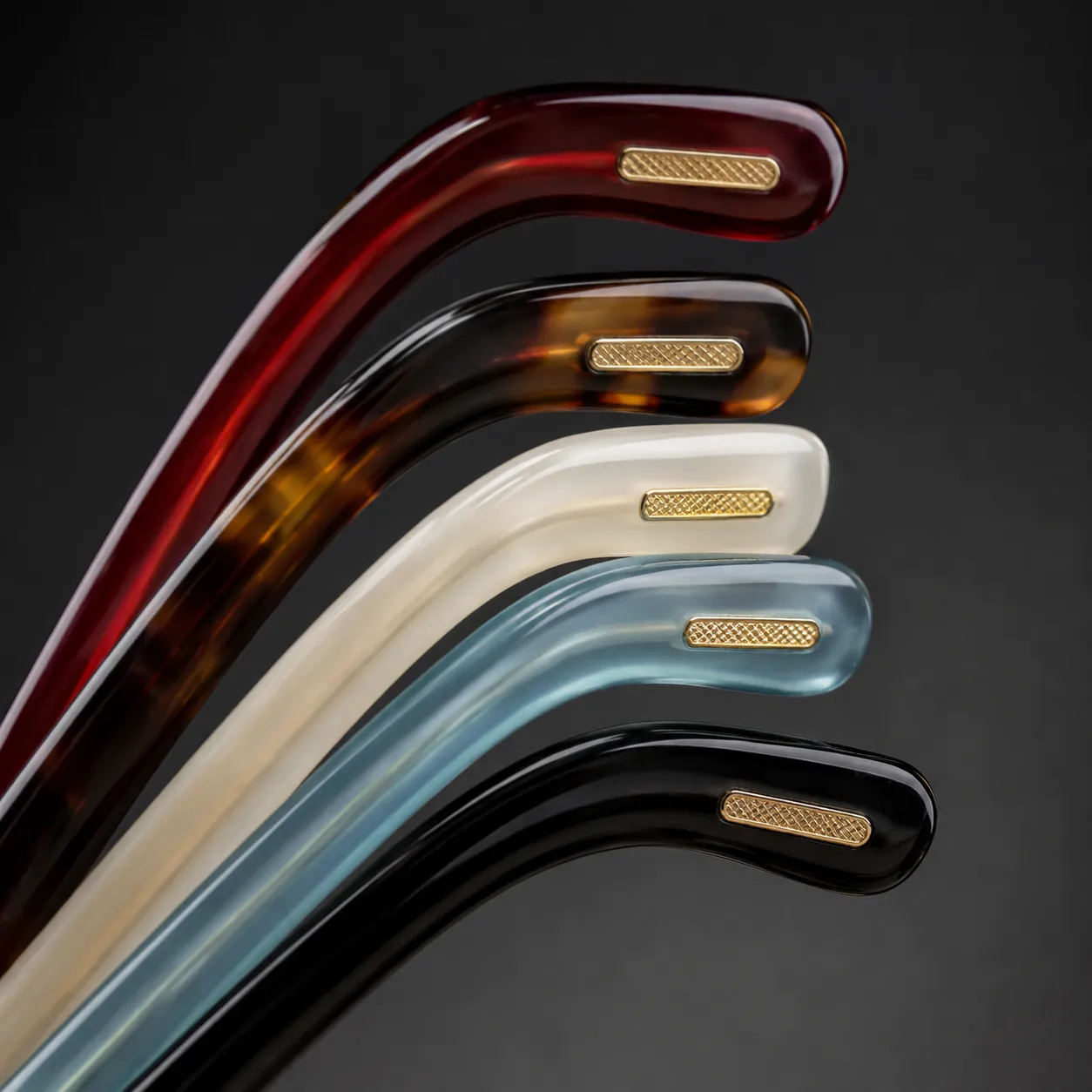
Your first sunglass production run is where cheap assumptions turn into expensive problems. A sample can look right and bulk can still fail on tint, fit, logo position, or delivery timing. The fix is simple: ask better questions before you approve production. This guide covers the points a real factory should answer clearly, with numbers, documents, and a defined process.
1) Start with the factory's real production setup
Do not start with price. Start with control.
If a supplier claims high output, it should be able to explain where each step happens, what equipment is used, and where inspection sits. If it handles injection molding, acetate cutting, CNC milling, lens tinting, decoration, and QC in-house, that matters. Fewer handoffs usually mean fewer errors and faster root-cause checks when something goes wrong.
Ask for the route for your exact frame type. Injection-molded frames usually go through molding, de-gating, trimming, alignment, and warpage checks. Acetate frames usually involve sheet cutting, rough shaping, polishing, hinge insertion, temple fitting, and final screw checks. Metal and mixed-material styles add CNC work, welding or riveting, plating checks, and corrosion-related inspection where needed.
If the supplier cannot walk through the process step by step, that is a bad sign.
Then ask what equipment is actually doing the work. Do they use CNC mills with repeatable programs? Is tinting monitored and recorded? Are screwdrivers torque-controlled? Are dedicated inspection lights used for color and surface checks? A serious factory can tell you where variation is controlled and where it is still operator-dependent.
Ask this directly: "Which steps are in-house for my model, which are outsourced, and where do you inspect each batch?"
Also ask whether sample making and bulk production run on separate lines. That matters. A sample room can produce a one-off approval piece. Bulk production has to repeat it against a documented tolerance, not one technician's memory.
2) Make sure the spec sheet is ready for production
Many first orders fail for one reason: the approved sample is too vague.
A buyer says, "Match the sample." Bulk arrives with different temple tension, tint, or logo position. That is not a mystery. It is a weak spec.
Your spec sheet should lock down measurable points. At minimum, ask for:
- Frame material and grade
- Lens material, tint target, and coating type
- Hinge style, screw size, and hinge opening feel
- Temple length, frame width, lens width, and bridge size
- Logo method: laser engraving, pad print, hot stamp, or metal logo plate
- Packaging content, carton configuration, and carton mark format
Do not accept "about" or "same as sample" for dimensions. Ask for a tolerance table. The factory should state actual limits for your model, especially for lens fit, hinge alignment, temple symmetry, and logo placement. If the style has a wrapped front or thick acetate profile, ask how warpage is controlled after polishing or heat-setting.
If CNC milling is involved, ask how left-right repeatability is maintained and how consistency is held across multiple production days. A decent answer should mention fixtures, program checks, and sampling intervals. You do not need every internal detail. You do need proof that the process is not guesswork.
One more point: define the sign-off rule. Does the approved sample become the production master? Is there a sealed golden sample held by both sides? Is the signed spec sheet issued with photos, measurements, and color references? If not, expect arguments later about what was approved.
3) Compare MOQ, price breaks, and what changes with volume
Low MOQ sounds good. It can hide trade-offs.
The real issue is not whether the factory will make 50 pairs. It is what changes at 50, 300, 1000, and 5000+ pairs. Unit cost, line efficiency, material sourcing, packing method, and inspection depth may all shift as volume rises.
If a supplier offers 50 pairs per design as a minimum and lower prices at 300, 1000, and 5000+ pairs, that is normal. Tooling recovery, labor efficiency, and material buying improve with scale. But price drops are rarely linear, and the production method may change more than buyers expect.
Use a comparison like this before you commit:
| Order size | Typical buyer use | What usually changes | What to confirm |
|---|---|---|---|
| 50 pairs/design | Market test, VIP launch, or photography run | Higher unit cost, more manual handling, slower line changeovers | Whether decoration, lens finish, and packing match bulk quality |
| 300 pairs/design | Small retail rollout or early reorder | Better material buying and steadier production scheduling | Whether color and logo position stay consistent across cartons |
| 1000 pairs/design | Established SKU or distributor test order | Lower per-unit labor cost and more predictable lead time | Whether QC sampling is tightened and carton labeling is accurate |
| 5000+ pairs/design | Chain-store or large distributor order | Best pricing, stronger line utilization, more formal batch control | Whether defect handling, packing sequence, and shipment split rules are fixed |
Do not compare ex-factory price alone. Ask what is included. Are cases, cloths, inserts, barcode labels, and retail boxes part of the quote? Is the logo method the same across all quantities? Laser engraving, pad printing, hot stamping, and metal logo plates have different costs, lead times, and visual results. A cheap quote is often just a reduced spec.
Ask the supplier to explain the breakpoints. A factory that knows its numbers should be able to tell you what changes when you move from stock lenses to custom tinting, from plain cartons to printed retail boxes, or from manual packing to more standardized packing. If it cannot, the quote may be built for sales, not production.
4) Check material control, especially for lenses and acetate
Material drift ruins repeat orders.
A frame can look fine in sampling and shift in bulk because the resin lot changed, the acetate sheet batch drifted, or the lens tint was matched differently. Ask how incoming materials are checked, how lots are separated, and whether approved materials are physically isolated from unapproved stock.
For lenses, color consistency is the first thing most buyers notice. If the tint is smoke gray, brown, mirror, or gradient, ask how the target is controlled and whether each batch is checked against a reference. Ask to see the color standard under the same inspection light source the factory uses, ideally D65 or a documented equivalent. If the style is polarized, ask about polarization performance, optical distortion limits, and whether lens curvature is matched to the front curve. Poor lens fit causes stress marks, edge lift, and lenses that pop out.
For coated lenses, ask how scratch resistance and coating adhesion are checked. Some factories do little more than a rub test. Better ones can explain how they inspect for haze, chipping, poor edge coverage, and mirror inconsistency around the perimeter.
For acetate, ask whether the factory tracks sheet thickness, color batch, and post-cut shrink behavior. Acetate reacts to heat, humidity, and polishing time. If process discipline is weak, two pairs that look similar on day one can fit differently after assembly. For dark tortoise or translucent colors, ask for batch photos under the same inspection lighting used for approval. Small drift shows fast on reorders.
For injection-molded frames, ask about mold condition, gate marks, sink marks, and whether regrind is used. If regrind is used, the factory should say so and explain the mix ratio and control method. If it refuses to answer, pay attention.
5) Put compliance requirements in writing
Compliance is not sales language. It is shipment risk.
If a supplier lists CE EN ISO 12312-1, FDA registration, ANSI Z80.3, AS/NZS 1067, REACH, ISO 9001, and BSCI, that gives you a starting point. It is not proof by itself.
Ask which standards apply to your target market and product type. For EU sales, sunglasses need the correct conformity path and marking. In the U.S., FDA registration may be relevant, but it is not the same as proof that your style was tested to the required performance standard. ANSI Z80.3 is relevant for non-prescription sunglasses. Australia and New Zealand use AS/NZS 1067. REACH covers restricted substances in the EU supply chain. ISO 9001 shows a quality management system. It does not certify the product itself. BSCI addresses social compliance, not product safety.
Request current documents. Then check the scope. Do the certificates or reports cover the factory site, the product family, the exact style, or only the management system? Ask when they expire, which lab issued them, and whether the test report applies to the style you are buying. That distinction matters.
Also ask how compliance appears on product and packaging. Are required marks laser-etched, printed, or placed on the inner temple? Are warning labels, cleaning instructions, and importer details included where needed? A factory that understands compliance should answer these points clearly and without improvising.
6) Ask for a real QC plan, not "100% inspected" talk
"100% inspected" sounds strong. It often means very little.
The real question is what gets checked, when it gets checked, and what counts as a fail. A credible QC plan covers incoming materials, in-process checks, and final inspection, with clear defect limits.
A practical inspection plan for sunglasses should include:
- Incoming check of frame components, lenses, screws, and packaging
- First-piece approval on the line before the full run starts
- In-process checks for lens fit, temple alignment, logo position, surface finish, and screw torque
- Final inspection against AQL or an agreed defect list
- Carton and packing verification for export shipment
Ask for the defect categories. Good factories separate critical, major, and minor defects. Example: a lens that pops out is critical. Obvious logo misplacement, wrong tint, or a crooked temple is major. A small cosmetic mark on an internal surface may be minor if it stays within agreed limits. If the supplier cannot classify defects, it cannot control them well.
Ask how many samples are pulled for final inspection. Many buyers use AQL 2.5 for major defects and 4.0 for minor defects as a reference, but the right level depends on your channel and risk tolerance. Also ask whether inspection is internal, third-party, or both, and whether the report includes photos of rejects. A report without photos is harder to challenge later.
Then ask about traceability. Can the factory identify the batch, date, shift, or carton range linked to a problem pair? Can it isolate a tint issue to one day's output? That is the difference between a contained claim and a full-shipment dispute.
7) Get the lead-time math before releasing the PO
Lead time is where many first orders go off track.
If a supplier says samples take 7 to 10 days and bulk takes 25 to 35 days, that may be reasonable. But only if the sample is fully approved, materials are available, and no tooling or packaging revisions are still open. Custom colors, special lenses, new molds, and retail-box changes all add time.
Ask the factory to break lead time into steps:
- Sample confirmation
- Material procurement
- Production scheduling
- In-process QC
- Final inspection and packing
- Export booking and handover
Then ask what usually causes delay. Common issues include late artwork approval, color matching revisions, coating rework, packaging shortages, and peak-season line congestion. A reliable factory should be able to describe its weak points. That is useful. "No delays ever" is not a credible answer.
For a first run, get milestones in writing: approved sample date, material arrival date, production start date, packed-goods date, and estimated handover date to the forwarder. If partial shipment is allowed, define which SKUs can ship first and whether the remaining balance will follow the same carton sequence and labels.
Build in buffer. Ports, customs, and freight do not care about your launch calendar.
Also ask whether the schedule includes time for correction or rework. A factory that plans for a small fix window is often more realistic than one that promises an aggressive date and rushes the last 20% of the order.
8) Use a written approval checklist before you say yes
Before you approve production, make the supplier answer these points in writing. Clear answers are a good sign. Vague answers are not.
- Which steps are in-house for this model?
- What is the approved master sample and who holds it?
- What exact materials, lens type, and logo method will be used?
- What are the tolerance ranges for size, alignment, and decoration?
- Which certifications apply to my market and can you share current documents?
- What inspection stages are used and what is the defect classification?
- What is the real lead time for samples, bulk, and shipment booking?
- What changes at 50, 300, 1000, and 5000+ pairs?
The point is simple. You are not only buying sunglasses. You are buying repeatability.
In-house molding, acetate cutting, CNC milling, decoration, and QC can give you more control. But even then, you still need the basics locked down: spec, tolerance, QC plan, compliance scope, and timing.
If the supplier answers with measurements, documents, and process steps, you can move forward with more confidence. If the answers stay vague, slow the project down until the details are written and agreed.
Have a custom sunglasses project in mind?
Send us your styles, target market and quantities and we will return a detailed quote with MOQ, lead time and a sample plan.
Get a QuoteWhy source this from Wenzhou with LumiShades
Wenzhou in Zhejiang Province is widely regarded as China’s eyewear manufacturing capital, producing a large share of the world’s sunglasses. That concentration matters to buyers: a deep local supply chain for acetate sheet, hinges, lens blanks, plating and packaging means shorter component lead times, easier color and material matching, and a workforce with decades of eyewear-specific skill. LumiShades has manufactured in this ecosystem since 2009, and our vertical integration — in-house injection molding, acetate cutting, CNC milling, lens tinting, decoration and quality control — means no part of your order is quietly subcontracted to a workshop you cannot audit.
For international buyers, that vertical control translates into accountability. When a single factory owns every step, defects are traced and fixed at source rather than bounced between vendors, and your specifications survive intact from first sample to bulk. We back this with 15+ years of experience, shipments to 60+ countries, more than 5 million pairs produced per year and a 98.5% on-time delivery rate. Our certifications — CE EN ISO 12312-1, FDA registration, ANSI Z80.3, AS/NZS 1067, REACH, ISO 9001 and BSCI audit — mean the compliance documentation your market requires already exists. Explore our manufacturing capabilities and quality control process to see how this works in practice.
Frequently asked questions
What should I ask first if this is my first sunglasses order? Start with the production route: what is made in-house, what the approved master sample is, and how the factory controls lens tint, logo placement, and final QC. Ask for the answers in writing, with photos or a signed spec sheet if possible. That gives you a stronger basis than price alone.
Is MOQ 50 pairs enough for a serious first run? Yes, if your goal is to test a design, validate a new channel, or produce a small launch order. For a retail rollout or distributor program, a higher quantity such as 300 to 1000 pairs usually gives better pricing, steadier scheduling, and a more useful QC picture across multiple cartons.
What tolerances should I expect on sunglass production? The factory should set the tolerance for your exact model and put it in the approved spec sheet. For many standard styles, buyers commonly ask for tight control on lens fit, hinge alignment, and symmetry, with the exact numeric limits agreed before production. Do not rely on a verbal "close enough" promise.
Which certifications matter most for export sunglasses? Use the certifications and documents that apply to your destination market. For the list in this article, CE EN ISO 12312-1 matters for EU markets, FDA registration is relevant for the U.S. market, ANSI Z80.3 is relevant for non-prescription sunglasses testing in the U.S., AS/NZS 1067 applies to Australia and New Zealand, REACH concerns restricted substances in the EU supply chain, ISO 9001 shows a quality management system, and BSCI addresses social compliance.
How do I know if the quoted lead time is real? Ask the factory to split it into sample approval, material purchase, production, inspection, packing, and shipment booking. Then ask what can delay each step. If the supplier can give only one total number and cannot explain the schedule, the lead time is less reliable.
What is the biggest mistake buyers make on first production runs? They approve a sample without locking measurable specs. Then the bulk order varies in tint, fit, logo position, or packaging, and nobody agrees what was actually approved. A signed spec sheet and a golden sample reduce that risk.
How should logo decoration be chosen for sunglasses? Choose based on look, durability, and quantity. Laser engraving is precise and durable, pad printing works well for colored logos and lower setup cost, hot stamping can create a premium finish on suitable surfaces, and metal logo plates add material and assembly cost. Ask the factory which method is most stable for your frame material and location.
Ready to start?
Explore our cat-eye sunglasses or request a quote — our sales team replies within 12 hours.
Request a Quote