
Seasonal Sunglasses Buying Calendar for Retailers
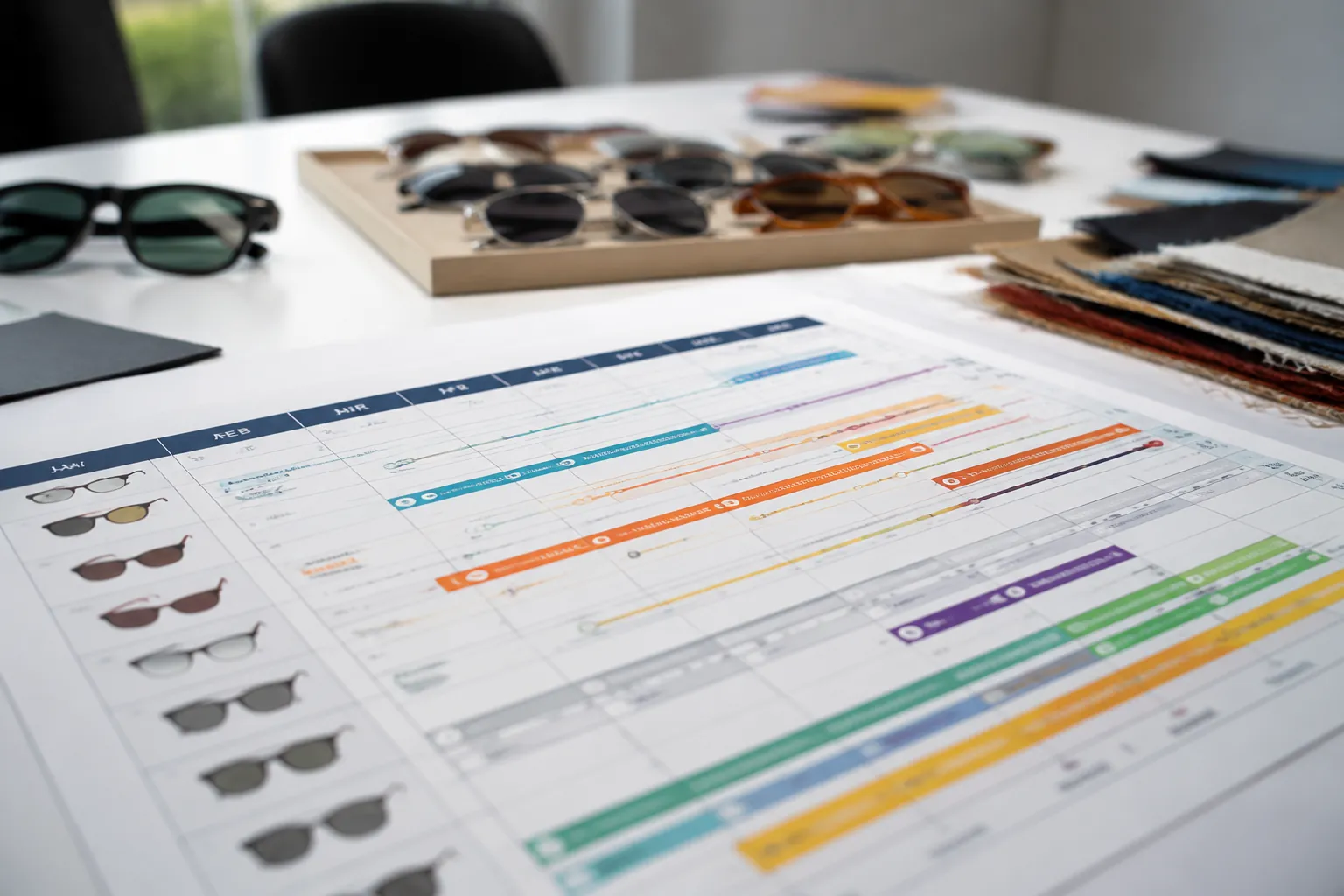
This guide is for overseas retailers, importers, distributors, and brand teams buying custom sunglasses in volume. It shows how to work backward from the sell date, freeze specifications before capacity is committed, and build a practical calendar for sampling, bulk production, compliance checks, QC, freight, and replenishment. Use it to plan spring launches, summer programs, holiday gift drops, resort ranges, and regional promotions with realistic factory and logistics timing.
Start With the Sell Date, Not the Quote
A seasonal sunglasses calendar should start with the date the product must be ready to sell in your warehouse, distribution center, or store network. Not the date you want to place the purchase order. Many retail teams count only factory production time. That leaves out sample transit, buyer review, deposit processing, packaging approval, pre-shipment inspection, freight booking, customs clearance, inland delivery, warehouse receiving, barcode checks, and store allocation.
For a new custom style, work backward from the sell date and leave room for both development and logistics. Existing styles with approved molds, standard lens options, and simple packaging can move faster. New tooling, custom acetate colors, special logo parts, polarized lenses, multi-market labeling, or retailer-specific carton rules need more time. Exact timing depends on the product, order size, production queue, and destination.
There is no single universal lead time. The real question is simpler: does the factory and importer have enough time to complete each step without forcing last-minute changes? If not, the calendar is too tight. Full stop.
- Design freeze: frame shape, material, color, lens, logo, and packaging concept are approved.
- Sample approval: a physical sample or signed visual approval confirms appearance, fit, and decoration.
- PO and deposit: commercial terms, quantity breakdown, carton marks, and shipping terms are confirmed.
- Production start: material purchasing, frame making, lens preparation, decoration, and assembly begin.
- Inspection and ex-factory: final QC is completed before the goods leave the factory.
- Arrival and first sale: customs, warehouse intake, labeling checks, allocation, and launch timing are protected.
Map the Calendar by Selling Season
Different peaks need different sourcing behavior. Spring and summer ranges usually combine core SKUs, fashion colors, and replenishment planning. Holiday drops depend more on packaging, gift presentation, and display readiness. Resort, cruise, duty-free, and travel retail often move on a different rhythm from domestic retail calendars.
| Selling window | Best factory PO window | Sampling should start | Key buying risk |
|---|---|---|---|
| Northern hemisphere spring launch, March to April | November to early January | September to October | Chinese New Year can affect labor, components, trucking, and vessel space |
| Peak summer sales, May to July | January to March | November to January | Late lens or color changes reduce replenishment options |
| Holiday gifting, November to December | July to September | May to July | Gift box, sleeve, barcode, and carton approvals often take longer than expected |
| Southern hemisphere summer, October to February | June to August | April to June | Buyers who wait too late may miss production slots before the season starts |
| Resort, cruise, duty-free, travel retail | Rolling, typically 60 to 100 days before delivery | Rolling, typically 80 to 120 days before delivery | Small mixed orders increase packing, SKU separation, and carton-label errors |
For Wenzhou eyewear production, January and February need special attention because Chinese New Year can disrupt staffing, component availability, subcontractor schedules, and transport capacity. Even if a factory normally turns bulk orders quickly, that timing may not hold during the holiday period. If goods must ship before Chinese New Year, freeze specifications and packaging early. If goods ship after the holiday, allow time for line restart, material confirmation, and QC stabilization.
If you sell in multiple regions, do not mix markets unless the product, labeling, lens category, and packaging rules are identical. Split the plan into launch stock, regional allocation stock, and replenishment stock. That keeps sell-through decisions cleaner and reduces the risk that one market's compliance requirement delays the whole order.
Pick the Right Development Route
The biggest calendar variable is not always order quantity. It is how much development work the factory must complete. Not every seasonal launch needs a new frame. Many retail programs work well with proven shapes, updated lens tints, temple logos, color stories, pouches, and display packaging.
| Development route | Typical MOQ and use case | Factory impact | Calendar advice |
|---|---|---|---|
| Existing mold with logo | Can suit lower-volume test runs, distributor samples, boutique retail, or influencer kits | Lowest risk; known tooling and established decoration positions reduce development uncertainty | Start early enough to cover compliance review, packaging approval, and freight booking |
| Existing mold with new colors and lenses | Often used for seasonal capsules and regional promotions | Medium risk; color matching, lens shade approval, UV category, and decoration tests add time | Allow more time than a straight repeat order, especially if packaging also changes |
| New injection or acetate frame | Best for long-term SKUs or brand-owned hero styles | Higher risk; tooling, fit checks, hinge alignment, lens groove depth, and shrinkage control may require revisions | Start well before the target season and include room for at least one revision cycle |
| Complex decoration package | Useful for premium private label, travel retail, or gift sets | Risk shifts to logo plates, adhesive strength, color registration, scratch resistance, and packaging dielines | Add extra time for artwork approval, packaging proofs, and functional checks |
LumiShades has in-house injection molding, acetate cutting, CNC milling, lens tinting, laser engraving, pad printing, metal logo plate application, assembly, and QC. That can cut handoffs, but it does not remove the need for clear approvals. A late change from smoke lens to polarized TAC lens, or from printed logo to metal plate, affects component purchasing, decoration setup, cost, lead time, and sometimes compliance labeling.
Freeze Specs Around Compliance, Fit, and Tolerances
A seasonal sunglasses style can look right in a showroom and still cause problems if compliance, fit, or measurement control is left too late. Lock the technical specification before sales teams present samples to accounts. The production file should include frame material, lens material, lens category, UV requirement, color target, hinge type, logo method, logo position, packaging, barcode format, carton marks, target market, and the required standard.
Use measurable tolerances in the specification. Buyers commonly control frame width, lens width, bridge, and temple length within a defined tolerance band, and logo placement should be specified clearly too. The exact tolerance should match the product, decoration method, and quality agreement. Lens fitting must be checked for gaps, rattle, stress marks, and edge chipping. Hinge opening should feel consistent across samples. Loose hinges create returns. Tight hinges crack temples or make the product feel poor in use.
Material behavior matters as well. Injection frames are efficient for volume and repeatability, but resin shrinkage can affect lens seating and temple opening if the tool or material changes. Acetate gives stronger color depth and a more premium feel, but sheet variation, heating, polishing, and hand adjustment can change the final fit. Metal parts and logo plates need plating, adhesion, and corrosion checks, especially for humid resort or coastal markets.
Compliance must be planned by destination market. Relevant certifications and standards may include CE EN ISO 12312-1, ANSI Z80.3, AS/NZS 1067, REACH, FDA registration, ISO 9001, and BSCI. Use only the standards and documents required for your market. Do not make claims the product or paperwork cannot support. Multi-market orders may need different warning labels, lens category wording, instruction sheets, or barcode formats. One package is convenient. It is not always compliant.
Use MOQ and SKU Logic to Shape Assortment Depth
MOQ affects both cost and calendar discipline. Small orders are flexible, but they carry higher unit cost and more handling per pair. Larger orders improve unit economics, but they leave less room for late changes. LumiShades can start from 50 pairs per design, which helps with test colors, regional samples, boutique orders, or influencer seeding. Better pricing usually comes at higher quantities, but the breakpoints depend on material, lens type, decoration, packaging, and inspection requirements.
For a seasonal retail range, separate styles into core, seasonal, and test groups. Core SKUs should carry the deepest stock because they can be replenished and forecast more reliably. Seasonal SKUs should support the campaign without tying up too much cash. Test SKUs should be measured quickly and repeated only if sell-through justifies a reorder.
- Core SKUs: black, tortoise, brown, smoke lens, green lens, or other proven combinations. Buy deeper and reserve replenishment capacity.
- Seasonal SKUs: bright acetate, mirror lenses, gradient lenses, holiday sleeves, or regional trend colors. Buy for the promotion window and avoid oversized commitments.
- Test SKUs: new shape, new age group, new channel, or new price point. Start at low MOQ, then scale winners.
One common mistake is spreading volume across too many colorways. Ten colors at shallow depth may look strong in a presentation, but it usually creates weak store coverage, more carton complexity, more barcode risk, and less leverage on price. Fewer colors with stronger depth usually give better unit economics, cleaner QC, simpler replenishment, and better retail execution.
Run Sampling and Pre-Production in Order
Sampling is not only about appearance. It verifies the production route: mold, lens shade, fit, hinge tension, decoration, packaging, and compliance labeling. Sample timing depends on design complexity and factory workload, so buyer response time matters just as much as factory response time. Build in time for internal review after sample receipt, and allow more time if several retail accounts must approve the same style.
- Send a tech pack or reference sample with measurements, a physical color target or Pantone reference, logo file, lens requirement, destination market, and target price.
- Ask the factory to confirm mold availability, material behavior, lens options, decoration limits, estimated MOQ, and price tier.
- Approve the first sample or request one measurable revision. Avoid comments such as "make it more premium" unless you define what should change.
- Confirm packaging, barcode, carton mark, warning label, and instruction sheet before production approval.
- Sign a golden sample and production specification sheet.
- Issue the PO, deposit, quantity breakdown, shipping method, inspection requirements, and delivery address.
Use physical samples for final approval whenever possible. Photos can distort lens color, transparency, mirror coating, and frame gloss. A smoke lens, gradient brown lens, and polarized lens may look similar in studio lighting but behave differently in testing and in store. If video approval is unavoidable, ask for daylight, white indoor light, side view, front view, temple opening, lens close-up, logo close-up, and a face-form view.
Do not approve a frame first and decide the lens category later. Lens category affects labeling, market suitability, inventory availability, and sometimes testing. Changing from a fashion tint to a higher sun-protection category near production start can trigger new material checks, documentation updates, and schedule movement.
Plan Replenishment Before the First Shipment Leaves
Replenishment works best when the mold, color, lens, logo, packaging, and carton file stay stable. It works poorly when every reorder becomes a redesign. If you expect repeat orders during summer, tell the factory during the first PO. That helps with material purchasing, lens inventory, decoration setup, and production slot planning.
Fast replenishment is most realistic for existing frames, standard lens colors, approved hinges, and logo methods already used in bulk. It is slower for custom acetate colors, non-standard lens tints, polarized lenses, metal logo plates, special pouches, printed boxes, or retailer-specific display trays. Even when a factory can produce quickly, raw materials and decoration components can still slow the order.
| Reorder type | Best-case speed | Watch point |
|---|---|---|
| Same frame, same color, same lens, same packaging | Most reliable repeat production | Confirm lens, hinge, and packaging inventory before promising retail dates |
| Same frame with new lens color | Moderate speed if the lens tint is standard | Lens category, labeling, and visual approval may change |
| Same frame with new logo or plate | Needs decoration setup confirmation | Pad print position, engraving depth, plate adhesion, and scratch resistance must be checked |
| New acetate color | Often slower | Sheet availability, color variation, polishing result, and batch consistency affect timing |
Set trigger points before the season starts. For example, a buyer may choose to reorder a core black SKU when sell-through reaches a defined level and warehouse cover drops below a chosen number of weeks. The trigger should be based on sales rate, freight mode, and service level. Air freight can rescue availability, but it cuts margin fast and should not be the normal plan.
Add QC, Packaging, and Freight Buffers
A strong calendar includes buffers. A weak one assumes every step happens on the best possible day. Sunglasses production has several points where one issue can stop packing: lens scratches, coating defects, hinge torque variation, logo misalignment, burrs, wrong UV category, carton label errors, missing warning inserts, or barcode mismatch.
LumiShades runs in-house QC across incoming materials, frame forming or injection, lens preparation, decoration, assembly, final inspection, and packing. Buyers should define acceptable quality expectations before production. Scratched lenses, wrong lens category, broken hinges, sharp burrs, incorrect warnings, and wrong barcode data should be treated as critical or major defects, not minor cosmetic issues.
- Internal approval buffer: allow time after sample receipt for review and sign-off.
- Packaging and barcode buffer: build extra time for chain retailers with strict carton and label rules.
- QC and inspection buffer: reserve time before the ex-factory date for final inspection and any corrective action.
- Freight buffer: air freight is faster; sea freight often needs several additional weeks depending on lane, customs, and inland delivery.
- Holiday buffer: add extra time around Chinese New Year and major destination-country holidays.
Ask for a production schedule with milestones, not just a promised ex-factory date. Injection or cutting date, lens-ready date, decoration date, assembly date, final QC date, and packing date show whether the order is healthy. One ship date tells you very little.
Buyer rule: if a product must be on shelf for a fixed retail event, freeze the specification earlier than feels comfortable. Late changes are expensive.
Work Backward From Freight and Shelf Readiness
Retail calendars fail most often in the last mile between factory completion and shelf availability. Even a clean production run can arrive late if the importer does not leave enough time for freight booking, customs clearance, warehouse receiving, carton checks, and store allocation. Build the calendar backward from the real in-store deadline, not the factory completion date.
A practical method is to assign three dates for every seasonal program: the latest shelf date, the warehouse receipt date, and the factory ex-factory target. Then add a buffer for each step. If the product is a new style or the destination is a complex market, widen the buffer. If the product is a repeat order with stable packaging and documentation, the buffer can be smaller, but it should not be removed.
For multi-region programs, do not promise one launch date to every market unless the shipping route, carton format, labels, and compliance documents are already aligned. Regional differences in holidays, port congestion, and customs practice can change timing fast. A good calendar leaves room for that instead of forcing one global assumption.
When in doubt, protect the sell date first and the factory date second. If the calendar gets too tight, cut complexity before you cut time.
Have a custom sunglasses project in mind?
Send us your styles, target market and quantities and we will return a detailed quote with MOQ, lead time and a sample plan.
Get a QuoteWhy source this from Wenzhou with LumiShades
Wenzhou in Zhejiang Province is widely regarded as China’s eyewear manufacturing capital, producing a large share of the world’s sunglasses. That concentration matters to buyers: a deep local supply chain for acetate sheet, hinges, lens blanks, plating and packaging means shorter component lead times, easier color and material matching, and a workforce with decades of eyewear-specific skill. LumiShades has manufactured in this ecosystem since 2009, and our vertical integration — in-house injection molding, acetate cutting, CNC milling, lens tinting, decoration and quality control — means no part of your order is quietly subcontracted to a workshop you cannot audit.
For international buyers, that vertical control translates into accountability. When a single factory owns every step, defects are traced and fixed at source rather than bounced between vendors, and your specifications survive intact from first sample to bulk. For procurement review, buyers can request process records, approved samples, quality checkpoints and project-specific compliance files before placing a bulk order. Required testing and documentation are confirmed against the destination market and product specification rather than assumed from a generic certificate list. Explore our manufacturing capabilities and quality control process to see how this works in practice.
Frequently asked questions
How early should we start planning custom sunglasses for a March retail launch? Start design and sampling in September or October if possible, then work backward from the shelf date to set the PO, production, freight, and warehouse milestones. If the style is new, packaging is custom, or the market needs specific compliance documents, start earlier and leave more time for review and correction.
Can we test a seasonal style before committing to large volume? Yes. A low-MOQ test order is a practical way to validate a new shape, color, lens, or channel. Use the first run to confirm fit, sell-through, packaging performance, and customer feedback, then scale only the styles that prove demand.
What is the normal sample and bulk production lead time? Lead time depends on the product and factory queue, so do not treat one number as universal. As a planning baseline, request the sample timeline first, then confirm the bulk production window only after the sample, packaging, and technical specification are approved. Always add freight, customs, and warehouse time on top of factory time.
Which specifications should be frozen before production? Freeze the frame material, frame color, lens material, lens color and category, logo method, logo placement, packaging, barcode rules, carton marks, destination market, and the signed golden sample. If any of those change after approval, the factory may need to revise materials, decoration setup, or compliance documents.
Which compliance standards should we plan for? Plan by destination market and only use the standards that apply to the shipment. Relevant documentation can include CE EN ISO 12312-1, ANSI Z80.3, AS/NZS 1067, REACH, FDA registration, ISO 9001, and BSCI. Confirm the required labels, warnings, and test reports before production starts.
Is replenishment possible during peak summer? Yes, if the reorder uses the same approved frame, lens, logo, packaging, and carton file. The safest approach is to set a sell-through trigger before the season starts and keep a replenishment plan ready. If you change the lens, decoration, or packaging, treat the reorder as a new approval cycle.
Ready to start?
Explore our shield & oversized sunglasses or request a quote — our sales team replies within 12 hours.
Request a Quote