
How to Check Sunglasses Factory Capacity Before Seasonal POs
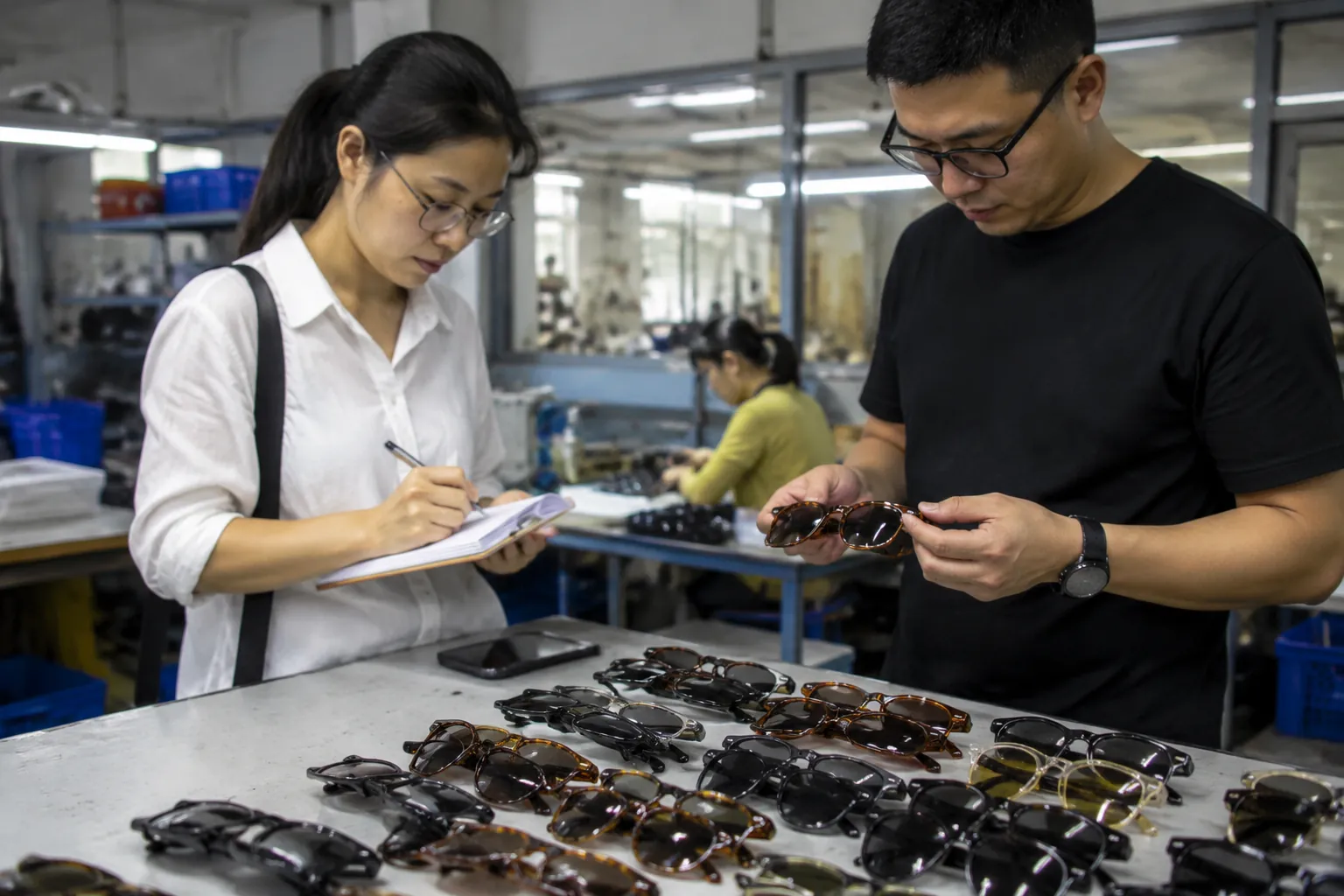
If you buy sunglasses for a season, a weak capacity check can blow the launch. This guide is for brands, importers, distributors, and retailers that need a practical way to verify whether a factory can ship the volume it promises. It shows how to assess output, spot bottlenecks, and separate real surge capacity from sales talk. It also explains how an integrated factory setup can reduce handoffs across molding, acetate cutting, CNC, tinting, decoration, and QC.
Start With The PO, Not The Brochure
Capacity only matters in relation to your order. A factory may say it can make millions of pairs a year and still be a poor fit if your seasonal PO includes multiple SKUs, several lens tints, custom decoration, and a tight ship window. Start with the order profile: style count, color count, lens count, packaging spec, destination market, target ship date, and whether the shipment goes to one warehouse or several distribution centers.
For sunglasses, capacity is not just pairs per day. It is the combined throughput of tooling, material flow, frame production, lens processing, decoration, assembly, QC, and packing. One weak step can hold up the rest. In seasonal sourcing, that weak step is often what breaks the schedule, not the headline production number.
Ask better questions. How many SKUs can the factory run at once? How many changeovers can it absorb? What happens to yield when the mix gets more complex? A plant may quote one output number for a single style with one lens color, but that number is often too optimistic for a program with multiple frame colors, multiple lens tints, and logo decoration. That is normal. What matters is whether the factory gives you the operating rate for your actual order, not a brochure maximum.
MOQ is not capacity. A low MOQ can help you test a style, but it does not prove the factory can handle a seasonal run at scale. Ask how many active styles can run at once, how many colorways can be scheduled per shift, and whether your order needs dedicated tooling or shared tooling. Those answers are useful. A generic "small MOQ" claim is not.
Break Capacity Into Six Bottlenecks
Use a bottleneck check, not a headline number check. Seasonal sunglasses orders usually slip in one of six places, and the slowest one sets the pace.
- Tooling and setup: Mold changeovers, acetate cutting programs, CNC fixture changes, first-article approvals, and color master confirmation can take real time when SKUs change often.
- Material supply: Resin pellets, acetate sheets, metal parts, TR90 or PC components, lenses, temple tips, packaging, and decoration materials may each have different lead times and minimums.
- Frame making: Injection molding speed, acetate cutting throughput, scrap rate, and rework rate determine how fast good frames move forward.
- Lens processing: Tint consistency, coating availability, polarization supply, and lens matching by SKU can create hidden queues.
- Decoration: Laser engraving, pad printing, foil stamping, hot stamping, and logo plate application can become the bottleneck because each method has its own setup, cycle time, and curing or drying requirement.
- Final QC and packing: Alignment, surface finish, lens centering, hinge torque, cleaning, barcode labeling, and carton packing speed all affect the ship date.
A factory should be able to tell you the hourly or daily output at each step, not just say "we can do your order." If one process is slower than the others, that process controls delivery. For seasonal POs, that is often decoration, lens supply, or QC rework rather than the molding machine itself.
Example: a pad print line can look fast on paper and still slow down hard once artwork complexity, number of positions, and drying time increase. Laser engraving is usually more repeatable, but the line still slows if every SKU needs a different jig or logo placement. This is why in-house integration matters. When molding, cutting, machining, tinting, decoration, and QC are coordinated under one roof, the factory can cut handoff delays and queue time between steps.
Ask For Capacity In Process Terms
Do not accept vague statements like "high capacity" or "large production lines." Ask for a breakdown by process, by product type, and by shift. A serious factory should answer with numbers you can compare against your forecast.
| Check point | What to ask | What a usable answer looks like |
|---|---|---|
| Daily output | Pairs per day by material type | Separate figures for injection, acetate, and metal styles, plus a note on whether output changes by lens type |
| Shift pattern | How many shifts run in peak season | Normal shift, overtime policy, weekend plan, and whether overtime is optional or built into capacity |
| Tooling | How many molds or cutting setups are active | Count of active tools, average changeover time, and whether first-article approval is done in-house |
| Decoration | Pad print, laser engraving, and logo plate capacity | Pairs per hour, setup time, curing or drying time, and maximum number of decoration variants per day |
| QC | Inspection sampling rate and final packing rate | Inspection method, defect categories, hold points, and average throughput per inspector per hour |
If the factory cannot answer in process terms, it probably does not have tight capacity control. That is a problem for seasonal POs because you need a ship date, not a promise. A real answer should sound operational. How many pairs can move through injection? How many through acetate cutting and finishing? How many decorated pairs can be completed per shift? How many pairs can QC release per day? The exact numbers will vary by style, but they should be specific enough to judge.
Also ask for the last peak season's actual constraint. Was it lens delivery, molding, decoration, or packing? A candid factory will admit when one line was full and another was idle. Good. That tells you where the pressure sits. Then ask how they respond: reallocate labor, add shifts, split the order across parallel lines, or stagger SKUs without breaking quality.
Lead Time Needs A Real Schedule
For custom sunglasses, lead time is a chain: sample approval, material prep, tooling validation, production, decoration, QC, packing, and export booking. If any link slips, the whole PO slips. That is why sample time and bulk time should be discussed separately.
A practical planning baseline for custom eyewear is 7 to 10 days for samples and 25 to 35 days for bulk when the order is technically straightforward. "Technically straightforward" means the design is confirmed, artwork is final, lens tint targets are approved, and tooling is already available or simple to make. New tooling, complex hinge design, extra lens tints, soft-touch coatings, or multi-position decoration can extend bulk timing.
Use lead-time logic by volume. A small pilot may fit into one production block and one QC release. A mid-size order may require a second shift or a second decoration run. A larger seasonal order may need staggered material arrival, line balancing, and a reserved packing team. The right question is not "How long?" It is "How does the schedule change at 300, 1,000, and 5,000+ pairs?"
Separate factory completion from market readiness. If your sell-in date is fixed, back-plan from the vessel date, not the factory-ready date. Add time for sample sign-off, packaging approval, carton testing if needed, booking space, and customs paperwork. A factory can still miss your window if art files arrive late or if you approve samples in stages instead of all at once.
For a seasonal launch, build a buffer between the promised completion date and the latest acceptable ship date. Do not plan to use the last available day as the real deadline. That is how programs slip.
Compare Production Paths Before You Commit
Different frame structures create different capacity risks. Do not compare an acetate style to an injection-molded style as if they were the same product. Material behavior, cycle time, finish quality, and rework risk all change the capacity math.
| Production path | Typical strength | Typical bottleneck | Best use case |
|---|---|---|---|
| Injection molded frames | Fast repeat output once tooling is stable; consistent geometry and color matching on high-volume runs | Mold availability, cooling consistency, trim quality, and gate mark control | Large seasonal runs with stable shape, stable color, and tight price targets |
| Acetate frames | Premium feel, deeper color effects, and stronger fashion positioning | Cutting accuracy, polishing, hand-finishing labor, and edge consistency | Higher-margin collections, premium retail programs, and fashion drops |
| Metal or mixed-material frames | Design flexibility and slimmer profiles | Assembly alignment, hinge fit, solder quality, and QC rework | Assortments with multiple design families and a wider style mix |
Injection usually gives the clearest scale advantage, but only when the mold is correct and the line is controlled. A good injection run depends on stable melt temperature, proper cooling time, and a clean trim process. If the part warps, the line may still produce volume but lose yield. Acetate gives you more design value, but it is usually slower because cutting, tumbling, polishing, and hand inspection take more labor. If your seasonal PO mixes both, ask the factory how it allocates line time instead of assuming one line can absorb the other's workload.
Decoration adds another layer. Laser engraving is often more repeatable than pad printing for small logos, especially on dark acetate or metal temples, because it avoids ink registration drift. Pad printing still works for color logos and branded marks, but it adds setup, ink control, and drying time. Metal logo plates create a separate placement step and can slow assembly if adhesive or fastening needs extra curing. Small steps add up fast.
Audit The Floor For Surge Capacity
The best capacity test is physical. If you can visit the factory, walk the floor and look for inventory, work in process, and line discipline. If you cannot visit, request a live video walk-through tied to your SKU family, not a general showroom tour.
- Check raw material storage for resin, acetate sheets, lens blanks, screws, hinges, nose pads, and packaging components.
- Look at the number of active machines versus idle machines, and note whether idle machines are blocked by material shortages or labor allocation.
- Ask how many styles are running at once and how changeovers are scheduled.
- Inspect the rework area. A large rework pile usually means hidden capacity loss and weak first-pass yield.
- Review QC checkpoints: incoming materials, in-process checks, final inspection, and packing sign-off.
- Confirm whether peak season uses overtime, weekend shifts, temporary labor, or cross-trained operators.
Surge capacity is not just more workers. More people without material readiness and QC control can raise defects. A good factory will explain how it scales without pushing scrap up. For example, if a line is producing 2,000 pairs a day but a meaningful share is held for lens mismatch or surface defects, the net output is lower than the headline number suggests. You want the released quantity, not the started quantity.
If the factory uses in-house QC, ask how defects are defined, who signs off on holds, and how rework is tracked. Ask whether the factory uses AQL sampling, what defect levels trigger rework, whether hinge torque is checked, and whether optical defects are evaluated under consistent lighting. Those are controls you can verify. They are not marketing language.
Match Compliance Before You Scale
Capacity is not useful if the product cannot clear the target market. Before you place a seasonal PO, confirm which compliance set applies to the destination. For eyewear, common references include CE EN ISO 12312-1 for the EU solar eyewear market, ANSI Z80.3 for sunglass performance in the US, AS/NZS 1067 for Australia and New Zealand, REACH for chemical restrictions, FDA registration where applicable in the US, ISO 9001 for quality management systems, and BSCI for social compliance.
Do not treat certificates as decoration. Ask for the current documents, the exact scope, and whether the product you are buying falls under that scope. A certificate for one factory site does not automatically cover every style, process, or subcontracted component. Also ask how compliance affects lead time. If you change lens tint, coating, frame resin, or decoration ink, the factory may need to recheck test reports or update declarations. That can delay shipment if you leave it too late.
For seasonal launches, the fastest factory is the one that can make compliant product on the first pass. A week saved in production does not help if customs, marketplace compliance, or retailer QA blocks the carton. If your buyer requires a lab report within a specific window, confirm the issue date and the applicable scope before sample approval.
Use A Simple Decision Rule
Put the factory through a pass-fail screen. If it cannot clear these points, do not bet a seasonal program on it.
- Can it state daily output by product type and process?
- Can it explain the bottleneck for your specific SKU mix?
- Can it support your required sample and bulk lead times with a clear schedule?
- Can it prove decoration, QC, and packing capacity, not just molding capacity?
- Can it match your market compliance requirements with current documents?
If the answer is yes, ask for a pilot order or a split PO. For a first seasonal run, 300 to 1,000 pairs is often enough to check workmanship, packaging, label accuracy, and on-time performance before you commit to a larger order. That pilot should include the exact lens tint, logo method, carton spec, and accessory pack you plan to scale.
Volume should affect both price and process control. Ask for pricing and lead time at more than one volume tier, then compare the factory's answers against the actual work required for each tier. The right supplier is not always the cheapest per pair. It is the one whose output matches the season.
Capacity is not a slogan. It is a chain of machines, people, materials, and controls. If that chain is visible, your seasonal PO has a chance. If it is not, walk away.
Have a custom sunglasses project in mind?
Send us your styles, target market and quantities and we will return a detailed quote with MOQ, lead time and a sample plan.
Get a QuoteWhy source this from Wenzhou with LumiShades
Wenzhou in Zhejiang Province is widely regarded as China’s eyewear manufacturing capital, producing a large share of the world’s sunglasses. That concentration matters to buyers: a deep local supply chain for acetate sheet, hinges, lens blanks, plating and packaging means shorter component lead times, easier color and material matching, and a workforce with decades of eyewear-specific skill. LumiShades has manufactured in this ecosystem since 2009, and our vertical integration — in-house injection molding, acetate cutting, CNC milling, lens tinting, decoration and quality control — means no part of your order is quietly subcontracted to a workshop you cannot audit.
For international buyers, that vertical control translates into accountability. When a single factory owns every step, defects are traced and fixed at source rather than bounced between vendors, and your specifications survive intact from first sample to bulk. For procurement review, buyers can request process records, approved samples, quality checkpoints and project-specific compliance files before placing a bulk order. Required testing and documentation are confirmed against the destination market and product specification rather than assumed from a generic certificate list. Explore our manufacturing capabilities and quality control process to see how this works in practice.
Frequently asked questions
What number should I ask for first when checking factory capacity? Ask for daily output by product type and process, not annual capacity. Daily or shift-based numbers show the real constraint faster and help you judge whether the factory can support your exact SKU mix.
Is MOQ a good proxy for production capacity? No. MOQ is a commercial threshold, not a capacity test. A factory can accept a small order and still struggle with a larger seasonal run if decoration, QC, lens supply, or changeover time is tight.
How do I know if a factory can handle peak season surge? Ask whether it uses overtime, weekend shifts, parallel lines, or temporary labor in peak season, and request the bottleneck process plus the average changeover time. Real surge capacity should come with a clear operating plan, not just a promise.
What lead time should I plan for custom sunglasses? For a straightforward order, a common planning baseline is 7 to 10 days for samples and 25 to 35 days for bulk. New tooling, more colorways, more decoration steps, or delayed artwork approval can extend that schedule.
Which certifications matter for export sunglasses? Use the certifications relevant to your target market and product type. Common references include CE EN ISO 12312-1, ANSI Z80.3, AS/NZS 1067, REACH, FDA registration, ISO 9001, and BSCI, but you should verify the current document and the exact scope before placing the order.
Should I place one big seasonal PO or split it? If the factory is unproven, split it. A pilot of 300 to 1,000 pairs lets you verify quality, packing, and schedule before you commit to the full volume, and it gives you a realistic read on the factory's true capacity.
Ready to start?
Explore our aviator sunglasses or request a quote — our sales team replies within 12 hours.
Request a Quote