
OEM Sunglasses Tech Pack: Factory-Ready Specs
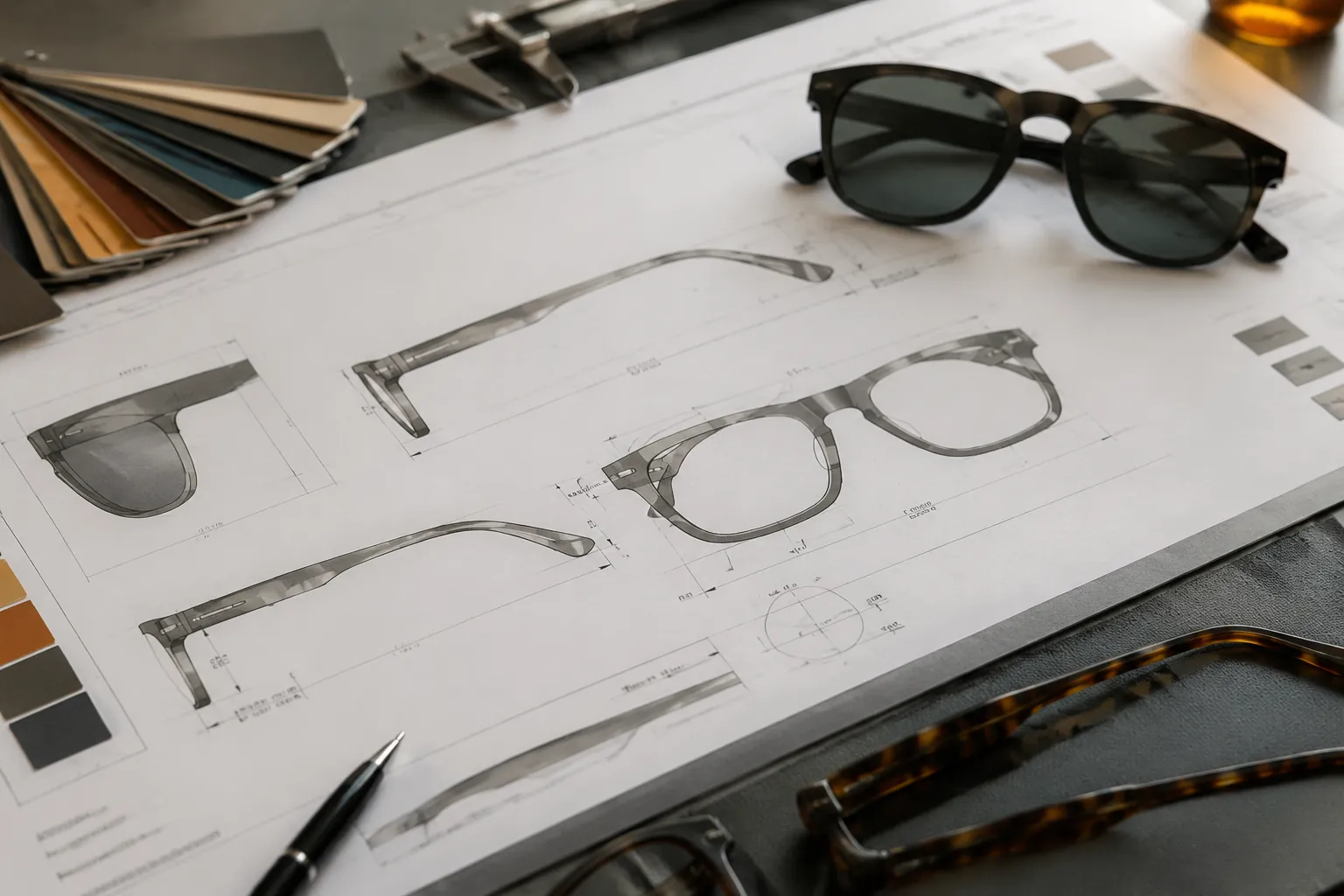
This guide is for brands, importers, distributors and retailers sourcing custom sunglasses from a factory. A strong OEM sunglasses tech pack is not a mood board. It is the control file for quotation, sampling, testing, packaging approval and bulk production. Clear specs help the factory quote the right process, sample with fewer guesses, inspect against measurable limits and avoid disputes over what was approved.
Start With a Brief the Factory Can Quote
Open the tech pack with a one-page commercial brief. Include brand name, style name, SKU, target market, wearer type, sales channel, estimated annual volume, first order quantity, sample quantity, target delivery date and destination country. Do not hide the destination market. Sunglasses sold in the EU, United States and Australia/New Zealand may need different markings, user information, test methods, import documents and labels.
State the sourcing route. Is the project based on an existing factory mold, an existing mold with logo and color changes, a modified mold, or a new mold? Existing mold OEM is usually the fastest route because the lens shape, hinge construction and main dimensions are already known. New mold work needs more approval steps: 2D drawing, 3D file or prototype review, tooling, trial injection, fitting check, lens cutting adjustment and pre-production approval.
Ask the factory to confirm MOQ, sample cost, tooling cost if any, decoration setup cost, packaging cost and price breaks by quantity. Do not assume a pilot order and a volume order have the same unit cost. Setup time, logo preparation, material purchasing, lens preparation, packing labor and inspection are spread across more units at higher quantities.
Use a practical RFQ format. Request price breaks by design, color and lens type: pilot quantity, launch quantity, replenishment quantity and annual-volume estimate. This shows the buyer the sample cost, first-order cost and scaled cost before artwork and sampling begin.
Define Frame Geometry Before Color or Branding
Frame dimensions control fit, lens cutting, optical performance, packing size and perceived quality. Color can often be adjusted later. Structure cannot be guessed from a lifestyle photo.
Put dimensions in millimeters on front, side and top views. At minimum, define lens width, lens height, bridge width, frame front width, temple length, end-piece width, hinge position, frame thickness, pantoscopic angle and base curve. If you have a physical reference sample, send it to the factory. Say exactly what it is: construction reference, fit reference, color reference or styling reference only.
| Frame item | Typical spec to define | Practical tolerance / control point | Why it matters |
|---|---|---|---|
| Lens width x height | Example: 52 mm x 45 mm | Define agreed tolerance after lens fitting; many projects use sub-millimeter control for critical lens fit | Controls lens cutting, visual balance and marking area |
| Bridge width | Example: 20 mm | Mark critical if fit-sensitive; agree tolerance with the factory before sampling | Too narrow causes pressure; too wide slides down |
| Temple length | Example: 145 mm from hinge to tip | Usually less critical than bridge fit, but still needs a measurable tolerance | Affects behind-ear comfort and adult/youth fit |
| Base curve | 4 base, 6 base or 8 base | Must match lens blank, lens cutting and frame groove | Affects wrap, distortion risk and sport versus fashion fit |
| Hinge type | Standard, spring, integrated or metal barrel hinge | Check opening angle, screw tightness, closing force and left-right symmetry | Changes durability, assembly cost and repair risk |
Use realistic tolerances. Injection-molded frames, acetate frames and metal frames behave differently in production. Injection parts are affected by mold condition, shrinkage and wall thickness. Acetate parts can be precise after CNC cutting, but tumbling and polishing may soften edges and change surface dimensions. Metal frames need control of soldering, plating thickness and alignment.
Mark only truly critical areas as critical. If every dimension is critical, nothing is. Inspection slows down, and the factory cannot focus on the fit and safety points that matter most.
Choose Frame Material by Use Case and Failure Risk
Material is not just a cost line. It affects weight, flexibility, surface finish, color stability, tooling route and how the product may fail in use. Write the intended material and production process. Do not write only "plastic frame." The factory needs to know whether the style is injection molded, acetate cut and polished, metal formed and plated, or a mixed-material construction.
- PC: Common for promotional and high-volume sunglasses. It has good impact resistance and efficient injection molding. It can feel harder and less premium than TR90 or acetate. It suits simple color frames, entry to mid-price retail and fast replenishment programs.
- TR90: Lightweight, flexible and comfortable for sport or active styles. It resists deformation better than many rigid plastics, but raw material and processing cost are usually higher than basic PC. Color matching needs control, especially on bright, translucent or rubberized finishes.
- Acetate: Used for premium fashion frames because it has good hand feel, color depth and polish quality. It is cut from sheet, CNC processed, tumbled, assembled and hand polished. Lead time and cost are usually higher than basic injection frames, but perceived value is also higher.
- Metal: Suitable for aviators, thin profiles and adjustable nose pad designs. It requires control of forming, soldering or welding, plating, screw assembly and alignment. For EU-bound goods, review nickel release and other applicable REACH chemical restrictions with the supplier and testing partner.
Define the color method. Injection frames may use pre-colored raw material, spray coating, rubber coating or another surface treatment. Acetate uses stock sheet, laminated sheet or custom sheet development. Metal frames may use plating, painting, electrophoresis or PVD-type finishes, depending on design and supplier capability. Each process affects scratch resistance, color repeatability, MOQ and lead time.
Also specify touch and finish: high gloss, matte, rubberized, transparent, translucent, frosted, tortoise, marble or metallic. For tortoise and marble patterns, provide a physical reference and define the acceptable range of variation. If every piece must look nearly identical, choose a solid color. It is safer.
Write Lens Specs to Prevent Returns
"UV400 smoke lens" is not a complete lens specification. A factory-ready tech pack should define lens material, tint, filter category, visible light transmission target, UV performance, polarization, coating, optical standard and cosmetic acceptance limits.
Common materials include PC, TAC polarized, nylon and CR39. PC is widely used because it is impact-resistant and suitable for many fashion and promotional sunglasses. TAC is common for polarized sunglasses and offers good value, but lamination quality must be controlled to avoid bubbles, edge separation and uneven polarization. Nylon is often used for higher-spec curved eyewear because it can offer better optical performance on wrap styles. CR39 has good optical clarity but lower impact resistance than PC and is less common for budget volume sunglasses.
Specify the compliance target by destination market. For general non-prescription sunglasses, EN ISO 12312-1 is the key European standard used with CE marking. ANSI Z80.3 is commonly referenced for the United States. AS/NZS 1067 applies to Australia/New Zealand. REACH may apply to chemical substances in EU-bound products, including frame materials, coatings, metal parts and accessories. For the United States, confirm with the supplier, importer and compliance adviser whether FDA registration or device listing obligations apply to the product and supply chain role. Do not copy a lens category from another model without checking actual transmission.
| Lens item | Example specification | Factory check |
|---|---|---|
| Material | PC, TAC polarized, nylon or CR39 | Confirm blank type, thickness and compatibility with frame curve |
| Transmission | Example: Category 3, with measured VLT within the category range required by the target standard | Measure with transmission equipment, not by eye |
| UV protection | UV400 claim or standard-specific UV requirement | Verify UVA/UVB blocking by the relevant test method |
| Polarization | Yes / no; define axis orientation | Check with polarized tester and approved alignment sample |
| Coating | Solid tint, gradient, mirror, anti-scratch or other coating | Inspect color uniformity, coating pits, adhesion and edge quality |
For cosmetic control, define the viewing zone. A practical rule: no visible scratches, dots, bubbles, coating pits or stains in the central viewing area under agreed inspection lighting and viewing distance. For mirror lenses, approve a physical master sample. Photos distort color and reflection. If lens appearance and lens category both matter, approve them together. A darker-looking lens may move the product into a different filter category.
Control Logos, Artwork and Decoration in Writing
Decoration causes many avoidable complaints. The logo may be small in the artwork file, but it is obvious to the customer. Define every mark: location, size, color, method, artwork file, orientation, tolerance and durability expectation.
Use vector artwork such as AI, EPS, PDF or SVG. Do not use low-resolution PNG or JPEG files for production. Mark logo size in millimeters. Measure placement from a fixed point, such as the hinge center, temple tip or lens edge. Example: "Pad print logo, white, 18 mm wide x 4 mm high, centered on outside left temple, front edge 32 mm from hinge, placement tolerance ±0.5 mm." If the logo appears on both temples, state whether both read forward when worn or one side is mirrored.
Common logo methods include laser engraving, pad printing, hot stamping, embossing, debossing and metal logo plates. Each method has different risks. Laser engraving is durable, but contrast depends on the substrate and coating. Pad printing works for one- or two-color logos, but ink adhesion should be checked on coated, matte or rubberized surfaces. Metal logo plates can look premium, but they add assembly steps. Check glue strength, edge smoothness and plating color consistency.
For lens printing, stay out of the central vision zone and do not interfere with required markings. For retail collections, define whether inside temple printing includes model code, size, lens category, CE marking where applicable, country of origin, batch code or importer information. Approve these details before bulk production. Changing inside temple printing after molding, coating or assembly can mean rework or scrap.
Specify Packaging, Labels and Cartons Early
Packaging affects cost, labor, carton volume, retail presentation, compliance review and warehouse receiving. Include it before the final quote. Do not add it after mass production starts.
Define unit packaging first: individual polybag, microfiber pouch, hard case, folding case, cleaning cloth, hang tag, warranty card, instruction leaflet, barcode sticker and warning label. Then define export packing: inner box quantity, master carton quantity, carton dimensions if restricted, gross weight limit, shipping marks, pallet requirement and carton drop-test expectation if required by the buyer or retailer.
Retail and e-commerce channels need tighter label control. If the goods go to Amazon, a distributor warehouse or a chain retailer, provide barcode format, SKU naming rules, label size, label position and carton label layout. A wrong carton label can delay receiving even if the sunglasses pass inspection.
For compliance labeling, match the destination market. EU products should be reviewed against CE marking requirements, EN ISO 12312-1 user information, filter category, driving restrictions if applicable and language requirements. US projects should review country of origin labeling, importer details, ANSI Z80.3 claims and any FDA registration or listing obligations that apply. Australia/New Zealand projects should reference AS/NZS 1067 requirements. Keep claims clean. Do not print "polarized," "UV400," "impact resistant," "CE," a standard number or a filter category unless the product spec and test evidence support the claim.
Build a QC Plan With Measurable Limits
A tech pack without QC criteria is only half a control document. Define what is checked, when it is checked, how many pieces are checked and which defects stop shipment.
For sunglasses, QC should cover frame dimensions, symmetry, hinge opening, screw tightness, temple alignment, lens fit, lens transmission category, UV performance, polarization if applicable, coating appearance, logo position, color match, sharp edges, packaging accuracy and carton marks. For larger orders, buyers commonly use an AQL-based final inspection plan and classify defects as critical, major or minor. Agree the AQL level and sampling plan in the purchase order or quality agreement.
- Critical defects: failed UV performance, wrong lens category, sharp edges that may injure the wearer, wrong or missing required compliance marking, broken hinge, missing required warning label or a claim not supported by the approved specification.
- Major defects: visible lens scratch in the viewing zone, loose hinge, obvious color mismatch against the approved sample, logo in the wrong position, lens gap at the rim, frame deformation, incorrect barcode or incorrect packing assortment.
- Minor defects: small cosmetic mark outside the main viewing or wearing area, slight packing wrinkle, small acceptable color variation within the approved range or minor carton mark imperfection that does not affect receiving.
If the factory operates under ISO 9001, treat that quality system as a process foundation. Still define product-specific limits in the tech pack. If social compliance is required by the buyer or retailer, request valid audit information such as BSCI status separately from product QC. BSCI is not a product safety certification.
Useful acceptance examples include logo position tolerance in millimeters; bridge width tolerance if fit-critical; no visible lens gap at the rim; no frame rocking beyond the approved sample condition; left and right temple opening resistance matching the approved feel; screws secured without stripped heads; no sharp burrs at temple tips, hinges or nose area. Inspect in stages: incoming material check, in-process dimensional check, decoration inspection, final appearance and function check, and pre-shipment review against the approved sample. Label, date and store the approved sample as the production standard.
Use Version Control for Samples, Price and Lead Time
Send the tech pack before asking for a final price. Factories quote faster and more accurately when dimensions, material, lens specs, decoration, packaging and compliance targets are in one file. Missing details create predictable problems: a padded price, a vague price or a low price that changes after the real requirements appear.
Lead time depends on the sourcing route. Existing mold projects with available materials usually move faster than new mold projects. New molds, custom acetate sheets, special mirror lenses, custom polarized lenses, complex logo plates, retail packaging, third-party testing and retailer-specific labels can all extend the timeline. Ask the factory to quote sample lead time, tooling lead time if applicable, bulk production lead time after approval, inspection time and document preparation time.
| Stage | Buyer input needed | Typical factory output |
|---|---|---|
| RFQ | Tech pack, quantity bands, destination market, compliance target | MOQ check, unit price, setup cost, tooling comments and risk notes |
| Sampling | Artwork, color references, lens selection, packaging direction | Prototype or sample with notes on any deviations from the tech pack |
| Approval | Written comments, approved physical sample or signed photo record | Locked production standard and updated quotation if specs changed |
| Bulk production | Deposit or payment confirmation, final packing file, shipping marks, inspection plan | Mass goods produced against the approved sample and latest tech pack |
| Final QC | Inspection criteria, shipment plan and required documents | Inspection report, packing list, compliance documents where applicable and shipment release request |
Keep strict version control. Use file names such as SKU123_TechPack_V3_Approved_2026-03-15. If lens color, logo size, material, compliance target or packaging changes after sample approval, update the document and record the change. Factories work from approved documents, not memory. A disciplined tech pack is production control.
Have a custom sunglasses project in mind?
Send us your styles, target market and quantities and we will return a detailed quote with MOQ, lead time and a sample plan.
Get a QuoteWhy source this from Wenzhou with LumiShades
Wenzhou in Zhejiang Province is widely regarded as China’s eyewear manufacturing capital, producing a large share of the world’s sunglasses. That concentration matters to buyers: a deep local supply chain for acetate sheet, hinges, lens blanks, plating and packaging means shorter component lead times, easier color and material matching, and a workforce with decades of eyewear-specific skill. LumiShades has manufactured in this ecosystem since 2009, and our vertical integration — in-house injection molding, acetate cutting, CNC milling, lens tinting, decoration and quality control — means no part of your order is quietly subcontracted to a workshop you cannot audit.
For international buyers, that vertical control translates into accountability. When a single factory owns every step, defects are traced and fixed at source rather than bounced between vendors, and your specifications survive intact from first sample to bulk. For procurement review, buyers can request process records, approved samples, quality checkpoints and project-specific compliance files before placing a bulk order. Required testing and documentation are confirmed against the destination market and product specification rather than assumed from a generic certificate list. Explore our manufacturing capabilities and quality control process to see how this works in practice.
Frequently asked questions
Can I send only reference photos and ask the factory to make a sample? You can, but the sample will include factory assumptions. If you send only photos, label them as style references and expect the factory to choose dimensions, material, lens type and construction unless you specify otherwise. For production-ready OEM work, provide frame dimensions, material, lens material, lens category or VLT target, UV requirement, color references, logo artwork, packaging, destination market and compliance targets before sampling.
What tolerances should I put in a sunglasses tech pack? Do not copy one tolerance across the whole product. Set tighter tolerances for fit-critical and customer-visible points such as bridge width, lens fit, hinge alignment and logo placement. Allow more practical tolerances for non-critical dimensions where the production process naturally varies. Ask the factory to confirm achievable tolerances by material and process, then record them in the approved tech pack. If a dimension affects safety, fit, lens retention or compliance marking, mark it as critical.
Which compliance standards should I specify for export sunglasses? Specify the standard by destination market. For the EU, reference EN ISO 12312-1 and CE marking requirements, and review REACH chemical restrictions where relevant. For the United States, reference ANSI Z80.3 and confirm whether FDA registration or listing obligations apply to the product and supply chain role. For Australia/New Zealand, reference AS/NZS 1067. State the target market before sampling so the correct lens category, markings, user information and test evidence can be planned.
Should I approve lens color by photo? No. Approve lens color by physical sample and, where possible, by measured visible light transmission. Photos can distort tint, gradient depth and mirror color because lighting, camera settings and screens vary. For mirror or gradient lenses, approve a master sample and record the acceptable color range. Also confirm that the approved appearance still meets the required filter category and UV performance.
How early should packaging be included in the tech pack? Include packaging before final quotation and before sample approval if possible. Cases, pouches, cleaning cloths, hang tags, warning leaflets, barcode labels, carton marks and retailer labels affect cost, packing labor, carton size, compliance review and warehouse receiving. If packaging is added after price approval, the factory may need to revise unit price, lead time and carton dimensions.
What order quantity should I quote if I may scale later? Ask for price breaks at realistic stages instead of requesting only one quantity. For example, request a pilot quantity, first retail launch quantity, replenishment quantity and annual forecast. Ask the factory to state MOQ by frame color, lens type, logo method and packaging type because each can have a different minimum. This shows which specifications drive cost before you commit to a larger order.
Ready to start?
Explore our shield & oversized sunglasses or request a quote — our sales team replies within 12 hours.
Request a Quote