
Turn Sunglasses Samples into Legal OEM Specs
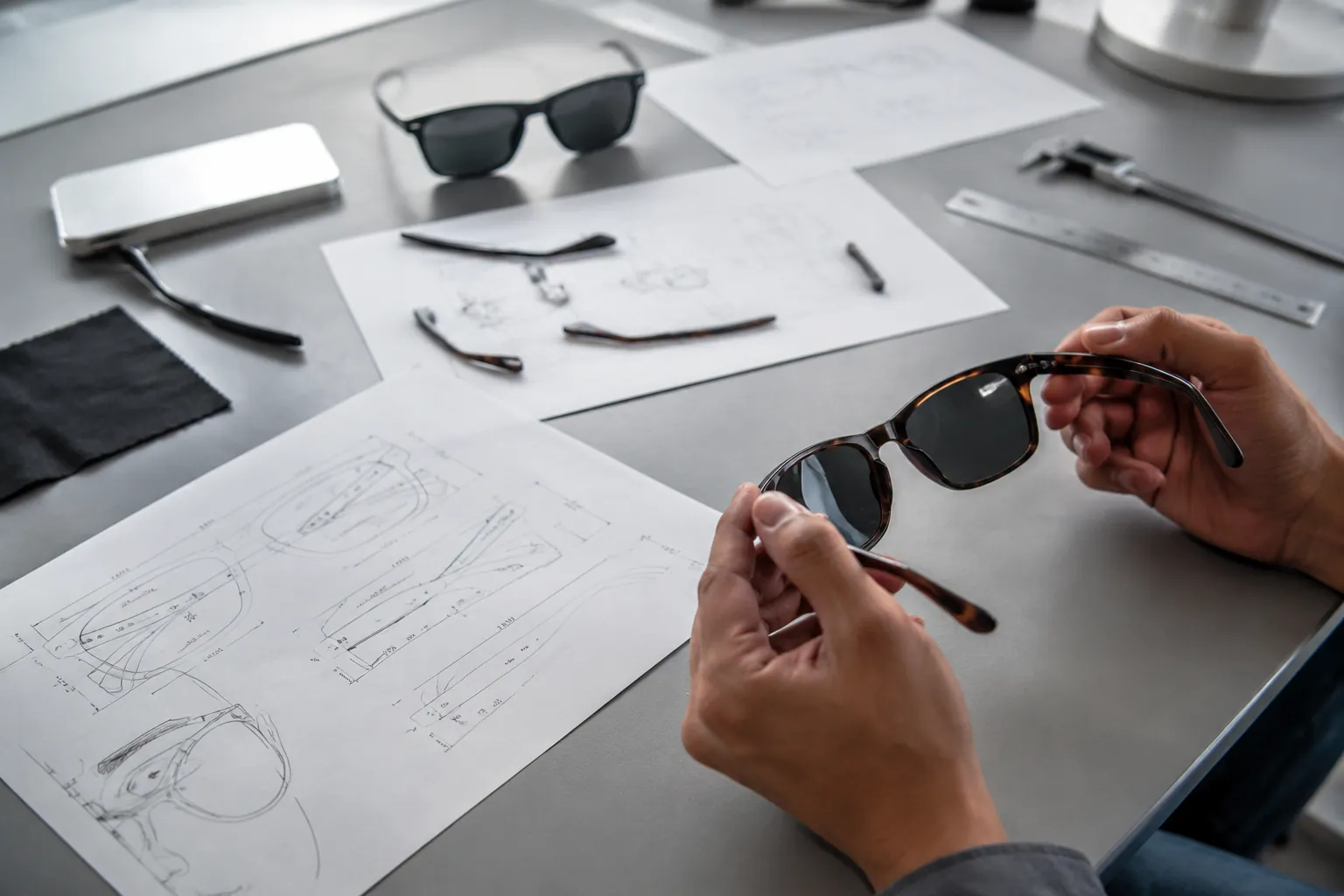
This guide is for brand owners, importers, distributors, and retail buyers who want to use a proven sunglasses sample as a reference without ordering a direct copy. It shows how to turn a physical sample into a changed OEM specification covering geometry, materials, lenses, decoration, packaging, testing, tolerances, MOQ, pricing inputs, and inspection. The aim is simple: reduce avoidable IP risk, give the factory enough detail to quote correctly, shorten sampling loops, and create a product your team can approve, buy, and document.
Start with the red line: reference is not replication
A competitor sample can be useful. It shows fit, scale, hinge feel, lens color, packaging standard, and the quality level buyers already accept. It is also a risk. If your brief says, "copy this but put my logo on it," you may create problems with intellectual property, marketplace review, retailer approval, customs, or brand reputation before production even starts.
A responsible OEM sunglasses brief separates what you like from what you will change. The reference can guide the target consumer, comfort, price tier, lens performance, and retail position. It should not dictate the exact frame outline, temple ornament, logo placement, packaging artwork, or color-and-logo system of another brand.
High-risk elements may include a recognizable front silhouette, lens shape, hinge plate, rivet layout, temple icon, surface pattern, trade dress, packaging structure, hangtag design, or repeated color system. A factory can advise whether a construction is moldable, polishable, printable, or cost-effective. It is not your legal counsel. For high-volume, marketplace, or chain-retail programs, ask qualified counsel to review trademarks, design patents, registered designs, trade dress, platform policies, and destination-market rules before you commit to tooling or production.
Practical rule: keep the commercial intent, not the exact design. Preserve the customer profile, comfort target, lens category, quality level, and price band. Change the geometry, branding, and packaging so the finished sunglasses stand on their own.
A safer workflow is direct: receive the physical reference sample, measure it, decide what must change, create a deviation plan, and then build a new OEM specification with adjusted dimensions, buyer-owned artwork, and a separate packaging system. That gives sourcing teams one controlled file to quote, sample, inspect, and explain internally.
Disassemble and measure before briefing the factory
Do not start with only a photo, a link, and a target price. Start with a teardown. A teardown turns "make it feel like this" into engineering data. It also prevents later arguments about whether the sample is too tight, too heavy, too curved, or the wrong color.
For a physical reference sample, record measurements with calipers, a lens clock where relevant, a gram scale, and clear photos from the front, side, top, hinge, nose bridge, and temple-tip angles. For sunglasses, the most useful baseline data includes:
- Frame dimensions: lens width, bridge width, temple length, frame front width, lens height, brow thickness, rim thickness, base curve, pantoscopic tilt, temple drop, and end-tip shape.
- Weight: total frame weight with lenses, measured with a calibrated scale. Record weight as a target and verify it later on approved samples.
- Material clues: PC is commonly injection-molded and rigid; TR90 is lightweight with better flex recovery; acetate shows layered color depth and polishing marks; metal styles need plating, soldering, nose pad, and corrosion review.
- Hinge structure: standard barrel hinge, spring hinge, injected hinge, riveted hinge, screwless hinge, screw diameter, opening angle, alignment, and resistance.
- Lens details: lens material, center thickness, tint category, UV protection requirement, polarization, gradient height, mirror coating, base curve, and whether the lens is decentered.
- Decoration: pad print, hot stamping, laser engraving, metal logo plate, temple insert, lens logo, barcode label, pouch mark, or hangtag treatment.
Define tolerances before sampling. Make them realistic for the material and process. As a starting point, buyers usually control hinge, groove, screw, and logo positions more tightly than general frame dimensions. Temple length and temple-tip bend often need more allowance than lens groove or screw placement. Control color with an approved swatch, Pantone reference, material chip, or master lens sample. Do not use phone photos as the standard. If tolerances are missing, the factory will apply its normal range, which may not match your retailer's expectations.
Build a deviation plan: what changes, and why
A safer OEM specification needs visible and measurable differences. Random tweaks are not enough. The changes must also protect comfort, balance, lens coverage, assembly stability, and production yield. A strong deviation plan changes several areas at once: front geometry, temple design, lens treatment, decoration, and packaging identity.
The table below shows practical change options and the sourcing trade-off behind each one.
| Sample feature | Safer OEM change | Production impact | Buyer note |
|---|---|---|---|
| Frame front outline | Change lens height, adjust corner radius, alter brow thickness, or redesign bridge profile | May require a new injection mold, new acetate CAD file, or CNC program adjustment | This is usually one of the most important visual differences |
| Temple design | Change temple width, taper, bend point, end-tip curve, hinge transition, or logo zone | Moderate tooling or CNC change; lower risk if hinge location remains stable | Good area to create brand identity without damaging fit |
| Decoration | Use buyer-owned laser mark, pad print, hot stamp, embossed logo, or metal logo plate | Low to moderate setup cost after artwork approval | Avoid copying a competitor icon, position, and scale |
| Material | Switch PC to TR90 for flex, acetate to PC for price, or PC to acetate for premium hand feel | Affects tooling, MOQ, polishing labor, weight, and defect risk | Material change can alter cost, comfort, and visual identity |
| Lens treatment | Change tint density, mirror color, gradient line, lens category, or polarization option | Requires lens sample approval and compliance check | Lens category marking must match tested performance |
| Packaging | Replace competitor-style box, pouch, cloth, label, warning card, and hangtag with your own system | Usually lower tooling cost than frame changes but needs artwork lead time | Packaging can form part of trade dress; do not overlook it |
Example: the reference is a black square acetate frame with thick straight temples. A changed OEM version could use a lower lens height, softer outer corner radius, thinner brow, saddle bridge instead of keyhole bridge, curved temple with a new logo panel, smoke gradient lenses instead of solid grey, and a matte recycled-paper sleeve rather than a glossy branded box. That is not a logo swap. It is a new product direction based on a proven market type.
Translate the idea into a factory spec sheet
The spec sheet is where sourcing discipline shows. A good file lets engineering, costing, sampling, QC, and packaging teams work from one controlled document. A weak file creates scattered emails, inconsistent samples, and arguments over what was approved.
Your OEM sunglasses specification should include these fields at minimum:
- Product definition: adult sunglasses, kids sunglasses, sports sunglasses, fashion sunglasses, optical-ready frame, clip-on, or promotional style.
- Target size: lens width, bridge, temple length, frame front width, lens height, base curve, pantoscopic tilt, and target weight.
- Frame material: PC, TR90, acetate, stainless steel, aluminum, or mixed construction, with color code, finish, and physical swatch.
- Lens specification: material, thickness, UV protection requirement, tint category, polarization yes or no, mirror coating, gradient, base curve, and color tolerance.
- Hinge and hardware: hinge type, screw size, metal color, torque feel, opening angle, corrosion expectation, and spare screw requirement if applicable.
- Branding: logo file, process, size, location, Pantone reference, engraving depth or print thickness where relevant, and acceptance limits.
- Packaging: pouch, case, microfiber cloth, barcode sticker, hangtag, instruction leaflet, warning label, polybag, inner box, master carton, and carton marks.
- Compliance target: CE EN ISO 12312-1, ANSI Z80.3, AS/NZS 1067, REACH, FDA registration where applicable, or other market-specific requirements confirmed by the buyer.
- Inspection plan: critical, major, and minor defects; AQL level if used; golden sample reference; and approved deviation limits.
For decoration, specify the process. Do not write only "logo on temple." Pad printing is cost-effective for simple one- or two-color logos on PC or TR90, but adhesion must be tested on coated surfaces. Laser engraving is durable and clean on metal and some coated parts, but it creates a tonal mark rather than a bright color. Hot stamping gives a metallic look but needs a flat, stable area. Metal logo plates can look premium but add tooling, assembly steps, and plating review. Lens logos should be small and positioned outside the main viewing area unless the buyer intentionally wants a fashion mark.
Keep one approved revision of the specification. Name the file clearly. Date it. Identify who approved it. If lens color, packaging text, logo size, or hinge hardware changes later, issue a revised version instead of relying on a message buried in an email thread.
Choose materials by behavior, not just appearance
Many buyers want the hand feel of a reference sample and a lower price. Sometimes that works. Often it does not. Material choice controls tooling cost, surface finish, flexibility, weight, polishing labor, MOQ, breakage risk, and perceived value.
PC is common for low-cost injection sunglasses. It is tough, light, and suitable for volume price points, promotional programs, and fast color runs. It can feel rigid in thin temples, and the surface may look less rich than polished acetate. TR90 is lighter and more flexible, which suits sports, active, and comfort-focused styles. It needs good mold control because thin areas can warp after ejection or lens assembly. Acetate gives better color depth, transparency, and premium polish, but cutting, tumbling, polishing, and hinge insertion add labor. It is slower and usually not ideal for very low-budget promotional orders. Metal styles can look refined and slim, but plating, soldering, nose pads, screw control, and corrosion testing become more important.
Lens choice follows the same logic. TAC polarized lenses are widely used for commercial polarized sunglasses and offer good value. PC lenses are often selected where impact resistance and sporty use matter. Nylon lenses can improve optical clarity and flexibility but raise cost. Acrylic lenses may be used for low-cost fashion styles, but they are less suitable where impact performance and optical quality are selling points.
Compliance must follow the tested lens and finished product, not the sales claim. For CE EN ISO 12312-1, ANSI Z80.3, and AS/NZS 1067 projects, confirm UV protection, visible light transmission, traffic signal recognition where required, optical quality, and labeling. A Category 3 fashion lens should not be marked for night driving. A mirror coating can change visible light transmission enough to require retesting or relabeling. If the product is polarized, check polarization axis consistency, delamination risk, and heat stability during pre-production approval.
Sampling, MOQ, tooling, and price drivers
For a changed OEM design, sampling is not one event. It is a controlled loop: teardown, deviation plan, first sample, buyer comments, revised sample if needed, golden sample approval, then bulk production. Timing depends on whether the style uses an existing mold, requires new tooling, needs special lenses, or includes custom packaging. Ask the manufacturer to state sample lead time, tooling lead time, and bulk production lead time separately in the quotation.
MOQ and price must be quoted against the exact specification, not a photo. A simple PC frame with standard lenses and one-color printing is not costed like an acetate frame with polarized lenses, spring hinges, metal logo plates, mirror coating, and custom hard case packaging. When comparing quotations, check whether lenses, logo setup, packaging, testing, inspection, artwork adjustment, spare parts, and carton marking are included or excluded.
Tooling is a separate decision. If your deviation plan requires a new injection mold, budget and timing change. A new front mold or temple mold can add cost and extend development, depending on complexity and approval speed. If the design can be adapted from an existing mold with changed color, lens, temple print, and packaging, lead time and development cost usually stay lower. For acetate and CNC-milled parts, CAD/CAM adjustments may be faster than building a full injection mold, but unit labor cost is higher because cutting, tumbling, polishing, and hinge work take time.
Blunt advice: approve the expensive decisions early. Frame material, hinge type, lens type, tooling route, and packaging format drive more cost than a small logo-position change. Lock those first. Then fine-tune logo size, pouch color, warning card text, and carton marks.
QC and compliance files that protect the order
An OEM specification is not finished until it can be inspected. The approved sample should become the golden sample, supported by dated photos, signed specification pages, and approved artwork files. QC then checks bulk goods against dimensions, frame color, lens color, lens performance, hinge function, screw tightness, logo position, packaging, warnings, barcode, and carton marks.
Define defects clearly. Critical defects may include cracked lenses, sharp edges, missing UV protection, wrong compliance marking, unsafe broken parts, or incorrect barcode on export cartons. Major defects may include visible scratches, loose hinges, wrong logo position beyond tolerance, lens color outside the approved range, poor print adhesion, or frame distortion. Minor defects may include small polishing marks, slight color variation within tolerance, or minor packaging scuffs that do not affect saleability. If using AQL, state the inspection level and AQL values in the purchase order or quality agreement. Do not assume the factory and buyer use the same default.
For export sunglasses, define compliance by destination market. CE EN ISO 12312-1 is relevant for many European programs. ANSI Z80.3 is commonly requested for the United States. AS/NZS 1067 applies for Australia and New Zealand. REACH is important for chemical restrictions in Europe, especially for frame materials, coatings, plasticizers, and metal contact parts. FDA registration may be relevant for eyewear entering the U.S. supply chain, depending on the product and importer requirements. ISO 9001 and BSCI can support supplier qualification and social-compliance review, but they do not replace product-specific testing.
Keep a technical file for every OEM style: final spec sheet, deviation plan, CAD or measurement drawings, artwork, packaging files, material notes, test reports, purchase order, golden sample photos, production sample approval, and inspection report. If a marketplace, retailer, customs broker, or internal legal team asks questions later, you need documents, not memory.
Have a custom sunglasses project in mind?
Send us your styles, target market and quantities and we will return a detailed quote with MOQ, lead time and a sample plan.
Get a QuoteWhy source this from Wenzhou with LumiShades
Wenzhou in Zhejiang Province is widely regarded as China’s eyewear manufacturing capital, producing a large share of the world’s sunglasses. That concentration matters to buyers: a deep local supply chain for acetate sheet, hinges, lens blanks, plating and packaging means shorter component lead times, easier color and material matching, and a workforce with decades of eyewear-specific skill. LumiShades has manufactured in this ecosystem since 2009, and our vertical integration — in-house injection molding, acetate cutting, CNC milling, lens tinting, decoration and quality control — means no part of your order is quietly subcontracted to a workshop you cannot audit.
For international buyers, that vertical control translates into accountability. When a single factory owns every step, defects are traced and fixed at source rather than bounced between vendors, and your specifications survive intact from first sample to bulk. For procurement review, buyers can request process records, approved samples, quality checkpoints and project-specific compliance files before placing a bulk order. Required testing and documentation are confirmed against the destination market and product specification rather than assumed from a generic certificate list. Explore our manufacturing capabilities and quality control process to see how this works in practice.
Frequently asked questions
Can I send a competitor sample to the factory and ask for a similar style? Yes, but treat it as a reference sample, not a copy order. Tell the factory which points are only references, such as fit, weight, quality level, lens category, and price target. Then require a written deviation plan covering frame shape, temple design, logo treatment, lens color, material, and packaging before sampling begins.
How much should I change to reduce IP risk? There is no reliable percentage rule. Make visible and measurable changes in several areas: front geometry, bridge profile, temple shape, decoration, lens treatment, color system, and packaging. For high-volume, marketplace, or retailer programs, have legal counsel review trademarks, design patents, registered designs, and trade dress before tooling or production.
Will changing the sample increase tooling cost? It depends on the change. Color, lens, logo, and packaging changes are usually lower-cost than frame-geometry changes. A new injection front or temple normally requires tooling. Acetate or CNC changes may avoid injection tooling but can raise unit labor cost because cutting, tumbling, polishing, and hinge work are more manual. Ask the factory to quote tooling and unit price separately.
What tolerances should I include in a sunglasses spec sheet? Include tolerances for the dimensions and features that affect fit, assembly, appearance, and compliance. Control hinge location, lens groove, screw position, lens fit, logo placement, frame width, lens width, bridge, temple length, weight, and color. Use tighter tolerances for functional points and wider tolerances where material behavior requires it. Confirm the final tolerance table with the manufacturer before sample approval.
What documents should I ask the manufacturer to prepare? Ask for a final spec sheet, deviation plan, measurement drawing or CAD reference, approved sample record, artwork placement file, packing specification, QC checklist, inspection report, and relevant compliance documents. Depending on the destination market, those may include CE EN ISO 12312-1, ANSI Z80.3, AS/NZS 1067, REACH documentation, or FDA registration information where applicable.
Can I start with a small order before committing to a larger run? Yes, if the manufacturer supports the requested MOQ for that construction. Use the first order to verify fit, lens color, logo durability, packaging, barcode accuracy, and retail response. Before scaling up, lock the golden sample, final artwork, inspection checklist, compliance requirements, and approved tolerances in writing.
How long does the OEM conversion process usually take? Lead time depends on the level of change. Existing-mold projects with standard lenses and simple decoration are faster than new-tooling projects with custom lenses or complex packaging. Ask for three dates in writing: sample completion, tooling completion if needed, and bulk production completion after sample approval, deposit, packaging approval, and material readiness.
Ready to start?
Explore our rimless sunglasses or request a quote — our sales team replies within 12 hours.
Request a Quote