
When to Seek SKU Exclusivity from an OEM Factory
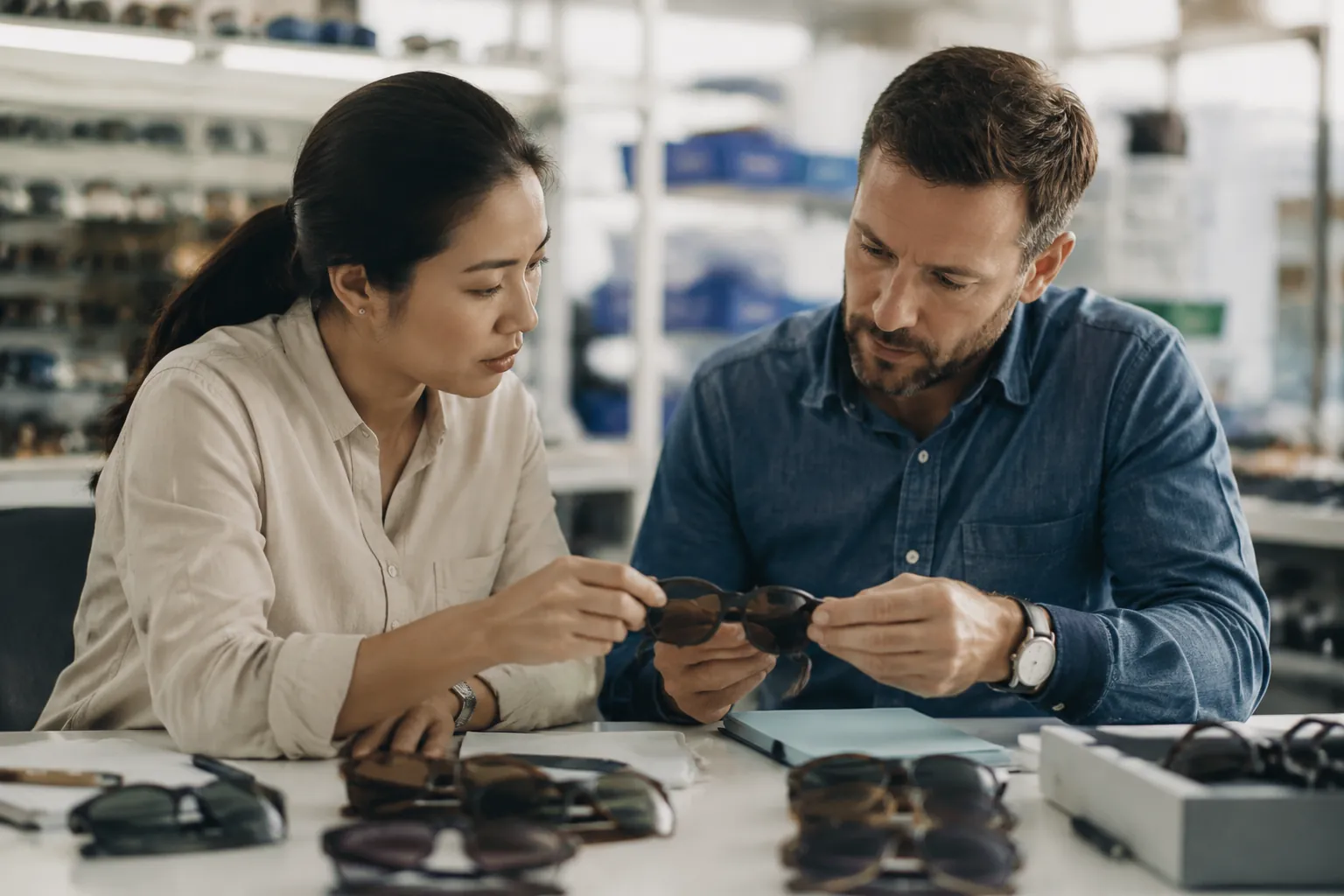
SKU exclusivity can protect margin, but only if the product is specific, the spec is frozen, and the commercial deal is real. Ask too broadly and you pay for a promise the factory can still work around. Ask narrowly, with the right sample and a believable reorder plan, and you cut direct competition without overbuying protection.
What Exclusivity Actually Means
In eyewear sourcing, exclusivity is not one thing. Buyers use the term loosely. Factories do not. They will ask three separate questions: exclusive where, exclusive to whom, and exclusive for how long? A factory may reserve a mold, a lens tint, a temple print, a package, or a full finished SKU. Those are different deals.
SKU exclusivity usually means the exact finished product cannot be sold to another buyer in the agreed territory, channel, or customer segment. That may cover the frame shape, front logo, temple decoration, lens color, case artwork, and carton pack-out. If you only protect the mold shape but leave color and decoration open, another buyer can still land on something very close to yours.
For sunglasses, the real question is how much of the item is unique. A stock frame with a new logo plate is not the same as a frame with a unique front design, custom temple profile, and a dedicated lens spec. Shared base parts can often be changed with small tweaks. Same shell. Different look. If you want real protection, the spec has to be tight enough that the factory cannot swap one cosmetic detail and call it a new item.
Material behavior matters too. Plastic and acetate parts can shift during cutting, polishing, or heat exposure, so a reserved design should be tied to an approved physical sample, not only a drawing. Injection-molded parts usually repeat well, but color matching can still drift if resin lots or masterbatch change. Lens tint can also vary if the dye, coating, or substrate changes. Define the stage you care about: mold, decoration, assembly, or fully packed SKU.
If the factory controls tooling, decoration, assembly, and packing in-house, exclusivity can be negotiated at the stage that actually matters. Ask for that stage. Do not settle for a vague promise.
The Three Exclusivity Models Buyers Use
| Model | What it protects | Best for | Main risk |
|---|---|---|---|
| Territory exclusivity | Sales limited by country, region, or named market | Importers, regional distributors, chain retailers | Cross-border resale and online leakage |
| Channel exclusivity | Sales limited by route, such as retail, e-commerce, optical, or promo | Brands that sell through one route and want to avoid direct overlap | Ambiguous channel definitions create disputes |
| Design or SKU exclusivity | Exact frame, colorway, lens tint, decoration, and pack-out are reserved | Brands with a clear brief and steady repeat orders | The factory may still sell near-identical variants unless the spec is tight |
Territory exclusivity is easy to explain. It is also easy to break in practice if parallel importers, marketplaces, or resellers move product across borders. The paper right exists. The market may ignore it.
Channel exclusivity works better for buyers who sell through one route and do not want the same item undercut online or in another trade channel. It still needs clean definitions. If you cannot define the channel in one sentence, the clause is too soft.
Design or SKU exclusivity is stronger, but it asks more of everyone. It can tie up tooling, production planning, and sometimes material stock. For many sunglasses buyers, the smarter move is a narrow package: exclusive in one territory, one channel, and one colorway family. That gives the factory enough room to use capacity without handing your exact item to a second buyer.
When the product uses common parts, narrow exclusivity is often the better trade. Reserve a unique lens tint, a custom temple print, or a specific case insert. Leave the base frame available to the factory for other customers. It is usually cheaper. It is easier to document. And it is more realistic for lower-volume programs.
Signals That You Should Ask For It
Not every SKU needs exclusivity. Ask for it when direct price competition would damage the business model. That usually shows up in four situations.
- You are placing a repeat order, not a one-off trial.
- The SKU can be copied from a public sample, social post, or trade show photo.
- You are spending on packaging, artwork, or launch work that depends on uniqueness.
- Your margin depends on being the only seller in a defined channel or region.
If the item is a generic frame with no unique tooling and no realistic reorder plan, the factory has little reason to lock it up. If you only need a small test order, exclusivity is early. The factory hears risk and low volume. That is not a strong pitch.
It gets more realistic once you can show forecasted demand, likely reorder timing, and where the product will be sold. A factory is more willing to reserve a SKU when the buyer can explain how the program moves from launch to replenishment. Exclusivity should sit on top of that logic, not replace it.
Two more signals matter. First, if the buyer needs a fast repeat cycle, exclusivity becomes more valuable because a copied SKU can erode sell-through before the reorder lands. Second, if the product has obvious visual cues - a custom front shape, a distinct lens tint, or a memorable case - it is easier to defend the request because the item is more likely to be recognized and compared in market.
How to Trade Volume for Protection
Exclusivity is a trade. The factory gives up the right to sell the same SKU elsewhere. In return, the buyer usually gives a forecast commitment, faster decisions, tighter spec control, or better payment terms. Do not treat it like a free add-on.
- State the commitment. Share a forecast, not just a first purchase order. Break it into launch, replenishment, and peak-season demand so the factory can plan labor, materials, and packing.
- Freeze the spec. Lock the frame material, lens tint, hinge type, logo method, case, and carton. If you keep changing details, no factory will hold exclusivity cleanly.
- Choose the scope. Pick territory, channel, or exact SKU. Do not ask for all three unless you are paying for real capacity reservation.
- Agree on a trigger. Make exclusivity active only after sample approval, deposit, or first mass order. That keeps both sides honest.
- Set a review date. If the buyer misses agreed commitments, the factory should be able to release the SKU after a notice period.
Factories care about production planning. A sunglasses program is not only about molding or cutting. It also touches lens tint consistency, decoration setup, packaging, and final quality control. If one buyer asks for reserved capacity and then keeps changing the order, the factory eats the cost. That is why many factories want a meaningful purchase commitment before they agree to anything strong.
A practical deal often uses staged protection. A buyer may reserve the launch version first, then expand protection after sell-through and repeat ordering are proven. In return, the factory can agree to hold the exact lens tint and front decoration only, instead of reserving the entire frame for one account.
What Should Be Written Into The Agreement
Good exclusivity language is specific. Weak language creates arguments later. At minimum, the agreement should cover the product identifier, territory, channel, term, and what happens if the SKU changes.
Put these points in writing:
- Exact SKU definition: frame code, lens color, decoration method, case, carton, and approved sample date.
- Protected scope: country list, channel list, or customer segment.
- Term: start date and end date, plus renewal rules.
- Minimum purchase commitment, or the exclusivity expires.
- What counts as a breach: direct sales, affiliate sales, marketplace sales, or private-label rebranding.
- Change control: if the factory revises the mold, decoration, or lens material, whether the new version stays protected.
For sunglasses, specify measurement references, not just the style name. A good appendix should include lens width, bridge width, temple length, front height, hinge type, logo location, and acceptable tolerance. Ask for the tolerance that matters to your market, and tie it to the approved sample and the measurement method used by the factory or test lab.
Decoration methods should also be named clearly. Pad printing can be fast and economical, but print wear and registration errors matter if the artwork is fine or multi-color. Laser engraving is durable, but it depends on the material and depth. Hot stamping can look premium on acetate cases or temples, but it needs controlled heat and clean tooling. If the approved sample uses a specific ink, foil, or engraving depth, keep that in the file so the factory cannot quietly swap to a cheaper method later.
If your market needs CE EN ISO 12312-1, ANSI Z80.3, AS/NZS 1067, REACH, FDA registration, ISO 9001, or BSCI-related supplier documentation, tie the compliance file to the approved sample and the exact materials used. Do not treat FDA registration as product approval. Ask for the relevant registration details and the supporting test reports. BSCI is an audit framework, not a product certification. Keep the compliance basis aligned with the SKU you are reserving.
Price, MOQ, And Lead Time Effects
Exclusivity can push economics in two directions. It may raise unit cost if the factory blocks a reusable SKU. It may also reduce landed risk if it prevents channel conflict and price erosion. Buyers should look at both. Not just the quote.
| Scenario | Typical commercial effect | Buyer risk | Factory position |
|---|---|---|---|
| Standard non-exclusive SKU | Lowest friction, easiest pricing | Easy to copy, easy to undercut | Factory can sell to multiple buyers |
| Channel-exclusive SKU | Slight price premium or stricter order terms | Needs tight channel definitions | Factory keeps flexibility outside your channel |
| Territory + design-exclusive SKU | Higher commitment, sometimes tooling cost recovery | Most protection, but strongest forecast requirement | Factory blocks sales and reserves planning space |
Exclusivity does not change the work needed to make a pair of sunglasses. If the design needs new tooling, custom lens tint matching, laser engraving, pad printing, or metal logo plates, there is setup time. A new mold or a revised hinge adds more risk than a decoration-only change because the factory must verify fit, finish, and repeatability before mass production. If you want reserved molds or a fixed production window, build that into the schedule early.
Lead time changes with complexity. A stock-frame rebrand is simpler than a fully customized program with new tooling, special packaging, or color matching. The more the request depends on approvals, material sourcing, and rework risk, the more buffer time you need. If you want exclusivity, negotiate timing with the same care as price.
Pricing usually follows setup cost and reuse. A reserved decoration-only SKU may carry a modest premium because the factory is holding print screens, artwork files, or packaging inventory. A fully dedicated tool or custom mold often needs tooling cost recovery if the run is small or if the item is unlikely to repeat. In many programs, the price is less about per-pair labor and more about whether the factory can spread setup costs across enough units.
A Buyer Checklist Before You Ask
Use a simple filter before you request exclusivity. It keeps the conversation clean and saves time.
- Can the product be copied from a sample in a short time?
- Will another seller directly damage your margin if the same item appears in the market?
- Do you have forecasted repeat demand, not just a launch order?
- Can you define territory or channel in one sentence without ambiguity?
- Are you ready to freeze the spec and approve samples fast?
- Can you meet the factory's purchase, payment, and production-planning needs?
If the answer to most of those questions is yes, ask for exclusivity early, during sample and quotation stage. If the answer is no, do not force it. A cleaner spec, better timing, and a stronger repeat order often deliver more value than a weak exclusivity clause.
In practice, the best negotiations are short and concrete. State the SKU, the market, the volume plan, the protection you want, and the term. Then ask the factory what commitment it needs in return. If the factory cannot protect the exact item, narrow the ask to the part of the product that truly matters: a lens tint, a logo placement, a case, or a channel definition. That is usually the fastest path to a workable deal.
If you already have sell-through data, bring it. A retailer that can show real reorders and stable velocity has a stronger case for renewal than a buyer with only a concept deck. Exclusivity is easier to defend when the numbers show the SKU is commercially proven.
Have a custom sunglasses project in mind?
Send us your styles, target market and quantities and we will return a detailed quote with MOQ, lead time and a sample plan.
Get a QuoteWhy source this from Wenzhou with LumiShades
Wenzhou in Zhejiang Province is widely regarded as China’s eyewear manufacturing capital, producing a large share of the world’s sunglasses. That concentration matters to buyers: a deep local supply chain for acetate sheet, hinges, lens blanks, plating and packaging means shorter component lead times, easier color and material matching, and a workforce with decades of eyewear-specific skill. LumiShades has manufactured in this ecosystem since 2009, and our vertical integration — in-house injection molding, acetate cutting, CNC milling, lens tinting, decoration and quality control — means no part of your order is quietly subcontracted to a workshop you cannot audit.
For international buyers, that vertical control translates into accountability. When a single factory owns every step, defects are traced and fixed at source rather than bounced between vendors, and your specifications survive intact from first sample to bulk. For procurement review, buyers can request process records, approved samples, quality checkpoints and project-specific compliance files before placing a bulk order. Required testing and documentation are confirmed against the destination market and product specification rather than assumed from a generic certificate list. Explore our manufacturing capabilities and quality control process to see how this works in practice.
Frequently asked questions
When should I ask for SKU exclusivity with an OEM sunglasses factory? Ask when you can define the SKU clearly, explain where it will be sold, and show why overlap would hurt your business. The best time is after sample approval and before mass production, when the spec is frozen and the factory can still plan around it.
Is territory exclusivity better than design exclusivity? It depends on how easy the product is to copy and how well you can police the market. Territory exclusivity is easier to negotiate and enforce if your sales are truly limited by geography. Design exclusivity is stronger if the product is distinctive and you can lock the exact sample, but it usually needs a tighter spec and a stronger commercial commitment.
How much volume do I need before a factory takes exclusivity seriously? There is no universal number. What matters is whether your forecast is credible, repeatable, and large enough to justify the factory giving up other buyers. Ask the supplier what annual commitment, reorder cadence, and payment structure it needs to reserve the SKU, then put that in writing.
Can I get exclusivity on a sunglasses colorway or lens tint only? Yes, and that is often the cleanest starting point. Narrow protection around one colorway, tint, logo placement, or case design is easier to define and cheaper to defend than locking the whole frame. Use an approved physical sample and written material references so the factory cannot switch to a close variant.
What should I do if the factory already sells a similar SKU to others? Do not ask for broad exclusivity on a product the factory already treats as a shared base item unless you are funding new tooling or committing meaningful repeat volume. Instead, narrow the request to a unique decoration set, a reserved lens tint, a custom package, or a specific territory or channel. Ask the factory to list exactly what parts remain open for other customers so the boundary is clear.
Do certifications change the exclusivity discussion? Yes, if compliance is part of the product brief. Keep the approved sample, material list, and test reports aligned with the SKU, especially for CE EN ISO 12312-1, ANSI Z80.3, AS/NZS 1067, REACH, FDA registration, ISO 9001, and BSCI-related supplier records. Also remember that FDA registration is not the same as product approval, so ask for the supporting documentation, not just the registration claim.
Ready to start?
Explore our cat-eye sunglasses or request a quote — our sales team replies within 12 hours.
Request a Quote