
OEM Sports Sunglasses Sourcing Guide
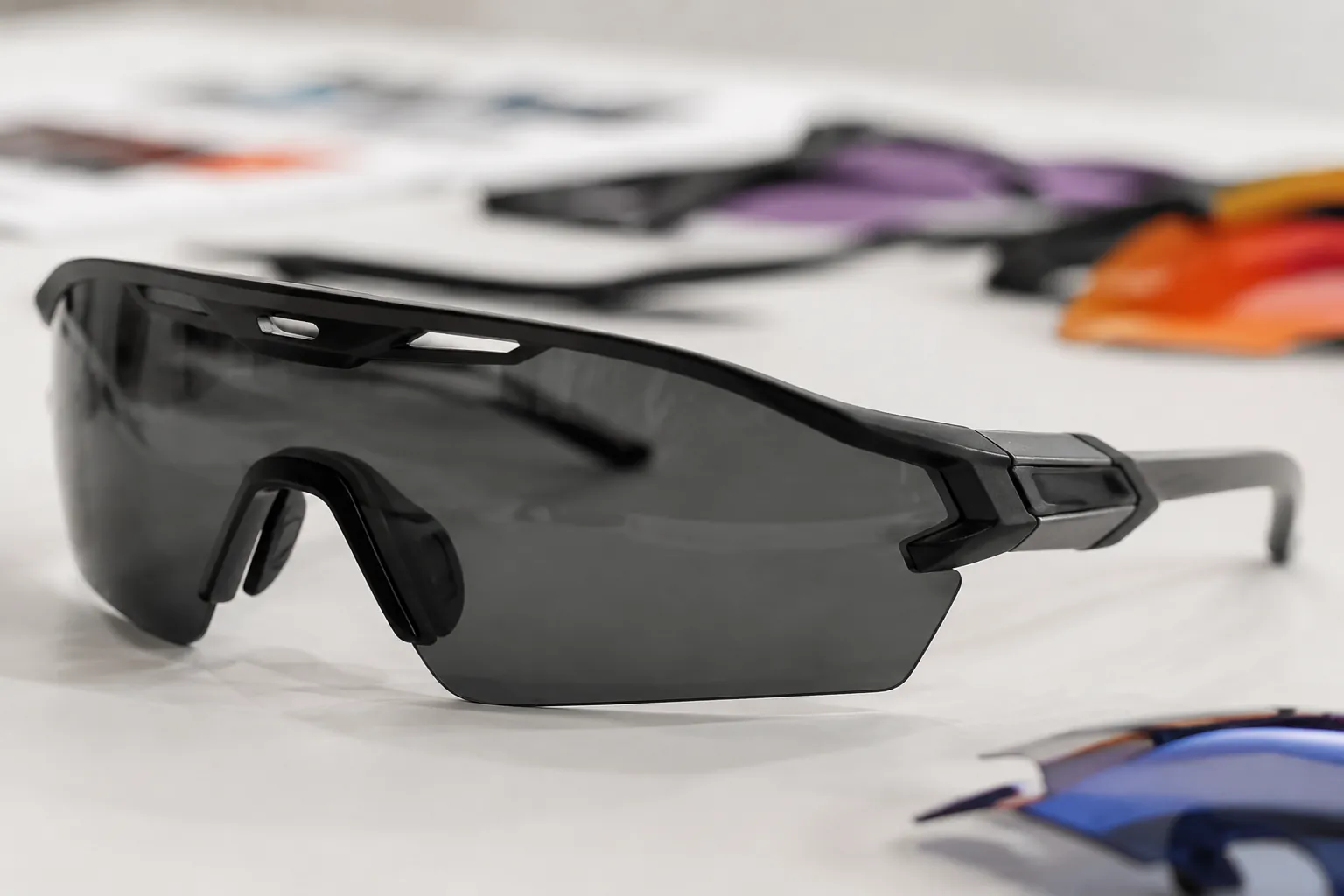
This guide is for outdoor, cycling, running, team, and retail buyers sourcing OEM sports sunglasses in volume. It shows how to brief wrap fit, grip parts, lens options, compliance, sampling, pricing tiers, and QC so a supplier can quote and build from measurable requirements instead of assumptions. The goal is fewer failed samples, clearer inspection standards, and a product spec that can scale from a pilot order to repeat production without changing the core construction.
Start With the Use Case, Not the Shape
A sports sunglasses brief should start with the activity, wearing position, sales channel, and target user. A road cycling frame, a trail running frame, and a fishing frame may all sit under "sports eyewear," but they fail for different reasons. Cycling buyers usually care about helmet compatibility, frontal coverage, wind protection, and low bounce. Runners care more about grip, weight, pressure points, and stability during repeated impact. Fishing and water-sport buyers often prioritize glare control, lens color, corrosion resistance on metal parts, and long-wear comfort.
Write the brief in production language. Not marketing language. Instead of saying "TR90 sporty style," specify the intended use: road cycling, gravel riding, triathlon, trail running, hiking, fishing, team promotion, outdoor retail, or entry-level giveaway. Then add the wearer profile if you know it: adult unisex, narrow face, medium Asian fit, large Western fit, youth fit, or helmet-first fit. If the frame must sit under a cycling helmet, ski helmet, cap, or visor, state that clearly. Factories quote more accurately when the use case is concrete.
Before CAD changes or sample revisions, lock the core fit points: frame front width, lens height, base curve, temple length, bridge width, nose pad type, and temple-tip construction. These dimensions affect comfort and repeatability more than style sketches do. A practical launch plan often separates three stages: small pilot quantities for fit and market testing, a first commercial order for SKU validation, and larger replenishment orders after the inspection standard is proven.
Ask for a quote only after the supplier knows the destination market, target retail or wholesale price, lens requirements, decoration method, packaging, and compliance expectations. A simple bulk promotional frame cannot support the same construction as a premium polarized, mirrored, hard-case retail set. If the supplier has to guess the market position, it may overbuild features your customer will not pay for and underbuild areas that affect returns.
Wrap Fit Specs That Prevent Returns
Wrap fit is not just a visual style choice. It affects facial coverage, wind blockage, optical comfort, helmet clearance, and whether the frame presses into the temples after extended wear. Too much wrap without suitable lens geometry can increase edge distortion. Too little wrap can make a sports frame wear like lifestyle eyewear with rubber parts added. Neither is good.
Buyers should define fit using measurable targets and tolerances agreed with the supplier. For many injected sports frames, frame front width and temple length can be controlled within narrow millimeter-level tolerances when tooling is stable, but the exact tolerance should be confirmed against the material, mold, and inspection method. Lens alignment and left-right symmetry should be checked more strictly than on appearance-only products because small mismatches are obvious when the frame sits close to the face. For shield styles, lens curvature, edge finish, retention force, and lens-to-frame gap are part of the fit spec.
| Spec Point | Common Range | Production Detail | Buyer Instruction |
|---|---|---|---|
| Base curve | 6 to 8 for many sports frames | 8-base gives stronger wrap and coverage; 6-base is often easier for broader consumer fit | Confirm optical comfort on physical samples using the actual lens curve |
| Frame front width | 135 to 150 mm for many adult styles | Controls coverage and temple pressure; variation should be measured against the approved sample | Approve width on the signed sample and require measured pre-production samples |
| Lens height | 42 to 60 mm for many sport and shield styles | Taller lenses improve coverage but may require better ventilation and anti-fog planning | Ask for front, side, and top-view photos with measured dimensions |
| Temple length | 120 to 135 mm for many helmet-compatible styles | Shorter or flatter temples may sit better under helmets and caps | Specify whether the end tip should curve down or remain flatter behind the ear |
| Nose bridge | Fixed or adjustable | Adjustable pads improve fit range but add assembly and alignment checks | Use adjustable pads for mixed-region sales and fixed bridges for simpler SKU programs |
Do not approve a frame from photos alone. Request a measurement sheet, a side view, a top view, a front view, and physical samples. Test the sample on several real wearers who match the target market. If the product is for cycling or trail use, test it with the intended helmet, cap, or headwear. A good sports frame should stay secure without leaving hard temple marks or pinching the bridge after a realistic wear session.
Grip Parts Carry More Risk Than They Look
Sports sunglasses often fail in the field through small components rather than the main frame. Slipping nose pads, hard temple tips, loose rubber sleeves, weak screw retention, and sweat-related adhesion failure are common return causes. These parts look cheap on the bill of materials. They are not cheap once they start failing.
For nose pads, soft silicone or TPR generally provides better grip than hard plastic, but the compound and geometry must match the use case. Typical sports nose pads often use a medium-soft feel, but the buyer should approve hardness by physical sample and, where possible, specify Shore A hardness with the supplier. Softer parts can improve grip but may feel tacky in hot weather or attract dust. Adjustable metal-core nose pads can solve bridge-height differences, but they add forming, alignment, corrosion, and torque checks during assembly.
Temple tips matter too. Co-molded rubber can be more durable than glued sleeves when the material bond and molding process are stable. A sleeve that is only press-fit may twist or loosen after repeated wear, sweat exposure, sunscreen contact, or heat. Hinges also affect perceived quality: a standard screw hinge can work for entry and mid-range programs, while spring hinges improve opening range and comfort but increase part count, cost, and inspection time. For high-movement products, ask the supplier how it checks hinge opening force, screw retention, and temple alignment after handling and drop checks.
Vent openings can reduce fogging, but they should be designed around the material, wall thickness, and mold flow. Large vents in thin frame sections can create weak points, sink marks, or sharp edges if the geometry is not controlled. Ask the supplier whether the vent design has been sampled with the intended frame material, lens thickness, and lens retention method.
- Nose pads: Specify material, hardness target if available, attachment method, and whether sweat exposure should be checked.
- Temple tips: Confirm whether they are co-molded, glued, or sleeve-fit, and define the acceptable pull or twist resistance.
- Hinges: Define screw type, opening force, temple alignment, and whether spring action is required.
- Vent areas: Confirm that vents do not create sharp edges, weak points, lens gaps, or molding defects.
- Finish: Matte finishes hide small scratches better, while gloss finishes are easier to wipe but may show fingerprints and scuffs.
For brand colors, do not accept "black rubber" or "grey temple tip" as a complete spec. Two black TPR or silicone batches can look different under daylight, especially on textured surfaces. Use a Pantone reference where color accuracy matters, and approve a physical material chip or production color sample before bulk production. If rubber parts will be exposed to sweat, heat, sunscreen, or salt water, ask whether the supplier can provide previous material performance data or run a defined exposure check on the approved material.
Lens Choices Drive Cost and Risk
The lens choice can change cost, production risk, and compliance requirements more than first-time buyers expect. A simple smoke lens is relatively straightforward. Adding polarization, mirror coating, hydrophobic coating, anti-fog treatment, photochromic performance, or interchangeable lens sets adds process steps and extra inspection points. Each added step can increase cost and the number of possible defects.
For cycling and running, common lens colors include smoke, brown, amber, rose, and clear or low-light options. Smoke and brown are widely used for bright conditions. Amber and rose can improve perceived contrast in mixed or overcast light. If photochromic performance matters, define the expected visible light transmission range instead of using the word "photochromic" alone. Ask for the light transmission range in dark and activated states, activation and fade timing, test conditions, and whether the performance changes with temperature.
For fishing and water sports, polarized lenses can reduce glare from horizontal reflective surfaces. The trade-off is simple. Polarized lenses may make some phone, navigation, vehicle, or instrument screens harder to read at certain angles. If the user group relies on digital displays, confirm that trade-off with physical samples before locking the lens. Mirror coatings can improve perceived retail value, but they show scratches, pinholes, and edge wear more visibly than plain tint. For mirrored lenses, the protective film, pouch, case, and carton layout should be treated as part of the product spec.
Compliance should be tied to the destination market before quotation. For the EU, discuss CE marking requirements aligned with EN ISO 12312-1 and REACH obligations where applicable. For the US, discuss FDA registration and ANSI Z80.3 requirements relevant to non-prescription sunglasses. For Australia and New Zealand, request documentation aligned with AS/NZS 1067. ISO 9001 and BSCI are supplier-management or factory-audit documents, not product performance certifications, so they should not replace lens and market-specific compliance checks.
Buyers should specify lens category, tint target, coating stack, polarization requirement, optical comfort on the selected base curve, and pack-out method. If the order includes mirrored lenses, require a packing method that prevents lens-on-lens contact during transit. If the line includes interchangeable lenses, define the number of spare lenses, wrapping method, lens-change instructions, acceptable lens-change force, and replacement-lens labeling.
Material and Construction Trade-Offs
Most OEM sports sunglasses use injected plastic frames, flexible nylon-family materials often described commercially as TR90-style, PC shield lenses, or mixed constructions with rubber inserts. The right choice depends on weight, cost, durability, wrap angle, finishing requirements, and target retail price. Acetate can work for premium outdoor lifestyle styles, but it is usually heavier and less suitable for highly wrapped cycling shapes. Metal can add a premium feel, but it may increase weight, corrosion risk, and fit complexity.
TR90-style flexible materials are popular because they can be lightweight and comfortable under motion. They can tolerate some bending, which helps with wear and shipping, but color matching can vary by resin batch, pigment system, and processing conditions. Standard injected plastics can be cost-effective and repeatable, but they require controlled molding to avoid gate marks, sink, stress whitening, and warpage. PC shield lenses are common for cycling and fast outdoor use because they provide broad coverage and low weight, but edge finish, optical clarity, coating quality, and lens retention need careful review.
| Construction | Best Use | Strength | Watch-Out |
|---|---|---|---|
| Injected plastic frame | Entry and mid-volume sports lines | Cost control and repeatable molding when tooling is stable | Check mold accuracy, gate marks, sink, stress marks, and warpage |
| TR90-style flexible frame | Cycling, running, youth sports, active outdoor use | Lightweight feel and flexibility under movement | Color can vary by resin batch, pigment, and heat history |
| PC shield lens frame | Road cycling, triathlon, and fast outdoor use | Wide field of view and low weight | Edge finish, optical distortion, coating defects, and retention need strict review |
| Acetate sports lifestyle | Outdoor fashion or retail capsules | Rich color depth and polished finish | Heavier, longer processing, and less suitable for aggressive wrap |
In production, stable output depends on controlling injection pressure, cooling time, lens edging, screw torque, rubber-part assembly, coating handling, and packing sequence. If the front cools unevenly, warpage can increase. If screw torque is too high, stress marks or small cracks can appear around hinges or logo plates. If lens edging tolerance is loose, the lens may rattle, show uneven gaps, or pop out under heat or flex. A precise spec sheet and approved pre-production sample are the buyer's best tools for controlling these risks.
Decoration Must Survive Sweat and Handling
Logo and artwork decisions on sports sunglasses should be made for durability first and appearance second. Pad printing is economical and can work well for temples and lens corners, but placement matters. A logo on a high-touch temple area may wear faster than one placed away from the hinge and grip zone. Laser engraving can provide a permanent mark on suitable materials and coatings. Metal logo plates can look premium, but they add component sourcing, adhesive or mechanical fixing, alignment checks, and potential corrosion review.
For team, event, distributor, and retail programs, specify the logo size in millimeters, exact position from the hinge or temple end, color reference, artwork file format, and acceptable placement tolerance. If the logo lands on rubber, confirm ink compatibility with the exact compound. Some inks adhere well to hard PC or nylon materials but fail on TPR or silicone-like surfaces. A supplier may say a logo is "possible," but the real question is whether it survives rubbing, sweat contact, sunscreen exposure, and normal packing.
Packaging changes perceived quality and defect risk. A microfiber pouch may be enough for many entry-level sports orders. A hard case increases cost and carton volume, but it protects mirrored lenses and interchangeable lens sets better. For retail programs, confirm barcode placement, warning text, lens category marking, country-of-origin marking, and SKU separation before bulk packing. It is easier to correct one approved packing sample than to relabel finished goods.
Decoration also affects lead time and yield. Simple one-color pad printing is usually faster than multi-color artwork, metal plates, or complex laser positioning, but the actual timing depends on order size, fixture setup, and inspection requirements. If the launch window is tight, keep the first run simple, validate market demand, and add complex decoration only after the product construction is stable.
Sampling, MOQ, and Price Logic
A reliable sourcing plan separates sample approval from scale approval. The first sample should verify shape, comfort, lens color, grip feel, and branding direction. The pre-production sample should verify final material, exact lens, markings, screws, rubber parts, packaging, and inspection standard. Bulk production should not begin until the final sample and written inspection criteria are approved. Simple rule. No signed sample, no mass production.
A practical order flow is to send the intended use, reference photos, target measurements, lens requirements, logo files, destination market, compliance expectations, target price, and packing needs. Then confirm whether an existing mold can be used, modified, or whether new tooling is required. If the structure is already available, samples may be faster; if a new mold, new shield lens, or custom component is required, the schedule extends. The supplier should confirm sample timing, tooling timing, and bulk lead time in writing before deposit.
MOQ and pricing should be discussed in tiers. Very small orders are useful for market testing, dealer samples, club programs, or fit validation, but they carry more setup cost per unit. As quantities increase, setup, tinting, decoration, QC, and packing labor are spread across more units, so unit cost can improve. However, the final price still depends on lens type, coating, frame material, decoration, case, compliance testing, yield, and packaging. A hard-case, polarized, mirrored, interchangeable-lens set should not be compared with a plain smoke-lens promotional model.
When a supplier quotes a low unit price, ask what is included and excluded. Confirm frame material, lens material, lens category, coating, logo method, pouch or case, carton packing, test documents, spare parts, tooling charges, sample charges, and freight terms. A useful quote should make assumptions visible. If the quote does not state the lens, packing, compliance scope, and decoration method, it is not ready for purchase approval.
- Send use case, reference images, target measurements, target price, and compliance market.
- Confirm whether the supplier can use an existing mold, modify tooling, or must open new tooling.
- Review the first sample for fit, visual balance, lens color, grip comfort, and helmet or cap compatibility.
- Test the sample on real wearers who match the target market and document requested changes.
- Approve the pre-production sample with final lens, logo, screws, rubber parts, packaging, and labeling.
- Release bulk production only after tolerances, defect definitions, and inspection standards are frozen in writing.
QC and Compliance Checklist Before Shipment
Performance eyewear needs more than visual inspection. The QC plan should cover fit, function, lens quality, decoration, packaging, and documents. If standards are defined only at final inspection, every defect can become a negotiation. The best time to agree on tolerances and defect classifications is before the first production order starts.
Use measurable checks wherever possible. Frame width, temple length, bridge width, lens height, and temple opening angle should be compared with the approved sample and agreed tolerances. Hinge movement should be smooth without looseness. Lens fit should not rattle, and shield lenses should sit evenly without visible distortion from uneven gaps. If the product uses polarized lenses, polarization direction and performance should be checked against the approved reference. If it uses mirror coating, inspect for pinholes, streaks, scratches, edge wear, and color inconsistency.
- Frame checks: width, symmetry, hinge movement, screw tightness, temple opening angle, molding marks, stress marks, and warpage.
- Lens checks: tint consistency, lens category, scratches, coating marks, optical distortion, polarization direction if applicable, and secure fit.
- Grip checks: nose pad alignment, rubber adhesion, temple tip pull or twist resistance, and sweat-contact areas.
- Decoration checks: logo position, print color, rub resistance, engraving clarity, and metal plate alignment.
- Packing checks: pouch or case, protective film, barcode, warnings, lens category marking, carton strength, and SKU separation.
- Document checks: CE EN ISO 12312-1, ANSI Z80.3, AS/NZS 1067, REACH, FDA registration, ISO 9001, or BSCI documents as required by the destination market and buyer file.
A practical rule is to approve the exact sample you want duplicated, then write the inspection points from that sample. This gives the factory a visible and measurable production standard. A supplier can control dimensions, materials, process steps, and inspection criteria. It cannot reliably control subjective taste if the target is undefined.
For repeat programs, keep a signed control sample, a measurement sheet, a packaging sample, approved artwork, and the compliance document list in one buyer file. When the next order is placed, compare the new pre-production sample against that file before releasing bulk production. In sports eyewear, the difference between a good pilot sample and a stable replenishment program is usually documentation and repeatable inspection, not only factory capacity.
Have a custom sunglasses project in mind?
Send us your styles, target market and quantities and we will return a detailed quote with MOQ, lead time and a sample plan.
Get a QuoteWhy source this from Wenzhou with LumiShades
Wenzhou in Zhejiang Province is widely regarded as China’s eyewear manufacturing capital, producing a large share of the world’s sunglasses. That concentration matters to buyers: a deep local supply chain for acetate sheet, hinges, lens blanks, plating and packaging means shorter component lead times, easier color and material matching, and a workforce with decades of eyewear-specific skill. LumiShades has manufactured in this ecosystem since 2009, and our vertical integration — in-house injection molding, acetate cutting, CNC milling, lens tinting, decoration and quality control — means no part of your order is quietly subcontracted to a workshop you cannot audit.
For international buyers, that vertical control translates into accountability. When a single factory owns every step, defects are traced and fixed at source rather than bounced between vendors, and your specifications survive intact from first sample to bulk. For procurement review, buyers can request process records, approved samples, quality checkpoints and project-specific compliance files before placing a bulk order. Required testing and documentation are confirmed against the destination market and product specification rather than assumed from a generic certificate list. Explore our manufacturing capabilities and quality control process to see how this works in practice.
Frequently asked questions
What MOQ should a cycling brand use for a first OEM sports sunglasses order? Use a small pilot quantity only to check fit, lens color, branding, packaging, and dealer feedback. For a commercial launch, ask suppliers for tiered pricing at several quantities, such as pilot, first retail order, and replenishment volume. Compare not only unit price but also what is included: lens type, coating, case, logo method, test documents, tooling, and packing. Do not approve a large order until the pre-production sample and inspection standard are signed.
Can I use one sports frame for cycling, running, and outdoor retail? Yes, but only if the fit is not too extreme. Choose a moderate wrap, stable nose grip, temple tips that work under helmets and caps, and a frame width that fits the target market. Very aggressive 8-base cycling frames may suit riders but feel too technical or tight for casual outdoor retail. Before committing, test the same sample with cycling helmets, running movement, caps, and several wearer face shapes.
Which certifications or documents should I request for selling in the EU, US, Australia, and New Zealand? For the EU, request CE documentation aligned with EN ISO 12312-1 and confirm REACH obligations for materials and restricted substances. For the US, discuss FDA registration and ANSI Z80.3 requirements for non-prescription sunglasses. For Australia and New Zealand, request AS/NZS 1067 documentation. ISO 9001 and BSCI can support supplier review, but they do not replace product-specific sunglass compliance documents.
How long should sampling and bulk production take? Timing depends on whether the supplier uses an existing structure or develops new tooling. Existing molds and standard lenses are usually faster; new frame tooling, new shield lenses, custom rubber parts, or complex coatings take longer. Ask the supplier to separate the schedule into sample timing, tooling timing if any, pre-production sample approval, bulk production, inspection, and packing. Do not count bulk lead time until final specifications, artwork, packaging, and deposit are confirmed.
Why does the quoted price change so much between small and large quantities? Small orders carry more setup cost per unit for lens tinting, coating, decoration, QC, packing, and line changeover. Larger orders spread those fixed tasks across more units, but price does not drop automatically if the product is complex. Polarized lenses, mirror coatings, interchangeable lens sets, hard cases, metal logos, custom colors, testing, and low-yield finishes can keep costs higher. Ask for itemized assumptions before comparing quotes.
What should I check before approving mirrored or polarized lenses? For mirrored lenses, check coating color, pinholes, scratches, edge wear, packaging protection, and whether the lens surface touches any other part in transit. For polarized lenses, check polarization direction, glare reduction, optical comfort on the actual wrap curve, and compatibility with screens your customers may use. For both, confirm lens category, destination-market compliance documents, approved tint sample, and final packing method before mass production.
Ready to start?
Explore our cat-eye sunglasses or request a quote — our sales team replies within 12 hours.
Request a Quote