
Regional Sunglass Assortments for Chain Stores
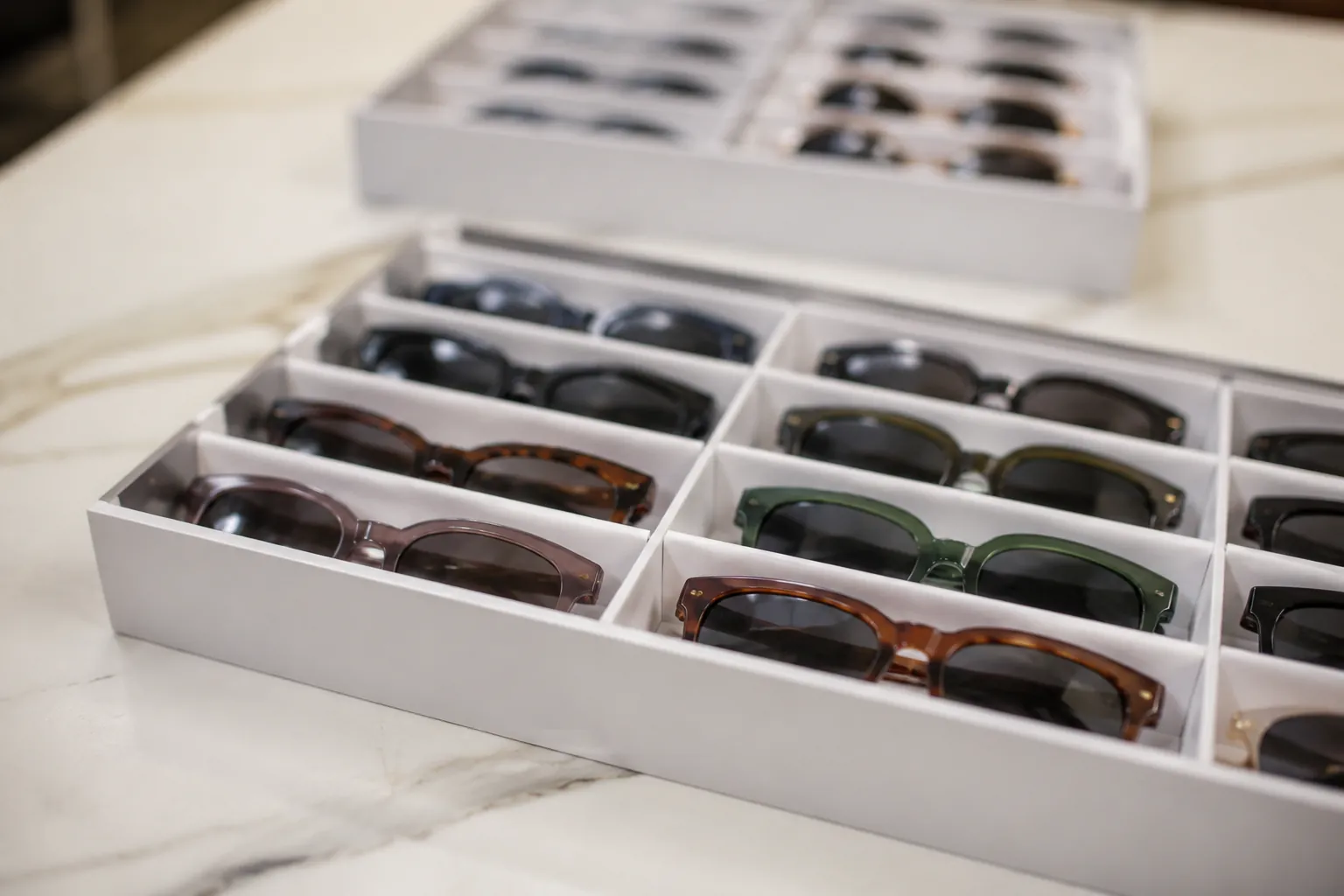
This guide is for retail groups, distributors, importers, and brand owners building sunglass programs across several countries, price tiers, or store formats. The aim is simple: reduce SKU chaos without killing local relevance. Buyers need shared platforms, clear regional options, controlled lens claims, correct packaging, realistic MOQs, and clean shipment splits. The planning logic below reflects factory execution for custom sunglasses, including material behavior, mold and color-change costs, decoration limits, sample timing, pre-production approvals, AQL inspection, compliance routes, and bulk lead-time risks.
Start With One Core Program
Regional sunglass sourcing gets messy when every country buyer runs a separate project. The factory receives small fragmented orders, repeated color-matching requests, duplicate packing instructions, and several near-identical versions of the same product. Cost rises. SKU control weakens. Labels, barcodes, and lens claims become easier to mix up.
A better model is one master program with only the visible or legal details split by market. Keep the base common: frame platform, material, hinge type, lens category, UV requirement, logo method, packaging structure, carton quantity, barcode rules, and inspection standard. Then localize the parts that need to change: frame color, lens tint, hangtag language, importer label, retail price sticker, or display-box artwork.
For chain stores, the program usually has three layers. The engineering layer covers mold, bridge fit, temple length, lens curve, screw size, and hinge construction. The commercial layer covers color, lens finish, decoration level, and price tier by store format. The logistics layer covers purchase-order split, market code, carton mark, shipping window, and document set.
Ask the supplier which processes are in-house and which are outsourced. Injection molding, acetate cutting, CNC milling, lens tinting, decoration, packaging coordination, and QC may sit under one factory or several vendors. Map every handoff. Outsourced tinting, plating, logo parts, or printed packaging can change approval timing, color consistency, and packing windows.
Build the Assortment Matrix First
Do not start with twenty random samples. Start with an assortment matrix. It tells the factory what is shared, what can vary, and where cost must be protected. Approve this before sample orders so quotations follow real production logic, not guesses.
| Program Element | Keep Common Across Markets | Allow Regional Variation | Buyer Control Point |
|---|---|---|---|
| Frame platform | Mold, bridge width, lens curve, hinge type, temple length | Color, finish, small temple decoration | Freeze dimensions before color sampling |
| Lens | UV400 target, base material, impact target, category range | Gray, brown, green, gradient, mirror coating | Confirm VLT and legal lens category by country |
| Packaging | Polybag, pouch size, inner quantity, master carton size | Hangtag language, barcode, warning label, display artwork | Send print-ready files before bulk deposit |
| Price tier | Material family, QC level, lens protection claim | Basic, mainline, premium decoration levels | Limit low-volume variants below the supplier's efficient run size |
| Compliance | Technical file structure and test method | Market markings and document language | Match CE EN ISO 12312-1, ANSI Z80.3, AS/NZS 1067, FDA registration, and REACH as needed |
The matrix prevents familiar retail problems. Germany may approve matte black with gray category 3 lenses. Australia may want tortoise with brown lenses. The US buyer may later ask for blue mirror lenses. These requests are manageable when planned before mold booking, lens approval, and packaging artwork. They become expensive after purchase orders are split and printed materials are released.
Choose Platforms That Span Price Points
One strong frame platform can support several store formats if the buyer controls lens, finish, and decoration. That lets a chain run a promotion line, mainline range, and premium display line without creating three unrelated assortments.
Injection frames reward volume. Mold setup, resin drying, color matching, machine cleaning, and first-piece approval are spread across more units. A color change can require machine cleaning, trial shots, and scrap allowance for purging. For PC and TR90-style materials, stable dimensions and consistent shrinkage matter. Agree on measurable tolerances for bridge width, lens seating, temple length, and hinge alignment before bulk production.
Acetate looks richer, but it is slower. Cutting, CNC shaping, tumbling, polishing, hinge installation, and final adjustment add labor. Sheet availability also affects MOQ because special acetate colors may require a larger material purchase than the buyer's trial order. Metal trim or mixed-material fronts add more fixtures and more cosmetic checkpoints.
- Entry format: PC or TR90-style injection frame, solid colors, UV400 target lenses, pad-printed logo, polybag or simple pouch.
- Mainline format: better tint control, matte or translucent colors, laser engraving, printed hangtag, barcode labeling by country.
- Premium corner: acetate or metal detail, metal logo plate, gradient or mirror lenses, microfiber pouch, tighter cosmetic AQL.
Confirm MOQ by design, material, color, lens type, decoration method, and packaging split. Trial orders may be possible at low quantities, but better economics come from stable platforms moving into larger runs. The savings come from stronger material purchasing, fewer color changes, longer machine runs, cleaner decoration setup, and lower QC cost per unit. Treat small regional runs as validation, not mass-cost production.
Set Lens Rules Before Color Approval
Lens color is not only a fashion choice. It affects visible light transmission, lens category, driving suitability, labeling, customer complaints, and test reports. A tint that looks good under showroom lights may be too dark for a driving claim or too light for a category 3 promise.
Write the lens requirement in measurable terms: material, UV protection target, visible light transmission range, lens category, tint code, coating, and test standard. CE EN ISO 12312-1 is relevant for Europe. ANSI Z80.3 applies to the US market. AS/NZS 1067 applies to Australia and New Zealand. FDA registration supports the US supplier file where applicable, but it is not the same as passing ANSI performance requirements. REACH applies to restricted substances in frame materials, coatings, lenses, and packaging components placed on the EU market.
Use approved master samples, not verbal tint names. Brown, smoke, gray, and green mean different things to different buyers and suppliers. Mirror coatings add risk because coating uniformity, edge chipping during assembly, and batch-to-batch color shift are visible at retail. Gradient lenses need top-to-bottom consistency so the pair does not look uneven on a peg. For bulk approval, the supplier should mark each master lens with model number, tint code, VLT range, category, date, and buyer signature.
Keep two sealed approval sets: one in the factory QC room and one with the buyer or inspection agent. During final inspection, compare production against the sealed set and approved technical file. Not a phone photo. Not an unapproved PDF.
Localize With Decoration and Packaging
Regional identity does not always require a new frame. In many chain programs, decoration and packaging are the safest ways to localize. The product stays stable while each market gets the right language, barcode, warning label, importer detail, and price point.
Decoration methods behave differently on the line. Pad printing is economical for one-color logos, but curved temples need position checks and ink adhesion testing. Laser engraving is durable and clean, but it can look too subtle on translucent frames. Heat transfer carries more color, but film edges and rub resistance must be controlled. Metal logo plates add perceived value, but they also add component sourcing, adhesive or rivet checks, and fixture control. Lens corner logos need tight positioning. A small tilt is visible to shoppers.
- Approve the blank frame and lens first.
- Approve decoration artwork at actual size, not only as a PDF.
- Run a decorated pre-production sample using the real material color.
- Check adhesion, rub resistance, logo position, and color match.
- Lock packaging drawings, barcode data, warning text, importer details, and carton marks before bulk packing starts.
Packaging is where regional programs often fail. A French hangtag, US UPC sticker, Australian warning label, and Middle East importer label may each be correct. They still create risk if the packing list does not tell the line which label belongs in which inner carton. Use market codes on the purchase order, inner carton, master carton, and packing list. Do not rely on warehouse memory.
Plan MOQ Around Shared Volume
The fastest way to lose margin is to split one annual program into too many small SKUs. The factory then faces frequent resin changes, small lens batches, printing plate changes, packing-line interruptions, and separate QC records. The buyer expects annual-volume pricing, but the factory is still running inefficient batches.
Share volume wherever the consumer will not notice the difference. Three countries can often use the same black frame and gray lens, then split hangtags and barcodes. That improves material buying and machine planning even when packaging is market-specific. By contrast, five transparent colors across five countries may look attractive in a spreadsheet but create color-matching delays, leftover resin, and uneven sell-through.
| Quantity Level | Best Use | Factory Logic | Buyer Risk |
|---|---|---|---|
| Trial quantity | Limited store tests, regional color checks, sell-through validation | Higher setup cost per unit, small decoration batches | Expect test pricing, not mass-program pricing |
| Initial rollout | Confirmed regional demand or first chain launch | Better machine planning and packaging efficiency | Too many color splits can erase savings |
| Stable program | Repeat model across several countries | Improved material buying, lens batch use, QC allocation | Late market changes can delay the whole platform |
| High-volume hero SKU | Cost-driven seasonal program or core replenishment item | Longer runs, fewer setups, strongest unit-cost leverage | Forecast accuracy and compliance files must be locked early |
Ask the supplier to quote the same platform at several quantity breaks. Also ask them to separate the cost impact of color, lens coating, logo method, and packaging split. This shows which variations deserve space in the program and which should be treated as paid tests. If one market insists on a unique low-volume color, price it separately. Do not make the strongest market subsidize the weakest one.
Control Samples and Lead Time
A multi-country retail program needs two sample stages. The first proves the product: frame fit, material, lens tint, decoration method, and basic packaging. The second proves the exact regional split: barcode, hangtag, warning label, carton mark, PO allocation, and document set. Skipping the second stage only works if nothing changes. Usually, something changes.
Confirm sample and bulk timing in writing for each project. Timing depends on material availability, mold status, lens type, decoration method, packaging artwork, testing requirements, and holiday schedules. Simple repeat designs with available materials are usually faster than new molds, special acetate sheets, mirror coatings, metal logo parts, or multiple regional packaging versions.
| Stage | Buyer Output Needed | Factory Output | Main Risk |
|---|---|---|---|
| Design brief | Assortment matrix, target price, countries, compliance needs | Feasibility review and quotation | Too many low-volume variants |
| Sample round | Frame colors, lens tints, logo method, packaging draft | Product samples and initial comments | Approving color before lens category check |
| Pre-production | Final artwork, barcode list, carton marks, PO split | Signed PP samples and production file | Regional labels mixed or missing |
| Bulk production | Deposit and locked specifications | Production against approved file | Late artwork change delaying packing |
| Final inspection | AQL level, shipment split, document requirements | Inspection report and packing confirmation | Product passes but market allocation fails |
Set a hard cut-off date for artwork, barcode, and price-sticker changes. Retail teams often underestimate this risk. The frames can be molded, the lenses can pass testing, and the order can still miss shipment because one country changed a label after printed materials were made.
Inspect by Market Split
Final QC for regional programs must check more than scratches and loose hinges. It must confirm that each market receives the correct product, label, barcode, document support, and carton mark. A total shipment pass can hide a regional failure.
For sunglasses, inspection should include frame symmetry, bridge alignment, hinge tension, screw tightness, lens fit, lens surface defects, decoration position, logo adhesion, color consistency, barcode scan, pouch or tag content, and carton marking. Practical checks include opening and closing temples repeatedly, checking lens seating at the rim, comparing left and right temple alignment, and confirming that no sharp edges remain around hinges or nose areas.
Use AQL levels agreed in advance. Many retail programs define critical, major, and minor defect limits before production, but the exact AQL plan should be confirmed between buyer, supplier, and inspection agency. Lens checks should follow the agreed compliance route, such as CE EN ISO 12312-1, ANSI Z80.3, or AS/NZS 1067. ISO 9001 and BSCI can support factory management and social-compliance expectations, but they do not replace product testing for sunglasses.
- Check one sealed master sample against each market version.
- Open cartons from every market code, not only the largest country order.
- Scan barcodes from actual retail packaging, not artwork proofs.
- Confirm carton marks match the packing list and purchase order.
- Record lens tint and category against the approved sample.
- Separate hold cartons for any failed market instead of blocking the whole shipment.
Regional assortments succeed when approvals, labels, test requirements, and packing instructions are locked before production pressure begins. A supplier cannot pack correct market assortments from incomplete or changing data, even if the sunglasses are made correctly.
Have a custom sunglasses project in mind?
Send us your styles, target market and quantities and we will return a detailed quote with MOQ, lead time and a sample plan.
Get a QuoteWhy source this from Wenzhou with LumiShades
Wenzhou in Zhejiang Province is widely regarded as China’s eyewear manufacturing capital, producing a large share of the world’s sunglasses. That concentration matters to buyers: a deep local supply chain for acetate sheet, hinges, lens blanks, plating and packaging means shorter component lead times, easier color and material matching, and a workforce with decades of eyewear-specific skill. LumiShades has manufactured in this ecosystem since 2009, and our vertical integration — in-house injection molding, acetate cutting, CNC milling, lens tinting, decoration and quality control — means no part of your order is quietly subcontracted to a workshop you cannot audit.
For international buyers, that vertical control translates into accountability. When a single factory owns every step, defects are traced and fixed at source rather than bounced between vendors, and your specifications survive intact from first sample to bulk. For procurement review, buyers can request process records, approved samples, quality checkpoints and project-specific compliance files before placing a bulk order. Required testing and documentation are confirmed against the destination market and product specification rather than assumed from a generic certificate list. Explore our manufacturing capabilities and quality control process to see how this works in practice.
Frequently asked questions
Can one sunglasses model be sold in different countries with only packaging changes? Yes, but only if the physical product meets each market's requirements. Confirm the lens category, UV protection claim, visible light transmission range, warning text, importer details, and allowed product claims before treating packaging as the only regional change. Use CE EN ISO 12312-1 for Europe, ANSI Z80.3 for the US, AS/NZS 1067 for Australia and New Zealand, REACH for restricted substances in applicable markets, and FDA registration where relevant to the US supplier file.
What is the safest MOQ strategy for testing regional assortments? Keep the frame platform common and test regional differences through color, lens tint, decoration, or packaging. Ask the supplier to quote trial, rollout, stable-program, and high-volume quantity breaks for the same platform. Use small orders to validate sell-through and compliance details. Then move proven color and lens combinations into larger shared runs so setup, material buying, lens batching, decoration, and QC become more efficient.
How early should we provide barcodes and country labels? Provide final barcode data, hangtag language, warning text, importer labels, price stickers, carton marks, and market codes before pre-production approval. The factory should make PP samples using the actual regional labels and scan the real barcode on retail packaging. Any change after printed packaging is released should be treated as a schedule and cost risk.
Which product details should be locked before bulk production starts? Lock the frame material, frame color, lens material, lens tint, VLT range, lens category, UV claim, coating, logo method, decoration position, packaging, barcode, carton quantity, market code, AQL plan, and required test standards. Also lock the document set for each market, including test reports, declarations, importer details, and any REACH or FDA registration support where applicable.
Can LumiShades handle different colors and packaging for several store formats in one order? Yes, if the program uses a shared platform and clear market codes. The buyer should provide an assortment matrix showing which frame, lens, decoration, and packaging elements are common and which are market-specific. LumiShades should confirm MOQ, lead time, tooling or fixture needs, artwork deadlines, inspection rules, and packing splits before deposit so each store format can be produced and packed without cross-market mixing.
Ready to start?
Explore our cat-eye sunglasses or request a quote — our sales team replies within 12 hours.
Request a Quote