
Sourcing Sunglasses for Chain Retail Stores
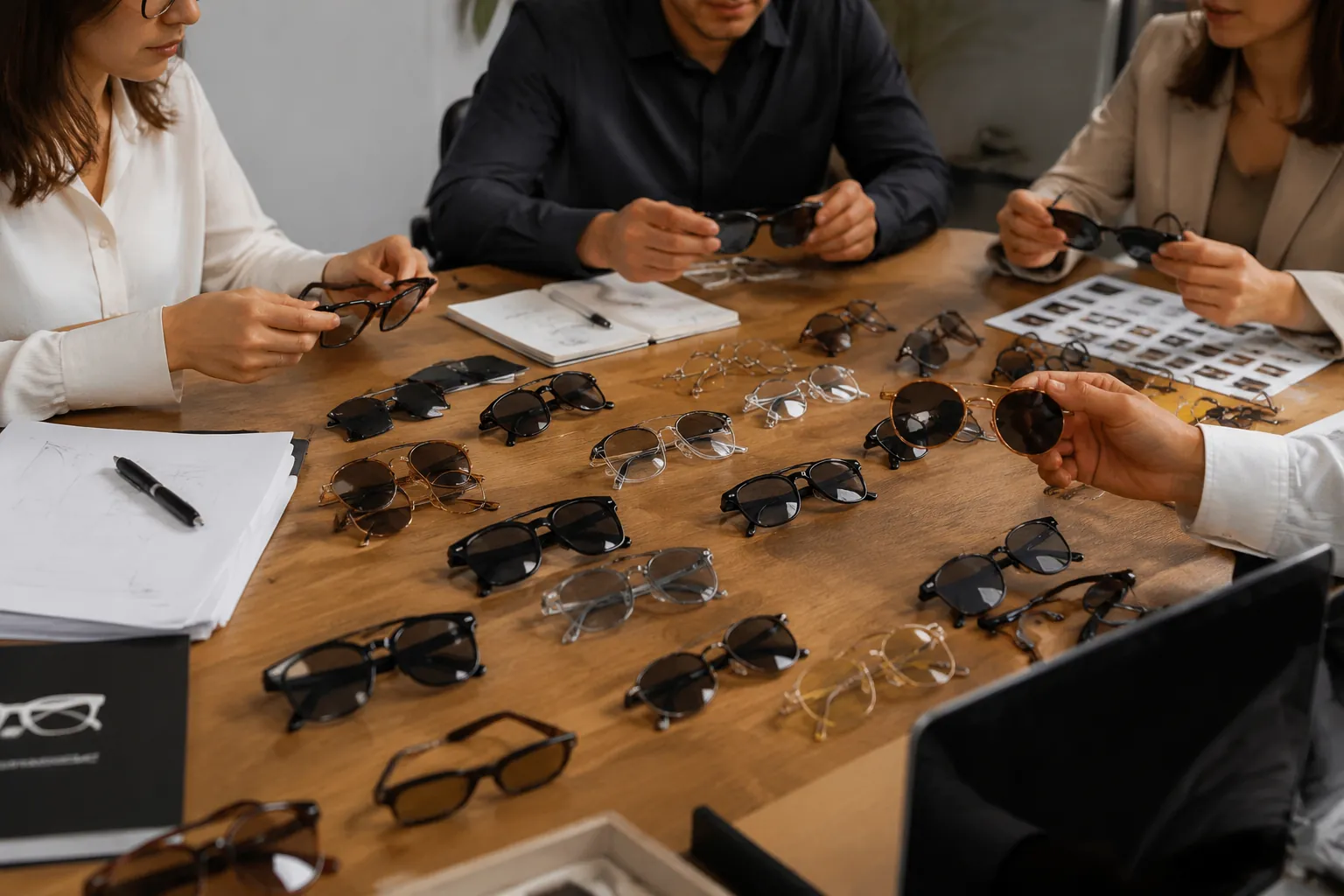
This guide is for overseas buyers building sunglasses programs for supermarkets, pharmacy chains, convenience retail, discount stores, and value retailers. It focuses on execution: price ladders, compliant labeling, stable materials, display-ready packaging, replenishment planning, and fewer surprises between sample approval and store launch. It is written for buyers who need volume pricing, retailer documentation, barcode control, and factory discipline rather than catalog-style style selection.
Start With the Retail Program, Not the Frame
A chain retail sunglasses program is not just a set of attractive frames. It is a price structure, SKU map, compliance file, packaging system, display plan, and replenishment model. If those pieces are not defined before sampling, suppliers will quote against different assumptions. The prices will not compare.
Define the role of the program first. An opening-price supermarket bin may prioritize PC injection frames, standard smoke lenses, simple labeling, and efficient carton packing. A pharmacy spinner rack usually needs stronger comfort, conservative colors, clearer warnings, and tighter claims control. A private-label fashion wall may justify acetate, metal details, polarized lenses, printed pouches, and stricter cosmetic standards.
Keep the first range controlled. For a regional test, 12 to 24 SKUs is usually enough. For a full seasonal launch, 36 to 72 SKUs may be appropriate. After sell-through is visible, the replenishment core often narrows to 8 to 20 SKUs. That is normal. Too many styles on day one create shallow depth and messy store execution.
- Opening price: PC injection frame, standard UV400 tinted lens, simple hangtag, bulk-efficient carton packing.
- Mid-tier retail: better hinge feel, polarized options, tighter lens tint consistency, pouch or branded case.
- Pharmacy program: comfort fit, conservative colors, compliant warnings, reader adjacency, low-return construction.
- Impulse display: pre-packed trays, fixed assortment ratio, scannable barcodes, minimal store handling.
Build a Price Ladder Buyers Can Manage
Retail buyers need a price ladder that protects margin without creating production risk. A factory can make a very low-cost pair of sunglasses. That does not mean the product will survive customer handling, barcode scanning, compliance review, display packing, and repeat orders.
For suppliers, MOQ and price should be tied to the same specification sheet. The sheet should state frame material, hinge type, lens category, UV claim, polarization requirement, logo method, packaging, barcode format, carton quantity, inspection level, and destination market. A quote with polarized lenses, printed pouch, and retailer carton marks cannot be compared with a quote for standard tinted lenses and loose bulk packing.
| Order Level | Typical Use | Cost Logic | Buyer Watchpoint |
|---|---|---|---|
| 50 pairs/design | Style trial, buyer sample set, small market test | Short-run setup, limited material efficiency | Do not expect full-volume pricing or custom display packing |
| 300 pairs/design | Small chain launch or controlled SKU test | Better component buying and production planning | Quote barcode, hangtag, pouch, and carton costs separately |
| 1,000 pairs/design | Main seasonal SKU depth | Stable line efficiency and lower decoration waste | Lock lens color, logo process, and QC standard before bulk |
| 5,000+ pairs/design | National program or replenishment core | Best batching, tooling use, and unit-cost leverage | Forecast materials early to prevent reorder gaps |
Ask the supplier to quote every tier from the same sheet. Then compare like with like. If the spec changes, the price changes. Simple.
Match Materials to Store Abuse Level
Supermarket and pharmacy sunglasses are handled harder than boutique eyewear. Customers bend temples, drop frames into baskets, try them over hair and hats, leave them in vehicles, and put them back on the display incorrectly. Material choice should reflect that use pattern, not only the showroom sample.
PC injection is common for opening-price and high-volume programs because it is light, repeatable, and efficient. It works well for kids ranges, value displays, and large seasonal fills. TR90 costs more and offers better flex memory and comfort, which makes it useful for pharmacy, sport-inspired, and travel programs. Acetate gives richer color and a more premium hand feel, but it needs cutting, tumbling, polishing, hinge fitting, and more careful adjustment. Metal frames require plating control, soldering checks, screw retention, nose pad inspection, and bridge alignment.
Write functional limits in inspection language. Temple opening should be even left to right. Lens seating should show no visible gaps or stress whitening. Frame twist should stay within the approved golden sample limit. Screws should not back out after repeated opening and closing. For value retail, a simple internal test can catch many bulk problems before shipment: 50 open-close cycles, light lens push, dry-rub logo check, barcode scan, and display-hook fit.
- PC: best for low cost, light weight, high output, and simple color programs.
- TR90: better for flexibility, comfort, active styling, and reduced breakage complaints.
- Acetate: best for fashion capsules, deeper colors, and higher perceived value.
- Metal: suitable for aviators and classics; inspect plating, solder points, screws, pads, and bridge symmetry.
When tinting, decoration, or polishing is outsourced, ask for incoming inspection records. Confirm that the approved golden sample matches the bulk batch. Drift starts there.
Control Lens, Compliance, and Labeling Before Artwork
Compliance is not a final sticker. It affects lens selection, warning text, retail packaging, documentation, and sometimes SKU grouping. Confirm destination markets before approving lens colors, hangtags, printed pouches, or display cards.
For retail sunglasses, request only the documents relevant to your destination market and product scope. Commonly requested items include CE EN ISO 12312-1 for Europe, FDA registration for the United States, ANSI Z80.3 performance expectations for the United States, AS/NZS 1067 for Australia and New Zealand, REACH for restricted substances, ISO 9001 for quality management, and BSCI for social compliance. Request current copies that match the exporting entity, factory scope, and product category.
Lens category matters. A dark lens is not automatically better. Category 2 is often suitable for medium sunlight, Category 3 is common for bright sunlight, and Category 4 is very dark and generally not suitable for driving. If a program sells across the EU, U.S., and Australia, the physical product may be similar, but packaging language, warnings, importer details, and standard references may need market-specific versions.
- EU: confirm CE references, filter category, warning language, importer details, and local language needs.
- United States: align documentation with FDA registration and ANSI Z80.3 performance expectations.
- Australia/New Zealand: verify AS/NZS 1067 classification and required consumer information.
- Chemical files: keep REACH support for frames, coatings, inks, logo parts, and packaging.
Do the compliance review before mass printing. Reprinting thousands of hangtags because the warning text, importer line, or category statement is wrong is a waste of time and money.
Specify Decoration, Packaging, and Displays Together
Display-ready execution is where many sunglasses programs fail. The frames may pass inspection, but store teams cannot fix wrong barcodes, missing tags, mixed carton ratios, or displays that do not match the planogram. Packaging, decoration, labeling, and carton marks must be treated as one system.
Each retail unit should have a confirmed SKU code, model number, color code, barcode, country of origin, lens category where required, retail price logic, and required importer or distributor information. If the shipment uses mixed assortments, master cartons should show assortment code, quantity per SKU, carton number, destination, and any retailer routing information. For pharmacy programs, product claims should stay conservative. Avoid medical, therapeutic, or eye-health claims unless the retailer has approved them and the compliance file supports them.
Decoration method affects cost and durability. Laser engraving is durable and clean but subtle, especially on dark frames. Pad printing gives stronger color visibility but needs adhesion testing on curved temples and glossy materials. Metal logo plates add perceived value but increase part cost and require pull-strength checks. Printed pouches and cases support branding but add lead time, artwork approval steps, and carton volume.
- Approve the retail price ladder and SKU list.
- Assign model codes, color codes, and barcode numbers.
- Confirm lens category and warning text by market.
- Approve logo process, hangtag, sticker, pouch, case, and display artwork.
- Build a packed pre-production sample, not only a loose frame sample.
- Check carton marks against the retailer routing guide before production packing.
The packed sample is the decision point. It shows whether the product is truly store-ready, scannable, compliant, and easy for store staff to place on the display.
Use Sampling to Find Bulk Problems Early
Samples in 7 to 10 days are realistic for many existing molds, standard colors, common lens tints, and normal decoration. New tooling, special acetate colors, custom metal trims, nonstandard lens coatings, or retailer-specific packaging can add time. Separate design sampling from production validation.
A strong sampling path starts with selection samples, moves to branded samples, then to a pre-production sample using actual materials, actual lens tint, actual decoration, actual barcode, and actual packaging. Do not approve chain-store bulk from photos alone. Photos hide hinge tension, lens distortion, frame twist, logo adhesion, sharp edges, barcode readability, and carton packing mistakes.
For supermarket and pharmacy programs, approval should include handling tests. Open and close the temples at least 50 times. Rub printed logos with a dry cloth and then a damp cloth. Apply light pressure to lenses to check seating. Scan every barcode on the sample set. Hang the unit on the intended hook or place it in the intended tray. Check that price stickers do not cover warnings, lens category, or barcode areas.
- Selection sample: confirms shape, fit direction, color range, and assortment balance.
- Branded sample: confirms logo size, position, color, and decoration method.
- Pre-production sample: confirms bulk materials, lens tint, packaging, barcode, and carton method.
- Golden sample: remains sealed as the reference for production QC and final inspection.
Keep one approved golden sample at the factory and one with the buyer. If a dispute appears during inspection, both sides need the same physical reference instead of memory, photos, or email descriptions.
Set Replenishment Rules Before the First PO
Bulk lead time of 25 to 35 days can work for planned seasonal launches, but it is too slow if the buyer waits until racks are empty. Chain programs need reorder rules before the first purchase order ships. Otherwise, best sellers disappear while slow movers keep taking shelf space.
Separate launch quantity from replenishment quantity. The launch order fills stores, distribution centers, and promotional reserves. Replenishment should focus on proven core SKUs, not every seasonal color. A 72-SKU launch may narrow to 15 or 20 reorder SKUs after the first sales read. That is normal and should be expected in the forecast model.
Forecasting works best when buyers share a rolling view of store openings, promotion timing, and expected sell-through. Suppliers cannot hold unlimited lenses, hinges, logo plates, printed tags, and display cartons without planning. A monthly forecast is more useful than an urgent purchase order after inventory has already fallen below cover.
| Planning Item | Recommended Rule | Reason |
|---|---|---|
| Launch order | Cover store fill, DC reserve, and first promotion | Prevents early out-of-stock during the launch window |
| Reorder trigger | Review sell-through before stock drops below planned cover | Allows 25 to 35 days production plus freight time |
| Core SKU list | Keep black, tortoise, smoke, brown, and polarized basics active | Improves material planning and reorder efficiency |
| Seasonal colors | Buy with limited repeat expectation | Reduces leftover components after the season ends |
Fast replenishment is not luck. It comes from stable specifications, early forecasts, disciplined packaging control, and avoiding unnecessary artwork changes between orders.
Inspect Like a Retail Chain, Not a Sample Room
Final inspection should reflect how the goods will be sold. A sample-room check looks at a few nice pieces on a table. A retail-chain inspection checks cartons, assortments, labels, barcodes, pack ratios, display readiness, and customer-visible defects.
For sunglasses, QC should cover frame symmetry, hinge tension, screw tightness, lens fit, lens tint consistency, optical distortion, decoration placement, sharp edges, nose pad comfort, and packaging accuracy. For display-ready orders, inspectors should open master cartons and verify assortment counts against the packing list. One wrong color ratio can break a display plan across many stores.
Define defect categories before production. Critical defects include wrong compliance labeling, unsafe sharp edges, lenses falling out, or incorrect barcode assignment. Major defects include visible frame twist, loose hinges, poor logo position, scratched lenses, wrong packaging, or unacceptable tint variation. Minor defects include small cosmetic marks within the approved limit. If these standards are not written down, every inspection becomes a negotiation.
Buyer rule: the approved golden sample, artwork file, packing method, barcode list, and compliance text must all be part of the QC reference. A frame-only inspection is not enough for chain retail.
Ask for in-process checks as well as final inspection. Factory QC is most useful when it checks injection, lens tinting, decoration, assembly, and packing before cartons are sealed and freight is booked.
Have a custom sunglasses project in mind?
Send us your styles, target market and quantities and we will return a detailed quote with MOQ, lead time and a sample plan.
Get a QuoteWhy source this from Wenzhou with LumiShades
Wenzhou in Zhejiang Province is widely regarded as China’s eyewear manufacturing capital, producing a large share of the world’s sunglasses. That concentration matters to buyers: a deep local supply chain for acetate sheet, hinges, lens blanks, plating and packaging means shorter component lead times, easier color and material matching, and a workforce with decades of eyewear-specific skill. LumiShades has manufactured in this ecosystem since 2009, and our vertical integration — in-house injection molding, acetate cutting, CNC milling, lens tinting, decoration and quality control — means no part of your order is quietly subcontracted to a workshop you cannot audit.
For international buyers, that vertical control translates into accountability. When a single factory owns every step, defects are traced and fixed at source rather than bounced between vendors, and your specifications survive intact from first sample to bulk. For procurement review, buyers can request process records, approved samples, quality checkpoints and project-specific compliance files before placing a bulk order. Required testing and documentation are confirmed against the destination market and product specification rather than assumed from a generic certificate list. Explore our manufacturing capabilities and quality control process to see how this works in practice.
Frequently asked questions
What MOQ should I use for a supermarket sunglasses test? For early range testing or buyer review sets, 50 pairs per design is a workable starting point if the factory already has suitable molds and standard components. For a cleaner chain-store launch and more realistic cost, 300 pairs per design is often a better test size. If the program is moving toward a core replenishment style, ask for 1,000 pairs per design or more so pricing, packing, and QC reflect production conditions rather than sample conditions.
How long should I allow from sample approval to shipment? If the style uses existing molds, standard lens tints, and standard decoration, samples can often be prepared in 7 to 10 days. After approval, bulk production commonly needs 25 to 35 days, then freight time on top. Add time if you still need artwork approval, compliance review, packed pre-production approval, or retailer routing confirmation before production starts.
Which certifications should I request for retail sunglasses? Request only the documents that fit your destination market and product scope. The common set includes CE EN ISO 12312-1 for Europe, FDA registration and ANSI Z80.3 expectations for the United States, AS/NZS 1067 for Australia and New Zealand, REACH for restricted substances, ISO 9001 for quality management, and BSCI for social compliance. Check the factory name, scope, issue date, validity, and whether the document matches the entity that will export your order.
Can one sunglass assortment work for the EU, U.S., and Australia? Sometimes the same physical assortment can be sold across markets, but the paperwork and packaging usually cannot be identical. Check the lens category, warnings, importer or distributor details, language requirements, and standard references for each destination before printing shared artwork. If the buyer wants one design sold in multiple regions, approve market-specific labels and cartons before mass production.
What should be included in a display-ready approval sample? It should include the exact frame, lens tint, logo decoration, hangtag or sticker, barcode, pouch or case if used, inner packing, carton marks, and assortment ratio. Also verify that the sample scans correctly, hangs correctly on the retail fixture, and matches the retailer's routing or labeling guide. A loose frame sample does not prove the program is ready for store receiving and display setup.
How do I reduce reorder delays after the first launch? Keep core SKUs stable, avoid changing packaging between orders, and share a rolling forecast before stock runs low. Reorder trigger points should leave enough time for production plus freight, not just factory lead time. It also helps to keep artwork, barcode data, and compliance text frozen for the core program so reorders do not restart the approval cycle.
Ready to start?
Explore our rimless sunglasses or request a quote — our sales team replies within 12 hours.
Request a Quote