
Sunglasses Size Guide for Private-Label Buyers
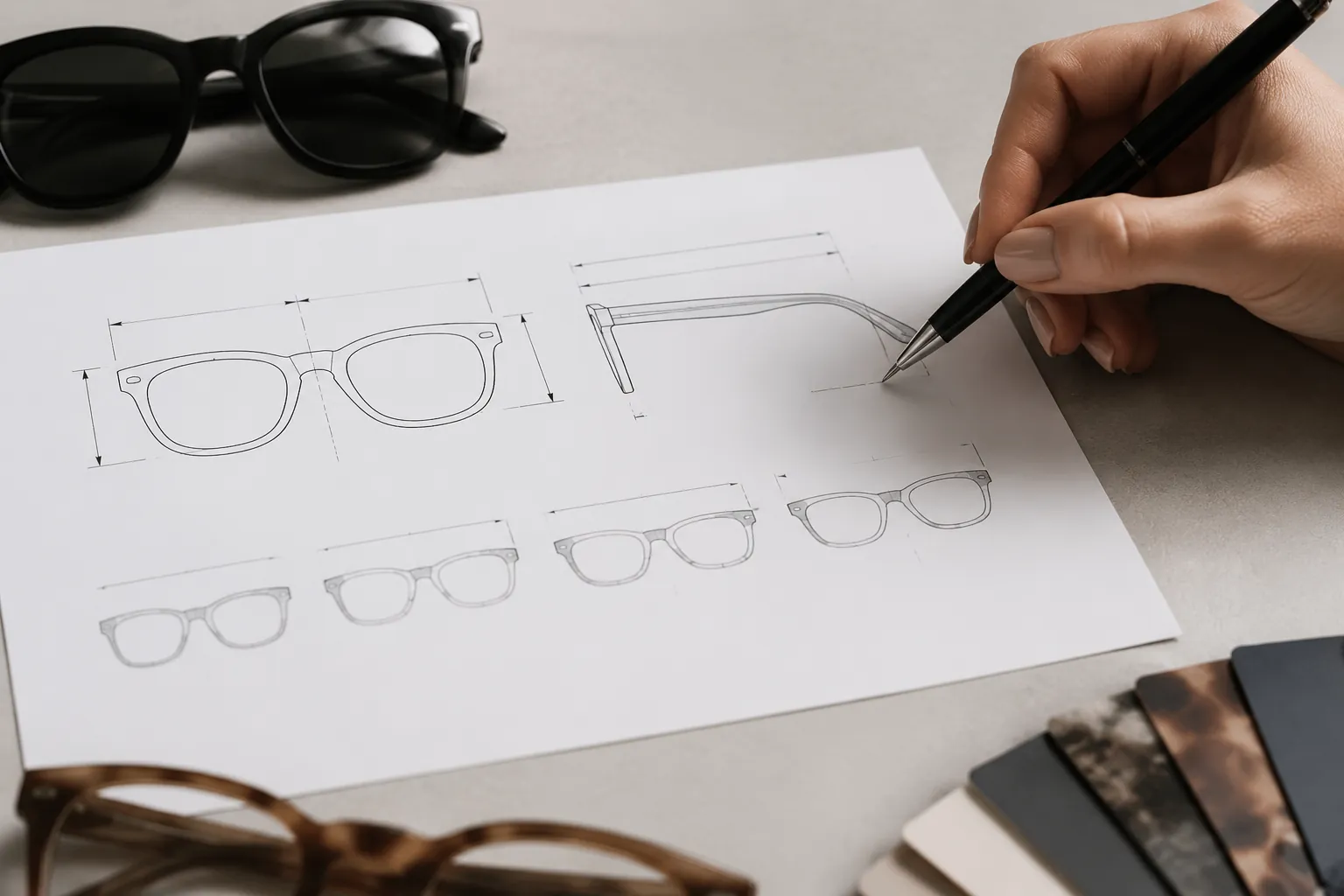
This guide is for brand owners, importers, distributors, promotional buyers, and retail teams developing private-label sunglasses. It explains how to specify lens width, bridge width, temple length, lens height, front width, fit version, materials, decoration, tolerances, samples, and compliance requirements in terms a factory can quote, sample, inspect, and repeat. The aim is simple: reduce fit complaints, cut wasted sample rounds, and approve a size specification that fits the target wearer, sales channel, compliance market, and order quantity.
Start with the wearer, channel, and order plan
Most sunglass sizing problems begin before CAD work starts. A buyer picks an attractive front shape and asks the factory to "make it fit Europe," "make it Asian fit," or "make it universal." Those phrases do not control production. They are too vague.
A producible sunglass size is a set of dimensions and angles. It must work with face width, nose bridge height, cheekbone position, temple pressure, lens coverage, and the retail promise. The style can look right on a screen and still fail on a face.
First, define the commercial job of the frame. A women's fashion retailer selling oversized cat-eye sunglasses may accept a wide front and a bold look, but still needs cheek-clearance testing. An outdoor or surf distributor needs stability, suitable wrap, secure temple curvature, and lens performance for the destination market. A promotional buyer ordering a small event run usually needs a safer middle fit. A premium online brand should not depend on "one size fits all" without publishing clear measurements and planning for return risk.
- Mass retail fit: use safer proportions, usually medium lens width, moderate bridge width, and 140-145 mm temples. Avoid extreme oversized or narrow silhouettes unless the range includes more than one size.
- Fashion fit: can be intentionally wide, narrow, thick, or tall, but bridge contact, pantoscopic tilt, lash clearance, and cheek clearance must be tested on real wearers.
- Sport or outdoor fit: requires controlled wrap, temple grip, nose stability, and the correct lens category and labeling for the sales market.
- Kids or youth programs: need separate size development. Do not simply shrink an adult CAD file; hinge position, temple pressure, lens height, and safety expectations may change.
- Online retail fit: needs complete published sizing, including total front width, because the customer cannot try the product before buying.
At the start of a private-label project, confirm the target wearer, sales countries, sales channel, retail price range, preferred material, compliance requirements, estimated order quantity, and whether the style will use an existing model or new tooling. MOQ and sizing are linked. For a small validation order, keep the fit conservative and avoid expensive geometry changes unless fit is the main test. For larger programs, a second size, a low-bridge version, or a separate temple-spread version may be worth the work.
The core measurements your factory needs
A proper sunglass specification is not "small," "medium," or "large." The factory needs lens width, bridge width, temple length, lens height, total front width, and preferably hinge-to-hinge width, base curve, pantoscopic angle, and temple spread. Use millimeters. Verify the sample with calipers or an agreed inspection fixture.
| Measurement | Typical adult range | What it controls | Common sourcing mistake |
|---|---|---|---|
| Lens width | 48-62 mm | Visual coverage, style proportion, and part of total front width | Choosing oversized lenses without checking final face width |
| Bridge width | 16-24 mm | Nose fit, sitting height, sliding, and pressure | Using one bridge shape for both high-bridge and low-bridge wearers |
| Temple length | 135-150 mm | Ear position, comfort, retention, and balance | Copying 145 mm from a reference sample without checking the bend point |
| Lens height | 38-56 mm | Coverage, fashion look, lash space, and cheek contact | Approving tall lenses that touch the cheeks when the wearer smiles |
| Total front width | 130-150 mm | Overall face fit and visual balance | Changing lens size without rechecking hinge-to-hinge width |
| Temple spread | Often 125-145 mm at tips, depending on design | Head pressure, retention, and long-wear comfort | Approving a frame that feels secure for one minute but painful after ten minutes |
For many adult unisex private-label sunglasses, a practical starting point is 52-55 mm lens width, 18-20 mm bridge width, 140-145 mm temple length, 42-48 mm lens height, and 138-145 mm total front width. Petite or youth-oriented styles may move toward 48-51 mm lenses and 130-138 mm fronts. Oversized women's frames often use 56-60 mm lenses and wider fronts. Still, do not widen the bridge just to balance a drawing. The bridge has to support the frame on the nose.
Finished eyewear is affected by molding, CNC cutting, tumbling, polishing, lens insertion, heating, hinge setting, and final temple adjustment. Agree tolerances before bulk production. For stable acetate or injection styles, factories often control key linear dimensions such as lens width, bridge width, and front width within a narrow tolerance, commonly around ±0.5 mm where the design and process allow. Temple length, temple spread, and wrap may need different tolerances because material memory, heat adjustment, hinge setting, and final alignment affect them. Put the tolerance in the purchase specification and QC plan. Do not leave it for the inspection dispute.
Choose lens width by front width, not by size code alone
Lens width is the number buyers notice first. Total front width is what decides how the frame wears across the face. A 54 mm lens can feel fairly narrow if the bridge is 17 mm and the outer lugs are slim. The same 54 mm lens can wear wide if the bridge is 22 mm, the rim is thick, and the hinge sits far outside the lens.
For classic acetate-inspired unisex programs, 50-54 mm lens width is often a safer starting range. For injected fashion or sport-inspired sunglasses, 54-58 mm may work because larger lenses provide more coverage and a stronger retail look. Men's square styles commonly sit around 55-60 mm. Oversized women's shapes may reach 56-62 mm. But final approval should be based on total front width, hinge-to-hinge width, and wearer testing. Not lens width alone.
Factory note: Increasing lens width by 2 mm on each side does not always add only 4 mm to total front width. Rim thickness, lug length, hinge position, bevel structure, and lens groove placement can also change. After every size change, recheck total front width, hinge-to-hinge width, lens fit, and temple opening.
Retail price and channel should influence the sizing strategy. Lower-price or promotional programs usually need a middle fit because one SKU must satisfy many users. Higher-price capsule lines can justify two sizes, such as 52-18-140 and 55-19-145, or a regional bridge version. For small validation runs, avoid size splits unless the test is specifically about fit. For larger orders, better fit engineering may be easier to justify because tooling, sampling, decoration setup, lens preparation, QC, and packing are spread across more units.
Bridge design is where global fit often fails
The bridge controls where the frame sits vertically, how much weight lands on the nose, and whether the sunglasses slide. Two frames with the same lens width and temple length can feel completely different if the bridge shape changes. This matters most for brands selling across regions or through online channels.
A high keyhole bridge can look premium and may work well on higher nose bridges, but it can slide on lower nose bridges if the effective contact area is too low or too wide. A saddle bridge spreads weight, but it can feel heavy if the contact area is broad and the frame is thick. Molded nose pads on injection frames are clean and cost-efficient, but they are not adjustable like metal pad arms. Acetate bridges can be refined through CNC cutting and polishing, but large bridge changes may affect lens shape, tooling, polishing access, and front strength.
- Higher nose bridges: test 18-21 mm bridges depending on lens width, rim thickness, frame weight, and desired sitting height.
- Lower nose bridges: consider raised nose pads, a narrower effective contact area, reduced pantoscopic tilt, adjusted temple spread, or a separate low-bridge version.
- Oversized fashion fronts: do not widen the bridge only to make the drawing look balanced. A 22-24 mm bridge on a heavy front can cause sliding if nose contact is poor.
- Online retail: publish the full size code, such as 54-19-145, and include total front width, lens height, and model photos on different face types when possible.
If a buyer requests "Asian fit" or "low-bridge fit," ask for the actual change. Raised nose pads? Reduced pantoscopic angle? Flatter front curve? Adjusted temple spread? Longer end tips? Write the answer into the specification. Otherwise, sampling becomes guesswork and the factory may solve the wrong problem.
Temple length, curve, and hinge angle control comfort
Temple length is often treated as a standard number: 140 mm or 145 mm. That is not enough. The bend point, temple width, core wire stiffness, hinge angle, end-tip curve, and temple spread all affect comfort. A frame can measure 145 mm and still press behind the ear if the bend starts too early. Another 140 mm frame can feel stable if the curve and hinge angle are right.
As a practical guide, 135 mm is common for petite or youth frames, 140 mm works for many adult medium fronts, and 145 mm is common for larger or male-oriented styles. 150 mm may be used for large frames, but it can look and feel excessive on smaller fronts. Sport-inspired styles often use more wrap and stronger inward temple curve. Check pressure after several minutes of wear, not just during a quick try-on.
Material changes the adjustment window. Injection temples are consistent once the mold and process are stable, but post-molding correction is limited. Acetate temples with metal cores allow more heat adjustment, but heating must be controlled to avoid warping, gloss change, misalignment, or lens stress. TR-style and other flexible materials can feel comfortable, but they may need tighter hinge, screw, and alignment controls to maintain fit over time.
Decoration must respect fit engineering. Laser engraving, pad printing, hot stamping, metal logo plates, and embedded badges should not sit where the temple must be bent, heated, or flexed repeatedly. A logo close to the hinge may look good in a render but can crack, lift, distort, or block adjustment if the structure is wrong. Review branding location together with temple geometry before bulk production.
Material choice changes sizing risk, lead time, and cost
Buyers often choose frame material by look and price. Add sizing risk to that decision. Injection molding, acetate cutting, CNC milling, lens tinting, and decoration all behave differently during sampling and bulk production.
| Frame type | Fit advantage | Fit risk | Best use |
|---|---|---|---|
| Injection plastic | Consistent geometry after mold, material, and process are stable; efficient for repeat volume | Mold changes can add time and cost; molded nose pads and temples have limited adjustment | Promotional, mass retail, sport-inspired, and repeat-volume programs |
| Acetate | Better hand feel; bridge, edges, and temples can be refined through cutting, polishing, and heat adjustment | More process steps; polishing, heating, and assembly can affect final measurements | Fashion brands, premium private label, optical-style sunglasses |
| CNC-milled components | Useful for controlled small-batch shaping, detailed refinement, and validation before tooling | Higher unit cost than simple injection at scale; still requires final fit testing | Capsule runs, design testing, refined fronts or temples |
| Hybrid with metal logo plates | Visible branding and a more premium retail appearance | Plate position can interfere with flex, polishing, heating, or temple adjustment | Retail programs where durable visible branding matters |
If your supplier handles injection molding, acetate cutting, CNC milling, lens tinting, decoration, assembly, and QC in-house, use that during sampling. Review fit, color, lens performance, logo placement, and packing together. One change can affect another. A thicker temple may improve perceived quality but increase pressure. A darker lens may need different labeling. A metal logo plate may limit where the temple can be heated.
Do not treat new geometry like a color change. New molds or major shape changes normally require CAD review, first sample, physical fitting, written correction notes, possible mold or process adjustment, pre-production sample, and a signed golden sample. Skip that sequence and the bulk order may be hard to sell, even if it matches the artwork.
Size approval checklist before bulk production
A good size approval process is simple and strict. Complete it before final packaging details take over the schedule. Packaging can often be corrected late. Bridge fit, temple pressure, lens performance, and required labeling cannot.
- Confirm the size code: lens width, bridge width, temple length, lens height, total front width, hinge-to-hinge width if available, and target temple spread in millimeters.
- Measure the sample: use calipers or an agreed measurement fixture and record actual values against the specification, including the agreed tolerance for each dimension.
- Test several face types: include narrow, medium, wide, higher nose bridge, and lower nose bridge wearers. For online or premium retail, increase the test group and record feedback consistently.
- Run movement checks: ask the wearer to look down, smile, turn the head, and wear the frame for at least several minutes. Record sliding, cheek touch, lash contact, temple pressure, and behind-ear discomfort.
- Check lens and compliance: confirm UV protection, visible light transmission, lens category, impact or robustness requirements, warnings, and labeling for the destination market.
- Approve decoration position: make sure laser engraving, pad printing, hot stamping, or metal plates are not placed on high-flex, high-wear, or heat-adjustment areas unless the construction has been tested.
- Lock the golden sample: signed frame, measurement sheet, lens color, logo placement, packaging, screw and hinge details, and QC limits must all match the approved production standard.
Compliance is not decoration. Lens tint, UV performance, visible light transmission, lens category, warnings, labels, and restricted substances must match the destination market. Common requirements may include CE EN ISO 12312-1 for Europe, ANSI Z80.3 for the United States, AS/NZS 1067 for Australia and New Zealand, FDA registration where applicable for U.S. market obligations, REACH for restricted substances, and factory management or social-audit systems such as ISO 9001 and BSCI when required by the buyer. State the target countries at the beginning of the project so lens selection, label content, test reports, and documentation are built correctly.
How to brief LumiShades for fewer sample rounds
A factory can move quickly when the brief is complete. A thin brief creates emails, rework, and late arguments about what was "understood." For a private-label sizing project, send the target wearer, sales countries, retail price range, preferred material, reference frame, target size code, required compliance, decoration method, packaging plan, and order quantity by color. If you have a best-selling frame, send one physical unit. Photos help. A real sample shows bridge contact, temple curve, hinge angle, weight, and balance.
Use concrete language: "Unisex square sunglass, medium fit, target front width 142 mm, size around 54-19-145, lens height about 45 mm, no cheek contact on low nose bridge, CE EN ISO 12312-1 and ANSI Z80.3 required, smoke category 3 lens, laser logo on outer left temple, test order split between black and tortoise." That is workable. "Trendy universal fit, high quality, fast delivery" is not.
For MOQ planning, separate technical validation from commercial rollout. A small test order can confirm style direction, color, decoration, and basic fit, but it may not justify new tooling or multiple regional fit versions. A larger order can support more engineering work, such as a revised bridge, separate size, custom lens color, or special decoration, but only after the size has been tested and approved. Avoid ten sizes and twelve colors unless the forecast supports that complexity. A tighter range with correct sizing usually sells cleaner than a large range full of compromises.
LumiShades can manufacture to the agreed specification, but the buyer still owns one critical decision: approving a size that matches the customer. The supplier can help measure, sample, adjust, and inspect. It cannot fix a wrong market assumption after cartons ship. Treat fit approval as a commercial decision, not just a technical checkpoint.
Have a custom sunglasses project in mind?
Send us your styles, target market and quantities and we will return a detailed quote with MOQ, lead time and a sample plan.
Get a QuoteWhy source this from Wenzhou with LumiShades
Wenzhou in Zhejiang Province is widely regarded as China’s eyewear manufacturing capital, producing a large share of the world’s sunglasses. That concentration matters to buyers: a deep local supply chain for acetate sheet, hinges, lens blanks, plating and packaging means shorter component lead times, easier color and material matching, and a workforce with decades of eyewear-specific skill. LumiShades has manufactured in this ecosystem since 2009, and our vertical integration — in-house injection molding, acetate cutting, CNC milling, lens tinting, decoration and quality control — means no part of your order is quietly subcontracted to a workshop you cannot audit.
For international buyers, that vertical control translates into accountability. When a single factory owns every step, defects are traced and fixed at source rather than bounced between vendors, and your specifications survive intact from first sample to bulk. For procurement review, buyers can request process records, approved samples, quality checkpoints and project-specific compliance files before placing a bulk order. Required testing and documentation are confirmed against the destination market and product specification rather than assumed from a generic certificate list. Explore our manufacturing capabilities and quality control process to see how this works in practice.
Frequently asked questions
What is a safe sunglass size for a first unisex private-label order? A practical starting point for many adult unisex styles is 52-55 mm lens width, 18-20 mm bridge width, 140-145 mm temple length, 42-48 mm lens height, and about 138-145 mm total front width. Use this only as a starting range. Approve the final size by measuring a physical sample and testing it on narrow, medium, wide, higher-bridge, and lower-bridge wearers.
Should we make one global fit or separate regional fits? For small validation orders, one conservative middle fit is usually more practical. For larger programs or online sales across very different face profiles, consider separate versions only when you can define the change clearly, such as raised nose pads, narrower effective bridge contact, reduced pantoscopic angle, adjusted temple spread, or a second size code. Do not request a regional fit label without specifying the geometry.
What production tolerance should we allow on sunglasses sizing? Set tolerances by dimension, material, and process before bulk production. For stable designs, lens width, bridge width, and front width may often be controlled tightly, commonly around ±0.5 mm where the structure allows. Temple length, temple spread, wrap, and final alignment may need separate tolerances because heat adjustment and material memory affect them. Put the tolerance table in the purchase specification and QC checklist.
Can bridge width be changed after sampling? Sometimes, but the difficulty depends on the material and structure. Minor refinements may be possible through CAD adjustment, CNC correction, polishing control, or mold correction. Large bridge changes can affect sitting height, lens shape, front width, nose contact, tooling, and front strength. If bridge fit is critical, test it before approving the golden sample and before ordering bulk materials or tooling changes.
Which compliance standards should we specify for sunglasses? Start by listing the sales countries. Common requirements may include CE EN ISO 12312-1 for Europe, ANSI Z80.3 for the United States, AS/NZS 1067 for Australia and New Zealand, FDA registration where applicable for U.S. market obligations, and REACH for restricted substances. Also specify UV protection, visible light transmission, lens category, warnings, user information, and labeling language required for the market.
How long should we allow for sizing samples and bulk production? Timing depends on whether you use an existing model or develop new geometry. Existing-model adjustments are usually faster than new molds or major fit changes. Build time into the schedule for CAD review, first sample, wearer testing, correction notes, pre-production sample, compliance documentation, and golden-sample approval. Do not book a launch date based only on the first sample date.
What MOQ should we use for size testing? Use the smallest commercially sensible order to test the decision you need to validate. If the goal is basic fit and style feedback, a small controlled run may be enough. If the goal is to test regional fit, online returns, or retail sell-through, the order should include enough units per size and color to produce useful feedback. Keep the first range focused; too many colors and size versions can hide the real fit result.
Ready to start?
Explore our cat-eye sunglasses or request a quote — our sales team replies within 12 hours.
Request a Quote