
Metal Logo Sunglasses: Hardware, Fixing, and QC
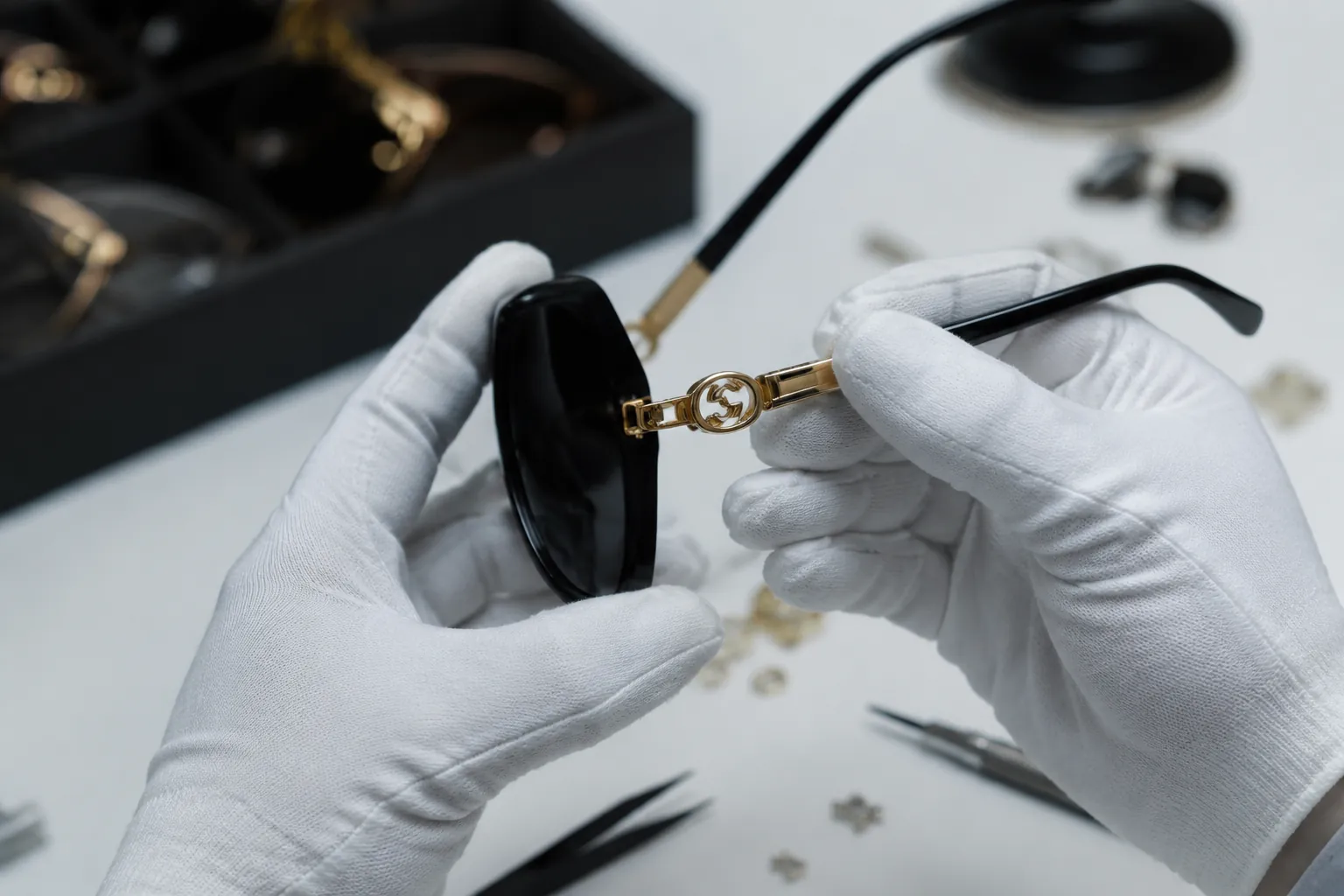
This guide is for brands, importers, distributors, and retailers planning sunglasses with metal logo plates, temple badges, metal strips, screw emblems, or decorative hardware. Metal details can make acetate, TR90, PC, or injection-molded frames look more premium. They also add risk. Common defects are predictable: loose plates, crooked placement, glue overflow, plating color drift, scratched badges, burrs, corrosion, and poor left-right symmetry. The buyer's job is simple: define the construction, finish, placement, testing, and inspection standard before mass production. Do that early. Sampling moves faster, bulk inspection gets clearer, and disputes are easier to avoid.
1. Decorative Trim or Structural Hardware?
Metal logo parts on sunglasses fall into two practical groups. The first is decorative: a small logo plate on the temple, a badge near the hinge, a thin metal strip on the front corner, or a laser-etched insert in a shallow pocket. These parts mainly affect appearance.
The second group is structural or semi-structural: hinge covers, rivet-style trims, bridge pieces, screw-fixed emblems, or metal parts that need bosses, holes, pins, molded seats, or extra frame thickness. These parts change the frame design, not just the decoration.
This distinction affects tooling, cost, and inspection. A surface-mounted 12 mm × 4 mm plate may be added to an existing temple if the surface is flat enough and the bonding area is large enough. A flush badge is different. It needs a recess designed around the actual badge thickness, adhesive layer, and final height. In many eyewear projects, the recess is made slightly deeper than the plate thickness to allow adhesive and seating control. Still, confirm the depth by sample testing. Do not rely on a generic rule.
A screw-fixed badge needs more than a screw hole. The frame must have enough material around the hole to prevent cracking, whitening, or thread stripping. For injection-molded frames, this may require a molded boss or reinforced area. For acetate, the hole position and local wall thickness must be checked before drilling. Acetate pockets are often CNC milled. Injection-frame seats may be built into the mold or added by secondary machining, depending on volume, frame design, and tooling budget.
Factory floor rule: if the metal logo must sit flush, design the pocket before tooling or CNC programming. Do not ask the line to "make it fit" after bulk frames are already molded.
2. Metal Logo Options Compared
There is no single best metal logo method. The right choice depends on frame material, target retail price, logo detail, order quantity, wear conditions, and the inspection standard the buyer is willing to enforce.
Thin plates are usually easier to control. Die-cast badges look heavier and more dimensional, but they add weight, adhesion risk, and balance issues. Long metal strips need accurate curve matching. If the strip does not match the temple curve, the ends may lift after flexing, heat exposure, or long storage.
| Option | Typical Size / Thickness | Best Use | Fixing Method | Main Risk |
|---|---|---|---|---|
| Stamped metal plate | About 8-25 mm long, commonly 0.2-0.5 mm thick | Simple logos, medium/high volume programs | Adhesive, pins, or shallow recess | Fine logo edges can lose sharpness if line width is too small for stamping |
| Die-cast badge | About 10-30 mm long, commonly 0.8-2.0 mm thick | Raised 3D logos and luxury-style temples | Pins plus adhesive or micro screws | Heavy badges can detach if the fixing relies only on weak bonding area |
| Laser-etched insert | Commonly 0.2-0.6 mm thick | Fine text, serial-style marks, minimalist branding | Adhesive into milled recess | Etching contrast can vary by finish, plating color, and brush direction |
| Decorative metal strip | About 20-80 mm long, commonly 0.3-0.8 mm thick | Premium temple line or front corner detail | Long recess with adhesive, sometimes held by fixtures during curing | Ends can lift if the strip curve does not match the frame curve |
| Screw-fixed emblem | Usually 1.0 mm+ thick | Sport, luxury, or visible hardware design | Micro screws into prepared holes or reinforced areas | Screw loosening, stripped holes, cracked bosses, or stress whitening |
For a first custom sunglasses project, a stamped or laser-etched plate in a shallow recess is often the safer premium option. It gives a clear brand mark without the weight and assembly complexity of die-cast hardware.
If a supplier offers low-MOQ production, ask how the metal part is made. New tooling, existing generic hardware, laser cutting, and small-batch machining all have different limits for cost, repeatability, and finish control.
3. Placement Rules That Stop Crooked Bulk
Most metal logo defects are not caused by the metal part. They are caused by vague placement instructions. "Logo on side" is not a production spec.
A temple badge needs measurable reference points: distance from hinge barrel, distance from top or bottom edge, orientation angle, and whether the badge follows the temple curve. A front-corner badge needs distance from the lens groove, frame edge, hinge screw, or front bevel. Make the location measurable. Make it inspectable.
For recessed plates, a placement tolerance around ±0.3 mm is often achievable when the pocket or jig controls the location. Confirm this on the actual frame material and fixture. For surface-mounted plates, ±0.5 mm is usually more realistic unless a dedicated fixture is made. For long strips, define the end gap tolerance too, such as the maximum visible gap allowed at either end. If the plate must be centered vertically on a temple, state the centerline and reference edge. Do not rely on visual alignment.
- Provide vector artwork and final plate size in millimeters, not only a logo file.
- Mark placement on a 1:1 frame drawing or annotated sample photo.
- State whether the logo is flush, raised, or inset; even a small raised edge can show on glossy frames.
- Confirm left and right temple orientation separately to avoid mirrored, reversed, or mismatched logos.
- Approve one physical pre-production sample before bulk decoration starts.
Symmetry is a common failure point. Buyers may approve one temple photo and forget the opposite side. Then bulk arrives with the left badge too close to the hinge or mirrored incorrectly. For branded retail programs, request photos of both temples, plus a top view, side view, and worn-angle view before sign-off.
4. Fixing Methods: Glue, Pins, Screws, Heat
A metal plate on plastic or acetate is a mixed-material joint. Metal, acetate, PC, TR90, and other plastics react differently to flexing, sweat, sunscreen, humidity, and heat. The fixing method must match the frame material, badge weight, bonding area, curvature, and use environment.
Adhesive-only fixing is common for thin plates on flat temples. It works best when the surface is clean, the adhesive suits both materials, the adhesive layer is controlled, and the part is held in position during curing. A thin plate with broad contact area is safer than a small heavy badge with only a few contact points.
Curved temples make bonding harder. The metal part should be pre-curved or held in a fixture during curing. Otherwise, the ends can lift. It may pass the first photo check and fail later.
Pins add mechanical hold. A small badge may use two pins inserted into drilled or molded holes, often combined with adhesive. Screws can provide stronger retention, but they need controlled torque and enough local material thickness. Over-tightening can whiten PC, crack acetate, or strip a plastic boss. Heat staking can work on selected plastic frames, but it is process-sensitive. Too much heat can cause sink marks, gloss change, deformation, or whitening.
- Adhesive only: best for thin, light plates in a shallow recess on flat areas.
- Adhesive plus pins: better for thicker badges, curved temples, or areas that flex during wear.
- Micro screws: suitable for visible hardware styling, but screw holes, boss design, and torque must be specified.
- Heat staking: possible for some injection frames, but not a universal answer for acetate or thin parts.
During sampling, request basic retention checks on the approved construction: tape pull, light pry check, manual flex check, and post-curing visual inspection. For larger runs, add an inspection point after decoration and before lens insertion. Catch loose plates, glue overflow, and misalignment before final assembly and packing.
5. Materials, Plating, and Corrosion
Metal logo parts are small, but they sit in a high-contact area. Fingers, sweat, sunscreen, salt air, and cleaning chemicals can attack weak plating. A badge can pass visual inspection and still discolor after storage or wear if the base metal, plating thickness, undercoat, or protective lacquer is wrong.
Common base materials include stainless steel, brass, zinc alloy, and aluminum. Stainless steel has good corrosion resistance and works well for many thin plates or etched parts, but it is less suitable for some deep 3D shapes. Brass gives good stamping quality and a strong plating appearance. Zinc alloy is common for die-cast badges, but it needs tight plating control. Aluminum is light, but surface treatment, color stability, and scratch resistance must be tested on samples.
Common finishes include nickel color, gunmetal, gold tone, rose gold, black plating, brushed finish, and enamel fill. Gold tone and rose gold can show batch color variation more easily, so keep an approved color standard or signed sample. Black plating can show scratches on raised edges. Brushed finishes hide small scuffs but may reduce logo contrast. For enamel fill, define the Pantone target, fill level, surface smoothness, and whether slight edge shrinkage is acceptable.
For overseas B2B buyers, compliance depends on product type, destination market, and material. Relevant eyewear and business requirements may include CE EN ISO 12312-1, ANSI Z80.3, AS/NZS 1067, REACH, FDA registration, ISO 9001, and BSCI, depending on the market and buyer program. For metal trims, REACH matters because coatings and metal parts may involve restricted substances. Lens performance still needs its own compliance path. A premium logo plate does not prove UV protection.
6. MOQ, Cost, and Lead-Time Logic
Metal hardware changes both cost and timing. The added cost is not only the badge. It can include artwork conversion, stamping or die-casting setup, mold or die charges, plating setup, plating loss, sorting, placement labor, adhesive cure time, fixture use, and extra QC. If the frame needs a recessed pocket, tooling, mold modification, or CNC programming may also be required.
Lead time depends on what is already available. The fastest route is usually an existing frame, standard lens tint, simple metal plate shape, standard plating color, and confirmed artwork. New metal tooling, special plating, strict color matching, enamel fill, or frame pocket changes can add time. Ask suppliers to separate sample time, tooling time, bulk production time, packaging approval, and freight or courier transit. One broad delivery estimate hides the risk.
| Order Level | What Usually Changes | Buyer Expectation | Risk to Manage |
|---|---|---|---|
| 50 pairs/design | Small-batch decoration and limited setup spread | Useful for market testing, influencer seeding, or sales samples if the supplier supports this quantity | Higher unit cost, limited hardware options, and less process economy |
| 300 pairs/design | Better material planning and more stable labor flow | Suitable for boutique brand launch or a controlled first buy | Confirm consistency across all frame colors and lens combinations |
| 1000 pairs/design | Hardware setup cost spreads better | Stronger price position and clearer QC planning | Define AQL, packing method, signed sample, and allowed cosmetic limits |
| 5000+ pairs/design | Dedicated scheduling and batch-level hardware control become more practical | Better unit economics if the construction is stable and repeatable | Batch plating, color matching, incoming hardware inspection, and replacement-part control become critical |
Do not approve pricing before confirming the logo construction. A surface-mounted thin plate and a recessed die-cast badge with pins are not the same product, even if both are quoted as "metal logo sunglasses." Ask the supplier to state the metal material, finish, fixing method, placement method, sample approval process, and inspection standard in the quote or product specification sheet.
7. Sample Approval Before Bulk
The sample is not only for judging style. It becomes the control standard for mass production. Inspect it like a production reference, not a social media photo.
Check the logo size with calipers. Compare the plate position to the approved drawing. View both temples from the side, top, and front. Open and close the temples repeatedly. Lightly flex the temple by hand to see whether the badge edge lifts, catches, or shifts.
Inspect the metal part under daylight and indoor light. Some gold, rose gold, and gunmetal finishes shift noticeably under warm lighting. Check for burrs on badge edges, scratches on raised details, plating bubbles, glue overflow, gaps, uneven seating, and enamel defects. Run a microfiber cloth lightly across the badge. If the edge catches, the edge radius, plate seating, or recess depth may need adjustment. For long strips, check both ends after mild hand flexing.
- Confirm plate size, thickness, finish, and logo orientation against the drawing.
- Check whether the badge is flush, raised, or recessed exactly as specified.
- Inspect glue line, edge gaps, plating defects, scratches, burrs, and enamel fill.
- Confirm lens tint, UV claim, frame color, and hardware finish as one complete product.
- Ask the factory to keep a signed golden sample for bulk comparison.
If the approved sample has a crooked plate, bulk production may copy that crooked plate. Approval must be specific. Sign the sample, keep clear photos, record allowed deviations, and list open corrections in writing before production starts. If a correction is required, request a corrected sample or written engineering confirmation before approving bulk decoration.
8. Bulk QC and Packing Points
Metal logo sunglasses need more than a standard lens and frame check. The badge is a visible brand mark. Consumers notice defects there first.
At incoming hardware inspection, check plate dimensions, plating color, burrs, logo clarity, finish consistency, and quantity before parts enter assembly. During decoration, check placement at the start of each shift, after any fixture adjustment, and whenever the operator, adhesive batch, or frame color changes.
Final QC should cover frame alignment, lens fit, hinge movement, logo position, plating defects, loose parts, glue marks, sharp edges, and packing rub risk. A raised badge can scratch another frame during transport if the polybag, pouch, or tray is too tight. If the plate has sharp corners, specify an edge radius or approved edge condition. For premium programs, consider individual sleeves, protective film on metal badges, or trays that prevent temple-to-front contact.
Define defect classes before production. A loose badge, reversed logo, missing plate, sharp burr, or visible plating peel is normally a major defect because it affects function, safety, or brand presentation. Small cosmetic marks may be minor or major depending on position, size, contrast, and retail price level. The cleanest approach is to attach photos to the inspection standard, set acceptance limits before production, and compare bulk output against the signed golden sample.
Have a custom sunglasses project in mind?
Send us your styles, target market and quantities and we will return a detailed quote with MOQ, lead time and a sample plan.
Get a QuoteWhy source this from Wenzhou with LumiShades
Wenzhou in Zhejiang Province is widely regarded as China’s eyewear manufacturing capital, producing a large share of the world’s sunglasses. That concentration matters to buyers: a deep local supply chain for acetate sheet, hinges, lens blanks, plating and packaging means shorter component lead times, easier color and material matching, and a workforce with decades of eyewear-specific skill. LumiShades has manufactured in this ecosystem since 2009, and our vertical integration — in-house injection molding, acetate cutting, CNC milling, lens tinting, decoration and quality control — means no part of your order is quietly subcontracted to a workshop you cannot audit.
For international buyers, that vertical control translates into accountability. When a single factory owns every step, defects are traced and fixed at source rather than bounced between vendors, and your specifications survive intact from first sample to bulk. We back this with 15+ years of experience, shipments to 60+ countries, more than 5 million pairs produced per year and a 98.5% on-time delivery rate. Our certifications — CE EN ISO 12312-1, FDA registration, ANSI Z80.3, AS/NZS 1067, REACH, ISO 9001 and BSCI audit — mean the compliance documentation your market requires already exists. Explore our manufacturing capabilities and quality control process to see how this works in practice.
Frequently asked questions
What is the safest metal logo method for a first custom sunglasses order? For most first orders, choose a thin stamped or laser-etched plate in a shallow recess on a relatively flat temple. Ask the supplier to confirm the plate material, thickness, recess depth, adhesive type, and placement tolerance on a pre-production sample before bulk decoration starts.
Can I order only 50 pairs with metal logo plates? Some suppliers support low-MOQ metal logo projects, but the exact minimum depends on frame availability, logo method, metal tooling, plating color, and packaging. At 50 pairs, expect a higher unit cost and fewer custom hardware options. Confirm whether the logo is made from existing hardware, laser-cut parts, or new tooling before approving the quote.
What placement tolerance should I specify for temple badges? For recessed plates, ±0.3 mm is a reasonable target when the pocket or jig controls placement, but it should be verified on samples. For surface-mounted plates, ±0.5 mm is often more realistic unless a dedicated fixture is used. Always define reference points, such as distance from hinge, top edge, and temple centerline.
Which fixing method is strongest? Pins plus adhesive or screws usually provide stronger mechanical retention than adhesive alone, but they only work well when the frame has enough material around the holes. For thin plates on flat temples, adhesive in a recess may be sufficient. For heavier badges, curved temples, or flex areas, request pins, screws, or another mechanical support and test the sample for lifting.
Will metal badges affect eyewear compliance? They can affect restricted-substance compliance because metal parts and coatings may fall under REACH requirements. Sunglass performance still needs separate verification under applicable standards such as CE EN ISO 12312-1, ANSI Z80.3, AS/NZS 1067, and FDA registration where relevant. ISO 9001 and BSCI relate to management and social compliance, not lens UV performance.
How long do samples and bulk production take? Timing depends on whether the frame, lens, metal part, plating color, and packaging are already confirmed. Ask the supplier to quote sample time, tooling time, bulk production time, and transit time separately. New badge tooling, special plating, enamel fill, or a recessed frame pocket can add days or weeks compared with a standard frame and simple plate.
What defects should I watch for during bulk inspection? Check crooked placement, reversed left/right logos, glue overflow, loose plates, plating color variation, burrs, scratches on raised edges, enamel defects, and inconsistent seating height. Also inspect packaging because raised metal badges can rub against frames in transit. Use the signed golden sample and annotated defect photos as the inspection reference.
Ready to start?
Explore our shield & oversized sunglasses or request a quote — our sales team replies within 12 hours.
Request a Quote