
ODM Sunglasses Catalog Selection for Faster Private Lines
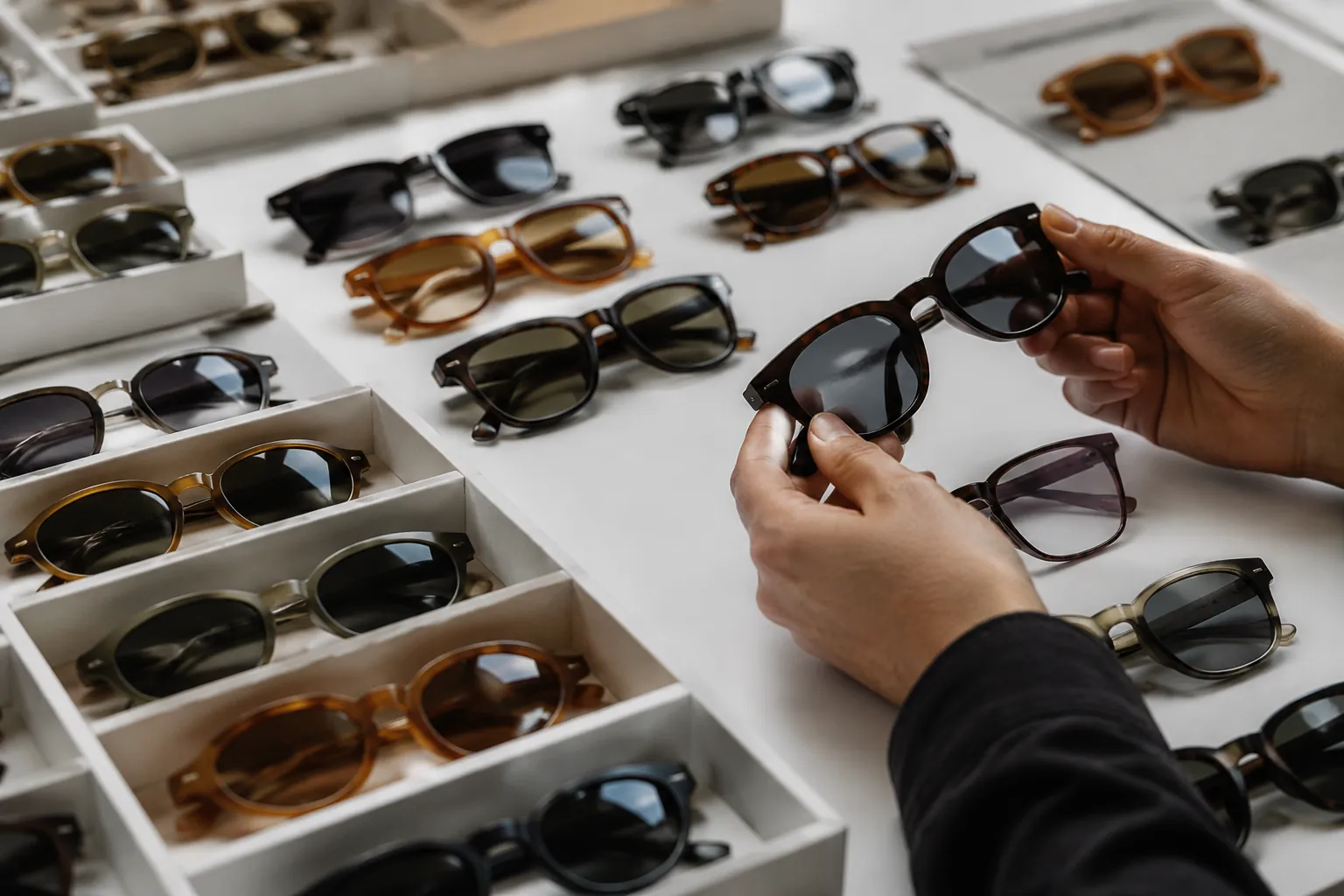
For overseas brands, importers, distributors, and retailers, ODM sunglasses are the fastest route to a private-label line when full OEM tooling is too slow or too expensive. Instead of opening a new mold, you start from factory-ready frames and customize the commercial specification: frame color, lens type, logo method, surface finish, packaging, labeling, barcode, carton mark, and compliance file. When the catalog style is active and the brief is complete, ODM catalog selection can move from shortlist to approved sample in 7-10 days and into bulk production in about 25-35 days after sample approval. The goal is not only speed. A strong ODM program also protects MOQ, unit cost, fit consistency, inspection standards, and market compliance.
The ODM Decision: Speed First, Tooling Later
ODM sunglasses sourcing means selecting an existing factory frame and changing the visible specification around it. The mold, hinge position, lens groove, bridge geometry, temple angle, screw structure, and assembly fixtures already exist. That is the commercial value: the buyer gets a proven product platform without paying for full frame engineering.
For seasonal assortments, distributor trials, resort programs, influencer kits, retailer pitches, promotional campaigns, and first private-label launches, ODM is often the practical route. At LumiShades in Wenzhou, MOQ starts at 50 pairs per design. Samples normally take 7-10 days when the base frame is active and the artwork file is clear. Bulk production usually runs 25-35 days after sample approval, material confirmation, and packaging sign-off. Full OEM can make sense later, but it normally requires 3D design, prototype adjustment, mold opening, fitting rounds, tooling correction, and higher upfront cost.
The key limit is structural control. In ODM, you can usually change frame color, lens color, lens category, logo placement, pad printing, laser engraving, metal logo plates, pouch, case, barcode label, hang tag, insert card, and carton marks. You should not expect to change bridge width, lens groove depth, hinge location, screw size, pantoscopic angle, or temple curve without moving into semi-OEM or OEM work. Those changes affect fit, tooling, QC gauges, assembly process, and sometimes compliance testing.
Buyer rule: choose ODM when the frame shape is commercially close enough and the main business risk is launch speed, not engineering originality.
How To Read A Factory Catalog Like A Buyer
A sunglasses catalog is not a fashion lookbook. Treat it as a production menu. Every shortlisted frame should be checked for material, mold condition, hinge type, lens base curve, surface finish, decoration area, and previous production history. A strong product photo does not prove the mold is stable, the frame fits your target market, or the lens can support your claim.
Ask for the factory style code, frame measurements, material, lens width, bridge width, temple length, total front width, lens category options, hinge specification, color chip options, current production status, and previous order notes. For acetate styles, confirm whether the frame is cut from acetate sheet or made from injection plastic with an acetate-like finish. For injection frames, ask whether the mold is active, how many cavities it has, when it was last used, and whether previous bulk orders showed fitting, shrinkage, lens-retention, or surface defects.
- Frame width: confirm total front width and temple length before assuming fit for EU, US, Australia, Southeast Asia, or Latin America buyers.
- Lens tooling: check whether replacement lens tooling exists for solid, gradient, mirrored, polarized, category 3, or market-specific lenses.
- Hinge: standard metal hinges reduce cost; spring hinges add comfort but require tighter component control and assembly checks.
- Surface finish: matte frames show oil and rub marks faster; transparent colors reveal flow marks, bubbles, weld lines, and poor polishing.
- Logo area: flat temples accept pad printing more cleanly than curved temples; curved temples may need smaller artwork, laser marking, or a metal plate.
- Packaging fit: confirm whether the frame fits the proposed pouch, hard case, display tray, and carton layout before approving the packaging cost.
If a supplier cannot provide basic measurements and production notes, do not build a line around that style. You will be guessing on fit, cost, defect risk, and inspection criteria. Guessing becomes expensive after the purchase order is placed.
Customization Choices That Actually Change The Line
Most ODM programs become private and commercially distinct through a controlled stack of changes. A stock black frame with smoke lenses looks generic. The same mold in translucent olive, brown gradient lenses, a 6 mm metal temple plate, and a branded microfiber pouch can look like a separate retail product. The base structure is catalog-ready, but the buyer-facing identity is different.
LumiShades can manage injection molding, acetate cutting, CNC milling, lens tinting, laser engraving, pad printing, metal logo plates, assembly, and QC in-house. This matters because every extra process needs color matching, fixture control, drying time, adhesion checks, positioning checks, and final inspection. When decoration is outsourced to several vendors, schedule control becomes weaker and defect responsibility becomes harder to assign.
| Customization area | Best use | Process detail | Buyer caution |
|---|---|---|---|
| Frame color | Seasonal identity and private colorways | Pantone reference or physical chip; custom color needs sample approval before bulk | Transparent and matte colors need stricter checks for flow marks, scratches, bubbles, and color drift |
| Lens tint | Changing mood, lens category, and price tier | Solid, gradient, mirrored, polarized, or category-specific lenses can be selected | Visible light transmission, UV claim, and warning text must match the selling market |
| Pad printing | Simple temple logos, model codes, CE text, and lens category marks | Best on flat areas; simple placement is often controlled within about 1 mm after artwork approval | Small text can blur on curved, textured, rubberized, or coated surfaces |
| Laser engraving | Subtle, durable marks on suitable plastic or metal areas | No ink layer; fixture positioning and engraving depth must be controlled | Not all materials engrave evenly, especially soft coatings, translucent plastics, and thin metal trims |
| Metal logo plate | Higher perceived value on fashion frames | Requires plate tooling, adhesive or pin fixing, and stable placement fixtures | Longer setup and more risk if the temple has no recess, flat area, or enough thickness |
| Packaging | Retail programs, distributor kits, gift sets, and brand presentation | Pouch, case, cloth, hang tag, barcode, insert card, sticker, and carton mark can be specified | Case size, insert material, and carton count affect freight volume and retail shelf planning |
Do not customize every component in the first run. Pick two or three high-visibility points and control them well. A first ODM order with custom frame color, custom lens tint, metal plate, printed case, printed cloth, special barcode labels, multiple insert cards, and market-specific cartons has too many failure points unless the order volume justifies the process control.
A Practical Line-Building Process
A strong ODM line is not built by choosing random attractive frames. It starts with a range plan. Define the selling channel first: entry-price retail, mid-tier fashion, sports, kids, resort, promotional, airport travel retail, chain-store display, or online marketplace. Then assign frame shapes, materials, lens types, packaging levels, price targets, and compliance markets to each segment.
- Shortlist 12-20 catalog styles: request measurements, material notes, live sample photos, current colors, hinge details, and production status.
- Cut to 6-8 commercial styles: remove frames with risky fit, weak logo space, narrow market appeal, poor color compatibility, or unclear mold status.
- Define the color matrix: 2-4 colors per frame is usually enough for a first line; too many SKUs dilute MOQ and slow approval.
- Confirm lenses: select solid, gradient, mirrored, polarized, or category-specific lenses based on market requirement and price tier.
- Approve decoration artwork: fix logo size, position, color, method, tolerance, and file format before physical sampling.
- Sample and revise: check fit, hinge tension, lens color, print sharpness, packaging, label accuracy, barcode scanning, and carton marks together.
- Freeze the spec sheet: bulk production should begin from one approved specification file, not scattered chat messages.
For a small launch, 50 pairs per design can validate presentation, fit, and sell-through. Around 300 pairs per style, buyers usually see better setup allocation and more efficient material planning. At 1000 pairs, production scheduling, component purchasing, and QC sampling become more stable. At 5000+ pairs, unit cost can improve significantly, with suitable specifications reaching about $2.10 per pair depending on material, lens type, decoration, packaging, inspection requirements, and shipment plan.
Cost And Lead-Time Logic Buyers Should Expect
ODM pricing is not only the frame body. The final unit price includes frame material, lens type, hinge and screw cost, labor, decoration, packaging, QC, wastage allowance, and order quantity. A 50-pair order with a custom color carries more setup cost per unit than a 1000-pair order. That is factory math, not a pricing trick.
Lead time follows the same logic. A catalog frame in an existing color with one pad-printed logo is fast. A custom translucent frame color, polarized lens, metal logo plate, printed case, country-specific insert, and carton label require more approvals. Samples from LumiShades normally take 7-10 days when the frame exists and the customization file is clear. Bulk production usually needs 25-35 days after approved samples, confirmed materials, final artwork, and clean packaging files.
| Order scenario | Typical use | Cost behavior | Timing risk |
|---|---|---|---|
| 50 pairs per design | Market test, buyer presentation, influencer pack, distributor showroom | Highest unit cost because setup is spread across few units | Low if using existing colors, simple logo decoration, and standard packaging |
| 300 pairs per design | Small retail run, resort program, or distributor trial | Better price break and more stable material planning | Medium if several colors need matching, approval, and separate packing |
| 1000 pairs per design | Private-label launch, online range, or chain-store program | Stronger pricing and better production efficiency | Medium; AQL inspection, barcode control, and packaging accuracy become more important |
| 5000+ pairs per design | Large import, seasonal program, national rollout, or multi-store replenishment | Lowest practical unit cost, down to about $2.10 on suitable specs | Higher if artwork changes late, shipments split, or multiple markets need different labels |
The fastest ODM orders look simple on paper: approved catalog style, confirmed color chip, fixed lens category, one logo method, final packaging dieline, signed sample, and one frozen SKU file. Simple specifications ship on time.
Compliance Cannot Be Added At The End
Sunglasses are not only accessories. They protect eyes from visible light and UV exposure, so compliance must be considered during style and lens selection, not after packing. For the EU, CE EN ISO 12312-1 is the key sunglasses standard. For the United States, buyers commonly request FDA registration and ANSI Z80.3 alignment. For Australia and New Zealand, AS/NZS 1067 applies. REACH matters for restricted substances in frame materials, coatings, colorants, nose pads, adhesives, and printed inks.
LumiShades works with CE EN ISO 12312-1, FDA registration, ANSI Z80.3, AS/NZS 1067, REACH, ISO 9001, and BSCI. Buyers should not ask a supplier to print marks, category claims, UV claims, or warning text that are not supported by product documents. Unsupported claims create customs, retailer, marketplace, and recall risk.
Lens selection is where many ODM projects become weak. A darker lens is not automatically safer. UV protection, visible light transmission, optical quality, lens category, and warning text must match the destination market. Mirrored and gradient lenses need extra checking because coating thickness and tint variation can change transmission values across batches.
- Ask for documents: request applicable reports for the lens and frame combination or the closest tested equivalent before bulk production.
- Check labels early: confirm category marking, warnings, country text, barcode, importer details, and language requirements before packaging production.
- Control materials: review REACH-sensitive parts such as coatings, colorants, nose pads, adhesives, printed inks, and soft-touch finishes.
- Match claims: align UV400, polarized, category 3, mirrored, and kids claims with test data and destination-market rules.
- Keep records: save approved specs, test reports, artwork, batch details, inspection reports, and shipment documents for retailer audits.
QC Points That Separate Catalog Goods From Brand Goods
ODM does not mean accepting generic quality. The frame may come from a catalog, but the shipment must be checked against the buyer's private specification. The most common failures are small but commercially damaging: loose hinges, uneven temple opening, lens gaps, color drift, crooked logos, rough edges, poor polishing, mixed packaging, wrong lens stickers, or incorrect barcode labels.
For injection frames, inspect parting lines, sink marks, gate trimming, lens fit, screw tightness, hinge pull, surface gloss, and color consistency. Transparent injection colors are especially revealing because flow marks and bubbles are easier to see. For acetate frames, inspect sheet pattern consistency, CNC edge quality, polishing, temple alignment, rivet or hinge setting, and whether the front curve remains stable after heating and assembly. Acetate can look richer, but it is less forgiving if polishing and alignment are rushed.
A practical QC plan includes incoming material checks, in-process checks after molding or cutting, lens inspection, assembly checks, decoration checks, packaging checks, and final AQL inspection before shipment. LumiShades reports 98.5% on-time delivery, supported by in-house molding, lens tinting, decoration, and QC. Buyers should still define measurable pass criteria instead of relying on words such as good, premium, or acceptable.
- Fit: temples should open evenly and the frame should not twist on a flat inspection surface.
- Lens retention: lenses should sit tightly in the groove without visible gap, rattle, pressure mark, or stress whitening.
- Logo tolerance: simple temple marks are commonly controlled within about 1 mm after artwork and fixture approval.
- Color control: approve a physical chip or signed sample, not only a screen image, rendering, or catalog photo.
- Hinge control: hinge movement should feel consistent across the batch, without looseness, excessive stiffness, or screw back-out.
- Packing accuracy: barcode, model code, lens sticker, pouch, case, insert, carton mark, and PO quantity must match the SKU file.
How To Keep An ODM Line Exclusive
ODM frames use existing platforms, so exclusivity must be defined carefully. If you need a mold that no other buyer can use, that is OEM territory. If you need a line that looks private in your channel, ODM can work well through protected color recipes, lens combinations, logo hardware, packaging artwork, and agreed sales restrictions where possible.
Ask the factory what can realistically be reserved: a custom frame color, a lens-and-frame combination, a metal plate design, packaging artwork, a branded SKU file, or a regional non-disclosure arrangement. Be practical. A factory cannot honestly promise that a common aviator, square, round, cat-eye, or wayfarer-type frame will never appear elsewhere. It can protect your logo, artwork, approved color recipe, packaging files, and SKU specification.
The cleanest control tool is a style file for every SKU. Include factory frame code, buyer SKU, frame color reference, lens color, lens category, lens claim, logo method, logo size, packaging components, compliance market, barcode, carton quantity, inspection standard, approved sample date, and version number. That file becomes the shared language between buyer, factory, QC team, and forwarder.
For multi-country buyers, keep the base frame consistent and vary packaging or lens category only where required. Complexity multiplies quickly. A 12-SKU line with two packaging versions is manageable. A 12-SKU line with five lens claims, four logo methods, and country-specific cartons becomes a control problem that can slow production and increase inspection failures.
Have a custom sunglasses project in mind?
Send us your styles, target market and quantities and we will return a detailed quote with MOQ, lead time and a sample plan.
Get a QuoteWhy source this from Wenzhou with LumiShades
Wenzhou in Zhejiang Province is widely regarded as China’s eyewear manufacturing capital, producing a large share of the world’s sunglasses. That concentration matters to buyers: a deep local supply chain for acetate sheet, hinges, lens blanks, plating and packaging means shorter component lead times, easier color and material matching, and a workforce with decades of eyewear-specific skill. LumiShades has manufactured in this ecosystem since 2009, and our vertical integration — in-house injection molding, acetate cutting, CNC milling, lens tinting, decoration and quality control — means no part of your order is quietly subcontracted to a workshop you cannot audit.
For international buyers, that vertical control translates into accountability. When a single factory owns every step, defects are traced and fixed at source rather than bounced between vendors, and your specifications survive intact from first sample to bulk. We back this with 15+ years of experience, shipments to 60+ countries, more than 5 million pairs produced per year and a 98.5% on-time delivery rate. Our certifications — CE EN ISO 12312-1, FDA registration, ANSI Z80.3, AS/NZS 1067, REACH, ISO 9001 and BSCI audit — mean the compliance documentation your market requires already exists. Explore our manufacturing capabilities and quality control process to see how this works in practice.
Frequently asked questions
Can I put my logo on an ODM catalog style at 50 pairs? Yes, if the logo method suits the frame. Pad printing or laser engraving is usually practical at low MOQ. Custom metal plates may require plate tooling, extra sampling, placement fixtures, and a more stable order quantity.
Will my ODM sunglasses be exclusive? The base mold may not be exclusive. Your color recipe, lens combination, logo, packaging, artwork, barcode file, and SKU specification can be private if they are clearly documented with the factory.
How fast can I receive samples for catalog-based sunglasses? For LumiShades, ODM samples usually take 7-10 days when the frame exists and the customization file is clear. Custom lens tinting, metal logo plates, printed packaging, or unclear artwork can add approval time.
Which compliance documents should I request before bulk production? Request documents relevant to your market, such as CE EN ISO 12312-1 for the EU, ANSI Z80.3 and FDA registration for the US, AS/NZS 1067 for Australia and New Zealand, plus REACH where required.
What quantity gives a meaningful price break? MOQ starts at 50 pairs per design, but pricing usually improves around 300, 1000, and 5000+ pairs because setup, material purchasing, decoration, labor, packaging, and QC are spread across more units.
Should I choose acetate or injection frames for an ODM launch? Choose acetate for richer hand feel, layered color, and a premium look, but expect stricter polishing and alignment control. Choose injection frames for lower cost, faster scaling, and broader color testing.
Ready to start?
Explore our sport wrap sunglasses or request a quote — our sales team replies within 12 hours.
Request a Quote