
Stock-Mold OEM Sunglasses: No New Tooling
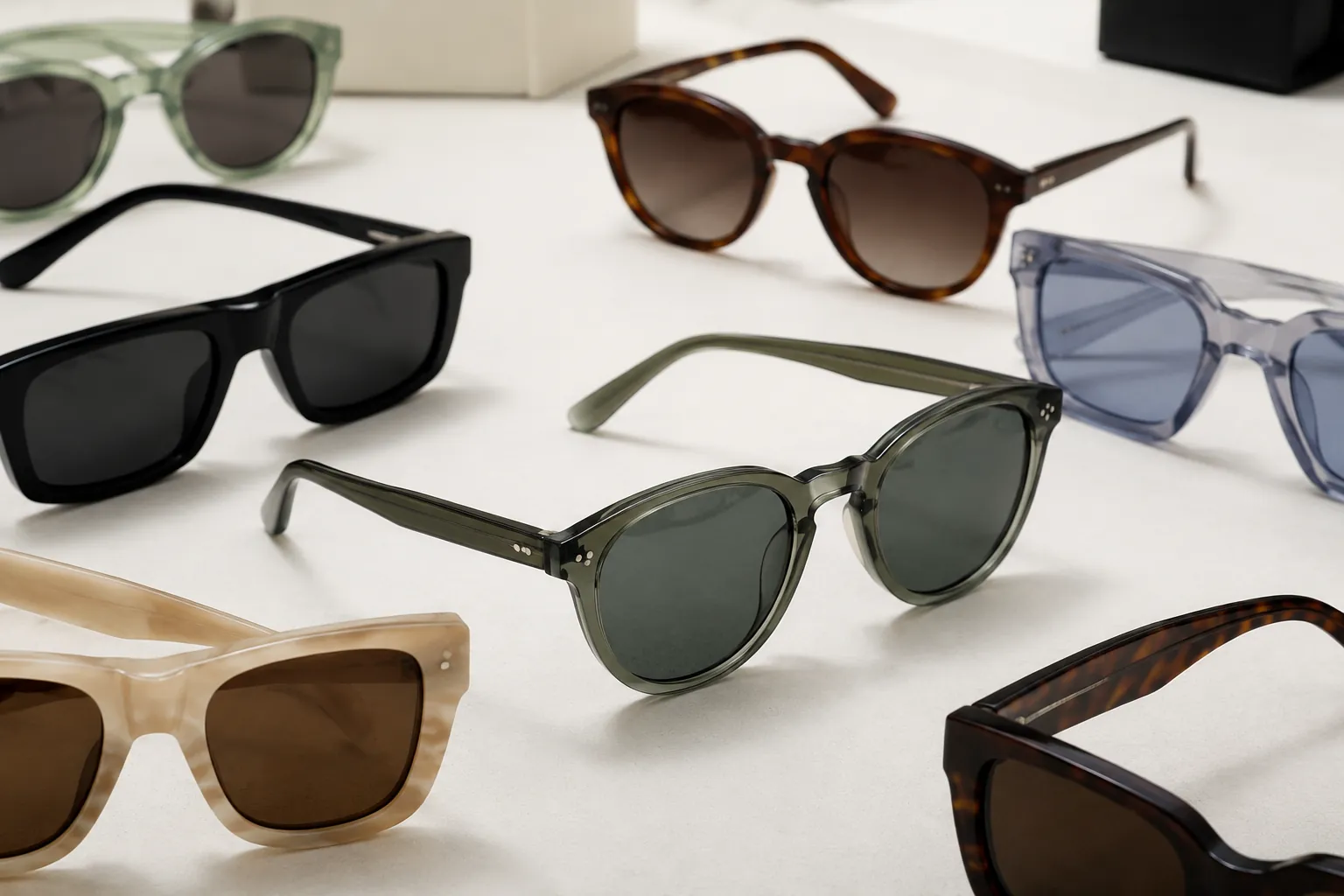
This guide is for brands, importers, distributors, and retailers that want custom sunglasses without paying for new frame tooling. Stock-mold OEM production uses existing frame molds and customizes the parts buyers notice: colors, lenses, logos, hardware, packaging, labels, and compliance details. It is often the fastest low-risk route for testing an eyewear line, building a private-label range, or preparing retail-ready sunglasses before investing in exclusive tooling.
Start with the frame. Customize the visible parts.
A stock mold is an existing frame tool owned or controlled by the manufacturer. The buyer chooses a frame shape from the supplier's model library instead of paying to develop a new injection mold, acetate forming setup, or metal frame construction.
The frame geometry usually stays fixed. That means lens shape, bridge, temple length, hinge position, front curve, rim structure, and lens seating do not change unless new tooling or engineering work is added. Do not assume small changes are simple. In eyewear, a small geometry change can affect fit, lens retention, assembly, and testing.
What can change? Usually the visible and commercial details: frame color, lens color and function, logo method, hinge or screw color, temple decoration, nose pads, pouch, case, retail box, barcode label, country-of-origin mark, warnings, and compliance text.
This route works well for first orders, seasonal drops, retailer tests, promotional programs, and distributor assortments. It is not the same as buying an off-the-shelf catalog item. A serious stock-mold OEM order still needs a written specification covering model code, material, color target, lens category, UV requirement, logo artwork, packaging, carton marks, inspection criteria, and destination-market compliance.
Where stock molds save money, and where they do not
The main saving is tooling. New frame tooling requires upfront cost, engineering time, sampling, fit correction, and production trials before the first approved product is ready. With a stock mold, the basic frame geometry has already been produced. The buyer can focus on branding, lenses, packaging, and quality control.
Stock mold does not mean every change is free. Custom frame colors require material preparation and color approval. Lens tinting, mirror coating, polarization, laser engraving, pad printing, metal logo plates, custom cases, retail boxes, printed inserts, and special labels can all affect cost and lead time.
Small runs can also have a higher unit cost. Setup, color changeover, lens cutting, decoration, inspection, and packing still take time. Those costs are spread over fewer pairs.
| Launch route | Upfront cost | Sample timing | Bulk timing | Best use |
|---|---|---|---|---|
| Stock mold with standard colors | Lowest | Usually shortest; confirm by model availability | Depends on quantity, lens type, decoration, and packaging | Retail tests, promotional orders, and reorderable basics |
| Stock mold with custom color and logo | Low to medium | Depends on color approval and logo process | Depends on approved sample, order size, and production queue | Private-label collections and seasonal launches |
| Stock mold with custom lenses and packaging | Medium | Depends on lens specification, coating, and packaging artwork | Can increase if packaging or labeling needs correction | Retail-ready brand launches and distributor programs |
| New private mold | Highest | Requires tooling, engineering review, and fit approval | Starts only after tooling, samples, corrections, and pilot production are accepted | Exclusive shapes, protected design language, and long-term proprietary programs |
Use a simple test. If the frame shape is not the product's main competitive asset, start with stock molds. Spend the budget on lens quality, fit consistency, durable decoration, compliant labeling, and inventory control.
Frame materials used in stock-mold programs
Most stock-mold sunglasses use injected plastic, acetate, metal, or combination construction. Each material has different cost drivers, finish limits, and inspection points. Ask for the exact material grade. Do not rely on broad labels such as "plastic" or "premium acetate."
- PC or injected plastic: common for sport, promotional, kids', and price-sensitive sunglasses. Check parting-line finish, gate marks, frame warpage, temple flexibility, lens retention, and surface scratches.
- TR90-style flexible material: often chosen for lightweight flexible frames. Confirm the actual material, color-matching method, heat resistance, and batch consistency.
- Acetate: gives stronger perceived value, deeper color, and a polished finish. It usually needs more cutting, tumbling, polishing, forming, hinge work, and manual adjustment than basic injected frames.
- Metal or combination frames: useful for fashion and optical-style sunglasses. Inspection should cover plating adhesion, solder joints, screw retention, nose pad comfort, temple alignment, and corrosion resistance where relevant.
For injection stock molds, ask whether the color is molded into the material or applied as a surface coating. Molded-in color usually reduces coating adhesion risk. Coating can create finishes raw material cannot. If coating is used, require adhesion and rub-resistance checks that match retail handling and the target market.
What can change without new tooling
Stock-mold OEM is flexible, but it has limits. Buyers can usually change surface finish, branding, lenses, hardware color, and packaging. They usually cannot change lens shape, bridge width, hinge location, frame curve, rim thickness, temple cross-section, or the lens seating method without creating tooling, fit, or assembly issues.
For branding, match the logo process to the material and order size. Laser engraving can be durable on suitable surfaces. Pad printing is economical for one-color or simple logos, but it needs rub-resistance and alignment checks, especially on curved temples. Hot stamping, metal logo plates, and embedded decorations can look more premium, but they add process steps and positioning risk.
Keep early branding simple. A clean one-color logo in a realistic size is easier to produce and inspect than a tiny multicolor mark.
Lens specification needs more detail than "gray lens" or "UV lens." State whether lenses are non-polarized, polarized, solid tint, gradient, mirror coated, photochromic, or category-specific. For general sunglasses, buyers often request UV400 protection. The order should also state the applicable market standard and test basis. Common references include CE EN ISO 12312-1 for Europe, ANSI Z80.3 for the United States, AS/NZS 1067 for Australia and New Zealand, REACH for restricted substances in EU products, and FDA registration where relevant for U.S. sunglasses handling and importer obligations.
- Choose the stock frame model and confirm the supplier's model code.
- Confirm the frame material and whether color is molded, coated, plated, or laminated.
- Approve frame color using Pantone, RAL, a physical color chip, or a signed reference sample.
- Specify lens function, tint, visible light category, UV requirement, coating, and polarization if required.
- Select logo placement, process, color, artwork size, and position tolerance.
- Define screws, hinges, nose pads, temple tips, decorative parts, and metal finish where applicable.
- Lock packaging: pouch, microfiber cloth, case, hangtag, retail box, barcode, insert, master carton, and pallet requirements if used.
- Confirm compliance marks, warnings, language requirements, and destination-market documentation before production.
Build a specification sheet before sampling
A good specification sheet prevents slow sampling and weak inspections. The supplier cannot inspect against an expectation that was never written down. The approved sample matters, but it should be backed by measurements, material notes, artwork files, packaging files, and acceptance criteria.
For dimensions, use the standard eyewear size format: lens width, bridge width, and temple length. Add frame front width, lens height, base curve, and temple opening if fit is important for your channel. Stock molds have fixed dimensions, but the approved sample should still be measured and recorded.
Use realistic tolerances. Zero deviation is not a QC plan.
Color control also needs discipline. Pantone or RAL references are useful starting points, but plastic, acetate, metal plating, coatings, lenses, and printed paper reflect light differently. For brand-critical colors, approve a physical chip, lens swatch, or pre-production sample under controlled lighting. Keep one signed reference sample with the supplier and one with the buyer or inspection team.
Buyer note: the approved sample is the physical reference for mass production. If you approve a sample with weak hinge feel, a lens tint that is too warm, or a logo that is too large, do not expect bulk production to correct it automatically. Corrections must be written, confirmed, and re-sampled where needed.
The specification should also state inspection level, acceptable and unacceptable defects, barcode format, country-of-origin marking, carton labeling, suffocation warnings where polybags are used, packaging material restrictions, and retailer-specific label placement if required. Many shipment problems come from wrong cartons, missing warnings, incorrect SKU labels, or noncompliant inserts. The sunglasses may be fine. The shipment can still fail.
Sampling: reduce correction rounds
Sampling time depends on model availability, color requirements, lens specification, decoration process, packaging complexity, and the supplier's production schedule. Ask for a written sampling plan. Do not assume a fixed timeline.
The common delay points are predictable: low-resolution artwork, vague color descriptions, changing lens requirements after sampling, unapproved packaging dielines, and late compliance text.
Use a clean approval sequence. First, approve the stock frame model and fit, even if the first fit sample is in an available factory color. Second, approve color chips, lens swatches, or material references. Third, approve a branded sample with the final lens, logo, hardware finish, and packaging. For larger or retail-critical orders, request a pre-production sample made with the same materials and processes planned for bulk production.
- Artwork: send vector files and define exact logo width, color, process, and position from a fixed reference point.
- Lens: specify UV requirement, lens category, tint, coating, polarization, and test standard for the target market.
- Color: provide Pantone or RAL plus a physical reference if the shade is brand-critical.
- Packaging: approve dielines, warning text, barcode data, country-of-origin text, insert copy, and carton marks before bulk packing.
- Fit: test the sample on real users or fit models where possible. Check bridge comfort, temple pressure, pantoscopic angle, lens coverage, and stability during movement.
If the launch date is fixed, approve the frame, lens route, and compliance route early. Packaging can run in parallel. Do not leave it until the eyewear is already produced.
Bulk production and QC points to watch
Bulk timing should be confirmed by purchase order, approved sample date, material availability, lens type, decoration process, packaging readiness, and inspection schedule. Do not measure lead time from the first quotation or informal sample discussion. Measure it from the point where the supplier has final approved specifications, artwork, packaging files, order quantity, payment terms, and delivery requirements.
Production flow depends on material. Injected frames may involve material drying, color mixing, injection molding, trimming, surface finishing, hinge or screw assembly, lens cutting or fitting, decoration, adjustment, cleaning, inspection, and packing. Acetate frames may involve sheet cutting, CNC milling, tumbling, polishing, forming, hinge installation, lens fitting, adjustment, cleaning, and packing. Metal frames add more focus on plating, soldering, screw assembly, nose pad installation, and alignment.
QC should cover more than scratches. Check lens UV performance against the declared requirement, polarization if ordered, visible light category, lens color consistency, frame warpage, temple opening tension, screw tightness, hinge smoothness, logo adhesion, print position, coating defects, sharp edges, nose pad symmetry, lens retention, frame alignment, packaging accuracy, and carton labeling.
For export markets, confirm the correct compliance basis before shipment: CE EN ISO 12312-1, ANSI Z80.3, AS/NZS 1067, REACH, and FDA registration where applicable to the destination market and sales channel. ISO 9001 and BSCI can support supplier quality-management and social-compliance review. They do not replace product-level testing for the exact sunglass style and lens configuration ordered.
Request an in-line inspection or first-article check for the first mass-production pieces, especially when logo placement, lens coating, color matching, or packaging is new. Catch the error early. A wrong logo position or carton label is much easier to fix before the full order is packed.
Order quantity: test, consolidate, reorder
Order quantity should match the purpose of the order. Very small orders are useful for market validation, showroom presentation, influencer seeding, retailer review, or fit testing. They rarely deliver the best unit cost.
Medium quantities are better for a controlled private-label launch, especially when packaging and labeling are shared across several SKUs. Larger quantities can improve cost efficiency, but only after the frame model, material, lens, logo process, packaging, and inspection standards are stable.
Do not split an early order into too many frame colors, lens colors, or logo versions. Every extra colorway adds setup, QC references, packing separation, SKU management, and inventory risk. A stronger first program is often narrow: a few proven frame shapes, limited colors, one packaging system, and clear reorder rules.
For importers and distributors, reorder control matters more than squeezing the first order. Keep the stock model code, material description, lens code, color reference, logo artwork version, packaging dieline version, barcode data, compliance documents, inspection reports, and approved sample photos in one file. Reorders move faster when the original specification is complete and easy to find.
Have a custom sunglasses project in mind?
Send us your styles, target market and quantities and we will return a detailed quote with MOQ, lead time and a sample plan.
Get a QuoteWhy source this from Wenzhou with LumiShades
Wenzhou in Zhejiang Province is widely regarded as China’s eyewear manufacturing capital, producing a large share of the world’s sunglasses. That concentration matters to buyers: a deep local supply chain for acetate sheet, hinges, lens blanks, plating and packaging means shorter component lead times, easier color and material matching, and a workforce with decades of eyewear-specific skill. LumiShades has manufactured in this ecosystem since 2009, and our vertical integration — in-house injection molding, acetate cutting, CNC milling, lens tinting, decoration and quality control — means no part of your order is quietly subcontracted to a workshop you cannot audit.
For international buyers, that vertical control translates into accountability. When a single factory owns every step, defects are traced and fixed at source rather than bounced between vendors, and your specifications survive intact from first sample to bulk. We back this with 15+ years of experience, shipments to 60+ countries, more than 5 million pairs produced per year and a 98.5% on-time delivery rate. Our certifications — CE EN ISO 12312-1, FDA registration, ANSI Z80.3, AS/NZS 1067, REACH, ISO 9001 and BSCI audit — mean the compliance documentation your market requires already exists. Explore our manufacturing capabilities and quality control process to see how this works in practice.
Frequently asked questions
Can I change the frame size on a stock mold? Usually no. Lens width, bridge width, temple length, hinge position, frame curvature, and lens seating are built into the existing mold or frame construction. If size is critical, ask the supplier for nearby stock models with different dimensions. If none fit, budget for new tooling or a separately engineered frame.
What is the lowest practical MOQ for private-label sunglasses? The lowest practical MOQ depends on the supplier, material, lens type, logo process, and packaging. Ask for the MOQ by SKU and by colorway, not only by total order quantity. For early testing, keep variations limited so the supplier can control color, decoration, inspection, and packing accurately.
How long should I allow from sample approval to shipment? Ask the supplier to confirm lead time in writing after the final sample, artwork, lens specification, packaging files, order quantity, and payment terms are approved. Do not count from the first inquiry. Allow extra time for color correction, lens testing, packaging approval, final inspection, and freight booking.
Which compliance standards should I ask for? Match the requirement to the destination market and product type. Common references include CE EN ISO 12312-1 for Europe, ANSI Z80.3 for the United States, AS/NZS 1067 for Australia and New Zealand, REACH for EU restricted substances, and FDA registration where relevant for U.S. sunglasses handling. Ask whether testing applies to the exact lens and frame combination you are ordering, not only to a similar style.
Is a stock-mold style exclusive to my brand? Not automatically. A stock frame shape may be offered to multiple buyers. Your logo, color combination, lens choice, and packaging can be private to your order, but the underlying frame shape is generally not exclusive unless you sign a specific exclusivity agreement or invest in private tooling.
What should I send to the factory before sampling? Send the stock model code if already selected, target material, frame color reference, lens specification, logo vector file, logo size and placement, packaging requirements, destination market, compliance needs, barcode or SKU data, and any retailer labeling rules. Clear inputs reduce sampling rounds and make the first sample closer to production-ready.
What causes the most delays in stock-mold OEM orders? The most common delays are unclear color targets, low-quality logo files, changing lens requirements after sampling, late packaging dielines, missing warning text, unconfirmed compliance requirements, and buyer approval delays. Lock the frame, lens, logo, packaging, and market requirements before authorizing bulk production.
Ready to start?
Explore our aviator sunglasses or request a quote — our sales team replies within 12 hours.
Request a Quote