
Custom Sunglasses Color Matching: No Surprises
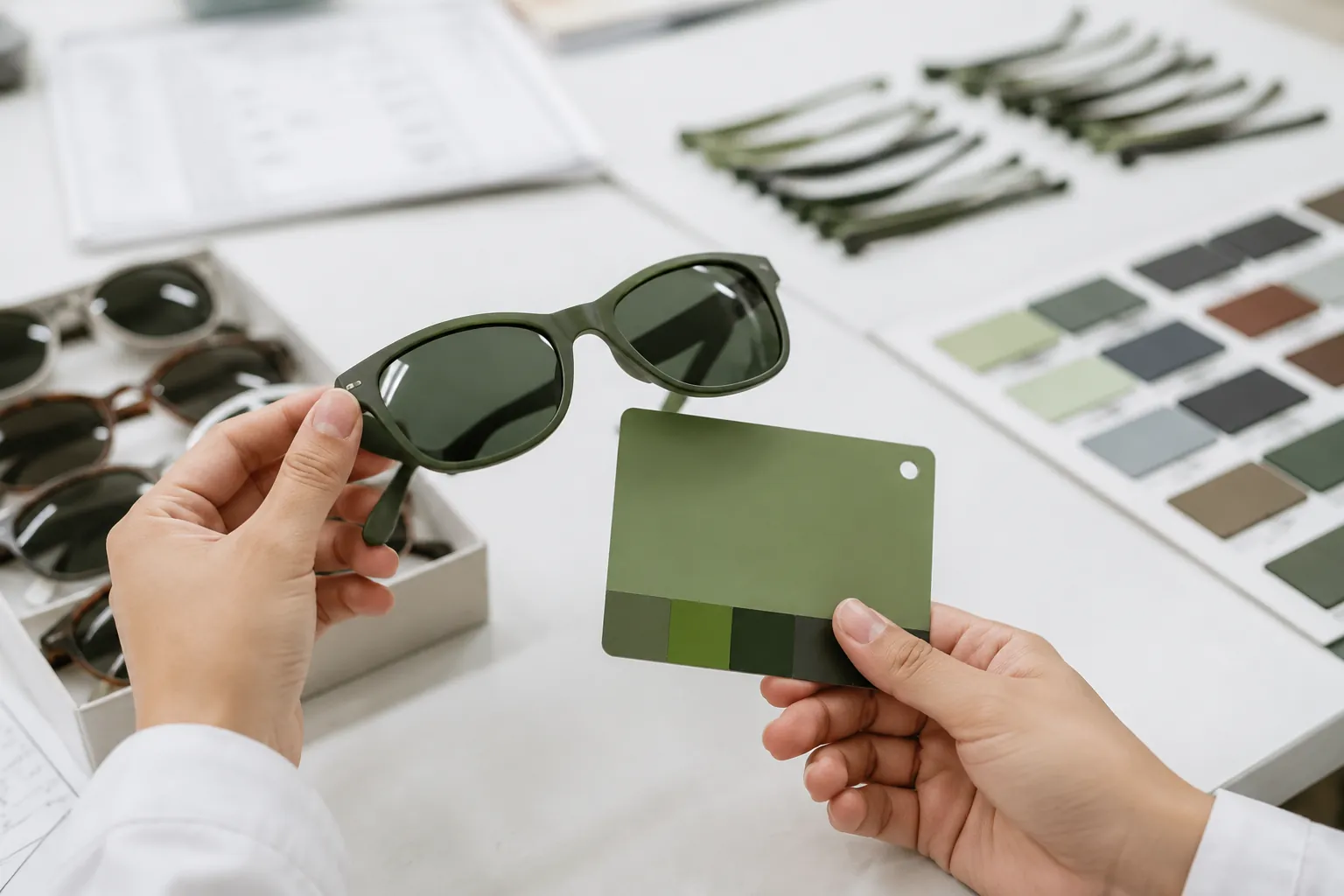
This guide is for brand owners, importers, distributors, and retail buyers who need custom sunglasses to match a brand color across frames, lenses, logos, and packaging. It shows where color shifts happen, which approvals matter, what tolerances are realistic, and how to keep repeat orders consistent. Use it to write better specifications, reduce rework, and catch color problems before bulk goods are assembled.
Start With a Color Control Sheet, Not a Mood Board
Screenshots and words like "navy," "cream," "champagne," or "smoke gray" are not production specs. They are clues. Sunglasses use several materials and processes: injected PC, PP, or TR90 frames; acetate sheets; tinted lenses; mirror coatings; pad-printed logos; laser marks; metal trims; microfiber pouches; and printed paper boxes. One Pantone target will not look the same on all of them. Each surface absorbs, transmits, and reflects light differently.
Before sampling, prepare a color control sheet for each SKU. For plastic and printed parts, Pantone Solid Coated references are commonly used, but the buyer and factory should confirm the exact Pantone guide and edition. Pantone books fade with handling and age. Older editions may not match newer books by eye. For high-risk brand colors, send a physical brand chip, approved product sample, or prior production sample in addition to the Pantone code.
A production-ready color control sheet should include:
- Frame: Pantone target or physical reference, material, finish, and whether the color is molded, sprayed, printed, plated, or selected from acetate sheet stock.
- Lens: material, tint name or target, visible light transmission target or filter category, gradient direction if any, mirror coating color if any, UV400 requirement, and polarization requirement if applicable.
- Logo: AI/PDF vector file, size, position, technique, ink, plating, engraving, or fill color, and minimum line width.
- Packaging: paper stock, pouch fabric, printing method, Pantone target, lamination or varnish, and the required proof or sample type.
- Approval rule: who approves, under what lighting, by what deadline, and whether the decision is based on physical samples, photo pre-checks, measured data, or a combination.
Do not approve final color from a phone photo. Camera white balance, screen brightness, compression, and factory lighting can hide a real mismatch. Photos are useful for pre-screening. Physical samples should decide production for color-critical parts.
Frame Color: Injection, Acetate, Spray, and Finish Behave Differently
Frame color is usually the largest visible brand element. It also causes the most disputes. The right tolerance depends on how the frame is made.
For injection molded PC, PP, or TR90 frames, color usually comes from pigment or masterbatch mixed with resin before molding. This method works well for solid brand colors and repeat programs because the recipe can be recorded and controlled. Still, the final shade can move with resin lot, pigment lot, processing temperature, cycle conditions, wall thickness, gate position, and surface texture. Gloss black and dark navy are more forgiving. Pale beige, neon, milky translucent, and high-chroma colors need tighter sampling control.
Acetate is different. Color is built into pre-made sheets before cutting, CNC milling, tumbling, and polishing. Tortoise, marble, crystal, and layered acetate patterns cannot be repeated pair by pair. Approve an acceptable range, not one perfect frame. If every unit must look almost identical, a solid injection frame is usually a better choice than patterned acetate.
Sprayed coatings help with small runs, special finishes, metallic effects, or colors that are hard to mold. They also add variables: coating thickness, base color, curing, adhesion, and scratch resistance. If the coating sits on high-contact areas such as temples or bridge surfaces, request adhesion and rub checks before approval.
Finish changes perception. Matte surfaces scatter light and often look lighter or chalkier than glossy surfaces using the same pigment. Translucent frames look different over white paper, skin, or darker lenses. For transparent smoke, jelly, or crystal colors, approve the assembled sample with lenses installed.
| Frame option | Typical MOQ logic | Color control level | Buyer warning |
|---|---|---|---|
| Injection molded PC/TR90 | Efficient when tooling, setup, and color mixing are spread across a sufficient quantity; confirm MOQ by model and color | Good after material and color recipe approval | Light colors show flow marks, weld lines, and batch variation more easily |
| Sprayed coating | Useful for smaller runs or special finishes when molding the color is not practical | Medium | Color shifts with coating thickness; adhesion, rub, and scratch checks are important |
| Acetate sheet | Best when suitable sheet stock is available or when custom sheet quantity is justified | Medium for solids, lower for patterns | Tortoise, marble, and layered patterns must be approved as a range |
| Transparent injection | Requires careful resin, pigment, and wall-thickness control | Medium | Lens tint, skin tone, background color, and wall thickness change appearance |
Lens Color Needs Tint, Transmission, and Coating Control
Lenses need their own approval method. Optical performance comes first. A lens can look close to a brand color and still fail sunglass requirements if visible light transmission, UV protection, or optical quality is wrong.
Confirm the selling market before sampling. Requirements may involve CE EN ISO 12312-1, ANSI Z80.3, AS/NZS 1067, REACH, and FDA registration requirements where applicable. FDA registration is not the same as FDA product approval. Buyers should confirm U.S. import and labeling obligations with their compliance team or testing provider.
Use Pantone only as a visual reference for lenses. The practical control points are lens material, tint depth, visible light transmission, UV400 performance, polarization if required, optical quality, and coating stack. For sunglasses, specify filter category or VLT range according to the applicable standard and intended use. Do not choose a lens only because it looks good on a color board. Test the assembled product.
Flat tint chips help, but they do not always predict the final look. Wraparound lenses can appear darker at the edges because curvature and thickness increase the optical path. Gradient lenses need top, middle, and bottom references. Mirror lenses require two approvals: the base tint and the mirror surface. A blue mirror over gray looks different from the same blue mirror over brown or green.
For practical approval, require at least one full pre-production sample under daylight or standardized daylight-equivalent light and indoor white light. If the product will be sold online, photograph the approved sample for internal reference. Keep the physical sample. For repeat orders, it is more reliable than a rendering or product photo.
Logo Color: Small Artwork Has Less Room for Error
Logo color matching sounds simple until the mark is only a few millimeters wide on a curved temple or lens. Tiny artwork behaves differently from a large packaging panel. Ink spread, line width, surface texture, curing, and base color all affect the result.
Common eyewear decoration methods include pad printing, silk screen printing for larger or flatter areas, laser engraving, hot stamping, and metal logo plates. Pad printing is often used for colored logos on temples or lenses because it can follow slight curves. The ink layer is thin. That matters.
Yellow, orange, light blue, or metallic ink printed directly onto dark or translucent material may look weak or dirty unless a suitable underbase is used and confirmed by sample. White ink on black plastic is often more stable visually, but adhesion and rub resistance still need checking.
Laser engraving does not create a Pantone color unless the groove is filled afterward. It exposes, melts, or changes the surface, so the result depends on the frame material. On black plastic it may look gray. On clear material it may be subtle. Metal plates can be plated, painted, printed, or enamel-filled, but metallic reflections make tight Pantone matching harder.
For logo approval, specify vector artwork, logo height, placement from hinge or lens edge, color, decoration method, and minimum line width. Avoid extremely fine lines unless the factory confirms feasibility on the actual surface and curvature. For exterior temple logos and lens logos, request rub resistance checks. A beautiful print that rubs off after handling is a failed decoration, even if the color matched at approval.
Factory-floor rule: the smaller the logo, the less useful a Pantone number becomes. Approve the physical mark on the actual frame or lens surface.
Packaging Color: Paper, Fabric, and Plastic Will Not Match Perfectly
Packaging often arrives late in the approval process. That is a mistake. If the retail box, microfiber pouch, hangtag, instruction card, and frame all carry the same brand color, they need color control from the start.
Paper printing is affected by stock color, absorption, ink density, lamination, varnish, and printing method. Pantone on white coated paper is easier to control than Pantone on kraft paper or uncoated stock. Matte lamination can make a color look duller and slightly lighter. Gloss varnish can make it look deeper. For retail boxes, request a printed proof, drawdown, or packaging sample. A digital mockup is not enough.
Microfiber pouches and cloth bags use dyed or printed fabric. Dye lots vary, and fabric texture changes color perception. A deep purple pouch may not match a purple paper box exactly even when both target the same Pantone. If close consistency is required, define one item as the master color and set acceptable variation for the others. If exact visual consistency is critical, reduce the number of substrates or use the same material and printing process wherever possible.
MOQ and cost also matter. Custom packaging may require print setup, dielines, pouch cutting, mold charges, or proofing charges, depending on the design. At low quantities, setup costs can take up more of the unit cost than buyers expect. Before approving a multi-component packaging system, ask which items are stock, which are custom, which require separate proofs, and which can be repeated later from stored files or retained color standards.
Sample Approval: The Gate That Prevents Bulk Mistakes
Sampling is where color problems should be found. Not after assembly. Lead time depends on the material, decoration, lens requirements, packaging proofing, and whether new color development is required. A standard-color frame with a simple temple print is usually faster than a custom acetate sheet, special lens tint, mirror coating, metal logo, or full retail packaging proof.
Do not schedule bulk production as if color matching is already solved unless the required samples have been approved.
A disciplined approval flow is simple:
- Send Pantone codes or physical references, artwork, lens requirements, market compliance target, packaging files, quantity target, and launch deadline.
- Factory checks feasibility against material, MOQ, decoration method, testing requirements, and schedule.
- Color chips or material swatches are made where needed, especially for injection colors, lens tint, acetate, coatings, and packaging.
- Pre-production samples are made using intended materials and decoration processes. If substitute parts are used, they must be clearly identified and should not be treated as final color approval.
- Buyer reviews under agreed lighting and records approval or change notes in writing.
- Factory and buyer keep an approved golden sample or approved component standards for production and QC reference.
- Bulk materials are purchased, mixed, printed, coated, or assembled based on the approved references.
Feedback must be specific. "Make it more premium" is not production guidance. "Frame is too blue; move closer to Pantone 2965 C, keep matte finish, no change to lens" is useful. If you change the Pantone target after approving a sample, expect another sample cycle. That is normal. It is also much cheaper than correcting bulk goods.
Tolerance: Define What Is Reasonable Before QC Starts
Professional buyers do not ask for "100% exact" color. That phrase creates false expectations. Different materials, lighting conditions, and viewing angles create visible shifts. Define tolerance by component, material, measurement method, and commercial risk.
For molded solid plastic, Delta E can be used when both buyer and factory have calibrated measurement tools and agree on the instrument, measuring geometry, surface area, backing, illuminant, and observer angle. Without that agreement, Delta E numbers can create disputes instead of solving them.
Many eyewear programs still use a practical visual tolerance: match the sealed golden sample with no obvious difference under agreed lighting at normal viewing distance. Transparent, neon, pearlescent, metallic, matte, patterned acetate, and gradient lens colors need more flexible visual judgment because instrumental measurement may not match what the customer sees.
Separate critical from non-critical colors. The front frame color, visible temple logo, and lens tint usually affect sell-through and brand perception. The inside cleaning cloth print, inner carton mark, or concealed component may not. This prevents QC from rejecting a shipment for a minor shade difference on a low-visibility item while missing a major mismatch on the frame.
For repeat orders, keep one approved sample with the buyer and one with the factory. The repeat PO should state: "Match approved sample from PO number X," not only repeat the Pantone code. If the factory claims ISO 9001 certification or BSCI audit status, ask for current documents and confirm they apply to the actual manufacturing site. These documents do not guarantee a color match, but they help buyers verify that the supplier has documented quality and social compliance systems.
Repeat Orders: Lock the Recipe Before the First Shipment Leaves
Repeat consistency is built before the first shipment, not after a buyer complains. It depends on disciplined records, retained standards, and clear purchase order instructions.
Before bulk production closes, ask for a production color record for repeatable items. Depending on the product, it may include the pigment or masterbatch code, mixing ratio, resin grade, acetate sheet reference, lens tint recipe, mirror coating reference, logo ink code, curing method, packaging print files, paper stock, finish, and approved sample photos. Photos help records. They should not replace the sealed sample or approved physical component standard.
If the order is likely to repeat, consider reserving or buying extra critical materials with the first order. This is especially useful for custom acetate sheets, unusual lens tints, special mirror coatings, custom logo hardware, or non-standard packaging paper. Storage planning matters. Check shelf life for inks, coatings, and adhesives.
QC should include incoming material checks, first-article approval, in-process checks, and final random inspection. Check color before assembly where possible. A wrong frame color is easier to stop before lenses, hinges, and logos are added. Final inspection should compare assembled goods against the sealed golden sample and confirm that lens performance and labeling requirements are not compromised by the chosen color.
Price and schedule follow the order structure. A one-color injected frame with a simple temple print is not comparable to acetate with gradient lenses, metal plates, mirror coating, and a custom retail box. Approve color early. Late color decisions can force material remakes, decoration changes, packaging reprints, or a new compliance check.
Have a custom sunglasses project in mind?
Send us your styles, target market and quantities and we will return a detailed quote with MOQ, lead time and a sample plan.
Get a QuoteWhy source this from Wenzhou with LumiShades
Wenzhou in Zhejiang Province is widely regarded as China’s eyewear manufacturing capital, producing a large share of the world’s sunglasses. That concentration matters to buyers: a deep local supply chain for acetate sheet, hinges, lens blanks, plating and packaging means shorter component lead times, easier color and material matching, and a workforce with decades of eyewear-specific skill. LumiShades has manufactured in this ecosystem since 2009, and our vertical integration — in-house injection molding, acetate cutting, CNC milling, lens tinting, decoration and quality control — means no part of your order is quietly subcontracted to a workshop you cannot audit.
For international buyers, that vertical control translates into accountability. When a single factory owns every step, defects are traced and fixed at source rather than bounced between vendors, and your specifications survive intact from first sample to bulk. We back this with 15+ years of experience, shipments to 60+ countries, more than 5 million pairs produced per year and a 98.5% on-time delivery rate. Our certifications — CE EN ISO 12312-1, FDA registration, ANSI Z80.3, AS/NZS 1067, REACH, ISO 9001 and BSCI audit — mean the compliance documentation your market requires already exists. Explore our manufacturing capabilities and quality control process to see how this works in practice.
Frequently asked questions
Can one Pantone color match the frame, lens, logo, and box exactly? No. Pantone is a target, not a guarantee across all substrates. Plastic, acetate, lens tint, mirror coating, ink, metal, fabric, and paper all handle light differently. Choose one master component, usually the most visible brand element, then approve physical samples and acceptable variation for the other components.
What sample should we approve before bulk production? Approve a fully assembled pre-production sample made with the intended frame material, lens tint or coating, logo method, and finish. If packaging color matters, also approve a printed packaging proof or finished packaging sample. Keep a sealed golden sample with the buyer and the factory, and reference it on the purchase order.
How tight can color tolerance be on custom sunglasses? It depends on the material and measurement method. Solid injection colors can often be controlled well after the color recipe is approved, especially if both parties use agreed measurement conditions or a sealed golden sample. Transparent, matte, metallic, pearlescent, patterned acetate, gradient lens, mirror lens, and fabric colors need wider visual tolerance because they shift with angle, thickness, texture, and lighting.
Will color matching affect lead time? Yes. Custom frame colors, custom acetate, special lens tints, mirror coatings, packaging proofs, or revised samples can add time. Build at least one approval cycle into your schedule, and add another cycle if you change the Pantone target, finish, lens tint, or logo method after seeing the first sample.
Which compliance standards matter for colored lenses? Confirm the selling market first. Sunglasses may need to meet CE EN ISO 12312-1, ANSI Z80.3, AS/NZS 1067, REACH, and FDA registration requirements where applicable. Color approval alone is not enough. Check visible light transmission, UV protection, optical quality, filter category, labeling, and any polarization requirement.
How do we keep repeat orders the same color? Reference the prior approved sample and PO number on the repeat order. Ask the factory to retain or record pigment, resin, acetate, lens tint, coating, ink, packaging stock, and print file details. Before bulk repeat production, approve a first-article sample against the sealed golden sample instead of relying only on the Pantone code.
Ready to start?
Explore our cat-eye sunglasses or request a quote — our sales team replies within 12 hours.
Request a Quote