
Private Label Sunglasses for Subscription Boxes
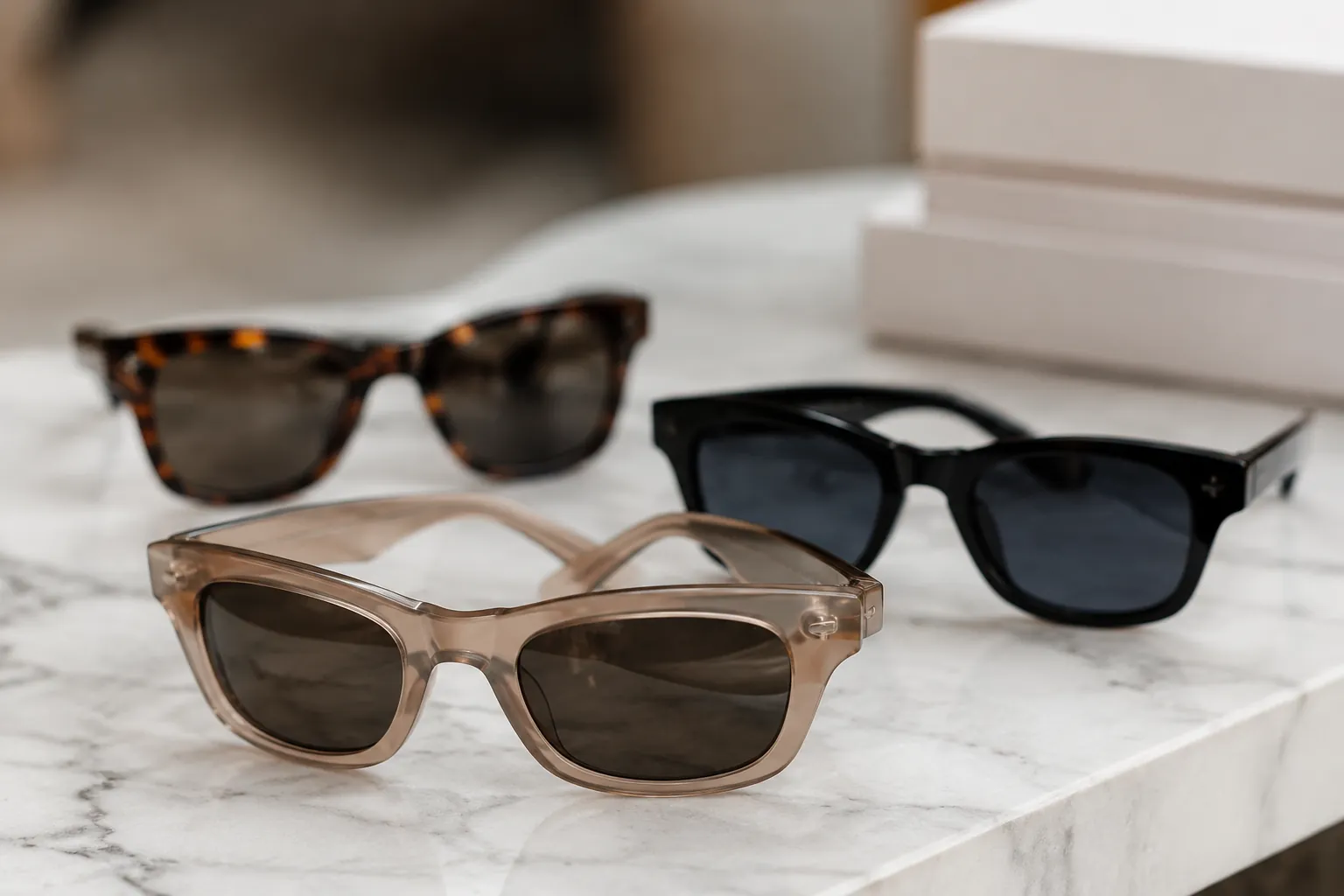
This guide is for buyers sourcing sunglasses for subscription boxes, seasonal gift sets, beauty bundles, resort kits, travel packs, retail promotions, and corporate gifting. The goal is simple: choose styles that fit many people, carry branding cleanly, survive kitting and transport, and arrive before pack-out. It focuses on decisions a buyer can verify: frame dimensions, material, lens category, logo method, packaging, compliance documents, inspection criteria, MOQ, and production timing.
Start With the Box, Not the Frame
Subscription and gift-set sunglasses are not sourced like a fashion collection. One SKU may need to fit thousands of unknown users, look good in campaign photos, stay protected inside a mixed bundle, and meet a fixed warehouse receiving date. That changes the order of decisions.
Start with the box. Confirm box dimensions, retail price target, user profile, kitting method, destination market, and compliance requirements before selecting the frame. A good-looking frame that does not fit the tray, pouch, carton plan, or compliance file is a problem, not a product.
For broad-fit adult programs, practical dimensions matter more than trend detail. A safe range is often lens width around 48 to 55 mm, bridge width around 18 to 22 mm, and temple length around 140 to 145 mm. Total frame width around 140 to 148 mm often works for mixed audiences. Frames above 150 mm may photograph well but can create tray, pouch, and carton-space issues. Very narrow frames save space, but they can increase fit complaints.
Ask for the packed sunglasses size, not only the open-frame size. A frame around 145 mm wide may still need a pouch around 90 by 180 mm. A thick wrap frame, high-front frame, or oversized cat-eye can require more space. If the sunglasses must fit a molded tray or fixed gift-box cavity, send the tray drawing before sample production. Small mismatches can slow kitting or force a packaging change.
Discuss MOQ by design, color, lens, logo method, and packaging type. A small pilot can often use stock frame colors, standard lenses, and simple decoration. Larger programs may support custom colors, dedicated pouches, barcode labels, insert cards, and detailed carton allocation. Ask the supplier to quote each cost component separately so you can compare pilot, mid-volume, and full-program options on the same basis.
Choose Low-Risk Styles for Broad Fit
The safest private label sunglass for a subscription box is often not the most original one. Buyers are not fitting customers in person. Proven shapes usually beat aggressive fashion details.
The frame should provide enough lens coverage, a stable bridge, moderate temple tension, and a smooth branding surface. Keep the shape familiar unless the campaign needs a stronger fashion statement.
| Style | Best Use | Risk Level | Factory Notes |
|---|---|---|---|
| Wayfarer-style PC frame | Unisex lifestyle boxes, beach kits, student promotions | Low | Efficient for injection production; temple logo area is usually easy to control on flat surfaces. |
| Soft square TR frame | Travel bundles, resort welcome packs, retail gifts | Low to medium | Flexible and comfortable, but material cost is usually higher than standard PC. |
| Round metal frame | Festival, fashion, and travel sets | Medium | Check bridge fit, nose-pad alignment, plating finish, solder points, and screw tightness. |
| Cat-eye acetate-look frame | Beauty boxes and seasonal female gift sets | Medium | Strong visual impact; avoid sharp corners and oversized shapes if the product must pack flat. |
| Sport wrap frame | Outdoor, cycling, fishing, and active kits | Higher | Lens curve, retention, face coverage, and impact expectations need closer review for the target market. |
Polycarbonate injection frames are common for price-sensitive bundled programs. They are light, repeatable, and efficient for volume production. Still, approve a physical pre-production sample. Catalogue photos do not show flow marks, sink marks, hinge feel, surface finish, or how the frame sits on the face.
Acetate and acetate-look frames can give better color depth and a heavier hand-feel. True acetate adds cutting, shaping, tumbling, hinge insertion, and polishing time. Metal frames can look more premium, but they add more inspection points: nose pads, solder joints, plating, screw torque, and temple symmetry. Do not upgrade the frame while cutting lens quality, UV compliance, or packaging protection. Scratched lenses, loose hinges, and poor fit are noticed fast.
Fix Materials and Lens Choices Early
Material choice affects cost, comfort, lead time, and defect risk. The right specification depends on the channel. A low-cost promotional giveaway, a premium beauty box, and a resort retail gift set should not always use the same frame, lens, and packaging plan.
- PC frame: Common low-cost option for volume programs, with light weight, good color repeatability, and fast injection output.
- TR frame: More flexible than standard PC and useful for comfort-focused or sport-inspired styles, but usually higher in cost.
- Acetate: Better hand-feel and color depth, but higher labor input, longer processing time, and more finish-control work.
- Metal: Premium look with more QC points, including plating, soldering, nose pads, screws, and temple alignment.
- PC lens: Common for sunglasses because it is light and impact-resistant; UV400 claim and lens category should be verified by test report.
- TAC polarized lens: Useful for glare reduction in outdoor, driving, fishing, and travel programs; requires polarization and visual-quality checks.
Fix the lens category before labeling and testing. Category 3 lenses are commonly used for strong sunlight. Category 2 can suit fashion, urban, or lower-light use, but it provides less visible-light reduction. Very dark lenses may look premium in photos. That is not enough. The declared category must match measured visible light transmission.
For color approval, ask the supplier to confirm tint under daylight and indoor light. Grey and brown lenses are generally safer for broad use because they are familiar to consumers and easier to match across batches. Green, gradient, and mirror lenses can look distinctive, but color variation, coating scratches, edge marks, and dust are easier to notice.
Approve a golden sample. Then define rejection points: central scratches, visibly different tint, loose lens seating, coating defects, warped vision, and obvious stress marks. Vague wording creates arguments later.
Use Branding Methods That Stay Controlled
Branding should match the order size, surface material, logo detail, and handling conditions. A logo can look acceptable on one sample and fail when thousands of units move through decoration, pouching, carton packing, receiving, and kitting. Treat logo approval as a production checkpoint.
| Method | Typical Fit | MOQ Logic | Watch Point |
|---|---|---|---|
| Pad printing | PC or TR temples, pouches, simple retail logos | Works best when setup cost can be spread across a defined production run | Avoid tiny reversed text; define logo position from a fixed reference point. |
| Laser engraving | Metal parts and selected coated surfaces | Useful for low to mid volume if the material gives enough contrast | Contrast may be subtle on black, dark plating, or glossy finishes. |
| Metal logo plate | Premium gift sets and retail bundles | Better suited to larger orders because it adds parts and handling | Check adhesive, pins, edge smoothness, alignment, and pull resistance. |
| Lens logo printing | Promotional programs and event kits | Can be simple if artwork is small and repeatable | Keep outside the main vision area and confirm rub resistance. |
| Custom color | Seasonal boxes and brand campaigns | More efficient when material buying and color matching justify setup | Approve color chips and molded samples before bulk material purchase. |
For any logo method, approve artwork size in millimeters, logo location, color reference, finish, and acceptable tolerance. Use a fixed reference point such as hinge edge, temple end, lens edge, or pouch seam. Do not approve only a digital mock-up.
A physical decorated sample is more reliable. It shows print density, edge sharpness, placement, contrast, and surface adhesion. It also shows whether the logo still looks clean after handling.
For simple temple logos, buyers often use a placement tolerance around ±1 mm. The correct tolerance depends on frame shape, surface curvature, and decoration method. For lens logos, define distance from the lens edge and maximum logo size so the mark does not interfere with use. For pouch printing, confirm fabric type and color. Microfiber, velvet-look fabric, recycled fabric, and coated materials absorb ink differently.
Plan Packaging Around Kitting
Packaging is where many bundled programs lose margin. The sunglass unit price may look acceptable, but the wrong case can increase carton volume, freight cost, receiving time, and kitting labor. Choose packaging for the pack-out line, not only the unboxing photo.
A microfiber pouch is the practical default for many gift sets and subscription boxes. It protects against light scratches, can function as a cleaning cloth, and packs flat. A common pouch size for adult sunglasses is around 90 by 180 mm, but the correct size depends on frame width, lens height, temple thickness, and folding profile.
A paper sleeve is cheaper, but it offers weak protection against cosmetics, bottles, keychains, and other hard items in the same box. A hard case improves protection, but it increases packed volume and may raise dimensional-weight freight costs. Test the actual bundle. Do not guess.
For retail or warehouse-controlled programs, packaging should identify barcode label, country-of-origin marking, model or SKU reference, carton quantity, color ratio, and any required warning or compliance text. Keep labels flat and scannable. Curved barcode labels on soft pouches can create receiving problems. If you require GS1 barcodes, carton labels, retailer routing labels, or mixed-style ratios, include those details in the purchase order before packing starts.
Carton planning also matters. Ask for inner quantity, master carton quantity, gross weight, net weight, and carton dimensions before freight booking. If hard cases are used, compare actual weight and dimensional weight before choosing air freight. For subscription pack-outs, ask whether the supplier can pack by kit sequence, color ratio, or retailer allocation to reduce warehouse sorting.
Lock Compliance Before Sampling
Sunglasses are eye protection products, not just accessories. Compliance depends on destination market, lens category, labeling, and material composition. Do this early. Late compliance changes can force retesting, relabeling, or repacking.
For the EU, buyers commonly request documentation against CE EN ISO 12312-1. For the United States, buyers may request ANSI Z80.3 test documentation and FDA registration details where applicable. Australia and New Zealand programs should check AS/NZS 1067. REACH is relevant for restricted substances in plastics, coatings, inks, metals, and pouch materials.
Ask which exact frame, lens, and construction the documents cover. A report for a similar model is not enough if the order changes lens tint, mirror coating, frame material, plating, ink, or decoration chemistry. Lens category, visible light transmission, UV protection, warnings, user information, and labeling should match the shipped product and destination-market requirement.
Useful supplier documents may include CE EN ISO 12312-1 reports or declarations, ANSI Z80.3 test reports, AS/NZS 1067 reports, REACH declarations or test summaries, FDA registration details where applicable, ISO 9001 certification, and BSCI audit documentation. Request current copies. Check the model or material scope, issue dates, supplier name, and product description.
Practical check: freeze the frame model, frame material, lens color, lens category, UV claim, logo ink, pouch material, barcode label, user information, carton marks, and destination markets before approving the sample. Changing any of these after testing may require document review or retesting.
Plan Cost, MOQ, and Lead Time Together
MOQ is not only a factory rule. It reflects material purchasing, machine setup, color mixing, lens tinting, logo tooling, pouch production, packing labor, inspection, and documentation. Ask which MOQ applies to the frame, color, lens, decoration, pouch, and carton packing separately.
This prevents a common sourcing problem: the frame MOQ looks low, but the custom color, pouch, or logo method has a higher practical minimum. One low number can hide several real thresholds.
| Order Size | Best Fit | Cost Behavior | Procurement Advice |
|---|---|---|---|
| 50 pairs per design | Pilot, VIP kit, buyer sample run | Higher unit price because setup cost is spread across few units | Use stock frame colors, standard lenses, and simple logo work. |
| 300 pairs | Small subscription drop or regional bundle | Better decoration and pouch economics than a pilot run | Confirm carton dimensions, label rules, and kitting method early. |
| 1000 pairs | Main subscription program or seasonal campaign | Stronger price movement; custom color may become more practical | Approve a pre-production sample before material purchase or full decoration setup. |
| 5000+ pairs | National retailer, distributor, multi-country program | Volume can support dedicated packing plans, staged shipments, and tighter process control | Use AQL inspection, carton photos, and delivery schedules tied to pack-out dates. |
Sample timing for standard customization is usually quoted after artwork, lens, packaging, and compliance requirements are clear. Bulk timing should be confirmed in writing after sample approval. It depends on quantity, material, lens type, decoration, packaging, inspection, and current factory capacity.
Custom molds, unusual colors, metal logo plates, polarized lenses, special packaging, and third-party testing can add time. Build the schedule backward from the warehouse receiving date, not the launch date.
Ask for an itemized quote separating sunglasses, lens type, decoration, pouch or case, insert card, barcode label, inner carton, master carton, testing, document fees, and freight terms. A low quote without packaging and compliance detail is not comparable. Also clarify whether pricing is EXW, FOB Ningbo or Shanghai, CIF, DDP, or another Incoterm. Freight, customs, duties, and local delivery responsibility can change landed cost sharply.
Put QC Points in the PO
Do not rely on the phrase good quality. It means different things to different people. Put measurable inspection points into the purchase order. Clear criteria reduce disputes and give the supplier a release standard before cartons leave the warehouse.
- Frame finish: No sharp edges, heavy flow marks, obvious sink marks, plating bubbles, exposed burrs, or visible color mismatch against the approved sample.
- Lens quality: No central scratches, waves, wrong tint, loose lens fit, coating dust, obvious stress marks, or visible optical distortion.
- UV and lens category: Must match the approved standard, product label, test document, and destination-market requirement.
- Hinge and temple action: Open and close smoothly; no loose screws, uneven temple spread, unstable nose pads, or excessive temple tension.
- Logo placement: Must follow approved artwork, size, color, position, and agreed tolerance for the decoration method.
- Packing accuracy: Correct pouch or case, insert, barcode, carton mark, quantity, SKU ratio, country-of-origin label, and compliance information.
For larger orders, define AQL level, defect categories, and sampling method before production. A common consumer-goods approach is to classify safety issues, compliance failures, wrong product, broken hinges, loose lenses, sharp edges, wrong barcode, and missing required labeling as major or critical issues, depending on retailer requirements. Cosmetic issues such as small non-central marks may be treated as minor if they do not affect use or saleability.
For multi-design or multi-color orders, request pre-shipment carton photos: outer carton mark, open carton, inner packing, barcode label, pouch or case, and random product close-ups. Photos do not replace inspection, but they catch many avoidable errors before shipment.
For subscription boxes, packing accuracy is as important as frame quality. One wrong barcode, color ratio, or carton label can block warehouse receiving and miss the kitting date.
Have a custom sunglasses project in mind?
Send us your styles, target market and quantities and we will return a detailed quote with MOQ, lead time and a sample plan.
Get a QuoteWhy source this from Wenzhou with LumiShades
Wenzhou in Zhejiang Province is widely regarded as China’s eyewear manufacturing capital, producing a large share of the world’s sunglasses. That concentration matters to buyers: a deep local supply chain for acetate sheet, hinges, lens blanks, plating and packaging means shorter component lead times, easier color and material matching, and a workforce with decades of eyewear-specific skill. LumiShades has manufactured in this ecosystem since 2009, and our vertical integration — in-house injection molding, acetate cutting, CNC milling, lens tinting, decoration and quality control — means no part of your order is quietly subcontracted to a workshop you cannot audit.
For international buyers, that vertical control translates into accountability. When a single factory owns every step, defects are traced and fixed at source rather than bounced between vendors, and your specifications survive intact from first sample to bulk. For procurement review, buyers can request process records, approved samples, quality checkpoints and project-specific compliance files before placing a bulk order. Required testing and documentation are confirmed against the destination market and product specification rather than assumed from a generic certificate list. Explore our manufacturing capabilities and quality control process to see how this works in practice.
Frequently asked questions
What is the safest sunglass style for a mixed-audience subscription box? A medium-size wayfarer-style or soft square frame is usually the safest starting point. It fits a broad adult audience and provides a flat temple area for branding. Ask for physical samples around 48 to 55 mm lens width, 18 to 22 mm bridge width, 140 to 145 mm temple length, and about 140 to 148 mm total frame width. Then test the packed size in your actual gift box or tray.
Can we order only 50 pairs for a test box? Yes, if the supplier supports that MOQ. Keep the specification simple: existing frame color, standard lens tint, standard pouch, and simple pad print or laser logo. Before approving the pilot, confirm whether the same frame, lens, logo method, and packaging can scale to the expected bulk quantity without changing price structure, lead time, or compliance documents.
How long should we allow before our kitting date? Build the schedule backward from the warehouse receiving date, not the consumer launch date. Allow time for sample production and approval, bulk production, inspection, export booking, freight, customs clearance, warehouse receiving, barcode verification, and any buffer required by the kitting provider. Ask the supplier to confirm sample timing and bulk timing in writing after all specifications are frozen.
Which compliance documents should we request? Match documents to the destination market and product specification. For the EU, request CE EN ISO 12312-1 documentation. For the US, request ANSI Z80.3 test documentation and FDA registration details where applicable. For Australia and New Zealand, check AS/NZS 1067. For restricted substances, request REACH documentation where applicable. Confirm that reports cover the exact frame, lens tint, lens category, material, and decoration used in your order.
Is a hard case worth it for gift sets? Use a hard case only when the retail positioning, damage risk, and freight budget justify the extra volume. For most subscription boxes, a microfiber pouch is more efficient because it protects against light scratches, packs flat, reduces dimensional weight, and speeds kitting. If the bundle includes bottles, metal items, cosmetics, or sharp accessories, test the pouch-packed sunglasses inside the actual box before confirming packaging.
What details should be frozen before bulk production? Freeze the frame model, frame color, frame material, lens tint, lens category, UV claim, logo size, logo location, logo method, pouch or case, insert card, barcode label, carton marks, country-of-origin marking, destination market, compliance documents, AQL level, and approved sample reference. Put these details in the purchase order so production, inspection, and warehouse receiving use the same standard.
Ready to start?
Explore our wayfarer sunglasses or request a quote — our sales team replies within 12 hours.
Request a Quote