
Private Label Sunglasses for Boutique Retailers
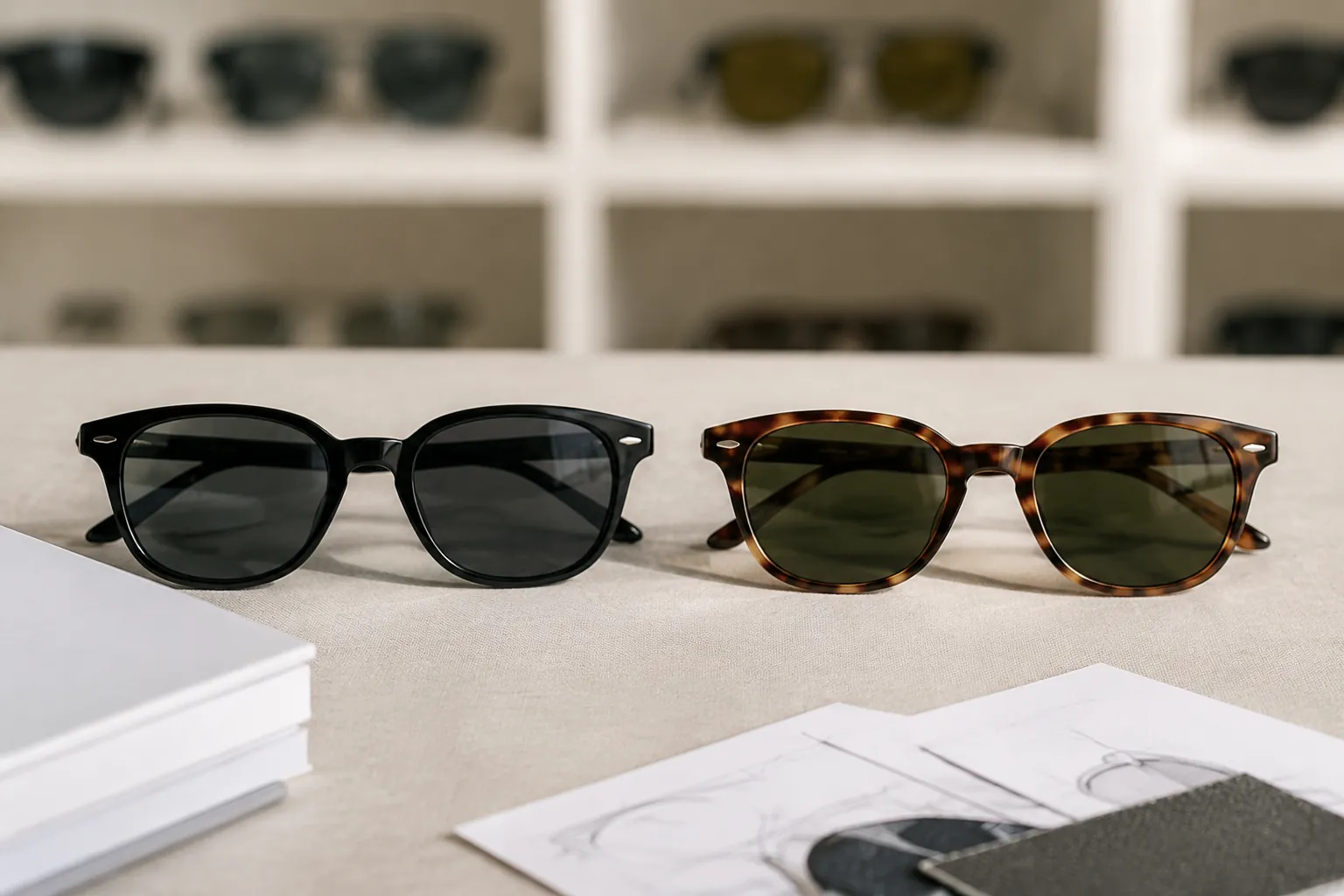
This guide is for boutique retailers, small chains, resort shops, concept stores, and distributors planning a private label sunglasses line without high-volume tooling. The safest first program is simple. Do not customize every part. Choose the details customers notice, control the approvals that affect quality, and avoid products that look like unbranded market stock. A practical sourcing path starts with existing mold selection, then frame color approval, lens tint and category checks, logo decoration, shared packaging, compliance documents, sampling, and pre-shipment QC.
Start With an Assortment, Not a Catalog
Small private label programs get messy when buyers choose too many shapes before they know what will sell. A boutique buyer may review dozens of samples, pick a wide range of frames, and then order shallow quantities of each SKU. The result is predictable: a scattered display, weak reorder data, and too many color, lens, logo, and packaging variables in one production order.
A stronger first launch is focused: 3 to 5 frame shapes, 1 to 2 colorways per shape, and one clear retail story. If the supplier supports low-MOQ production, treat the minimum as a test threshold. Not permission to create every possible SKU. A coordinated opening order usually performs better than a long list of unrelated styles because it gives the buyer cleaner merchandising and clearer sales data.
For example, a resort boutique might choose one square acetate-look frame, one soft cat-eye, one lightweight metal aviator, and one sporty wrap. The palette can stay tight: tortoise, champagne crystal, olive, matte black, brown gradient lenses, and smoke polarized lenses where polarization is verified. A streetwear store may build around heavier temples, smoke lenses, black or gunmetal hardware, and one quiet logo treatment used across several frames.
The mold is only one part of differentiation. A common frame can look like a real private label product when the color, lens, temple mark, hang tag, pouch, and care card all follow the same brand system. The reverse is also true. A custom-looking frame with weak color choices and generic packaging still looks cheap.
Use a Low-MOQ Customization Stack
At boutique quantities, the best private label sunglasses programs usually begin with existing molds and customize visible details. New tooling can make sense after a shape proves reorder demand. It is rarely the safest first step. Existing molds reduce development time, limit fit uncertainty, and use hinge, lens groove, and temple balance details that have already been tested in production.
| Customization Option | MOQ / Cost Logic | Production Detail | Risk Level |
|---|---|---|---|
| Available frame color | Usually easier for small runs | Uses existing resin, sheet, coating, or painted finish standards | Low |
| Custom injection color | May need higher volume or shared use across styles | Requires pigment matching, resin batch control, and color-chip approval | Medium |
| Standard lens tint | Best for small orders | Gray, brown, green, smoke, and common gradients are easier to approve and repeat | Low |
| Polarized lens | Higher unit cost but useful for beach, resort, and driving assortments | Requires correct lens orientation, polarization verification, and optical checks | Medium |
| Pad-printed logo | Practical for low-MOQ branding | Requires logo film, ink adhesion check, jig positioning, curing, and rub testing | Low |
| Metal logo plate | Better when reused across several SKUs or repeat orders | Requires plate tooling, recess control, bonding or fixing, and alignment inspection | Medium |
| New frame mold | Best after proven sales data | Requires design files, tooling, trial shots, fitting review, correction, and longer sampling | High |
Every added customization step creates another approval and inspection point. For a first collection, keep the stack controlled: existing mold, approved frame color, standard or verified lens tint, one logo method, and shared packaging. Ask the supplier which steps are done in-house and which are outsourced. That affects timing, traceability, and responsibility if a defect appears.
Approve Frame Material and Color Physically
Frame color is one of the fastest ways to make a small sunglasses line look intentional. It is also easy to misjudge on a screen. Black, tortoise, clear, brown, crystal gray, and green can all work. The finish still has to match the target retail price and the customer's expectations.
Injection frames depend on resin quality, pigment dispersion, mold temperature, cycle stability, and surface finishing. Gloss finishes show flow lines, sink marks, and small scratches more easily. Matte finishes can hide minor molding marks, but they may show fingerprints, oil, or rub marks from handling. Transparent colors are less forgiving. Bubbles, weld lines, stress whitening, and polishing marks are visible through the material.
Acetate and acetate-look frames add another variable: pattern placement. A tortoise or patterned sheet can look premium if the cut has depth and contrast. It can look flat if the front is cut from a weak area of the sheet. For thicker fronts, buyers should check edge polishing, lens groove cleanliness, screw fit, and whether both temples sit evenly after adjustment.
- Anchor color: use black, tortoise, brown, crystal gray, or dark green when reliable sell-through matters.
- Signature color: add one controlled accent such as champagne, olive, amber, cola, fog blue, or matte stone.
- Color approval: request physical chips or pre-production samples instead of approving only renders or phone photos.
- Finish control: define gloss, matte, transparent, painted, rubberized, or metal-plated finish before sampling.
- Batch reference: approve one physical standard and ask the supplier to retain it for bulk comparison and reorders.
For visible plastic parts, use a signed physical sample as the standard. Not just a color number. Store lighting, outdoor light, and phone cameras can all shift crystal colors, tortoise, and warm browns. If the line will be reordered, retained samples are essential. The next batch should match the approved display standard, not a memory or a verbal description.
Treat Lens Tint as Design and Compliance
Lens tint affects the look of the product, the wearing experience, and the compliance file. A dark lens can look strong on display and still cause complaints if optical power, haze, tint uniformity, or lens fit is poor. A gradient lens can work well for fashion use, but it should not be sold as a sports or high-protection lens unless the product category and test documents support that claim.
For low-MOQ orders, standard lens colors are usually safer: smoke gray, brown, green, G15-style green, brown gradient, gray gradient, and commonly available mirror coatings. Polarized lenses can add retail value for beach, resort, fishing, and driving assortments. They must be checked for correct axis orientation and consistent polarization effect. Retail demos help buyers understand the product. Production approval should still rely on supplier inspection records and retained samples.
Discuss compliance before sample approval. The destination market determines the required documents, markings, and claims. Common eyewear requirements include CE EN ISO 12312-1 for sunglasses sold in the European market, ANSI Z80.3 for non-prescription sunglasses in the United States, AS/NZS 1067 for Australia and New Zealand, REACH for restricted substances in the EU, and FDA registration for relevant U.S. import handling. ISO 9001 and BSCI relate to quality management and social compliance systems. They do not prove the optical performance of an individual sunglass style.
Typical sunglasses checks may include UV protection, luminous transmittance, filter category, optical power, prismatic effect, robustness, lens quality, labeling, and restricted substances where applicable. The right test scope depends on the market, product type, material, lens category, and claims printed on the product or packaging.
Use precise lens descriptions. Do not call a lens polarized unless it is verified. Do not claim impact protection, safety eyewear performance, blue-light filtering, or sports protection unless the design and test reports support it. Safer commercial language includes UV400, smoke lens, brown gradient, lens category where applicable, and polarized only when verified.
Keep Logo Decoration Quiet and Repeatable
Logo placement turns stock-looking sunglasses into private label product. Louder is not always better. Many boutique customers prefer a quiet mark: outer temple, inner temple, temple tip, lens corner, or a small metal plate. Oversized high-contrast logos on glossy plastic can make the product feel promotional.
Pad printing is often the most practical logo method for small private label sunglasses orders. It works best on flatter temple surfaces and requires correct ink selection, curing time, jig control, and adhesion testing. For curved temples, the supplier should confirm whether the logo can sit straight without distortion. Add a rub test to approval, especially on matte coating, painted surfaces, or flexible temple materials.
Laser engraving is more permanent on suitable materials, but visibility depends on base color, coating, and surface finish. It may look subtle on black or tortoise and more visible on metal parts. Metal logo plates create a stronger premium signal, but they add work: plate size, recess depth, glue or mechanical fixing, edge finishing, and left-right alignment. A small skew is obvious on a narrow temple.
A good first-order rule is simple: one logo width, one placement, and one color across the collection. Outer temple logos at a modest width are usually enough. Approve the exact size on the real frame, not only on artwork. Inner temples may need model information, origin, lens category, and compliance markings depending on the market. Approve the actual logo on the actual frame color and finish before bulk production.
Use Packaging to Build Brand Control
Packaging is often the most efficient way to make a low-MOQ sunglasses line feel intentional. A shared pouch, microfiber cloth, hang tag, barcode label, care card, and box can support every SKU. This keeps frame development controlled while giving customers a consistent brand experience.
The right packaging depends on how the sunglasses are sold. For peg-wall retail, a hang tag, barcode label, and pouch may matter more than a rigid box. For resort gifting, a paper box or foldable case can raise perceived value. For e-commerce, lens and temple protection matter more than shelf appearance. The frame should not rub against the packaging during transit.
A practical first-order packaging kit includes a microfiber pouch or soft case, microfiber lens cloth, swing tag, UPC or EAN label, care card, polybag if required, and export carton markings. Keep packaging shared across all SKUs at first. Spend the variation budget on frame and lens combinations, not on multiple box structures that complicate packing and inventory control.
Blunt rule: if a customer cannot tell the packaging belongs to your store from one meter away, it is probably too generic.
Ask the supplier to prepare packing approval samples exactly as bulk will ship: pouch, cloth, tag string, label position, barcode content, warning text, polybag, inner box, and carton marks. Many buyers approve the frame first and find packaging problems only after production. Avoid that. Make packaging part of sample approval.
Plan Cost, Timing, and Price Breaks Early
Low MOQ does not mean the lowest unit cost. It means lower inventory and cash risk while the buyer tests the assortment. Small runs carry more setup cost per pair because color approval, logo setup, lens selection, packing work, and QC time are spread across fewer units. Unit price depends on frame material, lens type, decoration method, packaging, order quantity, and the number of variations.
| Order Stage | Buyer Inputs | Factory Work | Typical Timing |
|---|---|---|---|
| Concept lock | Target customer, retail price, preferred shapes, logo files | Recommend molds, materials, lens options, packaging, and decoration route | Confirm with supplier |
| Sample build | Color choices, lens tint, logo placement, packaging direction | Frame preparation, lens matching, logo trial, assembly, and packing mockup | Confirm with supplier |
| Pre-production approval | Signed sample comments, barcode data, final artwork | Confirm BOM, QC checklist, carton plan, production references, and retained samples | Confirm with supplier |
| Bulk production | Deposit, final documents, shipment plan | Molding or cutting, lenses, decoration, assembly, QC, and packing | Confirm with supplier |
| Shipment handoff | Forwarder details and import requirements | Packing list, carton details, certificates or test reports as agreed, export coordination | Depends on freight method |
The most common avoidable delays are late vector logo files, unclear color standards, packaging artwork changes, missing barcode data, and lens tint changes after sample approval. Before paying a deposit, ask for a written quotation that separates frame cost, lens upgrade cost, logo cost, packaging cost, sample cost, mold or plate tooling if any, testing cost if required, and freight terms. Price comparisons are cleaner when every cost is visible.
Put QC Tolerances in Writing
Quality control for private label sunglasses is not only about broken hinges. Common complaints include uneven lens color, loose temples, scratched lenses, crooked logos, poor nose fit, sharp edges, glue marks, coating defects, inaccurate labels, and scuffed packaging. These problems are easier to prevent when the buyer defines inspection points before production.
Ask the supplier where quality checks happen: incoming materials, frame molding or cutting, lens edging or tinting, logo decoration, assembly, cleaning, final inspection, and packing. Then write acceptance rules. Vague phrases such as premium finish or good quality do not help production teams, third-party inspectors, or internal receiving staff.
- Frame symmetry: front should sit level on a flat surface without obvious twist or uneven temple height.
- Temple tension: hinges should open smoothly, hold position, and show no wobble after repeated opening.
- Lens fit: reject rattling, edge chips, stress marks, visible gaps, or uneven seating in the groove.
- Logo position: define side, distance from hinge, logo color, orientation, and acceptable visual alignment.
- Surface finish: reject deep scratches, color contamination, sharp flashing, glue marks, and obvious coating defects.
- Packaging accuracy: confirm SKU label, barcode, pouch, cloth, tag, care card, and carton count by style.
For logo and component placement, use approved samples and inspection photos instead of written descriptions alone. For higher-risk launches, request pre-shipment inspection photos by SKU and retained production samples from the same batch. If a reorder happens later, those retained samples become the practical reference for color, logo, lens, fit, and packaging consistency.
Have a custom sunglasses project in mind?
Send us your styles, target market and quantities and we will return a detailed quote with MOQ, lead time and a sample plan.
Get a QuoteWhy source this from Wenzhou with LumiShades
Wenzhou in Zhejiang Province is widely regarded as China’s eyewear manufacturing capital, producing a large share of the world’s sunglasses. That concentration matters to buyers: a deep local supply chain for acetate sheet, hinges, lens blanks, plating and packaging means shorter component lead times, easier color and material matching, and a workforce with decades of eyewear-specific skill. LumiShades has manufactured in this ecosystem since 2009, and our vertical integration — in-house injection molding, acetate cutting, CNC milling, lens tinting, decoration and quality control — means no part of your order is quietly subcontracted to a workshop you cannot audit.
For international buyers, that vertical control translates into accountability. When a single factory owns every step, defects are traced and fixed at source rather than bounced between vendors, and your specifications survive intact from first sample to bulk. For procurement review, buyers can request process records, approved samples, quality checkpoints and project-specific compliance files before placing a bulk order. Required testing and documentation are confirmed against the destination market and product specification rather than assumed from a generic certificate list. Explore our manufacturing capabilities and quality control process to see how this works in practice.
Frequently asked questions
Can a boutique retailer start with only 50 pairs per design? Yes, if the supplier confirms that 50 pairs per design is available for the selected mold, color, lens, logo, and packaging. Buyers should still ask for unit price, setup charges, sample charges, and packaging minimums in writing. Very small runs usually cost more per pair and may limit custom color or decoration options.
What is the best customization method for a small private label launch? Start with existing molds and customize the visible details: approved frame color, standard or verified lens tint, one logo placement, and shared packaging. This creates a branded product without the cost, delay, and fit risk of new frame tooling.
How should buyers approve frame color before production? Approve a physical color chip or pre-production sample under lighting similar to the retail environment. Keep one signed reference sample with the buyer and ask the supplier to retain one for production comparison, especially for transparent colors, tortoise patterns, matte finishes, and reorders.
Which compliance standards should sunglasses buyers ask about? Ask according to the destination market. For the EU, discuss CE EN ISO 12312-1 and REACH. For the United States, ask about ANSI Z80.3 and FDA registration where relevant to import handling. For Australia and New Zealand, ask about AS/NZS 1067. Confirm that product claims, labels, and packaging text match the available test documents.
Should custom packaging be used on the first order? Yes, but keep it simple and shared across all SKUs. A branded pouch, microfiber cloth, hang tag, barcode label, and care card often create enough retail identity without adding separate packaging complexity to every frame style.
When should a retailer invest in a new sunglasses mold? Invest in a new mold after sales data shows that a specific shape can support repeat orders. Before tooling, confirm design ownership, mold cost, sample correction process, expected timeline, minimum order quantity, and who controls the mold after production.
Ready to start?
Explore our wayfarer sunglasses or request a quote — our sales team replies within 12 hours.
Request a Quote