
Custom Sports Sunglasses OEM Buying Guide
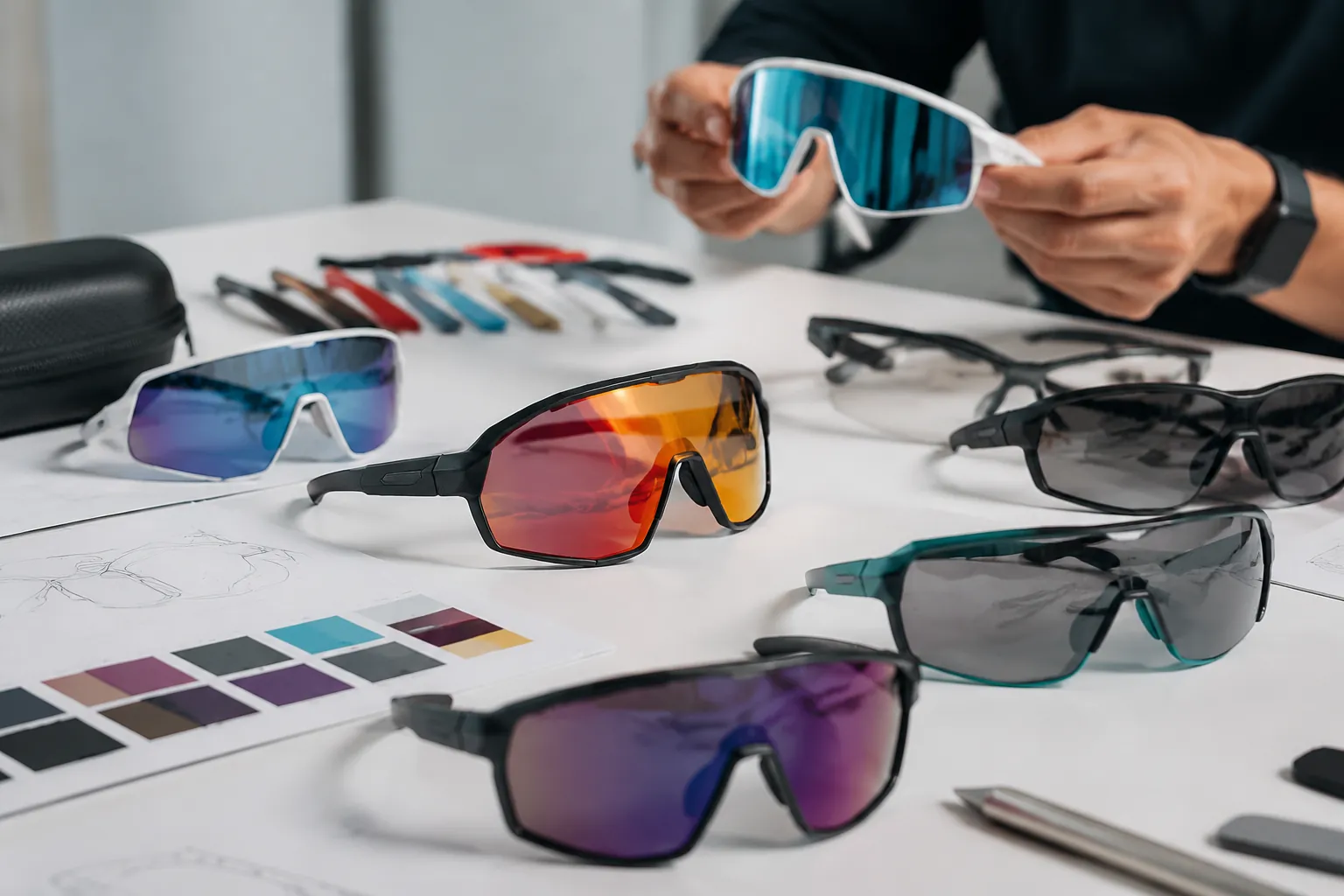
This guide is for overseas buyers sourcing custom sports sunglasses for teams, outdoor clubs, school leagues, event retailers, and activewear brands. It shows how to specify frames, lenses, logos, packaging, MOQ, samples, compliance, and bulk production so a factory can quote, sample, inspect, and repeat the order. The aim is simple: clearer purchase specs, fewer sample revisions, realistic lead times, and bulk sunglasses that match the approved sample and destination-market requirements.
Start With the Use Case, Not the Shape
Sports sunglasses usually fail for practical reasons. The frame slips. The lens is too dark. The logo wears off. Or the buyer picked a fashion frame for a product that needs sweat resistance, impact durability, stable fit, and reliable lens performance. Before choosing colors or logo positions, define the wearing conditions in writing.
A running club may need a lightweight frame, rubber nose pads, curved temples, and a smoke or brown lens for changing daylight. A fishing club may need polarized lenses, side-glare control, and scratch-resistant handling. A school league may need safe general-purpose lenses, cost control, and accurate team colors. An activewear brand selling through retail needs stronger packaging, barcode control, carton labels, and repeatability across reorders.
Start with a one-page buyer specification. Include activity, wearer age group, target retail price if relevant, order quantity, frame material, lens category, logo positions, packaging, destination market, inspection requirements, and delivery deadline. Do not make the supplier guess. Guessing creates sample revisions, delayed artwork approval, avoidable decoration charges, and unclear responsibility if bulk production misses the approved standard.
- Race events: prioritize low weight, existing molds, fast production, simple logo placement, and predictable packing.
- Clubs and leagues: prioritize durable hinges, team colors, reorder consistency, and simple SKU control.
- Fishing and boating: prioritize polarized lenses, lens stress inspection, and glare-reduction performance.
- Outdoor retail: prioritize lens compliance, packaging files, barcode accuracy, and AQL inspection.
- Youth programs: confirm front width, temple length, bridge fit, lens category, and avoid oversized adult frames.
Frame Materials and Fit Details
Most custom sports sunglasses use injection-molded plastic frames. They are repeatable, cost-effective, and suitable for both small branded orders and larger production runs. Material still matters. A brittle frame can look fine in a product photo but crack near the hinge after repeated opening and closing. A flexible frame can improve comfort during movement, but it needs tighter control of shape recovery, color consistency, and lens fit.
| Frame Option | Best Use | Typical Behavior | Buyer Watchout |
|---|---|---|---|
| PC injection frame | Events, clubs, low-cost team orders | Lightweight, impact-resistant, and consistent for repeat production | Can feel less premium; inspect hinge area, burrs, and surface finish |
| TR90-style flexible frame | Running, cycling, outdoor clubs | Flexible, comfortable, and better at recovering after bending | Higher unit cost; color and shape may need sample confirmation |
| Acetate frame | Retail lifestyle-sport crossover | Richer color depth and heavier premium feel | Less ideal for high-sweat sport; polishing and machining add lead time |
| Metal or mixed frame | Golf, sailing, lifestyle clubs | Slim appearance, adjustable nose pads, and premium retail look | More parts to inspect; plating, screws, and solder points need control |
For active club use, PC or flexible injection frames are usually safer than heavier lifestyle frames unless the product is mainly sold as fashion eyewear. Injection-molded frames also support custom colors, rubber nose pads, temple inserts, and repeatable dimensions when the same mold and approved material specification are used across orders.
Fit should be measured, not described as "comfortable." Ask the supplier for front width, temple length, bridge width, lens width, lens height, and base curve for the selected model. For youth programs, request smaller dimensions and a physical fit check before approval.
At sample stage, check hinge pull, temple open-close cycles, lens retention, burrs, sharp edges, and basic drop or handling performance for the order type. A sports frame should not be approved just because the gloss and logo look good.
Lens Tint and Performance Specs
Lens selection is where many team orders go wrong. Buyers often choose the darkest smoke lens because it looks strong in a mockup. Then athletes complain during cloudy mornings or struggle to track a ball in mixed light. Lens color, visible light transmission, UV claim, polarization, optical quality, and coating durability all need to match the activity and destination market.
For general sunglass orders, common compliance references include CE EN ISO 12312-1 for Europe, ANSI Z80.3 for the United States, and AS/NZS 1067 for Australia and New Zealand. FDA registration may be relevant for U.S. eyewear import records, but it is not a substitute for lens performance testing. REACH may apply to restricted substances in frame materials, coatings, inks, packaging components, and accessories.
| Lens Type | Typical Use | Buyer Benefit | Specification Note |
|---|---|---|---|
| Smoke gray | Running, cycling, general outdoor | Natural color view and broad market acceptance | Good default for mixed team orders; confirm lens category and VLT |
| Brown or amber | Baseball, golf, trail, hiking | Can improve perceived contrast in many outdoor settings | Confirm visible light transmission before bulk approval |
| Yellow or light orange | Low-light training, overcast days | Brighter view and contrast feel | Not suitable as a strong sun lens by itself unless the tested category supports the intended claim |
| Polarized smoke or brown | Fishing, boating, beach clubs | Reduces reflected glare from water, road, and other flat surfaces | Check polarization axis, stress marks, and lens warpage after assembly |
| Mirror coated lens | Team merchandise, cycling, outdoor retail | Strong visual identity and multiple color options | Inspect coating scratches, color drift, adhesion, and edge chipping |
For most sunglass orders, confirm the exact UV protection claim with supplier test data or an agreed third-party test. Agree visible light transmission by approved sample and, where needed, a test range. Do not approve lens color from phone photos. Camera settings and screen brightness distort tint and mirror appearance.
For polarized orders, check polarization alignment with a tester and inspect for stress patterns after lens mounting. For mirror lenses, inspect under consistent lighting. Color variation and coating scratches are easy to miss in mixed warehouse light.
Keep the lens menu tight. Too many tints in one order slow packing, increase SKU errors, and complicate after-sales support.
Logo Placement and Decoration Durability
A logo on sports sunglasses has to survive sweat, sunscreen, abrasion, heat, and careless storage in bags. Small artwork can disappear on curved temples. Large logos may crack, distort, or wear unevenly if placed across a flex point. The right decoration method depends on frame material, surface curve, order size, logo detail, color requirement, and expected wear conditions.
- Pad printing: suitable for simple team names, race marks, and low-MOQ orders. It is economical, but ink type, curing time, surface treatment, and testing affect durability.
- Laser engraving: clean and durable on suitable metal parts or coated surfaces. It is less colorful but difficult to rub off when applied correctly.
- Metal logo plate: gives temples a stronger retail feel and can suit activewear brands, but adds part cost, assembly time, and inspection points.
- Lens logo: useful for subtle branding, but it must be small, legal for the destination market, and outside the main field of vision.
- Pouch or box print: a low-risk way to add brand exposure without overloading the sunglass frame.
For bulk orders, avoid printing over sharp curves, rubber inserts, or areas close to the hinge unless the supplier confirms the fixture and provides a real sample. A logo that looks centered on flat artwork can look crooked on a wrapped temple. Ask for sample photos from the side, top, front, and worn position.
Set logo position tolerance in measurable terms, such as within ±1.0 mm to ±1.5 mm from the approved sample, depending on the decoration method and frame shape. Provide vector artwork, Pantone references where color matching is required, logo dimensions in millimeters, and minimum stroke thickness.
Thin white lines on black temples are a common risk. They can break during printing or look weak after curing. For sports use, request a rub test on the logo area before bulk approval, especially when sunscreen, sweat, or repeated handling is likely.
MOQ, Price Breaks, and SKU Discipline
MOQ and pricing depend on the selected frame, lens, decoration method, packaging, inspection level, and whether existing molds and materials are used. A low MOQ can work for pilot runs, team samples, influencer kits, or limited club drops. Larger quantities usually reduce the unit cost because setup time, color mixing, decoration fixtures, packaging preparation, and QC reporting are spread across more pairs.
Ask for price breaks using the same specification at several quantities, such as 50, 300, 1000, and 5000 pairs. This gives a clean comparison. It also prevents misleading quotes based on different materials or packaging. If the supplier quotes a very low unit price, confirm what is included: lens type, UV test support, logo method, pouch or box, carton labeling, inspection, spare parts if any, and export packing.
Do not split an order too aggressively. A 600-pair order divided into six frame colors, three lens tints, two logo colors, and two pouch designs behaves like many small orders, not one efficient bulk order. Each variation needs setup, line clearance, packing separation, QC sampling, carton labeling, and stock control. The factory floor feels that complexity. The quotation usually reflects it.
- Choose one core frame for the whole club, league, or event.
- Limit frame colors to one or two unless order volume supports more SKUs.
- Use one general lens tint; add polarized only for a clear activity case.
- Keep one logo method for the first bulk run.
- Separate giveaway packaging from retail packaging instead of mixing too many packaging versions.
- Request price levels at 50, 300, 1000, and 5000 pairs using the same specification.
A practical process is to run a small paid validation batch, collect wear feedback, then increase quantity after confirming fit, lens, logo, and packaging. For repeat programs, lock the frame code, lens tint, logo size, carton quantity, and inspection standard. Reorders become faster, cleaner, and easier to compare with the approved sample.
Samples, Lead Times, and Approval
Sample and bulk timing depend on supplier capacity, material availability, decoration method, packaging complexity, and whether existing molds are used. As a planning reference, samples for an existing frame with standard decoration often take about 7 to 10 days after complete artwork and specification approval. Bulk production for a standard order often takes about 25 to 35 days after sample approval and deposit. Confirm timing in writing for each order.
| Stage | Typical Time | Buyer Input Needed | Common Delay |
|---|---|---|---|
| Spec confirmation | 1 to 3 days | Frame, lens, logo, quantity, market, packaging | Unclear lens category or missing artwork |
| Sample production | 7 to 10 days for many existing-frame orders | Approved vector logo and Pantone or color reference | Changing logo size after the first sample |
| Pre-production approval | 1 to 5 days | Written approval or correction list | Slow buyer-side review or unclear comments |
| Bulk manufacturing | 25 to 35 days for many standard orders | Deposit, final SKU list, packaging files | Too many variations or late packaging changes |
| Final inspection and packing | 2 to 4 days | Inspection standard and shipping marks | Carton label revisions at the end |
For event sunglasses, work backward from the required delivery date, not only the production date. Include production, final inspection, international freight, customs clearance, and local distribution to clubs or venues. If the event date is fixed, choose an existing frame and standard packaging instead of developing a new mold. New tooling can suit a long-term retail program. It rarely suits a rushed team order.
Sample approval should be written and specific. Approve the frame color, lens tint, logo size, logo position, packaging, and carton marks separately. If a buyer says "sample approved except logo slightly larger," production should not start until the revised logo size is confirmed in millimeters.
Late artwork, late packaging files, and unclear SKU lists are buyer-side causes of production delay. Assign one person to issue final written approvals.
QC, Tolerances, and Compliance Documents
For sports and outdoor club sunglasses, QC should cover fit, lens performance, decoration durability, frame assembly, and packaging accuracy. A good-looking sample is not enough. Bulk cartons must match the approved sample, and the inspection checklist should be agreed before production starts.
Request compliance documents based on the destination market and product claim: CE EN ISO 12312-1 for Europe, ANSI Z80.3 for the U.S., AS/NZS 1067 for Australia and New Zealand, REACH where restricted substances matter, and FDA registration details where relevant for U.S. import records. ISO 9001 and BSCI can support factory management and social compliance review, but they do not replace product testing for the sunglasses themselves.
- Lens checks: UV claim support, visible light transmission, polarization if ordered, lens fit, distortion, coating defects, and mirror color consistency.
- Frame checks: hinge movement, screw tightness, temple symmetry, warpage, burrs, sharp edges, and lens retention.
- Decoration checks: logo position tolerance, adhesion, color match, rub resistance, and missing-print defects.
- Packaging checks: SKU separation, barcode scanning, pouch or box print, carton marks, country-of-origin label, and quantity count.
- Wear checks: nose fit, temple pressure, slipping, lens distortion during movement, and comfort after repeated opening and closing.
Set practical tolerances before production. For example, define logo placement within ±1.0 mm or ±1.5 mm of the approved sample where feasible. Control frame color by approved physical sample or color chip. Control lens color by approved physical lens, not a screen image.
For AQL inspection, many buyers use general inspection level II with critical, major, and minor defect categories. The exact standard should match the order value, product risk, and destination market.
Ask the supplier to confirm which tests are performed in-house and which require third-party laboratories. Keep copies of test reports, approved samples, packing lists, carton marks, and final inspection reports. Clear records make reorders easier and help resolve disputes if bulk production is questioned after delivery.
Packaging and Reorder Control
Sports teams and outdoor clubs often underestimate packaging. For giveaways, a microfiber pouch and simple polybag may be enough. For retail, buyers usually need printed boxes, barcode labels, care instructions, country-of-origin marking, carton labels, and sometimes assorted color packs. Include these details in the quotation. Do not add them at final packing.
For league, distributor, or activewear programs, create a reorder sheet with the exact frame code, material, color, lens tint, lens category, logo file name, logo size, packaging type, carton quantity, barcode, shipping mark, and inspection level. Keep one approved physical sample in your office and one with the supplier when possible. If a reorder comes six months later, nobody should match from memory or old phone photos.
Practical rule: if the sunglasses will be handed out once, keep packaging simple. If they will be sold, make packaging scannable, protective, and consistent across cartons.
Capacity is not the only factor behind delivery performance. SKU discipline, complete artwork, confirmed packaging files, and clear inspection standards matter just as much. A buyer who controls variations, approves samples quickly, and locks packaging early will usually get cleaner quotations, fewer packing errors, and fewer shipment surprises.
For a first program, compare quotes at several quantities using the same specification. That shows the real cost curve and helps decide whether to test small, buy for the season, or launch a retail-volume order.
Have a custom sunglasses project in mind?
Send us your styles, target market and quantities and we will return a detailed quote with MOQ, lead time and a sample plan.
Get a QuoteWhy source this from Wenzhou with LumiShades
Wenzhou in Zhejiang Province is widely regarded as China’s eyewear manufacturing capital, producing a large share of the world’s sunglasses. That concentration matters to buyers: a deep local supply chain for acetate sheet, hinges, lens blanks, plating and packaging means shorter component lead times, easier color and material matching, and a workforce with decades of eyewear-specific skill. LumiShades has manufactured in this ecosystem since 2009, and our vertical integration — in-house injection molding, acetate cutting, CNC milling, lens tinting, decoration and quality control — means no part of your order is quietly subcontracted to a workshop you cannot audit.
For international buyers, that vertical control translates into accountability. When a single factory owns every step, defects are traced and fixed at source rather than bounced between vendors, and your specifications survive intact from first sample to bulk. For procurement review, buyers can request process records, approved samples, quality checkpoints and project-specific compliance files before placing a bulk order. Required testing and documentation are confirmed against the destination market and product specification rather than assumed from a generic certificate list. Explore our manufacturing capabilities and quality control process to see how this works in practice.
Frequently asked questions
What is the best frame material for team sports sunglasses? For most clubs and leagues, PC injection frames or TR90-style flexible frames are the safest starting points. PC is cost-effective, lightweight, and consistent for bulk orders. TR90-style frames usually cost more but can improve flexibility and comfort. Confirm the exact material, frame dimensions, hinge construction, lens retention, and sample test results before approving bulk production.
Can we order only 50 pairs with our team logo? Many OEM suppliers can support small branded runs if the order uses an existing frame and a simple decoration method such as pad printing. Ask whether 50 pairs is available for your selected model, what setup charges apply, and whether the same specification can be quoted at 300, 1000, and 5000 pairs. Small runs are best for fit testing, club validation, event samples, or proof of concept before a larger order.
How long do custom sports sunglasses take to produce? For an existing frame with ready artwork, samples often take about 7 to 10 days, and standard bulk production often takes about 25 to 35 days after written sample approval and deposit. Confirm the schedule in writing because timing changes with material availability, logo method, packaging, testing, SKU count, and peak-season factory load. For events, add time for inspection, freight, customs clearance, and local distribution.
Which lens tint should we choose for a mixed outdoor club order? Smoke gray is usually the safest general-purpose tint because it keeps colors natural and works for many outdoor uses. Brown or amber can be better for contrast-focused sports such as golf, baseball, hiking, or trail use. Yellow or light orange should be treated as a low-light option, not a strong sun lens unless testing supports the claim. Choose polarized smoke or brown for fishing, boating, beach, or strong glare conditions.
What compliance documents should overseas buyers ask for? Ask according to the destination market and product claim. Common references are CE EN ISO 12312-1 for Europe, ANSI Z80.3 for the U.S., AS/NZS 1067 for Australia and New Zealand, REACH for restricted substances where applicable, and FDA registration details where relevant for U.S. import records. ISO 9001 and BSCI may support factory review, but they do not replace product-specific lens testing.
Is a lens logo a good idea for sports sunglasses? A lens logo can work if it is small, outside the main field of vision, and acceptable for the destination market. For sports use, temple printing, pouch printing, or a metal temple plate is often more practical because the branding is more visible and less likely to affect vision. Ask for a real sample and check logo position, visibility, rub resistance, and wearer comfort before approving bulk production.
Ready to start?
Explore our square sunglasses or request a quote — our sales team replies within 12 hours.
Request a Quote