
Team Sunglasses Buying Guide for Sports Merchandise
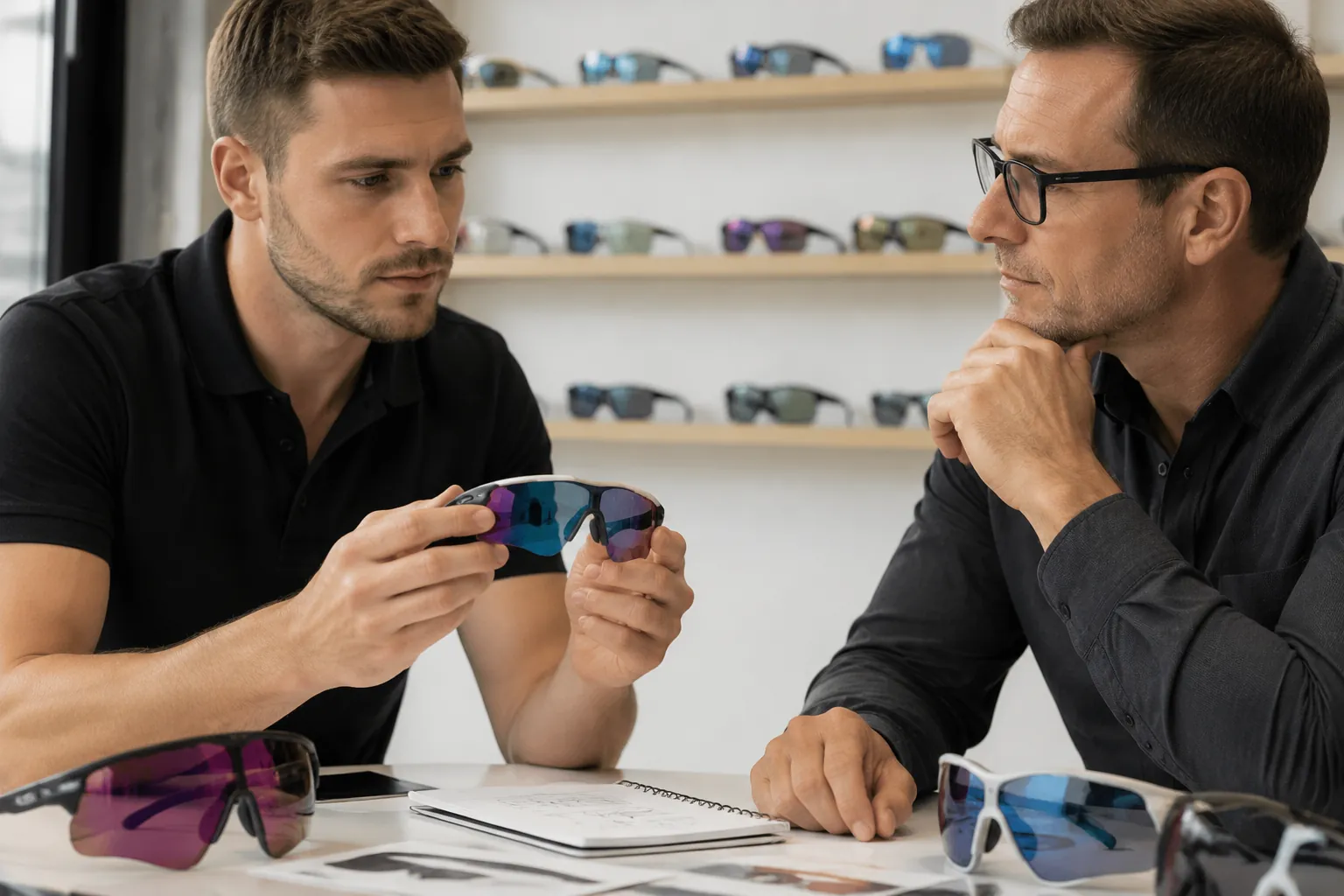
This guide is for sports clubs, event merchandise teams, importers, and distributors buying team sunglasses in bulk. It covers frame selection, color control, logo placement, adult and youth assortments, compliance, and how to protect a fixed event date. The aim is practical: fewer sample loops, cleaner purchase orders, stable packing, and less risk of late, mislabeled, or unusable stock.
Start With The Event Date
Most bad fan-merch eyewear orders do not fail because the frame is hard to make. They fail because the timeline is vague. Artwork lands late. A lens tint changes after sampling. Packaging files arrive separately. Compliance labels are never confirmed. Freight gets booked too close to the first selling date. Start from the warehouse arrival date, not the design meeting.
Lead time depends on frame type, decoration method, quantity, packaging, inspection, destination market, and freight mode. Build time for artwork review, samples, approval, production, final inspection, export paperwork, freight, customs clearance, and warehouse receiving. Existing molds and standard packaging are faster. New tooling is not.
- Confirm the event date and the warehouse arrival date.
- Freeze frame shape, lens type, team colors, logo position, market, and packaging before sampling.
- Approve a physical sample if color, tint, logo scale, or fit matters. Screen proofs are not enough.
- Prepare packaging artwork at the same time as frame artwork, including barcode, warning text, recycling marks if required, and carton marks.
- Keep a buffer for reinspection, relabeling, customs documents, or packing fixes.
If the date is tight, simplify the spec. Use an existing mold, one frame color, one lens tint, one logo method, and standard packaging. Skip custom metal badges, multiple temple prints, mirror coatings, and unusual retail packs unless the supplier confirms the schedule in writing.
Choose A Frame Platform That Fits Fans
Team sunglasses are worn by fans, students, parents, volunteers, and staff. Not just athletes. That changes the frame choice. A deep cycling wrap may look fast, but it fits fewer faces, is harder to print cleanly, and can create distortion near curved lens edges. For stadium retail, school teams, fan giveaways, tailgates, and charity runs, safer choices are medium-fit wayfarer, square, round, or light sport-wrap styles with stable hinges and enough temple space for branding.
Injection-molded polycarbonate or similar plastic frames are common in promotional eyewear because they support low pricing, faster production, and repeatable solid colors when the process is controlled. TR90 costs more, but it feels lighter and more flexible. That suits running clubs, outdoor events, and school sports. Acetate looks more premium and supports layered color effects, but sheet cutting, CNC milling, tumbling, and polishing add time and variation. Metal or metal-accent frames can raise retail value. They also add plating, soldering, assembly, and inspection steps. More steps. More risk.
| Frame option | Best use | Typical MOQ logic | Production note | Buyer risk |
|---|---|---|---|---|
| PC or similar injection frame | Giveaways, stadium retail, fan packs | Lowest MOQ is usually possible when using existing molds and standard colors | Fast molding, good color repeatability, low unit cost | Can feel cheap if hinge fit, lens seating, or surface finish is weak |
| TR90 sport frame | School teams, running events, outdoor clubs | Better unit pricing usually requires higher quantities than basic promotional frames | Flexible, lighter feel, good for active wear | Higher material cost and more color-control work than basic PC frames |
| Acetate frame | Premium club shop, limited drop, VIP gift | MOQ pressure rises because sheet color, cutting, and polishing are slower | Richer hand feel and more premium surface quality | Longer lead time and more manual finishing variation |
| Metal-accent frame | Higher retail price merchandise | Best suited to larger runs when custom plates, plated parts, or special hinges are used | Can use metal logos, plated temples, or upgraded hinges | More components to inspect and more color variation risk |
Ask the supplier which steps are in-house and which are outsourced. That matters. Color, fit, decoration, and packaging issues need fast root-cause checks before bulk production keeps moving.
Match Team Colors With Realistic Tolerances
Team colors matter, but production color is never a single fixed number. A Pantone reference helps. It still behaves differently on glossy plastic, matte TR90, acetate sheet, mirror coating, pad-print ink, pouch fabric, and paper packaging. The same blue can look deeper on a smoke lens, flatter on a matte temple, and brighter on a coated box.
Split color decisions into primary, secondary, and accent. Put the primary color in the frame body if the quantity supports custom resin, masterbatch, paint, or sheet selection. Use the secondary color on the temple print, pouch cord, lens mirror, or retail card. Keep accents tight. Every extra color can mean another ink setup, another approval point, and more scrap.
- Frame color: Approve under daylight and indoor light, not only from a phone photo or screen proof.
- Lens tint: Standard smoke, brown, green, and gray tints are usually easier to repeat than unusual team-specific red, orange, or electric blue tints.
- Mirror coating: Blue, silver, gold, and red mirror lenses give strong shelf impact, but coating uniformity, spots, and fingerprints need stricter inspection.
- Print color: Pad printing on curved temples may need artwork adjustment because straight lines can visually bend on the frame.
- Packaging color: Treat pouch, card, box, and carton artwork as separate approvals; fabric and paper will not match plastic exactly.
A practical method is to approve a usable range, not chase one perfect chip across every material. For repeat orders, keep a sealed golden sample and record the approved frame material, color reference, lens tint, print ink reference, and packaging proof. For larger programs, ask for top-of-production photos or first-carton confirmation before the supplier finishes the full run.
Logo Placement Must Be Easy To Run
The usual branding spots are outside temple, inside temple, lens corner, pouch, hangtag, retail card, and case. Outside temple branding sells well on a retail wall because fans can see the mark without opening the pack. Inside temple branding looks cleaner on premium styles. Lens-corner logos can work well in photos, but they must stay small and away from the central vision area.
Common decoration methods include pad printing, laser marking or engraving, metal logo plates, and lens printing. Pad printing is often the practical choice for fan merchandise. It is economical, fast, and works on many plastic frames. Temple print space depends on the model, temple curve, hinge position, and logo height. Very fine crest details, tiny sponsor text, and thin outlines can fill in, break, or distort. Laser marking is more durable, but it may have lower contrast on some plastics. Metal logo plates add value, but they need tooling, fixing, and pull-strength checks.
| Decoration method | Good for | Typical limitation | Practical advice |
|---|---|---|---|
| Pad printing | Team names, mascots, short slogans | Fine lines can fill in on curved temples | Use bold strokes, simplified marks, and one or two colors |
| Laser marking or engraving | Subtle logos, inside temple marks, repeat SKUs | Lower contrast on black, translucent, or certain coated plastics | Best for premium styles where understated branding is acceptable |
| Metal logo plate | Club shop retail, gift sets, VIP merchandise | Needs tooling, assembly, adhesion or fixing checks, and extra inspection | Use when the quantity and schedule justify the added process |
| Lens print | Event giveaways, photo moments, sponsor visibility | Can distract wearers if oversized or too central | Keep it near the outer corner and confirm comfort in a worn sample |
One blunt rule: do not put a complex crest on a narrow temple and expect every detail to read cleanly. Use a simplified mascot, initials, or short team wordmark on the frame. Put the full crest on the pouch, hangtag, microfiber cloth, retail card, or case where there is room.
Build Mixed Assortments Without Creating Chaos
Sports buyers often want adult, youth, retail, giveaway, VIP, sponsor, and staff versions in one program. That is normal. The mistake is treating every version as a separate product with its own mold, lens, logo plate, pouch, barcode, and carton rule. Complexity piles up fast, especially when the shipment has a fixed event date.
Use one shared platform wherever possible. For example, run adult and youth sizes in the same color story, with the same smoke lens, same one-color temple print, and clearly separated carton labels. If a higher-value retail version is needed, keep the frame color and lens the same, then upgrade the pouch, hangtag, barcode label, case, or logo method. That keeps purchasing simple while still giving the sales team different price points.
- Giveaway SKU: Basic plastic frame, standard lens tint, one-color temple pad print, polybag or simple pouch.
- Retail SKU: Better frame finish, UV-protection claim supported by test documentation, branded pouch, barcode label, and retail card.
- VIP SKU: Acetate, TR90, or metal-accent frame, subtle logo method, upgraded case, and tighter cosmetic inspection.
- Youth SKU: Smaller frame, appropriate lens category, hinge and small-parts review, age labeling if required, and separate carton marks.
MOQ and unit price depend on mold availability, frame material, lens type, decoration method, packaging, testing, and shipment split. Very small runs can be possible when existing molds, standard colors, and simple packaging are used. Pricing improves as setup time, print plates, color matching, and packing prep are spread across more units. For mixed assortments, ask the supplier to quote by component logic, not only by SKU count. Shared lenses, shared printing plates, and shared packaging formats reduce waste and errors.
Set Compliance Before Production Starts
Compliance should not start when cartons are already packed. Sunglasses sold in different markets need different tests, labels, and document sets. A serious PO should state the destination market before sampling, because lens category, warning text, UV claims, and packaging marks may need to be built into the product from the start.
Common references for non-prescription sunglasses include CE EN ISO 12312-1 for many European programs, ANSI Z80.3 for the United States, AS/NZS 1067 for Australia and New Zealand, REACH for restricted substances in the European Union, and FDA registration where applicable for the US market. ISO 9001 and BSCI relate to management systems and social compliance. They do not replace product testing.
Lens category needs attention. Very dark lenses may look strong for outdoor matches, but they may not suit driving or low-light use. Mirror coating still has to meet optical and UV requirements. For children's or youth sunglasses, ask about impact resistance, hinge safety, small parts, labeling, warning text, and package language. UV400 should not be treated as a slogan. The lenses need documentation that supports the claim in the target market.
Buyer note: If the same team design will be sold in the EU, US, and Australia or New Zealand, request the compliance plan at quotation stage. Do not assume one label, one warning statement, or one test file covers every market.
Write A Purchase Order The Factory Can Run
A good eyewear PO is not long. It is clear. It tells the supplier what to build, what to inspect, how to pack, and which documents must ship with the order. It also cuts down message traffic after deposit, which is where production time is often lost.
- Frame model, material, adult or youth size, finish, and color reference.
- Lens material, tint, UV requirement, lens category, and mirror coating if any.
- Logo artwork file, decoration method, print size, position, and approved color.
- Packaging type, pouch or case specification, barcode rules, carton marks, and inner carton quantity.
- Target compliance market: EU, US, Australia/New Zealand, or mixed shipment.
- Sample approval rule: physical sample, photo approval, sealed golden sample, or all three.
- AQL or inspection expectations for scratches, hinge tension, lens gaps, print defects, coating marks, barcode scans, and carton labeling.
For QC, focus on the failures that matter in merchandise: color mismatch, loose hinges, lens popping, temple print scratches, poor alignment, mixed sizes, missing barcodes, wrong warning text, and wrong carton labels. Practical inspection should include opening and closing tension, lens seating, surface scratches, logo position, coating defects, pouch count, barcode scan, and carton quantity. For larger programs, define the acceptable defect limit before production starts. A small rate of cosmetic defects can happen in molded eyewear. Mixed adult and youth sizes in the same pack are not acceptable.
Ask the supplier to attach the approved spec, sample photos, packaging proof, packing method, compliance documents, and inspection standard to the order file. Factories can run clear instructions. They cannot reliably infer retail, compliance, and warehouse rules from a logo file alone.
Have a custom sunglasses project in mind?
Send us your styles, target market and quantities and we will return a detailed quote with MOQ, lead time and a sample plan.
Get a QuoteWhy source this from Wenzhou with LumiShades
Wenzhou in Zhejiang Province is widely regarded as China’s eyewear manufacturing capital, producing a large share of the world’s sunglasses. That concentration matters to buyers: a deep local supply chain for acetate sheet, hinges, lens blanks, plating and packaging means shorter component lead times, easier color and material matching, and a workforce with decades of eyewear-specific skill. LumiShades has manufactured in this ecosystem since 2009, and our vertical integration — in-house injection molding, acetate cutting, CNC milling, lens tinting, decoration and quality control — means no part of your order is quietly subcontracted to a workshop you cannot audit.
For international buyers, that vertical control translates into accountability. When a single factory owns every step, defects are traced and fixed at source rather than bounced between vendors, and your specifications survive intact from first sample to bulk. For procurement review, buyers can request process records, approved samples, quality checkpoints and project-specific compliance files before placing a bulk order. Required testing and documentation are confirmed against the destination market and product specification rather than assumed from a generic certificate list. Explore our manufacturing capabilities and quality control process to see how this works in practice.
Frequently asked questions
Can we order only 50 pairs for one team design? Possibly, if the design uses an existing mold, standard frame or lens colors, simple decoration, and standard packaging. Ask the supplier to confirm the MOQ by frame model, color, logo method, and packaging type. For better unit pricing, reduce custom parts and group SKUs around shared lenses, prints, pouches, or cartons.
How long before an event should we place the order? Start from the required warehouse arrival date and work backward. Include time for artwork review, physical samples if needed, sample approval, bulk production, inspection, export paperwork, freight, customs clearance, and warehouse receiving. If the event date is fixed, build in a buffer and simplify the specification instead of adding new tooling, complex packaging, or late artwork changes.
Can the frame match our exact team Pantone color? A close match is realistic, but exact appearance varies by material, finish, surface gloss, lens tint, and lighting. Approve a physical color sample under daylight and indoor light, define an acceptable tolerance range, and keep a sealed golden sample for repeat orders. Do not expect plastic, fabric, paper, and mirror coating to look identical.
What is the safest logo method for fan sunglasses? Pad printing on the outside temple is usually the safest balance of cost, visibility, and speed for fan merchandise. Use bold artwork, avoid tiny crest details, and approve a worn sample or close-up production sample before bulk printing. Use laser marking for subtle premium branding and metal logo plates only when the quantity, budget, and schedule support the added tooling and inspection.
Which compliance documents should we request? State the selling market first, then request the relevant product test reports, labeling requirements, and supplier declarations. Common references include CE EN ISO 12312-1 for many European programs, ANSI Z80.3 and FDA registration where applicable for the US, AS/NZS 1067 for Australia and New Zealand, and REACH for restricted substances in the EU. ISO 9001 and BSCI can support supplier review, but they do not replace product-level sunglasses compliance.
Can adult and youth sizes be packed in the same shipment? Yes, but treat them as separate SKUs. Use separate size marks, barcode numbers, inner packing, carton labels, and packing-list lines. Before shipment, request carton photos, barcode scan confirmation, and a packing list that separates adult and youth quantities so the warehouse does not mix stock before the event.
Ready to start?
Explore our aviator sunglasses or request a quote — our sales team replies within 12 hours.
Request a Quote