
Choose Sunglass Hinges That Cut Returns
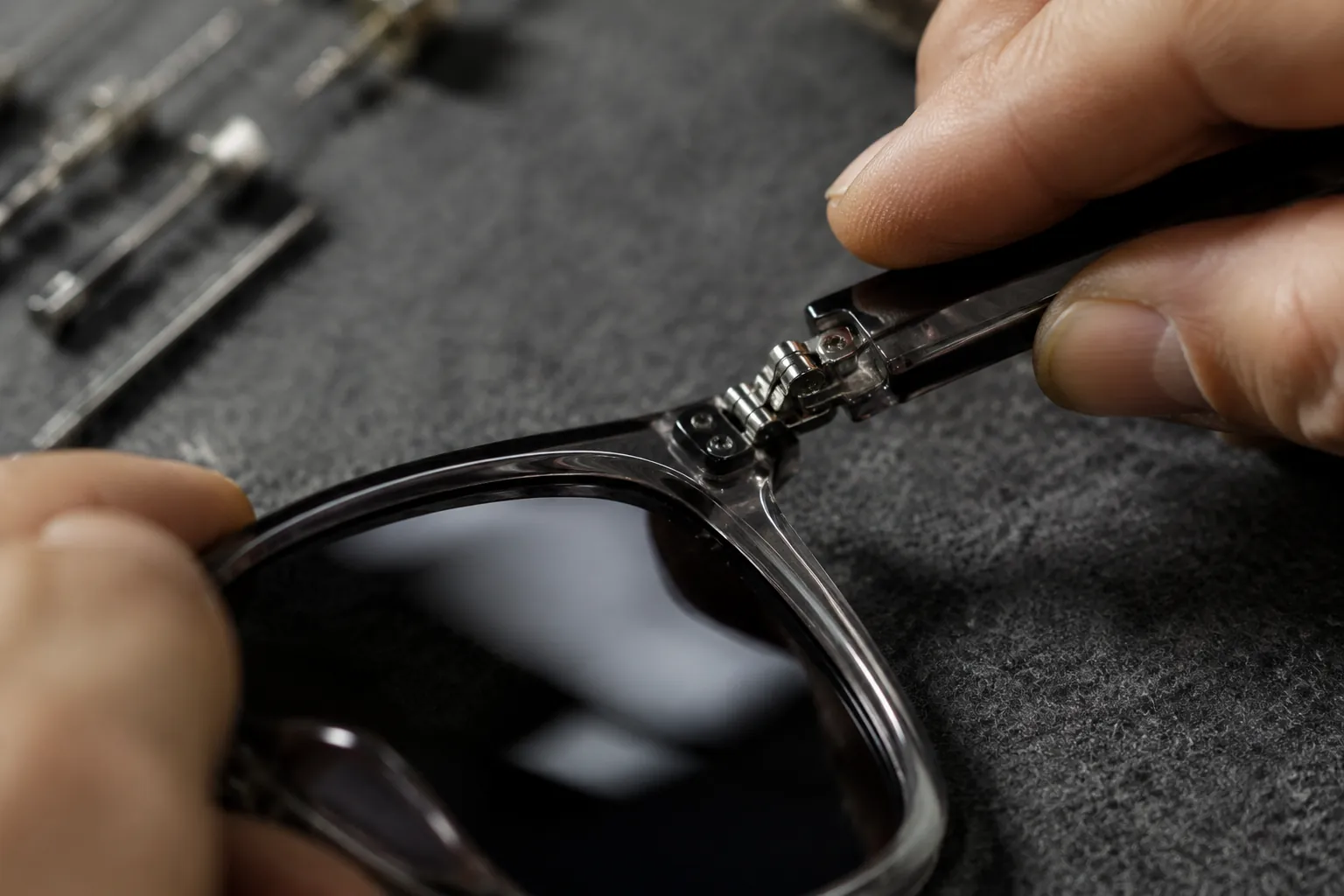
If you buy sunglasses in volume, hinge choice is not a small detail. It affects return rates, how the frame feels in hand, and whether reorders match the first shipment. This guide is for brands, importers, distributors, and retailers that need fewer defects and stable production from a factory that can hold the spec. The focus is practical: hinge types, screw behavior, material pairing, testing, decoration methods, tolerances, and what to put on the PO.
What a hinge actually does
A hinge turns a static frame into something people open and close hundreds of times. It carries repeated motion, side load from one-handed use, vibration in transit, and long-term stress from heat, sweat, and storage pressure. If the hinge spec is weak, the problems show up fast: loose screws, cracked hinge bosses or eye-wire ends, and frames that sit crooked.
For sunglasses, the hinge also sets the first impression. A frame that opens with controlled resistance feels better than one that flops open. Too stiff is also bad. It adds stress and makes fitting harder. The target is repeatable movement that still holds up after heat, humidity, packing pressure, and normal retail handling.
Buyer rule: specify how the hinge should perform, not just what it should be made of.
For private label programs, that means writing the hinge spec with the same discipline as lens tint, frame color, and logo placement. Without a clear spec, one batch may feel fine and the next may rattle, bind, or loosen under the same product name. A good factory can hold a hinge, but only if the buyer defines acceptable performance in measurable terms.
In practice, the hinge should be treated as a system with the temple material, barrel geometry, screw thread, drilling or molding method, and final inspection. Returns often come from the combination, not the hinge alone.
Main hinge types and where they fit
Most sunglass programs use a small set of hinge constructions. Each has a different cost, assembly burden, and failure pattern. The right choice depends on frame weight, target retail price, expected wear, and whether your channel expects repairability.
| Hinge type | Typical use | Strength point | Weak point | Buyer note |
|---|---|---|---|---|
| Standard 3-barrel metal hinge | Injection frames, acetate frames, entry to mid-price | Low cost, fast assembly, easy to source | Screw loosening if thread fit or torque control is poor | Best default for programs where unit price matters and temple load is moderate |
| 5-barrel metal hinge | Heavier acetate fronts, premium fashion frames, larger temples | Better load spread and a more solid hand feel | Higher material use and slower assembly | Use when the front is thick, the frame is heavy, or the brand wants a more substantial closing feel |
| Spring hinge | Comfort-focused retail, broader fit range, active lifestyle eyewear | Opens wider and reduces side stress on the face | More parts, more wear points, more variation in feel | Specify cycle target and opening resistance clearly or the same style may feel inconsistent across lots |
| Integrated acetate hinge block | Full acetate frames | Clean visual finish and solid aesthetic weight | Needs precise cutting, drilling, and alignment | Small positional errors show up quickly in temple fit, especially after polishing and heat adjustment |
The real difference is not only the hinge shape. It is whether the factory can run the right process for that hinge. Injection programs depend on molding consistency and boss design. Acetate programs depend on drilling accuracy, barrel alignment, and finish work after CNC cutting or manual adjustment. Metal frames depend on plating quality, welding accuracy, and screw retention.
That is why the same hinge style can behave differently in acetate versus injection. Match the hinge spec to the frame material. Do not force one generic construction across every product.
Material pairing: frame body and hinge must match
Hinge failures often come from bad pairing, not bad hardware alone. A metal hinge in a soft injection temple needs different screw retention than the same hinge in dense cellulose acetate. Acetate is generally more dimensionally stable than many plastics, but it is also more sensitive to drilling quality and heat during processing. If the barrel hole is off-center, the screw can sit under stress and loosen faster. If the boss wall is too thin, the first repair can split the temple.
For injection frames, the key variables are boss geometry, material shrinkage, screw bite, and cooling control during molding. Keep a robust wall around the hinge area and avoid decorative thinning in the load path. For acetate frames, the key variables are drilling accuracy, barrel alignment, and edge finishing after CNC milling or manual fitting. The hinge may be made correctly, but if the surrounding material is undercut or polished too aggressively, the load path weakens.
- Use stronger barrel geometry when the temple is long, the lens is oversized, or the frame feels heavy in hand.
- Keep hinge-area wall thickness generous; on injection parts, many factories specify roughly 1.2-1.8 mm around the boss depending on resin and design.
- Check left-right symmetry at the hinge axis, not just overall front width; a small offset can be visible in the closed frame.
- Confirm that pad printing, laser engraving, or metal logo inlays do not cut into nearby hinge walls or screw paths.
If you add a metal logo plate close to the hinge, leave enough distance so drilling, rivets, or adhesive work do not interfere with screw retention. Treat the whole hinge zone as one structural area. Not a decorative one.
Material behavior also changes after finishing. Acetate may move slightly after polishing or heat setting, while some injection materials can relax under warm storage. Final hinge approval should happen after the frame has been fully finished, not on a raw prototype.
Specs that actually reduce returns
The best hinge spec is one a factory can repeat. Buyers often ask for stronger hinges without defining the numbers. That is too vague for a production line. Put measurable controls on the PO and in the tech pack so sample approval, bulk production, and reorder quality follow the same standard.
A practical hinge spec should include the following:
- Barrel count: choose 3-barrel for cost control and lighter frames, 5-barrel for heavier fronts or higher perceived durability.
- Screw type and finish: define thread size, head style, plating or anti-rust finish, and whether the screw must be replaceable with standard optician tools.
- Opening resistance: define an acceptable feel target, expressed as a sample-approved range or internal reference frame, so the factory can match the same feel in bulk.
- Cycle target: specify a durability test goal suitable for the product, such as a bulk-validation cycle test with no meaningful loosening or cracking at the hinge.
- Alignment tolerance: define closed-frame symmetry, temple gap, and hinge-axis matching; a common working tolerance is within a small fraction of a millimeter depending on frame type.
Also lock in the process, not just the part. Ask whether screw insertion is manual, semi-auto, or torque-controlled, and whether thread lock is used. A small change in assembly method can matter more than a cosmetic finish change.
Consistency improves when the same team handles drilling, assembly, and final QC. Split those across too many hands and error can stack up. A factory with in-house QC can catch temple drag, uneven closing, and torque drift before packing. That matters because hinge issues often appear only after final alignment, not at the raw parts stage.
If the channel expects after-sales repair, specify serviceability. A hinge that local opticians can repair with standard tools reduces warranty cost and dead stock. If not, avoid tiny proprietary screws or unusual barrel spacing that complicate replacements.
Failure modes you should plan for
Most hinge-related returns are repetitive and avoidable. They are boring defects, which is exactly why they become expensive at scale. The same few problems show up across programs, especially when the buyer changes hinge type without changing the test plan.
| Failure mode | What causes it | What the buyer sees | How to prevent it |
|---|---|---|---|
| Loose temple | Poor screw retention, weak thread bite, vibration in shipping | Frame feels cheap and the temple drifts open | Lock screw spec, use torque checks, and run sample cycle tests after packing |
| Cracked hinge boss | Thin material, off-center drilling, over-tightening | Temple pulls away from the front or splits near the hinge | Increase wall thickness, improve drill accuracy, and cap assembly torque |
| Uneven closing | Left-right alignment error or barrel mismatch | Frame looks crooked in the box and sits off on face | Set symmetry tolerance and inspect at full closure, not only open position |
| Rust or staining | Weak plating, moisture exposure, poor storage or packing | Discoloration around the hinge or screw head | Require corrosion checks, better plating, and dry packing control |
| Temple flop or bind | Opening resistance outside the working range | Temples fall open too easily or resist opening | Specify the approved feel target and test both sides from the same baseline |
Packaging damage matters too. A hinge that survives production can still arrive bent if the carton stack is poor or the temple pressure point is wrong. Return rate is a system problem, not only a parts problem. If the temple tip presses against the lens or the hinge area is under constant load in transit, the finished product can shift before the customer ever opens the box.
One blunt point: if your product is sold as a fashion frame at a low price, do not specify premium hinge complexity unless the margin supports it. Extra parts add labor, inspection, and repair cost. A spring hinge or 5-barrel construction can be worth it, but only if the unit economics and brand positioning justify the added complexity.
Testing before bulk approval
Samples should not just look right. They should survive enough use to reveal weak hinge geometry, poor screw retention, and material stress around the joint. For overseas buyers, sample approval is where hinge mistakes can still be fixed cheaply. Bulk is where they become inventory damage and margin loss.
A practical pre-production check set includes:
- Repeated open-close cycle testing on both temples, using a sample size and cycle count that reflect the product risk and expected use.
- Torque feel check after heat exposure, then after cooldown, because some materials relax after warm storage or transport.
- Manual alignment check with lenses installed, not just on bare fronts, since lens load can reveal frame twist.
- Screw retention recheck after vibration and packing simulation.
- Drop and handling check in the same carton style and insert system you will use in bulk shipping.
Decoration can affect the hinge test. Pad printing near the temple can add solvent exposure, while laser engraving near a hinge boss can remove material or create a stress riser if the artwork is too close. If you use hot stamping, plating accents, or metal inserts, approve them on the final production substrate. A hinge that passes on a bare sample may fail after decoration changes the wall thickness or local heat profile.
For compliance, the hinge itself is only one part of the larger frame system. The full product still needs to meet the relevant market standard. For sunglasses, that means CE EN ISO 12312-1 for the EU, ANSI Z80.3 for the U.S. if that is your target, AS/NZS 1067 for Australia/New Zealand, plus REACH material restrictions and FDA registration where applicable. A hinge spec does not replace compliance testing; it supports it by keeping the frame stable during durability checks and normal use.
Sample lead time is typically shorter when the hinge style is already proven and the material is in stock. Bulk lead time is typically longer when the hinge type, plating, decoration, and packaging are all frozen before mass production. Mid-project changes to hinge style, plating, logo position, or screw type usually push the schedule out because they require re-approval and sometimes rework.
Cost, MOQ, and reorder consistency
Hinge choice affects price faster than many buyers expect. At low MOQ, the cost gap between a simple standard hinge and a more complex spring hinge is not just parts cost. It also includes assembly labor, slower QC, higher defect sensitivity, and more sample iterations. At higher order quantities, the per-unit price usually improves because setup cost gets spread out and the factory can stabilize the line.
For a simple injection or acetate frame, a well-controlled hinge spec can be one of the fastest ways to move the product toward a target price. But that only works if the reorder matches the first shipment. A cheap frame that reorders badly is not cheap at all.
Use the PO to lock the functional spec, not just the style name:
- Hinge type and barrel count.
- Screw size, head style, finish, and replacement standard.
- Opening feel target and acceptable torque band.
- Inspection points for alignment, gap, and screw retention.
- Approved samples with signed photos of the hinge area and any decoration nearby.
Reorder consistency depends on the same screw supplier, the same plating finish, and the same assembly torque. If the first order uses one screw plating and the reorder uses another with different friction behavior, the product can look identical and still fail differently. That is why technical lock-down matters more than a verbal promise of same as last time.
For brand owners, the useful metric is lifetime value, not only landed cost. A frame that comes back once or twice due to hinge looseness costs more than a slightly better frame that stays in the field. Lower warranty handling, fewer replacement shipments, and less retailer frustration are real margin protection.
What to send your factory
If you want fewer surprises, send a hinge brief that is easy to quote and hard to misunderstand. Keep it technical. Avoid vague language like premium finish unless you define the finish system, plating thickness, and acceptable wear standard. The better the brief, the fewer trial runs you need.
- Frame material: injection, acetate, metal, hybrid, or mixed build.
- Hinge type: 3-barrel, 5-barrel, spring, or integrated acetate block.
- Target market and compliance path: CE EN ISO 12312-1, ANSI Z80.3, AS/NZS 1067, REACH, FDA registration as needed.
- Quantity plan: first order, reorder target, and expected annual volume.
- Mechanical expectations: opening feel, repairability, cycle target, screw service standard, and visible finish standard.
- Decoration method: pad print, laser engraving, hot stamp, plating, insert, or logo plate location relative to the hinge.
- Packaging and shipping conditions: carton style, retail insert, pressure points, and expected transit length.
Ask for hinge samples tied to the actual production material, decoration method, and packing structure. Do not approve a hinge on a bare sample and then change the frame finish later. Geometry, fit, and stress behavior can all shift.
The best hinge spec is boring in the best way. It closes the same way every time, survives real handling, and does not create after-sales noise. That is what reduces returns and protects reorder value.
Have a custom sunglasses project in mind?
Send us your styles, target market and quantities and we will return a detailed quote with MOQ, lead time and a sample plan.
Get a QuoteWhy source this from Wenzhou with LumiShades
Wenzhou in Zhejiang Province is widely regarded as China’s eyewear manufacturing capital, producing a large share of the world’s sunglasses. That concentration matters to buyers: a deep local supply chain for acetate sheet, hinges, lens blanks, plating and packaging means shorter component lead times, easier color and material matching, and a workforce with decades of eyewear-specific skill. LumiShades has manufactured in this ecosystem since 2009, and our vertical integration — in-house injection molding, acetate cutting, CNC milling, lens tinting, decoration and quality control — means no part of your order is quietly subcontracted to a workshop you cannot audit.
For international buyers, that vertical control translates into accountability. When a single factory owns every step, defects are traced and fixed at source rather than bounced between vendors, and your specifications survive intact from first sample to bulk. We back this with 15+ years of experience, shipments to 60+ countries, more than 5 million pairs produced per year and a 98.5% on-time delivery rate. Our certifications — CE EN ISO 12312-1, FDA registration, ANSI Z80.3, AS/NZS 1067, REACH, ISO 9001 and BSCI audit — mean the compliance documentation your market requires already exists. Explore our manufacturing capabilities and quality control process to see how this works in practice.
Frequently asked questions
Should I choose a 3-barrel or 5-barrel hinge for sunglasses? Use a 3-barrel hinge when the frame is light, the temple load is modest, and your target price leaves little room for extra hardware or labor. Use a 5-barrel hinge when the frame is heavier, the front is thicker, or you want a more solid closing feel and more load spread. If you are unsure, ask the factory to sample both on the final frame material and compare the feel after cycle testing, because the right choice depends on the full build, not the hinge alone.
What hinge information should go on the PO? State the hinge type, barrel count, screw size and finish, opening feel target, alignment tolerance, cycle target, and whether the hinge must be repairable with standard tools. If decoration sits near the hinge, add that too, because finishing can change wall thickness and stress. The PO should let a second factory read the document and make the same part without extra clarification.
Do hinge specs affect compliance testing? Yes, but indirectly. The hinge does not determine compliance by itself, yet poor alignment, weak screw retention, or torque problems can cause failures during handling and durability checks for CE EN ISO 12312-1, ANSI Z80.3, and AS/NZS 1067 programs. A stable hinge helps the frame survive the test conditions more reliably, so it should be part of the compliance plan from the start.
How can I reduce loose-hinge returns? Control screw fit, drilling or molding accuracy, and assembly torque. Then verify that the frame material around the hinge has enough thickness to hold the joint after repeated opening and closing. Before approval, test samples after packing and vibration, because a hinge that feels fine right after assembly can loosen once the carton is handled in transit.
Is a spring hinge always better? No. A spring hinge gives a wider opening range and can improve comfort, but it adds parts, assembly time, and more wear points. If your price target is tight, a well-made standard hinge is often the better choice. Use a spring hinge only when the added comfort, fit range, or premium feel is worth the extra cost and complexity.
When should I approve the final hinge sample? Approve it only after the hinge is tested in the final frame material, with final decoration, final lens fit, and the same packing method you will use in bulk. A bare-frame approval is not enough because decoration, lens load, and packaging pressure can all change hinge performance. If the factory changes screw, plating, or assembly method after approval, treat it as a new sample for sign-off.
Ready to start?
Explore our shield & oversized sunglasses or request a quote — our sales team replies within 12 hours.
Request a Quote