
Frame Wall Thickness Guide for Sunglass Buyers
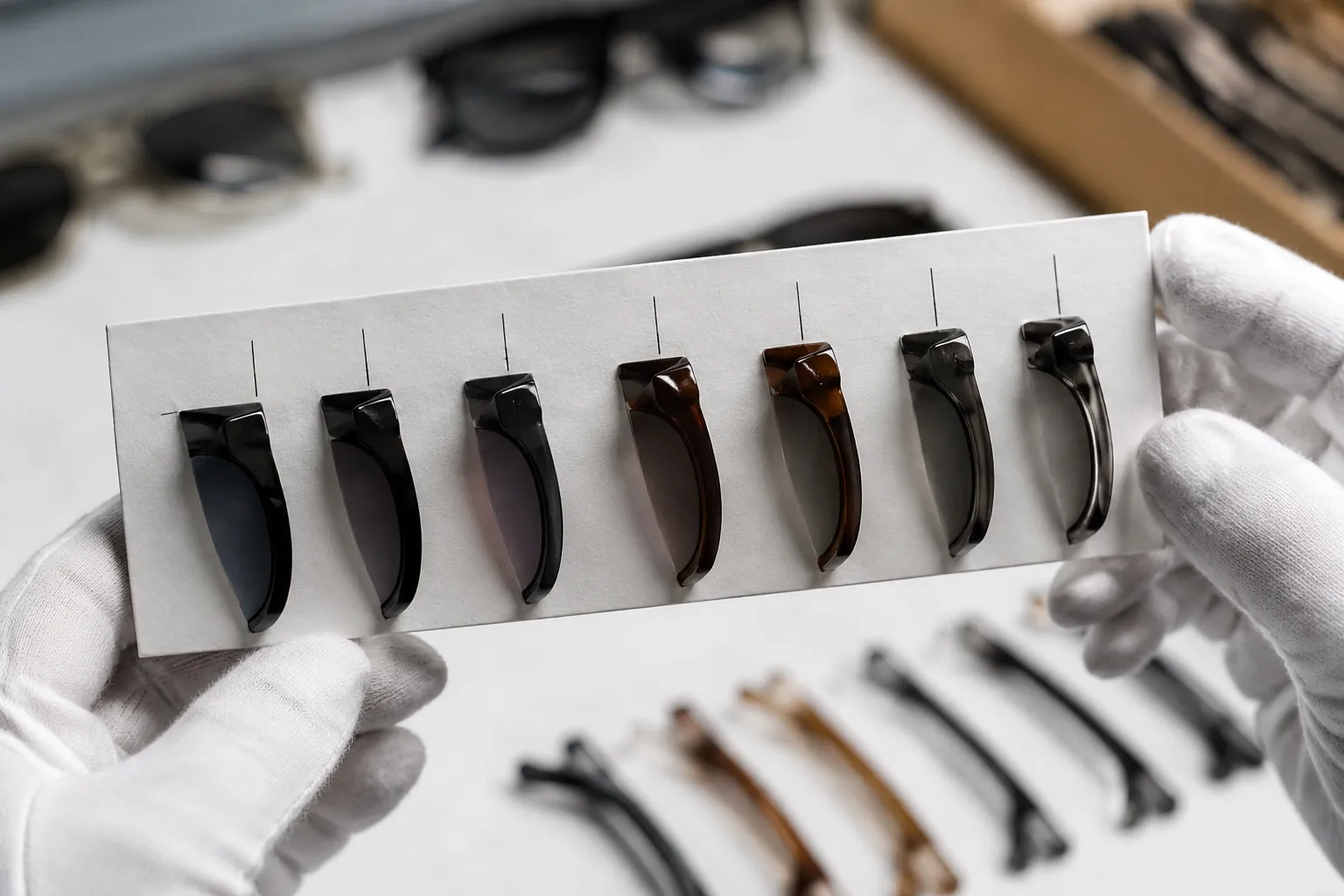
If you buy sunglasses in volume, wall thickness is not a design detail. It affects breakage risk, packaging damage, assembly quality, and margin. This guide is for brands, importers, distributors, and retailers that need frames to survive real use without unnecessary weight or cost. The goal is simple: choose the right geometry and reinforcement for the price point, then verify it in sampling and production.
What wall thickness actually controls
In eyewear, wall thickness affects three common failure areas: hinge-zone cracking, temple flex, and screw retention. If a section is too thin, the frame may pass visual inspection but fail after heat exposure, repeated opening, or lens installation. If it is too thick, you add weight, slow production, and invite sink marks, whitening, or warp. The right thickness is not the maximum. It is the minimum that fits the use case.
Acetate can be misleading because outside appearance hides the internal milled profile, core placement, and lens groove geometry. For injection-molded frames, ribs, boss design, and material flow matter more than a raw wall number alone. The weak points are usually the transitions: bridge-to-front, temple root, hinge boss, nose pad arm base, and lens groove termination. That is where cracks start. That is where claims start too.
The first question is not "How thick can we make it?" It is "What failure are we trying to stop?" A fashion frame worn lightly in retail has different needs from a sport wrap used daily in heat and sweat. A promo frame can carry less structural margin than a premium retail frame that must survive returns and repacking. Define the use case first. Then the factory can match the wall spec, core support, and hinge style to it.
As a practical start, ask for a drawing or sample approval that shows the minimum wall at the stress zone, not just the nominal outer dimension. A frame that starts with a 4.0 mm temple blank is not strong if the hinge root drops sharply after milling. For commercial programs, controlled variation at the critical zone matters more than a single nominal number. Agree the tolerance with the factory based on material, process, and style complexity.
Thickness targets by frame material
There is no single wall number that fits every frame, but there are practical production ranges that work across most bulk sunglasses programs. The table below is a starting point for sampling discussions. Final specs still depend on frame shape, lens size, hinge torque, surface finish, and whether the style will be used indoors, outdoors, or in active wear.
| Material / part | Typical practical range | What it gives you | Main risk if too thin |
|---|---|---|---|
| Injection-molded TR90 front | 1.2–1.8 mm wall, with local ribs at stress points | Lightweight, flexible, good impact recovery | Hinge cracking, screw pullout, distortion at heat |
| Injection-molded PC or PC blend front | 1.4–2.0 mm wall | Better impact resistance, stronger feel | Stress whitening, brittle behavior at sharp corners, warp if cooling is uneven |
| Acetate temple blank | 2.5–4.0 mm overall stock before milling | Stable feel, better polishing allowance, enough material for core support | Temple twist, weak hinge zone, polishing burn-through, visible core shadowing |
| Acetate front rim | 3.0–5.0 mm stock before cutting and shaping | Enough body for lens groove and front stability | Groove breakout, bridge weakness, edge chipping during edging |
| Metal core or insert zone | Usually reinforced locally rather than globally thickened | Controls flex without making the whole part heavy | Loose fit, cracking around insert ends, poor retention after heat cycling |
Local reinforcement usually works better than blanket thickness. A frame that is 0.3 mm thicker everywhere can cost more and still fail at the hinge. A frame with a proper rib, boss, corner radius, or core insert at the weak point often performs better because most failures begin where stress concentrates, not where the part is flat and well supported.
For molded parts, wall uniformity matters almost as much as wall size. A target wall of 1.5 mm with a sudden jump to 2.4 mm can create sink, flow hesitation, or internal stress. Many factories try to solve a weak point by making the whole part heavier. That raises cost without fixing the crack point. Better brief: set a nominal wall, then specify local rib height, rib draft, boss diameter, and corner radii around the joint.
Where failures start in bulk orders
Most breakage claims do not come from the middle of a frame. They come from repeated stress in the same places. During development and inspection, buyers should watch the same few zones every time because that is where field returns usually begin.
- Hinge boss: screws loosen, plastic splits, or the hinge plate pulls out after repeated opening; for small plastic bosses, thread engagement needs enough depth to hold the screw without stripping.
- Temple root: the thinnest transition zone cracks during packing, shipping, or customer use; a small increase in local support often matters more than adding mass elsewhere.
- Bridge underside: thin sections distort or crack if the frame is dropped, heated, or bent during lens fitting.
- Lens groove on acetate: poor wall support can cause breakout when lenses are pressed in; groove depth and remaining wall should be reviewed together, not separately.
- Nose pad arm base: on metal styles, small sections fail if the bend radius is too tight or the weld area is undersized.
In factory terms, the failure map should be documented before bulk approval. A mature supplier should measure wall at the hinge root, temple taper, bridge centerline, and groove land, then compare those figures with sample failure points. At a well-run Wenzhou sunglasses factory, in-house injection molding, acetate cutting, CNC milling, tinting, decoration, and QC can shorten that loop because geometry can be adjusted before it becomes a production problem. That matters. A cat-eye front and a square sport wrap do not share the same stress map.
For buyers, the most useful request is a failure-point review during sample approval. If a sample cracks during a drop or flex test, ask where it cracked, what the load condition was, and whether the failure was brittle fracture, shear, or pullout. That answer tells you whether to add wall, add a rib, change hinge placement, enlarge the radius, or reduce lens tension. Without that detail, the factory may simply thicken the part and call it solved.
If the weak point keeps moving after each change, the design is still unbalanced. The aim is not to make the sample feel heavy in the hand. The aim is to make it survive normal use without creating an obvious weak zone.
Reinforcement choices that actually work
Reinforcement should match the construction method. More material is not always better, and "reinforced" should mean a specific change you can inspect and measure. The most useful options are targeted.
- Add ribs near hinge zones: Best for molded frames. A rib height of roughly 0.6–1.2 mm, with a generous root radius, can stiffen the temple root without making the whole piece heavy.
- Use metal cores in acetate temples: Useful when you need memory control and hinge support. The core should extend far enough past the hinge area to support the transition, and the end taper should be designed carefully.
- Increase corner radii: Sharp internal corners are crack starters. A broader radius can improve durability more effectively than adding raw thickness.
- Strengthen screw bosses: A small change in boss wall, diameter, and thread engagement can reduce hinge-related claims. For many designs, the boss should not be the thinnest section on the frame.
- Control lens groove depth: For full-rim acetate, groove depth and wall support must stay balanced or the rim may chip during lens fitting; groove placement should be checked against the lens edge thickness.
- Use local gussets instead of global thickening: Small gussets near the bridge or hinge can add stiffness while preserving a cleaner visual profile.
Decoration can affect durability too. Laser engraving, pad printing, hot stamping, and metal logo plates should not sit on the most stressed section unless the wall underneath can support them. A metal plate may look neat, but if it lands on a weak temple root it adds local stress and can create a failure point. Pad print on a flex zone may wear early if the surface bends constantly.
Decoration method selection should match the substrate. On acetate, laser engraving can look crisp but may expose a lighter inner layer if the wall is too thin. On molded plastic, an overly aggressive cure or bake can make the surface more brittle. On metal parts, plating thickness and edge buildup should be checked because excessive buildup can hide sharp transitions instead of solving them.
Good reinforcement is invisible to the customer but obvious in production. The frame closes smoothly, the hinge does not wobble after opening, the lens edge seats without chip-out, and the finish still looks clean under inspection light.
How thickness affects cost and lead time
Buyers often separate durability from cost, but the two are tied together. Thicker stock uses more material, increases milling or molding cycle time, and may reduce line efficiency. A well-reinforced frame can also save money by reducing claims, replacements, and reshipments. The right trade-off depends on volume and channel risk.
| Build choice | Typical effect on unit cost | Effect on production timing | Return-risk profile |
|---|---|---|---|
| Minimal wall, no local reinforcement | Lowest upfront cost | Fastest cycle | Highest claim risk |
| Moderate wall with targeted ribs/core | Small increase | Usually neutral to slight increase | Best balance for most commercial orders |
| Heavy wall throughout | Higher material and processing cost | Longer cooling or milling time | Can still fail at weak transitions |
| Overbuilt structure plus decorative plates | Highest cost and inspection burden | Longer assembly and QC time | May reduce flex comfort and create cosmetic rejection |
For many bulk programs, MOQ and pricing steps matter as much as the wall spec. A supplier may quote one cost at 50 pairs per design and a better rate at 300, 1,000, or 5,000+ pairs because tooling setup, color matching, and line changeovers are spread over more units. Wall changes after tooling can erase those savings quickly.
Lead time also moves with geometry. A simple sample may take 7–10 days, but if the design needs new ribs, a different hinge, or updated CNC paths, the revision cycle can extend that timeline before the sample is stable. Bulk production often runs 25–35 days after approval, but a midstream wall change can force a new pilot run, new QC references, and sometimes reassembly checks. That is why wall decisions should be made during the first sample round, not after the shipping plan is already fixed.
If your channel is price sensitive, the usual move is to keep the visible design clean and spend the structural budget on hidden reinforcement. That protects margin without making the frame look bulky, and it often lowers claims more effectively than chasing a thicker outer profile.
How to specify it to a factory
Do not ask for "strong enough" frames. Send a measurable brief. The factory needs a target, a use case, and a test method. A useful spec sheet should include the construction method, the target wall range by zone, and the failure risks you care about most.
- Frame material and finish, including whether it is acetate, injection-molded plastic, metal, or a mixed construction.
- Target wall range for front, temple, hinge zone, and bridge, not just one global number.
- Expected abuse: retail display only, daily wear, travel, sport, children's use, or high-heat environments.
- Required cosmetic limits: sink marks, weld lines, parting lines, polish level, and any acceptable print or plating variation.
- Hinge type, screw size, and whether a metal core, insert, or reinforcement plate is required.
- Packaging method, because tight cartons and poor tray support can turn a borderline frame into a shipping claim.
- Compliance target: CE EN ISO 12312-1, ANSI Z80.3, AS/NZS 1067, REACH, FDA registration where applicable, plus ISO 9001 or BSCI if you want a supplier-system audit rather than a product regulation.
If your supplier can support in-house molding, CNC milling, tinting, decoration, and QC under one roof, they can close the loop faster. That matters because reinforcement decisions affect more than the frame. They affect lens fit, coating hold, hinge torque, and final assembly. A good supplier will not promise a wall number without asking about lens thickness, hinge torque, and packaging method. They may also ask for a signed sample standard with photos of acceptable sink, finish, and gap tolerances so production does not guess.
A practical drawing note can be as simple as: "Critical wall minimum at hinge root: 1.3 mm ± 0.15 mm; temple root radius minimum 0.8 mm; no sink greater than 0.2 mm in visible area; lens groove to hold edging without chip-out." Those are the kinds of instructions that help a factory build the right sample.
Rule of thumb: if a frame only survives because the carton is perfect, the frame is still too fragile.
QC tests that catch thin-wall problems early
Visual inspection alone misses most structural problems. Thin-wall failures often show up only after stress. The tests should be simple, repeatable, and tied to the real use case. They do not need to be fancy, but they do need to be consistent.
- Open-close cycle test: Check hinge loosening and temple root cracking after repeated use; many teams use a 500-cycle internal check for commercial styles and a higher count for active-wear programs.
- Drop test: Confirms whether local ribs and boss design survive handling damage; test from typical pocket, countertop, and parcel heights when relevant.
- Heat exposure check: Reveals warp risk in thin sections and poor core support; a short high-temperature exposure can expose stress whitening or set deformation before shipping.
- Fit and assembly check: Confirms that lens insertion does not chip the groove or split the rim; the result should be checked after edging, not only on loose frames.
- Torque check on screws: Catches over-thin boss walls before shipment and helps identify whether the hinge stack is too stiff for the substrate.
- Visual stress review under magnification: Finds tiny cracks, whitening, or plating fractures at corners before they become returns.
For overseas buyers, ask for first article samples, not just photos. The sample should represent the final wall spec, final hinge, final decoration location, and final lens condition. If your production plan includes CE EN ISO 12312-1, ANSI Z80.3, AS/NZS 1067, or REACH-related compliance work, the structure should be frozen before testing. Changing wall thickness later can invalidate the result or force a retest, which costs time and can disrupt the shipment calendar.
Good QC also means comparing sample behavior against a control. If one style survives 500 cycles and another fails at 180, the difference should be traced to the wall map, boss design, or hinge hardware, not simply recorded as pass or fail. That traceability is what reduces claims.
Real QC is boring. That is good. The frame that passes the same checks every time is the frame that keeps claims down.
A buyer's checklist before approval
Use this before you sign off on mass production. It is short because the important questions are usually the ones buyers skip. If a supplier can answer these quickly and with measurements, they usually understand structural control. If they cannot, the order is still at risk.
- Where is the real weak point on this style, and what measurement proves it?
- Is the reinforcement local, or is the whole frame just thicker?
- Will the hinge survive repeated opening without screw, boss, or plate failure?
- Does lens fitting damage the groove or rim, and what is the acceptable insertion force?
- Can the factory hold the same wall spec across the full order, including color and decoration variants?
- What test caused the last sample failure, and what changed after that?
- Is the sample wall exactly the same as the bulk plan, or only visually similar?
If the answers are vague, the return rate will usually be vague too. If they are specific, you have a better chance of shipping frames that stay in spec and stay out of your claims file. That is the real job here: balancing structure, cost, lead time, and assembly risk so the product survives the real world, not just the showroom.
For bulk buyers, the safest approval is the one that locks geometry, decoration, and packaging together. Once those three are aligned, the factory can repeat the result, and repeatability is what lowers returns.
What to do after approval
Approval is not the end of structural control. It is the point where the agreed sample must become the repeatable production standard. The buyer should keep one sealed golden sample, one working comparison sample, and a record of the wall map, hinge hardware, lens condition, and packaging format used for approval.
During pilot production, compare the first bulk pieces against the approved sample at the same locations every time. If the wall is thinner in the hinge root, the core sits differently, the lens fits tighter, or the finish changes after decoration, stop and review before full release. Small geometry changes usually show up first as cosmetic issues, then later as returns.
If the supplier is certified to ISO 9001 or audited under BSCI, that can help with process discipline, but it does not replace product verification. Product compliance still depends on the actual frame, the actual materials, and the actual finished geometry. Keep the approval notes clear enough that another buyer or QC person could verify the same standard six months later.
The goal is not perfection. The goal is repeatability. A repeatable frame is easier to pack, easier to inspect, and less likely to come back as a claim.
Have a custom sunglasses project in mind?
Send us your styles, target market and quantities and we will return a detailed quote with MOQ, lead time and a sample plan.
Get a QuoteWhy source this from Wenzhou with LumiShades
Wenzhou in Zhejiang Province is widely regarded as China’s eyewear manufacturing capital, producing a large share of the world’s sunglasses. That concentration matters to buyers: a deep local supply chain for acetate sheet, hinges, lens blanks, plating and packaging means shorter component lead times, easier color and material matching, and a workforce with decades of eyewear-specific skill. LumiShades has manufactured in this ecosystem since 2009, and our vertical integration — in-house injection molding, acetate cutting, CNC milling, lens tinting, decoration and quality control — means no part of your order is quietly subcontracted to a workshop you cannot audit.
For international buyers, that vertical control translates into accountability. When a single factory owns every step, defects are traced and fixed at source rather than bounced between vendors, and your specifications survive intact from first sample to bulk. We back this with 15+ years of experience, shipments to 60+ countries, more than 5 million pairs produced per year and a 98.5% on-time delivery rate. Our certifications — CE EN ISO 12312-1, FDA registration, ANSI Z80.3, AS/NZS 1067, REACH, ISO 9001 and BSCI audit — mean the compliance documentation your market requires already exists. Explore our manufacturing capabilities and quality control process to see how this works in practice.
Frequently asked questions
What wall thickness should I ask for on acetate sunglasses? Specify the front and temple separately, and ask for the minimum wall at the stress zones. In many acetate programs, the front starts around 3.0–5.0 mm stock before shaping and the temples around 2.5–4.0 mm stock, but the key check is the finished wall at the hinge root, bridge, and lens groove after milling. Ask the factory to show those measurements on the drawing or sample report.
Is thicker always better for durability? No. Extra thickness can add weight, slow production, and still miss the real failure point. A frame usually gets more durable when the factory reinforces the hinge, bridge, or temple root directly, rather than thickening the whole frame. Ask where the part failed in sample testing, then reinforce that zone specifically.
What is the best reinforcement for molded frames? For molded frames, start with local ribs near the hinge zone and a stronger screw boss design. Make sure the rib has a smooth root radius and that the boss is not the thinnest section on the frame. If the part still fails, review the wall transition and material flow before adding more material globally.
How do I reduce breakage claims without raising price too much? Use targeted reinforcement, not blanket thickness. A moderate wall plus better hinge geometry, sensible radii, and basic cycle and drop tests often gives a better cost-to-risk balance than heavy wall throughout. Also check packaging, because poor tray support can turn an acceptable frame into a shipping claim.
Should I change the wall spec after sampling passes? Only if you re-approve the change. Even small wall changes can affect fit, warp, hinge torque, and compliance results. Freeze the structure before bulk production, and keep the approved sample, drawing, and test notes aligned with the final wall, hinge, decoration, and packaging method.
Which certifications or compliance references should I mention to a supplier? Use only the standards that apply to your market and product. Common references for sunglasses include CE EN ISO 12312-1, ANSI Z80.3, AS/NZS 1067, REACH, and FDA registration where applicable. If you need supplier-system assurance, ask about ISO 9001 or BSCI, but do not treat those as product safety certifications.
Ready to start?
Explore our round sunglasses or request a quote — our sales team replies within 12 hours.
Request a Quote