
Best Sunglasses Frame Materials by Price Tier
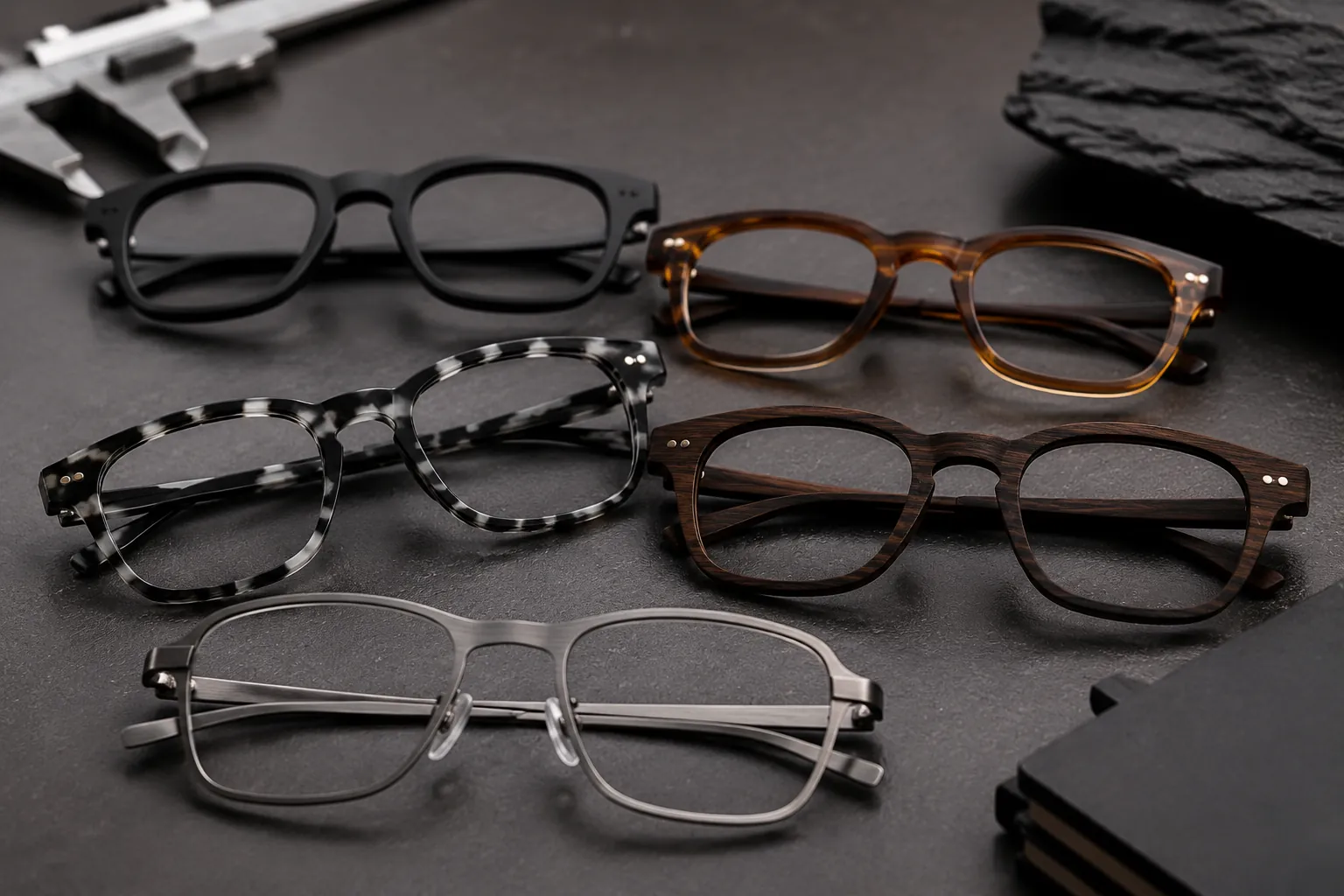
If you buy sunglasses for a brand, importer, chain store, or distributor, frame material affects more than style. It changes tooling cost, unit cost, breakage risk, compliance work, and the retail price the product can support. This guide compares injection, acetate, metal, and hybrid frames by price tier so you can judge the trade-offs before you place a production order.
Start With the Retail Tier
Most sourcing mistakes start with design first. Buyers pick a frame they like, then try to force it into a price point. That is backwards. Margin gets squeezed later.
Start with the shelf price. Then work back to the frame, the build, and the decoration. Ask a simple question: what retail band are you targeting, and what margin still has to survive freight, duty, packaging, returns, and defects?
For private label sunglasses, the frame material should follow the price tier. Injection usually fits entry and lower-mid tiers where unit cost has to stay tight and tooling can be spread across volume. Acetate fits the middle and upper-middle tiers because it has stronger visual depth and a more premium hand feel. Metal works well in slim styles where light weight and clean lines matter more than thickness. Hybrid frames are useful when you want a visible value cue, such as an acetate front with metal temples, without moving into fully labor-heavy acetate construction.
The production setup matters too. A factory that handles injection molding, acetate cutting, CNC milling, lens tinting, decoration, and QC under one roof can reduce handoff risk and shorten lead times. That does not erase material trade-offs. It just gives you tighter control over cycle time, defect rate, and changeover risk. In practice, buyers should think in this order: retail tier, then construction, then decoration, then color story.
Here is the real test. What is the acceptable factory cost? How much assembly labor can the product carry? What visual cue does the consumer need to justify the tag? A low-price program loaded with thick acetate, custom metal badges, and multiple print steps can lose margin fast. A premium program built on thin injection with weak finish control can look cheap. That mismatch is where money disappears.
What Each Material Does Best
| Material | Best retail tier | Main cost driver | Typical factory target | Buyer upside | Typical risk |
|---|---|---|---|---|---|
| Injection | $10-$25 | Mold amortization, cycle time, and reject rate | MOQ is usually lower for development runs and higher for efficient bulk pricing | Lowest unit cost at scale | Can look cheap if wall finish, hinge pocket, or gloss control is weak |
| Acetate | $20-$60 | Blank material, cutting, tumbling or polishing, and hand assembly | MOQ is usually lower for sample runs and higher for stable bulk economics | Better perceived value and richer color depth | More labor, more polishing time, and more scrap risk |
| Metal | $25-$70 | Parts count, welding, plating, and alignment precision | MOQ is usually higher when components or finish steps are shared across colorways | Light feel, premium look, slim profile | Plating wear, hinge alignment, corrosion control, and higher assembly sensitivity |
| Hybrid | $25-$65 | Mixed processes, extra parts, and assembly complexity | MOQ is usually higher before the bill of materials becomes efficient | Good value signal without full acetate labor | More SKUs, more QC points, and more cosmetic mismatch risk |
Injection frames are usually the lowest-cost path to a sellable product. Not the lowest-risk path. If the mold is weak or the finish is rough, the product reads cheap immediately. Acetate is the opposite. It costs more to make, but it photographs better and feels more substantial in hand. Metal can look expensive even with a simple structure, but only if plating, welding, and temple alignment are controlled. Hybrid frames are often the most practical compromise for brands that want a stronger shelf impression without moving fully into high-labor acetate construction.
The rule is simple. Match the material to the shelf story. A value line should not carry premium finishing steps it cannot recover. A premium line should not be undermined by a construction that looks thin or unfinished. When the match is right, margin is easier to defend and returns are easier to control.
Injection Frames Work Best at the Lowest Cost
Injection frames are the workhorse for volume programs. The common setup uses molded plastic materials chosen for the target look, flexibility, and compliance needs. The main advantage is repeatability. Once the mold is stable, cycle time is short, and unit cost drops as volume rises.
Tooling is the main risk. A basic frame mold may be manageable, but a poor tool locks in bad geometry. If temple angle, front wrap, or hinge pocket tolerance is off, the issue shows up across the whole batch. So samples need to be checked for fit, not just color. Temple symmetry, front curve, hinge boss position, and lens seating depth all matter. Ask the factory for internal tolerance targets and confirm the critical fit points during sample approval.
Injection also rewards restraint in decoration. Heavy embossing, oversized logo plates, or too many sharp transitions increase tool complexity and can show sink marks, flash, or parting-line issues. A simple logo, a clean temple tip, or a small pad print is usually a better commercial decision than adding visual features that do not lift the retail price enough to pay for them.
Use injection when the target retail is price-sensitive and the silhouette is simple. Keep decoration limited to pad print, small laser marks where appropriate, or basic logo plates. Ask for wall thickness consistency, hinge pull tests, and lens groove fit before mass production. Do not overload the style with detail that drives tool complexity.
- Use injection if the target retail is price-sensitive and the silhouette is simple.
- Keep decoration limited to pad print, small laser marks, or basic logo plates.
- Ask for wall thickness consistency, hinge pull tests, and lens groove fit before mass production.
- Do not overbuild the style with unnecessary detail that drives tool complexity.
Injection still needs full compliance testing as a finished sunglass product. The material does not change the requirement to test to the applicable market standard, such as CE EN ISO 12312-1, ANSI Z80.3, or AS/NZS 1067. For materials and substances, REACH may also apply depending on the market and product composition.
Acetate Frames Deliver Perceived Value
Acetate is where many brands create stronger perceived value. It has visual depth, richer color layers, and a hand-finished feel that buyers notice fast. It also supports higher retail pricing because it looks denser and more deliberate on shelf. But acetate is not low-effort. It needs blank selection, cutting, edging, tumble finishing or polishing, careful heat bending, and tighter assembly control than many buyers expect.
Acetate works best when you want a frame that looks expensive without becoming a metal-heavy design. It also handles tortoise, marble, translucent, and multi-layer lamination effects well, which is why it shows up so often in fashion-led assortments. The downside is labor. A polished acetate temple may need several passes: rough shaping, edging, barrel fit, hand bend, final polish, and QC. That stack of work is why a low retail target gets squeezed quickly.
One practical rule helps. If your retail target is below about $20, acetate often leaves too little room for margin after production and finishing. Between about $20 and $60, it becomes easier to justify because the market can usually support the richer look and there is still room for packaging, optics, and returns. Above that range, acetate is even more defensible, especially for brand stories that rely on color, thickness, and tactile finish.
Process control matters. Acetate blanks should be checked for stable stock thickness because variation affects how the front and temples behave after cutting and polishing. Good factories usually use CNC milling for shaping, then hand-finish the contact points, then QC hinge alignment and surface defects. Ask whether the factory uses heat-bending jigs for temple curve consistency. If bend angles drift, one batch may feel loose and the next one tight. On premium-looking acetate, the visible polish line on the front edge is often one of the first things consumers notice, so inspect the surface under direct light, not only in a flat sample room.
Strong acetate sourcing also depends on factory discipline. Ask whether the factory works to a documented quality system such as ISO 9001 and whether social compliance audits such as BSCI are in place if that matters to your channel. Those do not guarantee a good frame. They just suggest the process is controlled and repeatable.
Metal Frames Fit Slim Premium Styles
Metal frames work well when the buyer wants light weight, narrow profiles, and a cleaner premium impression. They are common in retail programs where the frame should feel refined rather than bold. Stainless steel, monel, aluminum, and alloy builds each behave differently, but the sourcing question stays the same: can the factory hold alignment, plating quality, and consistent spring tension?
Metal often looks more expensive than it is. Only if welding and finish control are right. A frame can fail visually with very small asymmetries. On shelf, a crooked bridge, uneven temple opening force, or dull plating edge is easy to spot. Corrosion resistance matters too. Buyers shipping into humid markets or coastal regions should ask how plating is managed, what pre-treatment is used, and what finish tests the factory runs before shipment.
Metal is often the better option at the $25-$70 retail tier if the style is slim and the design language is minimal. It is less suitable for oversized fashion silhouettes where the consumer expects thickness and color depth. If you want bold color blocks, acetate or hybrid usually performs better. If you want a minimal silhouette with a quiet premium cue, metal is often the cleaner commercial choice.
There are a few checks that matter more than most buyers realize. Ask for temple open and close force targets so the frame does not feel floppy or too stiff. Confirm nose pad alignment if the style uses adjustable pads, because even a small mismatch affects comfort and perceived quality. If the style includes soldered joints, inspect the weld zone under magnification for pits, uneven solder fill, or polishing marks. A frame can pass a casual photo review and still fail in real handling if those details are ignored.
| Check point | Why it matters | What to ask the factory |
|---|---|---|
| Plating thickness | Affects wear, color stability, and corrosion resistance | Ask for process details and the finish tests used for your market |
| Temple symmetry | Impacts comfort and shelf appearance | Request left-right alignment checks and open and close force targets |
| Bridge and nose pad fit | Affects wearability and return rate | Confirm fit across target face sizes and pad position tolerance |
| Weld quality | Affects breakage risk and finish appearance | Inspect stress points under flex and handling, not only in static photos |
Metal can carry strong margin. But only if the style is not overcomplicated. Every extra joint adds risk, and every added feature must earn its place.
Hybrid Frames Often Hit the Best Middle Ground
Hybrid frames combine two realities. Buyers want more perceived value than plain injection offers, but they do not want the full labor cost of a full acetate build. The usual mix is an acetate front with metal temples, or a plastic front with metal inserts and logo details. For many brands, this is the most practical answer for mid-tier retail programs because it creates contrast without pushing the bill of materials into premium territory.
Why does hybrid often win? Because the consumer sees more material contrast and more detail, while the factory still controls cost by limiting full-body labor. You get a stronger shelf story than plain injection and usually a lower cost base than full acetate. The trade-off is assembly complexity. More parts mean more alignment checks, more fastening steps, and more chances for cosmetic mismatch between front and temples.
For buyers, hybrid makes sense when the retail target is around $25-$50 and the frame needs to look more premium than basic molded plastic. It is also useful for retailers that want to split assortments into a value line, a core line, and a premium line without forcing every SKU into the same cost structure. That ladder gives the customer visible choices and gives the buyer a clearer margin map.
Decoration matters here. Laser engraving works cleanly on metal temples and can stay crisp if the surface is properly treated. Pad printing is fine for logos, but it needs abrasion testing if the product will see heavy handling or repeated cleaning. Metal logo plates can lift perceived value, but they add part count, fastening steps, and another QC point. Use them only when the price tier can support the added labor and the brand story benefits from the visual signal.
In practice, hybrid often works best when the front carries the color and brand story while the temples carry the structural economy. That split lets the product look richer without overextending the budget. It also gives factories a cleaner process path than trying to simulate premium thickness in a fully injected frame.
Price Tier Drives the Margin Math
At low retail, the frame has to be simple. The customer is buying price and basic utility. At mid retail, finish and feel start to matter. At higher retail, visual weight, comfort, and brand cues matter more. That is why the same material can work in one tier and fail in another.
- Below $15 retail: Favor injection. Keep tooling simple, decoration minimal, and the silhouette easy to manufacture.
- $15-$30 retail: Injection or hybrid can work. Choose based on whether the design needs a stronger visual cue or a better hand feel.
- $30-$60 retail: Acetate or hybrid usually gives better perceived value and better margin defense.
- Above $60 retail: Acetate and metal become more viable, but finish control and consistency must be tight enough to justify the price.
For volume buyers, the important number is not the factory quote alone. It is landed cost against expected retail support. Freight, duty, packaging, insert cards, case, test reports, and a defect allowance all sit on top. A frame that saves a little at factory but creates a higher return rate is not a win. A better material that supports a higher retail tag may be the real margin move. That matters even more once you account for rework, replacement freight, and the sales loss that comes from weak shelf presentation.
MOQ and lead time also shape the math. Smaller runs are useful for design validation, but the unit price is usually less efficient. At low quantities, you are buying speed and flexibility. As quantities rise, the factory can absorb tooling, material, and labor more efficiently. For lead time, treat sample and bulk timing as factory-specific rather than fixed promises, because complexity, decoration, and material availability all affect schedules. Confirm the lead time in writing with the current BOM and approved artwork.
When you request pricing, ask for tiered quotes tied to your intended order quantity and finish level. The same design can move from marginal to profitable once it crosses a volume tier. Compare the quote against the intended retail band, not against another random style.
Use This Before You Approve the Style
Use this before you send artwork or open tooling.
- Define target retail price first, then material.
- Confirm MOQ at the design level.
- Ask for sample timing and bulk timing in writing.
- Request compliance planning by market: CE EN ISO 12312-1, ANSI Z80.3, AS/NZS 1067, REACH, and FDA registration where relevant.
- Check the decoration load. More logo steps usually mean more QC risk.
- Get a material-specific approval sample, not just a photo.
- Confirm tolerance targets on hinge alignment, temple symmetry, and lens seating before tooling release.
- Ask whether the factory operates under ISO 9001 and whether BSCI is part of the supplier file if social compliance matters to your channel.
Buyers who skip this checklist usually pay later in rework, freight delays, or poor sell-through. Material is not only a style decision. It is a production decision, a compliance decision, and a margin decision. A good sample should answer more than whether it looks nice. It should answer whether it can be made repeatedly at the target cost with acceptable returns.
If the style needs to look expensive on shelf, choose the material that supports that perception with the least labor and least defect risk. If the style needs to hit a floor price, strip it back hard. The wrong material at the wrong tier hurts margin fast.