
Metal Injection vs CNC vs Die-Cast Sunglasses Frames
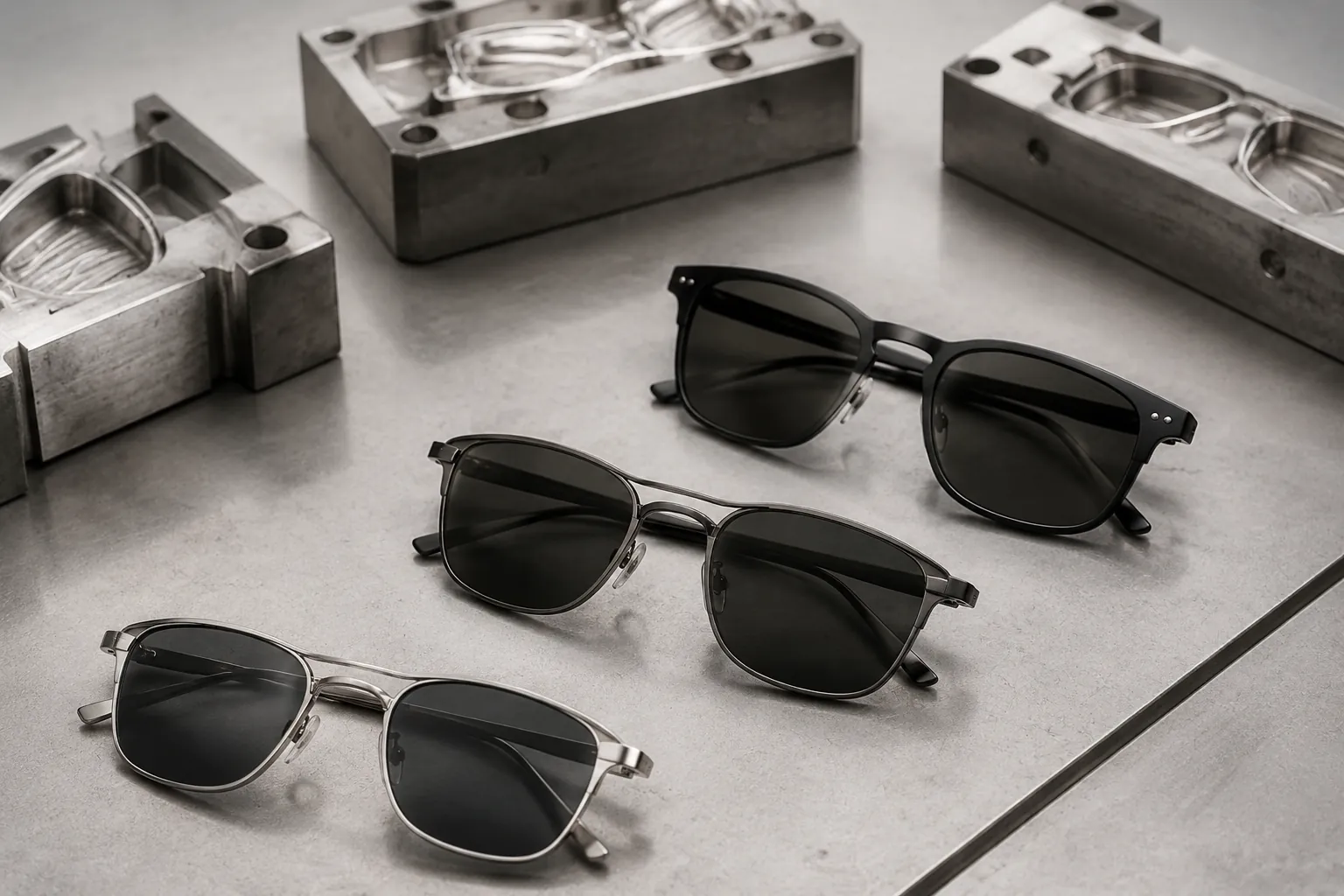
If you buy custom sunglasses for a brand, chain, or distribution program, the frame process matters as much as the design. Metal injection molding, CNC milling, and die-cast frames behave differently in cost, weight, tolerances, surface quality, and scale-up risk. This guide shows where each process is strongest, what buyers should ask for, and how to source without getting caught by shrink variation, plating defects, or avoidable rework.
Start With the Job, Not the Process
Metal frame sourcing goes wrong when buyers name a process before they define the product. The right method depends on geometry, target price, finish, order quantity, and how much the design may still change before production is locked. A lightweight fashion frame with drilled temples and a brushed gunmetal finish is a different problem from a heavier sport frame, a clip-on, or a mixed acetate-and-metal style.
For overseas B2B buyers, the first question should be simple: what is this frame supposed to do in the market?
- Lowest unit cost at scale: die-cast is often considered when the design can tolerate heavier walls and more finishing.
- Sharp detail and repeatability: metal injection molding fits small features, logo relief, and compact structural parts.
- Fast design changes and tight geometry control: CNC is usually the safest choice for early samples and revisions.
- Small launch quantity: a low MOQ makes testing possible, but confirm whether it applies to one style, one color, or one lens package.
A blunt rule helps: CNC is for precision and flexibility, die-cast is for volume and cost pressure, and metal injection sits between them for detail-heavy parts that need more scale than CNC can carry cheaply. The process should follow the brief. Not the other way around.
How Metal Injection Frames Are Made
Metal injection molding for eyewear starts with fine metal powder mixed with a binder system and injected into a mold as a green part. The binder is removed, then the part is sintered at high temperature so the metal particles fuse. That sintering step is where buyers need to pay attention. Final dimensions are not the mold dimensions. The part is built oversize and shrinks during densification. The shrink rate depends on the alloy, geometry, and process control, so a supplier should explain the expected shrink strategy for each critical feature instead of giving one vague number.
This process works best on small, repeatable components: bridges, temples, decorative inserts, hinge carriers, nose-arm parts, logo badges, end pieces, and thin structural elements. It becomes less attractive on oversized one-piece frames or broad decorative surfaces. Sintering load, warp risk, and dimensional drift rise as mass and span grow. A narrow temple arm may hold shape more easily than a wide bridge with uneven wall thickness.
Practical detail separates a stable production run from a decent-looking sample. A serious metal injection supplier should control:
- Shrink compensation: the tool must be built around measured post-sinter results, not guesses.
- Wall thickness uniformity: abrupt section changes can increase warp, sink, or stress after sintering.
- Surface condition before plating: pores, micro-roughness, and sinter marks can show through nickel, palladium, IP coatings, or colored finishes.
- Critical-fit zones: hinge seats, screw holes, temple openings, and lens-interface points need gauge checks and functional assembly checks, not only cosmetic sign-off.
For eyewear buyers, tolerance targets should be discussed feature by feature. Functional areas need tighter control than cosmetic surfaces, but the acceptable range depends on alloy, part size, secondary finishing, and assembly needs. If a supplier cannot explain how it controls critical dimensions by feature, it is not ready for production.
CNC Frames: Precision First, Cost Second
CNC milling starts from bar stock or sheet stock and cuts the frame or frame parts mechanically. The benefit is direct geometry control. If you need exact hole positions, crisp chamfers, sharp edge breaks, or a quick correction after first sample review, CNC is hard to beat. It is also the most transparent process for buyers because what you design is close to what gets cut. Fewer hidden variables. Fewer surprises.
That control has a price. CNC removes material, so there is waste. Machine time adds up, tool wear adds up, and fixture time adds up. On a complicated metal frame, cost per pair can stay high unless the design is simple or the order is modest. For many eyewear programs, CNC is most useful for premium collections, pilot batches, or styles where visual precision matters more than the lowest landed cost.
Typical CNC sourcing logic looks like this:
- You expect design changes before final lock-down and want to avoid paying for a new mold.
- You need tight control on hinge geometry, bridge fit, lens-seat alignment, or temple opening behavior.
- You are validating a market with a short run and want to de-risk the shape before tooling up.
Dimensional control on CNC parts is usually tighter than on cast parts, but finishing still matters. Polishing, coating, and plating can change final dimensions and edge feel, so buyers should confirm whether the tolerance target is pre-finish or post-finish. CNC is a poor fit when the style is already proven and expected to repeat across seasons in the same geometry. At that point, you are often paying for machine time and scrap you do not need.
Die-Cast Frames: Low Cost, More Cleanup
Die-cast frames are typically made by forcing molten alloy into a cavity under pressure. The main appeal is output. Once the tool is stable, die-cast can move a lot of units at a lower raw manufacturing cost than CNC. That is why buyers chasing aggressive price points often ask for it first. It can work for high-volume lines where small visual imperfections are acceptable and the design has enough mass to tolerate the casting process.
But die-cast is not free. It tends to carry more risk in porosity, edge softness, density variation, and finish inconsistency. Thin decorative details can round off. Sharp internal corners can fill unpredictably. Ejector marks, flash, and parting lines may need extra trimming. Post-cast finishing becomes a real cost line, because polishing, corrective grinding, deburring, and plating prep can consume more labor than the first quote suggests.
Buyers should watch three things closely:
- Porosity: pores can show through plating, trap polishing compounds, or weaken hinge-adjacent zones.
- Dimensional drift: repeated production should be checked with gauges, not only by visual approval of a sample.
- Polish cost: a low-cost casting can become expensive once the surface needs handwork to reach a retail-ready finish.
In practice, die-cast is strongest for higher-volume programs where the design can tolerate more material and the buyer cares more about unit cost than ultra-refined edge definition. It also works better with textured or matte finishes, which can hide some process noise better than a mirror polish.
Head-to-Head Comparison
| Method | Best use | Typical strengths | Typical weaknesses | Sourcing note |
|---|---|---|---|---|
| Metal injection | Detail-heavy metal parts and repeat styles | Fine features, consistent geometry, scalable beyond prototype volumes | Shrink compensation, sintering control, and plating prep must be disciplined | Good fit for brands that want a slimmer technical look and moderate-to-high volume |
| CNC milling | Samples, pilot runs, premium small batches | Tight tolerances, easy revisions, strong visual precision | Higher unit cost, more material waste, slower at scale | Best when design is still changing or fit-critical geometry needs certainty |
| Die-cast | High-volume price-driven programs | Lower cost at volume, efficient output, fast throughput | Porosity, softer edges, and heavier finishing burden | Best only if the shape can tolerate process noise and added polish labor |
Use a blunt rule: CNC buys certainty, die-cast buys cost, and metal injection buys a workable balance of detail and scale. The wrong choice usually shows up later as plating rejection, hinge misfit, lens-seat problems, or a margin that disappears after polishing and rework. Compare finished cost, not raw part cost alone. Finishing and scrap often decide the real winner.
Cost, MOQ, and Lead Time
For custom sunglasses, process choice is tied to quantity. A supplier can quote a low unit price and still leave you with a bad landed cost if the style is slow to approve, expensive to finish, or unstable in production. Ask what is included in the price: base frame, hinge or screw hardware, surface finishing, plating or coating, decoration, assembly, packaging, and any testing or rework allowance. That breakdown matters more than the headline quote. A cheaper molded part can become the most expensive program after polishing and reject handling.
That pricing curve is normal. A small order absorbs more fixture setup, hand polishing, plating touch-up, and quality checks per unit than a larger order. At the low end, the factory is not spreading tool programming, decoration prep, and QC labor across much volume. At the high end, fixed costs dilute, but only if the spec is stable and the defect rate stays low.
Read the economics this way:
- Small launch orders: pay for design validation, fit confirmation, and market testing, not the absolute lowest unit cost.
- Mid-size orders: compare process efficiency, plating risk, assembly labor, and packaging time.
- Large orders: insist on stable lead times, gauge-based QC, defect limits, and rework rules before you commit.
On lead time, ask the supplier to separate sample lead time from bulk lead time and to state what inputs are required before production starts. A realistic schedule depends on approvals, materials, lenses, plating, and packing. If a supplier promises unusually fast delivery, ask which steps are being shortened. The answer is often finishing, inspection, or rework.
What to Check in the Spec Sheet and QC Plan
Metal frame problems are often specification problems. Ask for a sheet that covers overall dimensions, critical feature tolerances, alloy family or approved material spec, surface finish, plating stack, lens fit, hinge type, temple opening force, and decoration method. If the supplier cannot define those items clearly, the style is not ready for production. The point is not more paperwork. The point is to make the factory inspect the same things you will reject later.
For a serious order, the QC plan should include:
- Incoming material check for metal stock, cast parts, or sintered parts.
- In-process dimensional control after forming, machining, casting, or sintering.
- Surface inspection before plating and after polishing.
- Assembly checks on hinge alignment, screw retention, torque, and temple symmetry.
- Final inspection for cosmetic defects, lens seating, packaging accuracy, and barcode or label correctness.
Decoration methods also need attention because they can create hidden failures. Laser engraving is clean and durable, but too much power can burn through coating or leave a rough edge. Pad printing is flexible for logos and small marks, but ink adhesion should be checked with the supplier's actual test method. Metal logo plates can look premium, but adhesion and plating compatibility need to be verified on the production substrate. Lens tinting should be checked against the target shade and light transmission because color drift can affect acceptance even when the style looks right.
Do not skip compliance. For overseas buyers, use the right standard for the destination market: CE EN ISO 12312-1 for the EU, ANSI Z80.3 for U.S. performance expectations, AS/NZS 1067 for Australia and New Zealand, REACH for restricted substances, and FDA registration context where required for U.S. market access. ISO 9001 and BSCI can support factory system checks, but they do not replace product testing. Ask for test reports tied to the exact style, not generic factory certificates.
A Simple Sourcing Decision Framework
Use this decision path before you request quotes:
- Choose CNC if the style is still moving, the fit is critical, or you only need a pilot batch and want revision flexibility.
- Choose metal injection if the design has fine details, repeated metal features, and a real chance to scale beyond a small launch.
- Choose die-cast if the model is volume-driven, price-sensitive, and the design can tolerate more post-finishing.
Then test the factory on four points. First, ask how they control shrink, warp, or porosity and what tolerance they hold on hinge and bridge features. Second, ask what finishing steps are done in-house, including polishing, plating, coating, engraving, and logo application. Third, ask for a production sample, not only a render or photo, because surface quality and alignment are hard to judge from images. Fourth, ask how they will inspect the batch before shipment and what defect limits trigger rework or sorting.
For a buyer building a long-term program, the best supplier is usually not the one with the lowest first quote. It is the one that can hold spec across repeat orders, explain defects clearly, and ship on time with consistent build quality. On metal sunglasses, that is the difference between one purchase order and a real line that can be reordered without redesign.
Have a custom sunglasses project in mind?
Send us your styles, target market and quantities and we will return a detailed quote with MOQ, lead time and a sample plan.
Get a QuoteWhy source this from Wenzhou with LumiShades
Wenzhou in Zhejiang Province is widely regarded as China’s eyewear manufacturing capital, producing a large share of the world’s sunglasses. That concentration matters to buyers: a deep local supply chain for acetate sheet, hinges, lens blanks, plating and packaging means shorter component lead times, easier color and material matching, and a workforce with decades of eyewear-specific skill. LumiShades has manufactured in this ecosystem since 2009, and our vertical integration — in-house injection molding, acetate cutting, CNC milling, lens tinting, decoration and quality control — means no part of your order is quietly subcontracted to a workshop you cannot audit.
For international buyers, that vertical control translates into accountability. When a single factory owns every step, defects are traced and fixed at source rather than bounced between vendors, and your specifications survive intact from first sample to bulk. We back this with 15+ years of experience, shipments to 60+ countries, more than 5 million pairs produced per year and a 98.5% on-time delivery rate. Our certifications — CE EN ISO 12312-1, FDA registration, ANSI Z80.3, AS/NZS 1067, REACH, ISO 9001 and BSCI audit — mean the compliance documentation your market requires already exists. Explore our manufacturing capabilities and quality control process to see how this works in practice.
Frequently asked questions
At what volume does metal injection start to beat CNC on cost? There is no universal break point. Metal injection only becomes cost-competitive once tooling cost, part complexity, finishing, and reject risk are spread across enough units. As a practical rule, CNC is usually better for samples, pilot runs, and early revisions, while metal injection becomes more attractive once the design is stable and the order is moving into repeat production. Ask the factory for a finished-unit comparison, not just a tooling quote.
Is die-cast always cheaper than metal injection? No. Die-cast can look cheaper on raw part cost, especially at higher volume, but polishing, scrap, rework, porosity-related rejection, and plating correction can erase the savings. Compare finished unit cost plus expected defect handling, not cast cost alone. Ask the supplier to show the finishing steps behind the quote.
What tolerances should I ask for on a metal sunglasses frame? Ask for tolerances by critical feature, not one blanket number. Focus on hinge locations, temple symmetry, lens opening, bridge alignment, and screw-hole position. CNC parts are typically specified tighter than cast parts, while metal injection needs shrink and sintering control on functional zones. The supplier should state its actual control plan and inspection method for each critical dimension.
Can LumiShades handle small test orders and later scale the same style? A supplier can only be judged on its published terms and actual samples. The safe buyer step is to confirm the MOQ, sample lead time, bulk lead time, and whether the same tooling and finishing path will be used for repeat orders. Before committing, ask for a production sample, the QC plan, and the reorder conditions so you can see whether the style can truly scale without redesign.
Which compliance documents matter for overseas buyers? For sunglasses, ask for the destination-market standard and product-specific test reports: CE EN ISO 12312-1 for the EU, ANSI Z80.3 for U.S. performance expectations, AS/NZS 1067 for Australia and New Zealand, REACH for restricted substances, and FDA registration context where relevant for the U.S. market. ISO 9001 and BSCI support factory systems, but they do not replace product testing.
How fast should sample and bulk delivery be for custom metal sunglasses? The correct answer depends on approvals, materials, lenses, plating, and packing. Ask the factory to separate sample lead time from bulk lead time and to list what must be approved before production starts. If a supplier promises unusually fast delivery, ask which finishing, inspection, or rework steps are being compressed so you can judge the risk.
Ready to start?
Explore our cat-eye sunglasses or request a quote — our sales team replies within 12 hours.
Request a Quote