
Wholesale Resort Sunglasses: Assortment, Specs, Margins
This guide is for resort buyers, travel retailers, coastal distributors, and brand owners planning sunglass programs for beach, pool, cruise, marina, and holiday retail. It shows how to specify frames, lenses, logos, packaging, compliance documents, quality checks, and reorder standards for products exposed to heat, salt air, sunscreen, sand, repeated try-ons, and travel handling. It also gives practical MOQ, pricing, lead-time, carton, and QC guidance from a factory-floor sourcing view.
Start With the Selling Environment
Resort sunglasses are not handled like fashion eyewear locked behind glass. A shopper may try on several pairs with sunscreen on their hands, push one onto wet hair, drop another into a beach tote, then buy fast because they forgot sunglasses at home. Frames may sit near windows, pool counters, open-air kiosks, marina shops, cruise port walls, humid stockrooms, and hot cars. The brief should start there. Not with a catalog page.
This channel needs three controls: low return risk, clear visual choice, and repeatable replenishment. Do not open with too many molds. A tighter buy is easier to manage: 3 to 5 proven frame shapes, 2 to 4 colors per shape, and deeper quantities in black, tortoise, smoke, brown, and crystal neutrals. Bright colors and novelty mirrors can work, but treat them as accent SKUs unless the location serves youth, festival, surf, or beach-party traffic.
Custom MOQ must be checked against the exact frame, lens, logo, and packaging spec. As a planning point, LumiShades can quote small custom runs from 50 pairs per design. Better unit economics usually appear as quantities move toward 300, 1000, and larger production runs. If a buyer spreads 500 pairs across ten weak styles, setup cost is harder to absorb and sell-through data gets muddy. If the same 500 pairs go into three proven shapes with controlled colorways, the buyer learns faster and can reorder with less risk.
Think by selling zone. A hotel boutique may need soft tortoise, champagne, warm brown, and gradient lenses. A surf shop may need rubberized black, mirrored blue, polarized smoke, and sport wraps. A cruise kiosk needs fast recognition from a few meters away: large lens shapes, visible product benefits, simple hang tags, scannable barcodes, and price labels staff can explain in seconds.
Build a Reorderable Resort Assortment
A balanced beach assortment does not need 40 SKUs at launch. It needs enough choice to cover face shape, style preference, price point, and activity. A useful opening structure is 60% core unisex, 20% women-focused, 10% sport or polarized, and 10% kids or premium. For a marina, increase sport and polarized styles. For a luxury resort boutique, reduce kids and add acetate or metal-acetate styles with better packaging.
| Assortment Role | Frame Direction | Lens Direction | Opening Buy Logic |
|---|---|---|---|
| Core unisex | Wayfarer-style PC or TR90, medium bridge, standard hinge | Smoke, brown, green, UV400 | 40-60% of units; strongest reorder base for hotels, beach stores, and kiosks |
| Women-focused | Oversized square, soft cat-eye, round-square acetate look | Gradient smoke, brown, rose brown | 15-25% of units; use richer colors but avoid too many novelty SKUs |
| Sport and water | TR90 wrap, semi-wrap, rubber temple tip, secure bridge | Polarized smoke, mirrored blue, mirrored green | 10-25% depending on boating, fishing, surf, or paddleboard traffic |
| Kids and teen | Flexible PC or TR90, smaller bridge, rounded edges | Smoke, brown, selected fun mirrors | 5-15% for family resorts; prioritize flexibility and low return cost |
| Premium shelf | Acetate, metal-acetate combo, thicker front, better polish | CR39 or nylon, polarized option | 5-15% for boutique displays; higher retail ticket and better packaging |
Give each SKU a role before production: core, seasonal, test, or premium. Core styles need stable color references and repeatable lens tints. Seasonal colors can be bought lighter. Test styles should stay near MOQ until sell-through proves demand. Reordering gets difficult when every SKU is treated as equally important. They are not.
Choose Frame Materials for Beach Use
Beach retail punishes weak frames. A pair may be left on a hot dashboard, rinsed after salt exposure, twisted during try-on, or packed under towels and sandals. Material choice drives complaints more than decoration does.
- PC injection frames: Low cost, light, and suitable for impulse programs. PC is relatively rigid, so hinge strength, screw fit, and lens groove consistency matter. Good for entry retail and promotional ranges.
- TR90 frames: More flexible than standard PC and often better at recovering after bending. Good for sport, kids, rental-heavy resorts, and customers who wear frames during activity.
- Acetate frames: Better hand feel, richer color, and stronger premium perception. Requires proper cutting, tumbling, polishing, hinge setting, and bridge thickness control. Costs more but can support a higher retail price.
- Metal frames: Slim and premium-looking, but coastal corrosion risk must be controlled through plating quality, screw material, nose pad quality, and salt-spray or corrosion-resistance checks where relevant.
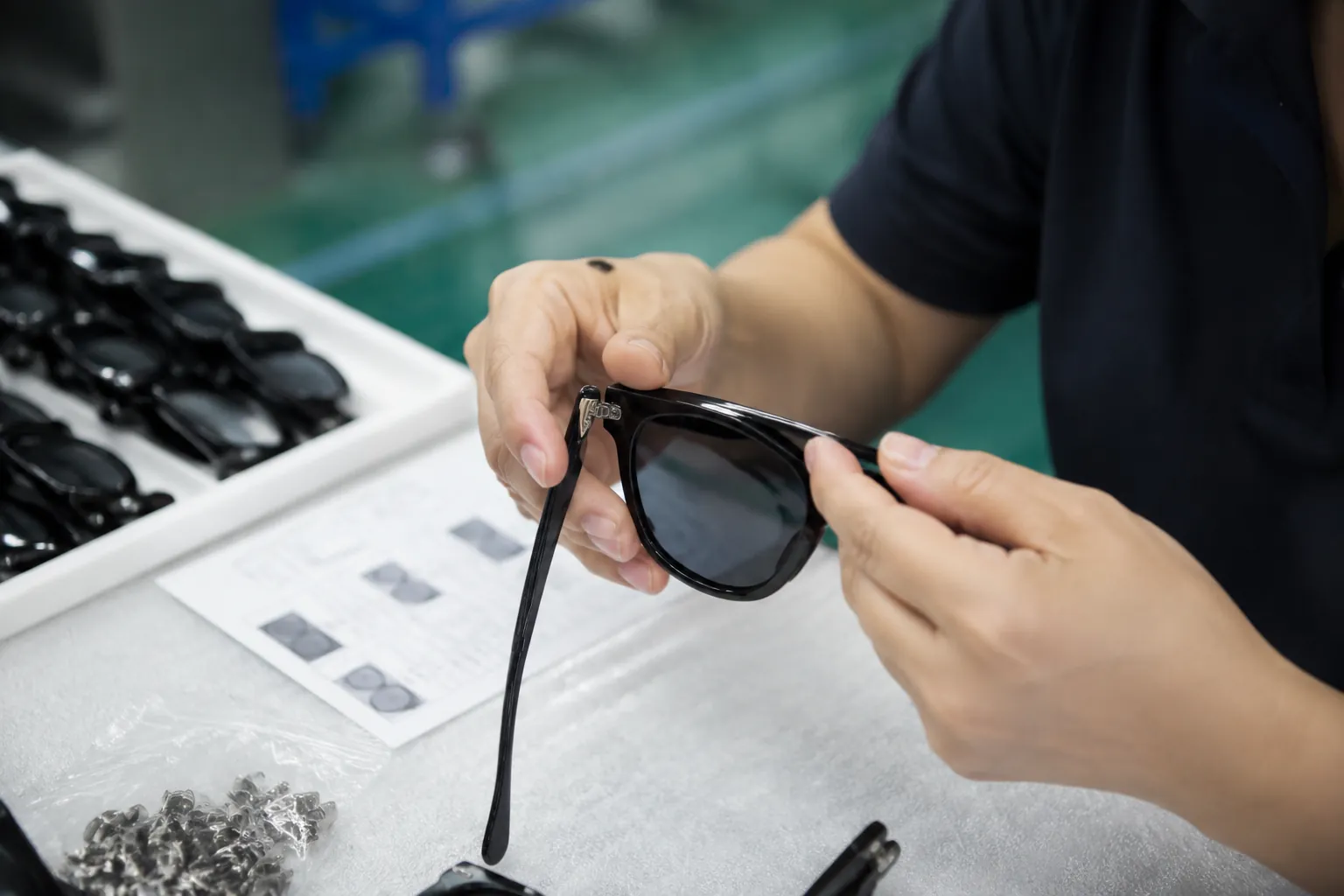
For injection frames, approve gate mark position, parting-line cleanup, temple opening angle, lens groove fit, and hinge resistance. A simple temple-opening check is to compare left and right temple symmetry against the approved sample when the frame is laid flat. Lens fit should be secure, with no visible stress marks or rattle. For acetate, check front thickness, bridge comfort, rivet alignment, polish level, and temple balance. Poor polishing or hinge setting may not show clearly in a photo. It will show after repeated try-ons.
If the same style will be reordered, freeze the approved sample. Frame shape, hinge, screw, lens curve, color chip, logo method, and packaging should become controlled standards. Any substitution should be documented and reapproved before bulk production.
Specify Lens Features Customers Feel
The lens sells the product once the customer puts the frame on. Smoke gray keeps color perception neutral and works for general sun. Brown improves contrast and feels warmer in bright light. Green is comfortable and traditional. Gradient lenses look more fashion-led, but they are less useful for glare-heavy water or driving. Mirror coatings create strong shelf impact. They also need scratch and adhesion checks.
Common lens choices include PC for value and impact resistance, TAC polarized for mid-range resort retail, and CR39 or nylon for a cleaner optical feel in premium programs. For many beach stores, a two-tier offer works: non-polarized UV400 entry styles for impulse buyers and polarized step-up styles for water, driving, fishing, and boating. The display should explain the difference plainly: polarized lenses reduce reflected glare from water, wet roads, sand, and boat decks.
Lens QC should include left-right tint consistency, surface scratches, bubbles, edge chips, optical distortion, lens seating, and polarization-axis checks on polarized styles. For tint matching, keep one approved production sample and compare under consistent light. Even a small left-right shade difference can look obvious on a resort counter. For polarized styles, request a polarization card check and axis verification before mass production. Poor lamination or uneven axis can cause distortion and discomfort.
UV and compliance claims need documents, not just stickers. Destination market matters. LumiShades can support CE EN ISO 12312-1, ANSI Z80.3, AS/NZS 1067, REACH, FDA registration, ISO 9001, and BSCI where applicable to the product and order. Do not print compliance marks, filter categories, warning text, or UV claims until the test basis and market requirement are confirmed.
Make Packaging Store-Ready
Resort sunglasses often sell from spinners, counter trays, wall hooks, acrylic stands, or branded display boxes. Packaging must protect the product, show the brand, carry barcode and price information, and reduce store labor. Polybag-only packing is cheap, but it can look unfinished in hotel boutiques and resort gift shops. A pouch, microfiber cloth, hang tag, barcode label, warning card, and display tray can raise perceived value without changing the frame mold.
Choose decoration by durability, surface, and order size. Pad printing is cost-effective for temple logos, but it needs rubbing tests, especially on matte, rubberized, or oily-feel coatings. Laser engraving is clean on metal plates, metal temples, and selected coated parts, but contrast depends on material. Heat transfer can support more complex graphics, but check for edge lifting. Metal logo plates look premium, but they add assembly steps and require checks for glue overflow, alignment, burrs, and color consistency.
- Approve frame, lens, and coating before final logo placement.
- Confirm logo size in millimeters, not only from a PDF mockup.
- Make one physical pre-production sample with final lens, logo, coating, tag, pouch, and carton label.
- Rub-test printed, transferred, plated, or coated logo areas before bulk packing.
- Confirm UPC or EAN scan position against the retailer or distributor system.
- Define inner box, display tray, mixed-color carton ratio, and master carton label before production starts.
Carton planning affects speed. If a resort group needs store-ready mixed cartons, specify the ratio before packing, such as 12 pieces black, 8 tortoise, and 4 crystal per inner carton. Repacking finished goods wastes time and adds handling damage. For coastal distribution, also consider silica gel, carton strength, and storage conditions for metal styles.
Plan MOQ, Pricing, and Margin
Factory price is only one part of resort retail margin. Buyers should include packaging, inspection, freight, duty, inland delivery, shrinkage, markdown risk, display cost, and payment terms. A low unit price can still be a poor buy if the assortment is too wide, packaging is weak, or best sellers stock out while slow colors remain.
LumiShades can quote custom work from 50 pairs per design when the specification is suitable. That can help test a resort account, logo placement, or seasonal color. Better economics usually appear at 300 pairs per design because setup, material preparation, logo work, and packaging are spread across more units. At 1000 pairs per design, color control and carton planning become more efficient. Larger programs can reduce unit cost further, but the final quote depends on material, lens type, lens coating, decoration method, packaging, inspection requirement, and delivery terms.
| Order Level | Best Use | Cost Behavior | Buyer Watchpoint |
|---|---|---|---|
| 50 pairs/design | Testing frame, color, logo, or resort account | Highest unit cost, lowest inventory risk | Do not expect full volume pricing or complex packaging |
| 300 pairs/design | Small chain, boutique launch, seasonal program | Better absorption of setup and decoration cost | Keep colors disciplined and packaging simple |
| 1000 pairs/design | Distributor, cruise retail, multi-store resort group | Good balance of price, repeatability, and flexibility | Lock color standards, lens tint, and carton ratio |
| Larger program | Annual program or planned replenishment | Lower unit cost may be possible on suitable specs | Plan QC, shipment split, and reorder calendar early |
Do not use the same retail multiple for every SKU. Entry PC styles may need a sharp impulse price. Polarized sport styles can carry more margin if the display explains glare reduction. Premium acetate or metal-acetate styles need better packaging and should be priced as a separate tier, not judged only by factory cost.
Work Back From Peak Season
Beach retail runs on dates. If goods arrive after peak travel weeks, the low price no longer matters. As a planning estimate, samples commonly require 7 to 10 days after the specification is clear. Bulk production commonly requires 25 to 35 days after sample approval, deposit, packaging confirmation, and material readiness. The clock does not start when a buyer sends a mood board. It starts when the factory has approved specs, artwork, color references, lens type, packaging, and carton instructions.
Work backward from the first selling week. Add time for sample shipping, internal approval, purchase order release, deposit, material booking, production, final inspection, export handling, freight, customs clearance, inland delivery, and store allocation. Air freight can rescue a small reorder, but it damages margin. Ocean freight protects margin, but it needs earlier forecasting and cleaner carton allocation.
A practical reorder system uses three buckets. Core black, tortoise, brown, and smoke styles are ordered deepest and monitored weekly. Seasonal colors are bought lighter and reviewed after the first month. Experimental styles stay near MOQ or one carton per location until proven. If a core style sells faster than planned, reorder before the shelf is empty. Waiting for stockout is not planning. It is guessing.
Factory-floor rule: freeze the frame, lens, logo, packaging, compliance text, barcode, and carton mix before bulk production. Late changes can create rework, shade variation, inspection delays, and missed ship dates.
Use a Coastal Retail QC Checklist
Quality control for resort sunglasses should target the failures customers bring back to the counter: loose hinges, lens scratches, peeling logos, crooked temples, uncomfortable bridges, missing barcodes, weak pouches, and unclear UV claims. A buyer does not need to inspect every technical detail personally. The purchase spec must tell the factory what matters and which sample is the control standard.
- Check frame symmetry, temple opening, hinge resistance, screw tightness, lens groove fit, and nose bridge comfort against the approved sample.
- Inspect lenses for scratches, bubbles, tint mismatch, edge chips, optical distortion, poor seating, and polarized-axis errors.
- Verify UV claims, filter category, warning text, and market documents for CE EN ISO 12312-1, ANSI Z80.3, AS/NZS 1067, FDA registration, and REACH where applicable.
- Rub-test pad printing, heat transfer, metal logo plates, matte coatings, rubberized coatings, and mirror lens coatings.
- Confirm barcode scan, hang tag text, pouch color, cloth size, retail carton mix, inner carton label, and master carton shipping marks.
- Use AQL inspection for bulk lots and tighten checks for first production after a new mold, new lens supplier, new coating, or new logo method.
Clear specs reduce disputes. Keep one golden sample with the buyer and one at the factory. For repeat seasons, also keep color chips, lens tint references, packaging artwork, and carton photos. Reorders run smoother when everyone is matching a physical standard, not a memory from last season.
Have a custom sunglasses project in mind?
Send us your styles, target market and quantities and we will return a detailed quote with MOQ, lead time and a sample plan.
Get a QuoteWhy source this from Wenzhou with LumiShades
Wenzhou in Zhejiang Province is widely regarded as China’s eyewear manufacturing capital, producing a large share of the world’s sunglasses. That concentration matters to buyers: a deep local supply chain for acetate sheet, hinges, lens blanks, plating and packaging means shorter component lead times, easier color and material matching, and a workforce with decades of eyewear-specific skill. LumiShades has manufactured in this ecosystem since 2009, and our vertical integration — in-house injection molding, acetate cutting, CNC milling, lens tinting, decoration and quality control — means no part of your order is quietly subcontracted to a workshop you cannot audit.
For international buyers, that vertical control translates into accountability. When a single factory owns every step, defects are traced and fixed at source rather than bounced between vendors, and your specifications survive intact from first sample to bulk. For procurement review, buyers can request process records, approved samples, quality checkpoints and project-specific compliance files before placing a bulk order. Required testing and documentation are confirmed against the destination market and product specification rather than assumed from a generic certificate list. Explore our manufacturing capabilities and quality control process to see how this works in practice.
Frequently asked questions
What is the safest opening order for a small resort chain? Start with 3 to 5 proven frame shapes and 2 to 4 colors per shape. Put the deepest units into black, tortoise, smoke, brown, and other neutral best-seller candidates. Use 50 pairs per design only for controlled tests when the specification allows it, then move proven styles toward 300+ pairs per design for better pricing, cleaner carton planning, and easier replenishment.
Should beach retailers buy only polarized sunglasses? No. Use polarized sunglasses as a step-up tier for water, boating, fishing, driving, and glare-heavy locations, but keep non-polarized UV400 styles for impulse buyers and lower price points. Label the difference clearly on the display: polarized lenses reduce reflected glare from water, wet roads, sand, and boat decks, while UV400 refers to ultraviolet protection.
How early should we place orders before peak season? Work backward from the first selling week. Allow time for sample approval, purchase order release, deposit, material booking, production, inspection, freight, customs, inland delivery, and store allocation. As a planning guide, samples often take 7 to 10 days after specs are clear, and bulk production often takes 25 to 35 days after approval and material readiness. Ocean freight needs additional lead time.
Which certifications and documents may be needed for overseas markets? Confirm requirements by destination market before printing any claim or compliance mark. LumiShades can support CE EN ISO 12312-1, ANSI Z80.3, AS/NZS 1067, REACH, FDA registration, ISO 9001, and BSCI where applicable. Match test reports, declarations, filter category, warning text, packaging language, and importer requirements before bulk production.
What packaging works best for resort and beach retail? Use display-ready packing that reduces store labor: pouch or case, optional microfiber cloth, hang tag, barcode label, retail price area, warning card, and store-ready carton mixes. Confirm UPC or EAN scan position before production, and specify inner carton ratio, master carton label, and shipping marks so goods can move directly to stores or resort locations.
Can we reorder the same sunglass style next season? Yes, if the controlled standards are documented. Keep the approved frame sample, material reference, lens color, coating, logo method, packaging artwork, barcode label, carton mix, and color chips. Ask the factory to confirm any material, lens, hinge, screw, coating, or supplier change before accepting a repeat order.
Ready to start?
Explore our wayfarer sunglasses or request a quote — our sales team replies within 12 hours.
Request a Quote